Tag Archives: omokage

Yōzei’in miko futari uta’awase 07

Left

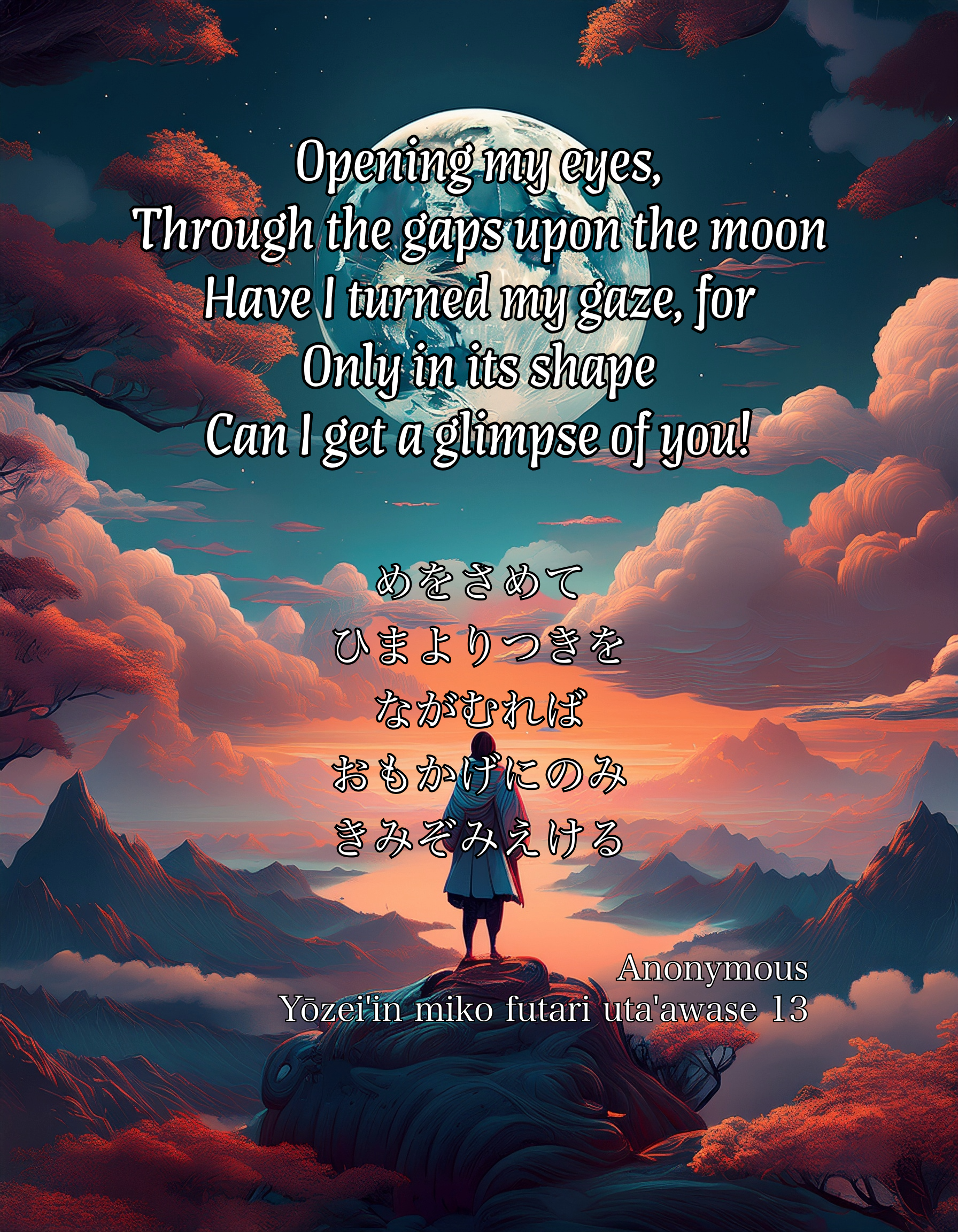
めをさめてひまよりつきをながむればおもかげにのみきみぞみえける

me o samete
hima yori tsuki o
nagamureba
omokage ni nomi
kimi zo miekeru
Opening my eyes,
Through the gaps upon the moon
Have I turned my gaze, for
Only in its shape
Can I get a glimpse of you!

13

Right

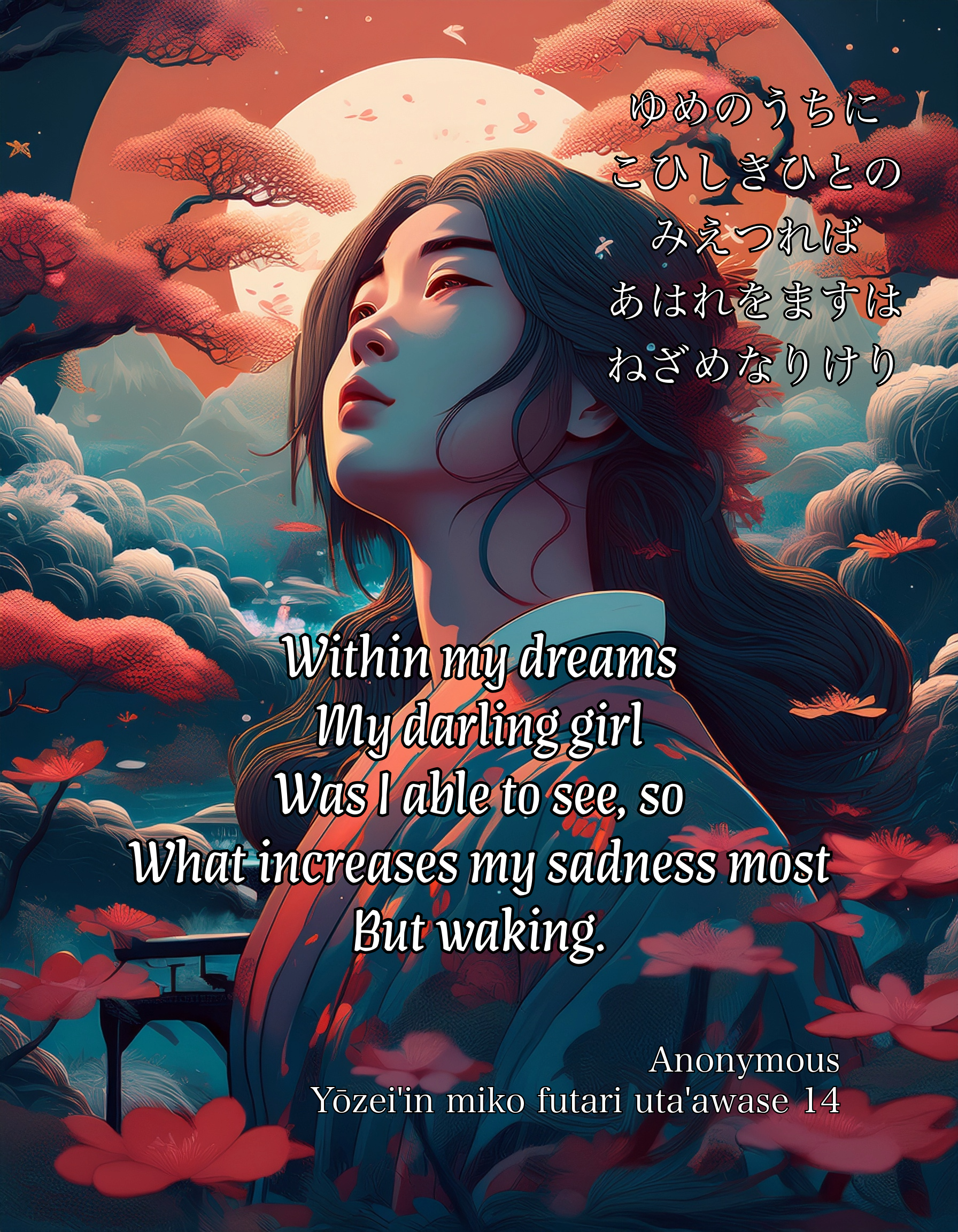
ゆめのうちにこひしきひとのみえつればあはれをますはねざめなりけり

yume no uchi ni
koishiki hito no
mietsureba
aware o masu wa
nezame narikeri
Within my dreams
My darling girl
Was I able to see, so
What increases my sadness most
But waking.

14

Yōzei’in miko futari uta’awase 05

Left

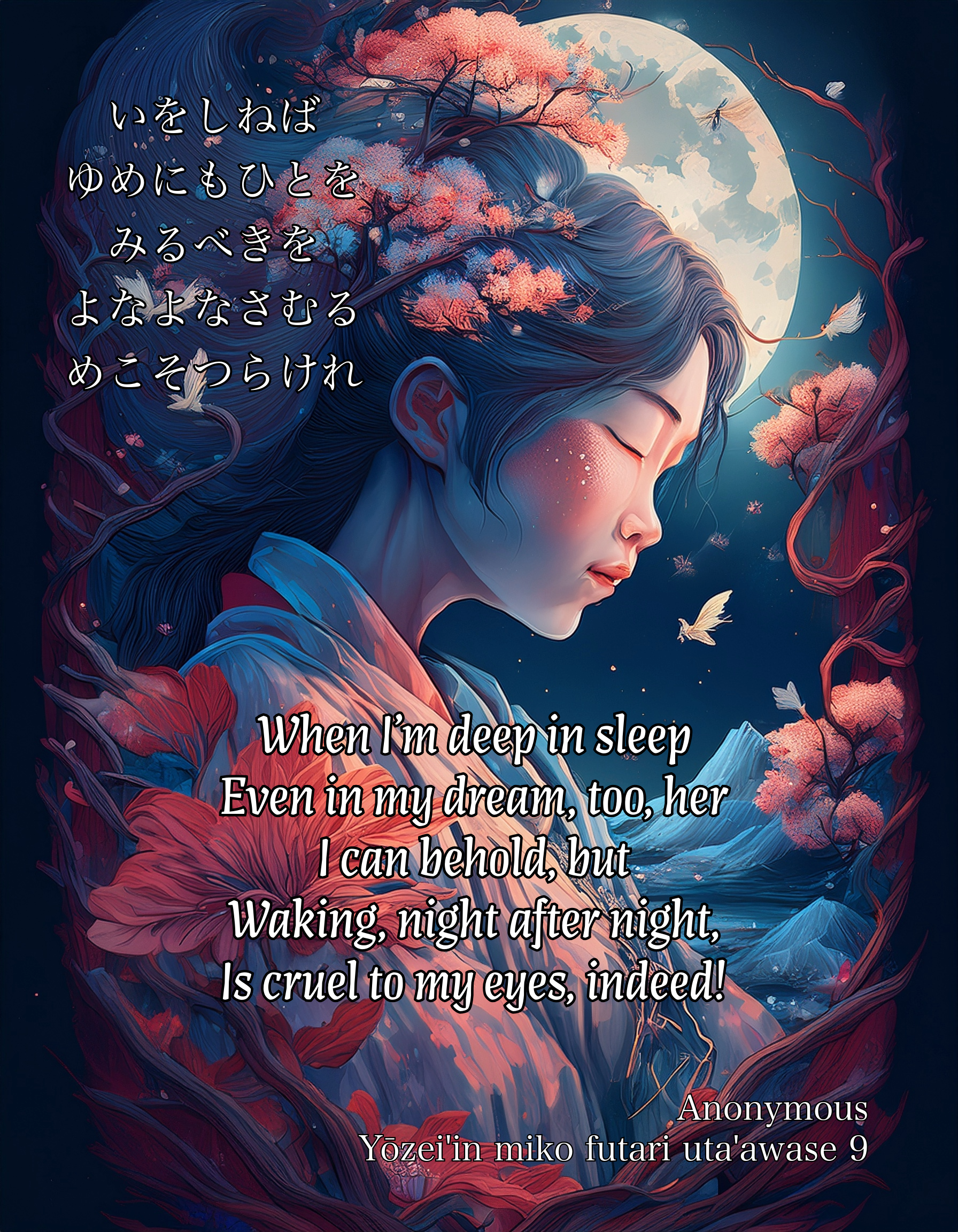
いをしねばゆめにもひとをみるべきをよなよなさむるめこそつらけれ

i o shi neba
yume ni mo hito o
mirubeki o
yonayona samuru
me koso tsurakere
When I’m deep in sleep
Even in my dreams, too, her
I can behold, but
Waking, night after night,
Is cruel to my eyes, indeed!

9

Right

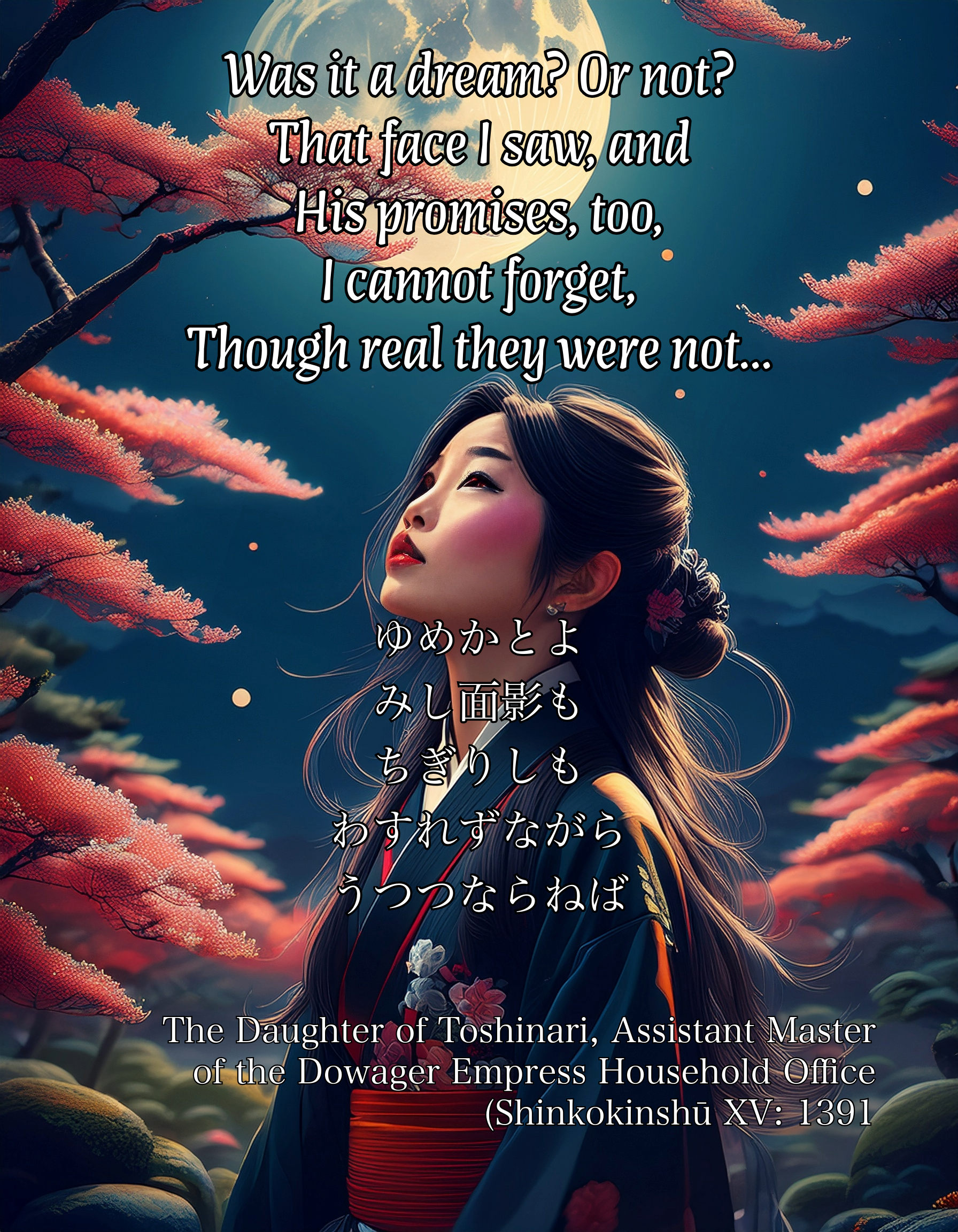
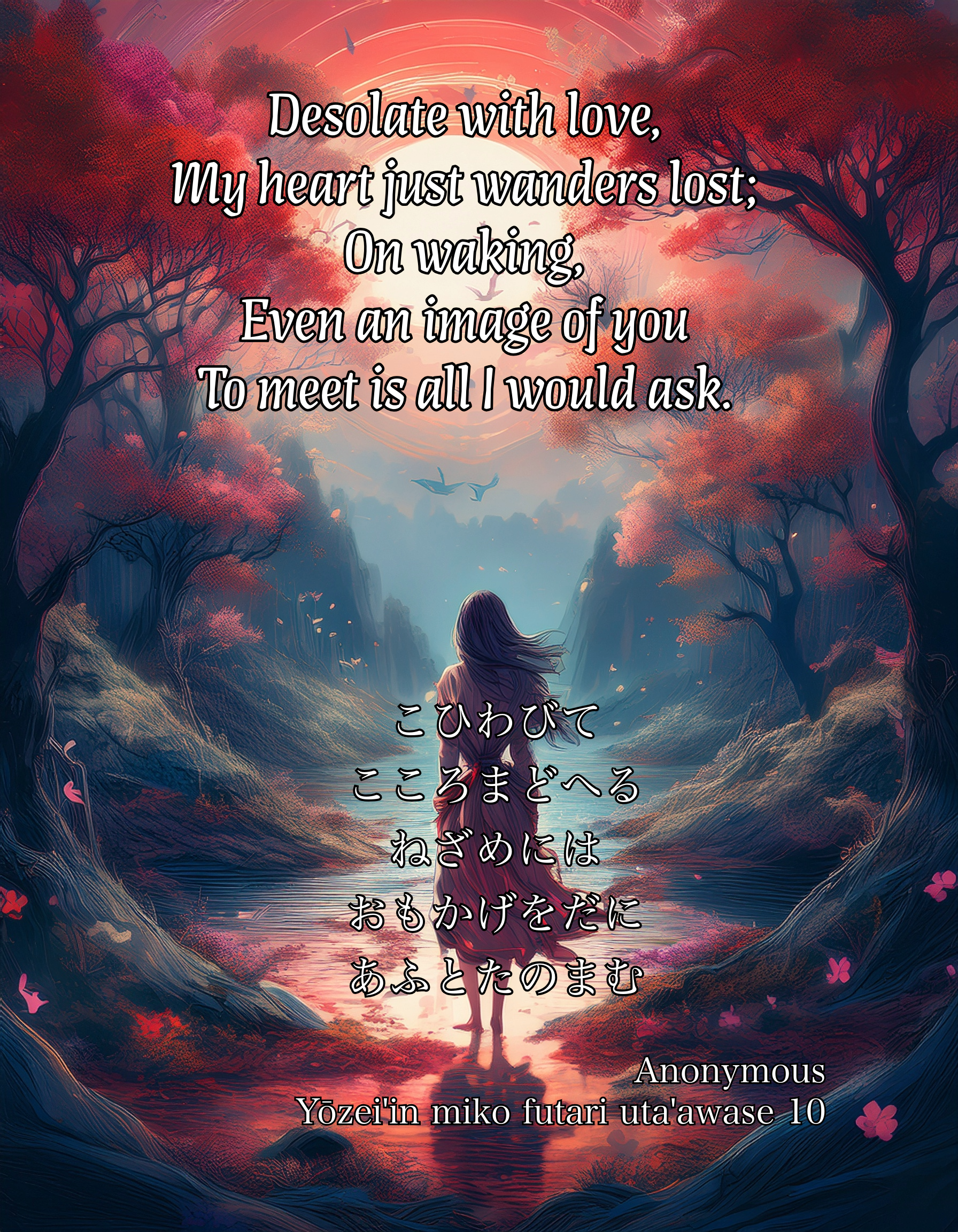
こひわびてこころまどへるねざめにはおもかげをだにあふとたのまむ

koiwabite
kokoro madoeru
nezame ni wa
omokage o dani
au to tanomamu
Desolate with love,
My heart just wanders lost;
On waking,
Even an image of you
To meet is all I would ask.

10

Love IX: 13

Left (Win)
主やたれ見ぬ世の色を写しをく筆のすさびにうかぶ面影

nushi ya tare
minu yo no iro o
utsushioku
fude no susabi ni
ukabu omokage
Who painted you?
Unseen in this present world, hues,
Reflected by
A comforting brush,
Bring her visage before me…

Lord Sada’ie
1105

Right
水茎の跡に堰きをく瀧津瀬をまことに落とすわが涙かな

mizukuki no
ato ni sekioku
taki tsu se o
makoto ni otosu
wa ga namida kana
Faint brush-strokes
Traces place a barrier, but
A cataract in torrents
Truly drops –
My tears…

Jakuren
1106

The Right state: the Left’s poem is rather casual about the person whom he loves. The Left state: the Right’s poem has no faults we can identify.

In judgement: the Gentlemen of the Right have stated that the Left seems somewhat blasé about the object of his affections, and this is certainly true. The Right’s poem, though, says that the poet is looking at a painting on something like a folding screen, where a waterfall is depicted, and he weeps in reality – this seems like he was simply moved by the painting. I feel that there is a stronger conception of love in seeing a painting and fondly recalling the face of one now long gone, than there is in being moved by the sight of a mountain stream.

Love VIII: 17

Left
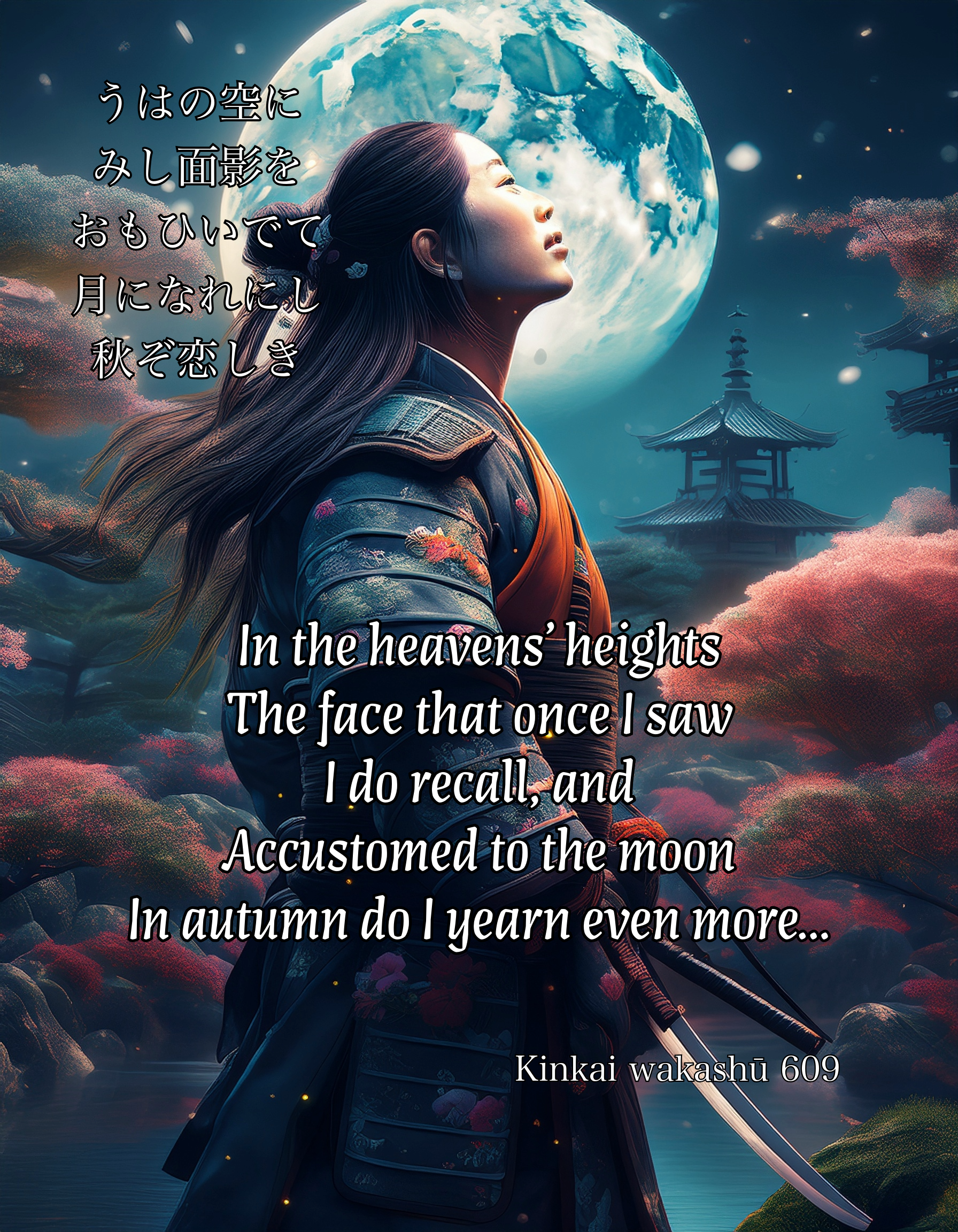
山鳥のはつおの鏡掛けねども見し面影に音は泣かれけり

yamadori no
hatsuo no kagami
kakenedomo
mishi omokage ni
ne wa nakarekeri
A mountain pheasant’s
Tail of hempen cord this mirror
Does not suspend, yet
The face I saw there once
Makes me weep out loud…

Kenshō
1053

Right (Win)
面影をほの三嶋野に尋ぬれば行衛知られぬ鵙の草ぐき

omokage o
hono mishimano ni
tazunureba
yukue shirarenu
mozu no kusaguki
Her face
I did but briefly see at Mishimano
When I visited there;
I know not where has gone
The shrike hiding in the grasses.

Lord Takanobu
1054

The Gentlemen of the Right state: the Left’s poem has no faults to mention. The Gentlemen of the Left state: we wonder about the appropriateness of combining ‘Mishima Plain’ (mishimano) with ‘the shrike hiding in the grasses (mozu no kusaguki). Is there a poem as a precedent for this? If not, is it suitable?

In judgement: both poems have the conception of love: of imagining the pheasant and his mirror, and weeping at the memory of a lover’s face; and thinking of the shrike hiding in the grasses, visiting Mishima Plain, and recalling the past. However, what should we do about the matter of whether there is a precedent poem for ‘the shrike hiding in the grasses’ on Mishima Plain? Surely, it could be any plain, so there is no reason not to use this. The configuration of ‘I know not where has gone’ (yukue shirarenu) sounds better than that of ‘makes me weep out loud’ (ne wa nakarekeri). The Right, again, must win, I think.


Love VII: 24

Left (Tie).
故郷に見し面影も宿りけり不破の関屋の板間洩る月

furusato ni
mishi omokage mo
yadorikeri
fuwa no sekiya no
itama moru tsuki
Back home
I saw her face, and
It lodges here,
At the Barrier House at Fuwa,
In the moonlight leaking through the boards.

A Servant Girl
1007

Right.
人恋ふる我ながめよ思けり須磨の関屋の有明の月

hito kouru
ware nagameyo
omoikeri
suma no sekiya no
ariake no tsuki
Loving you,
I will ever gaze,
I thought,
At the Barrier House at Suma
On the dawntime moon.

Nobusada
1008

The Right state: the Left’s poem is good. The Left state: the Right’s poem lacks any faults to indicate.

In judgement: the Left’s ‘Barrier House at Fuwa’ (fuwa no sekiya) followed by ‘the moonlight leaking through the boards’ (itama moru tsuki) is truly charming. In addition, if one wonders why ‘I saw her face’ (mishi omokage mo) has been used, it is certainly reminiscent of the poem ‘The dawntime moon, too, lodges in the waters clear’, but an improvement on it. It is difficult to say, however, that the Right’s ‘At the Barrier House at Suma on the dawntime moon’ (suma no sekiya no ariake no tsuki) is in any way inferior.

Love VI: 3

Left (Tie).
つれもなき人をもさそへ夜はの月影ばかりだによそに見るやと

tsure mo naki
hito o mo sasoe
yowa no tsuki
kage bakari dani
yoso ni miru ya to
That heartless
Man, will you invite
O midnight Moon!
Even just an image
In the distance would I wish to see…

Lord Suetsune.
905

Right.
秋の月妹が面影さそひきて我心にも宿すなりけり

aki no tsuki
imo ga omokage
sasoikite
wa ga kokoro ni mo
yadosu narikeri
The autumn moon
My darling’s face
Does bring to me, and
Within my heart
Has it found a place to stay.

The Provisional Master of the Empress’ Household Office.
906

The Right state: if one is inviting someone to come and visit, then there is no reason to mention ‘just an image’ (kage bakari). We wonder whether the invitation is addressed to the sky? The Left state: the Right’s poem is pedestrian.

In judgement: both Left and Right have the same conception of an invitation addressed to the moon. The Round can only be a tie.

Love V: 28

Left (Win).
旅寢する我をば床の主にて枕に宿る小夜の面影

tabinesuru
ware oba toko no
aruji nite
makura ni yadoru
sayo no omokage
When sleeping on my travels
I of my bedding
Am master!
Lodging by my pillow is
A face from a night too brief…

Lord Ari’ie
895

Right.
まどろまぬその夜な夜なを數ふれば夢路も遠き草枕哉

madoromanu
sono yona yona o
kazoureba
yumeji mo tōki
kusamakura kana
Unable to even doze
Night after night
I count them up, and
The path of dreams gets more
Distant from my grassy pillow.

Lord Takanobu
896

The Right state: the Left’s poem seems fine. The Left state: we find no faults to mention.

In judgement: the Right’s ‘the path of dreams gets more distant’ (yumeji mo tōki) sounds elegant, but the Left’s poem has already been assessed as ‘fine’ in the comments by the gentlemen of the Right. This round I will leave the judgement in their hands and make the Left the winner.


SZS XVIII: 1166

Composed in the conception of travel, when he presented a hundred poem sequence.

東路の野島が埼の浜風に我が紐ゆひし妹がかほのみ面影に見ゆ

azumadi no
nozima ga saki no
Famakaze ni
wa ga Fimo yuFisi
imo ga kaFo nomi
omokage ni miyu
On Eastern roads
At Nojima Point
In the breeze from off the beach:
My belt was tied
By my darling, her face,
A vision, appears before me…

Master of the Left Capital Office, Akisuke
左京大夫顕輔