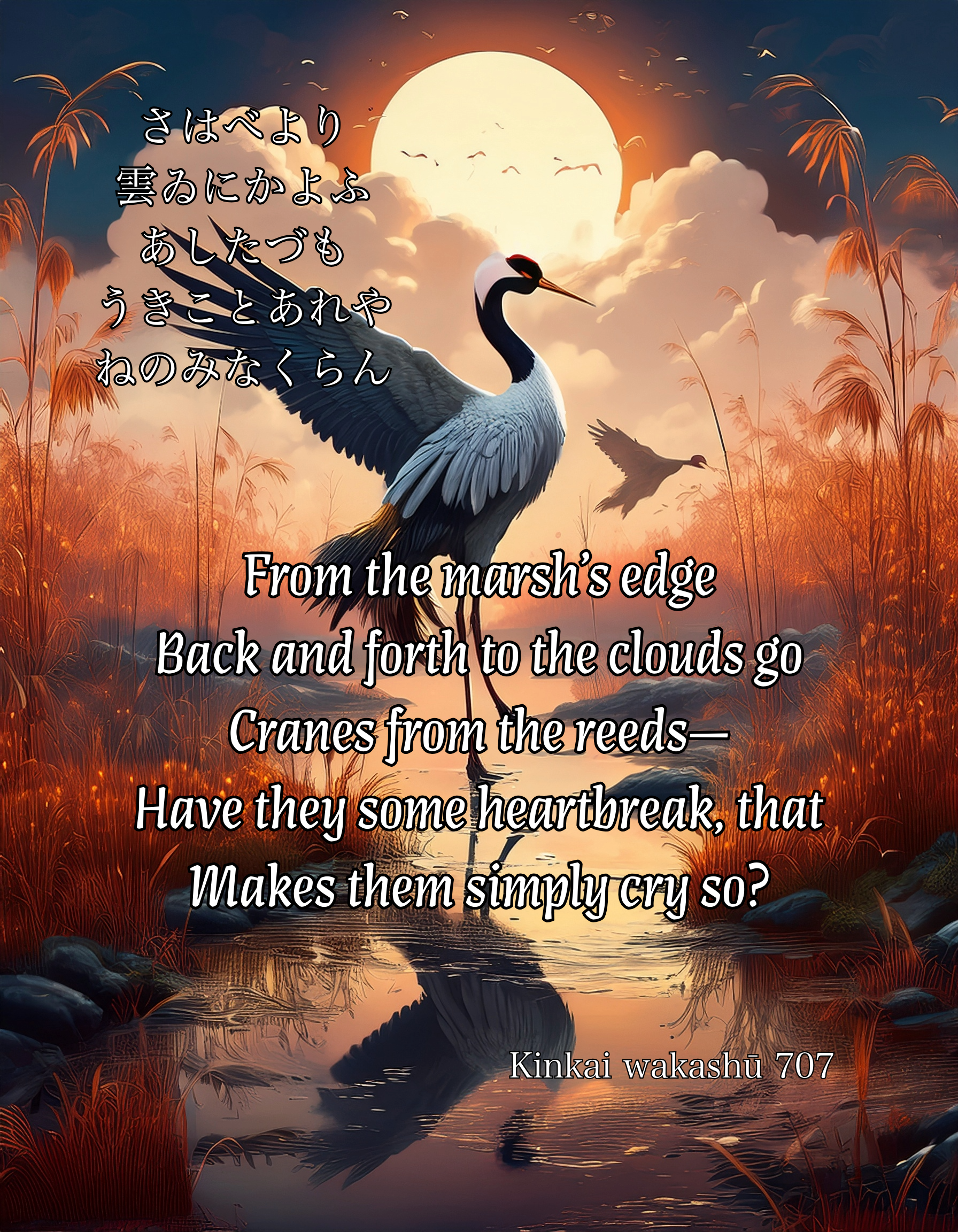
sawabe yori kumoi ni kayou ashitazu mo uki koto are ya ne nomi nakuran
From the marsh’s edge Back and forth to the clouds go Cranes from the reeds— Have they some heartbreak, that Makes them simply cry so?[i]
707
[i] See: Her reply. あしたづのくもゐにかかる心あらば世をへてさはにすまずぞあらまし ashitazu no / kumoi ni kakaru / kokoro araba / yo o hete sawa ni / sumazu zo aramashi ‘If, among the reeds, a crane / Toward the clouds / Had set his heart, then / Passing ages within the marsh, and / Dwelling there he surely would not!’ Princess Isoko (Gosenshū XI: 754)
asitadu no saFabe ni tosi Fa Fenuredomo kokoro Fa kumo no uFe ni nomi koso
Among the reeds, a crane, By the marsh’s edge years Have passed, yet, His heart is for the clouds’ Heights, alone…
The Minister of the Right 753
[i] Princess Isoko (Kinshi) 勤子 (904-938), the fifth daughter of Emperor Daigo 醍醐 (885-930; r. 897-930) (her sobriquet comes from her rank – shihon 四品 (‘Fourth Order’). She was to marry Fujiwara no Morosuke 藤原師輔 (909-960), who writes to her here, in 930, after a secret affair, becoming the first imperial princess to marry a commoner. She is chiefly remembered today, however, as the patron of Minamoto no Shitagō 源順 (911-983) who ordered him to produce Japan’s first dictionary, Wamyō ruijushō 和名類聚抄 (931-938).