aki sugite hanazakari naru kiku no hana iro ni taguite aki ya kaereru
Autumn is past and The flowers richly blooming are Chrysanthemums: With their hues Autumn does return!
Korenori 3
なみとのみうちこそみゆれすみのえのきしにのこれるしらぎくのはな
nami to nomi uchi koso miyure suminoe no kishi ni nokoreru shiragiku no hana
Simply as waves Do they, indeed, appear! At Suminoe Lingering on the shore White chrysanthemum blooms.
Korenori 4
わぎもこがひもゆふぐれのきくなればあかずぞはなのいろはみえける
wagimoko ga hi mo yūgure no kiku nareba akazu zo hana no iro wa miekeru
My darling girl Both day and eve is As a chrysanthemum, so Never sated am I with this flower’s Hues I see.
Korenori 5
きくのはなふゆののかぜにちりもせでけふまでとてやしもはおくらん
kiku no hana fuyu no kaze ni chiri mo sede kyō made tote ya shimo wa okuran
Chrysanthemum blooms In the winter wind Scatter not; Is it that up to today is when Frost is said to fall?
Korenori 6
かげさへやこよひはにほふきくのはなあまてるつきにかのそはるらん
kage sae ya koyoi wa niou kiku no hana ama teru tsuki ni ka no sowaruran
Even their shape Fills tonight with a scented glow; Chrysanthemum blooms To the heaven-shining moon Seem to add their fragrance.
Korenori 7
[i] Fujiwara no Suetada/Suenawa 藤原季縄 (?-919). Little is known of Suetada’s life, other than that he was apparently close to Ise 伊勢 and exchanged poems with her. The circumstances of his death, however, are recorded in Yamato monogatari, which relates that he fell ill in Engi 19 (919) when he held the position of Minor Captain in the Inner Palace Guards, Right Division (Ukonoe shōshō右近衛少将). On a day when he was due to be in attendance at the palace, he sent a message to Minamoto no Kintada 源公忠 (889-948), a Chamberlain and the Assistant Director of the Bureau of Housekeeping, to say that illness prevented his being there. Kintada replied that he should attend without fail on the day after tomorrow, but when that day came, Suetada sent him the following poem:
くやしくぞ のちにあはむと 契りける 今日をかぎりと 言はましものを
kuyashiku zo nochi ni awamu to chigirikeru kyō o kagiri to iwamashi mono o
I am struck with bitterness! Once more would we meet Did I vow, but Today I meet my end— That is what I would say…
SKKS VIII: 854
Concerned, Kintada ordered up a carriage and went immediately to Suetada’s residence, only to find he had died before he arrived. Greatly downcast, he returned to the palace and reported Suetada’s death to the emperor.
ueshi sono kokoro mo okanu shiragiku wa adanaru shimo ni utsuroinikeri
I planted them, yet Unconcerned are The white chrysanthemums, For with the faithless frost Have they faded.
Lord Munekuni 43
Right (Both Judges – Win)
菊のはな夜のまに色やかはれると霜を払ひて今朝みつるかな
kiku no hana yo no ma ni iro ya kawareru to shimo o haraite kesa mitsuru kana
The chrysanthemum blooms Within the space of but one night their hue Will change, I thought, so Brushing away the frost Will I gaze on them this morn!
Lord Kanemasa
44
Toshiyori states: the first poem uses ‘unconcerned’, doesn’t it. The second poem’s sequencing is undesirable, yet ‘brushing away the frost’ sounds like that really is the case. It seems superior.
Mototoshi states: one has to ask what on earth a chrysanthemum might be concerned about! As for the Right, ‘Within the space of but one night their hue’ is vague, I think, but ‘brushing away the frost and gazing’ is certainly charming—it is still lodged within my aged heart.
Composed on the conception of love at a famous location
とよ国の菊のながはま夢にだにまだみぬ人に恋ひやわたらん
toyokuni no kiku no nagahama yume ni dani mada minu hito ni koi ya wataran
In the land of Toyo, in the western isle, Lies the long beach of Kiku, I hear— Even in my dreams Have I yet to see her, but Will my love for her go on and on?
shimogare no kiku nakariseba itodoshiku fuyu no magaki ya sabishikaramashi
Were frost-burned Chrysanthemums there to be none, then How much more My brushwood fence in winter Lonely would be…
Lord Sadanobu 37
Right (T – Win)
しも枯るるはじめをみずは白ぎくの移ふ色を惜まざらまし
shimogaruru hajime o mizu wa shiragiku no utsurou iro o osamazaramashi
Frost-burns First sign I see not, so The white chrysanthemum’s Fading hues Cause me no regret at all…
Lord Masamitsu 38
Toshiyori states: the assembled company asked how it can be possible that a brushwood fence in winter would not feel lonely after the chrysanthemums have withered, even granting that they are still there, and this is, of course, the case. In the depths of winter, one would not catch sight of any chrysanthemums. Although, it does sound as if you could could compose in this way, depending upon how early in the season it was. The second poem is of about the same quality, but I feel that I prefer it at the moment.
Mototoshi states: both poems are of the same quality, but ‘My brushwood fence in winter / Lonely would be’ really does make me realise that’s how it is.
kareyuku o nageki ya suran hatsujimo no kiku no yukari ni oku to omoeba
On withering Do they grieve, perhaps? The first frosts upon The chrysanthemums feel they form a bond When falling, so…
Lady Shōshō 35
Right (M – Win)
わが宿の籬にやどる菊なくはなににつけてか人もとはまし
wa ga yado no magaki ni yadoru kiku naku wa nani ni tsukete ka hito mo towamashi
If at my home’s Brushwood fence lodging There were no chrysanthemums, Why, indeed, Would any folk come to call?
Lord Nobutada 36
Toshiyori states: the first poem is redolent of prior compositions and so does not appear to have anything novel about it; nor does the situation it refers to arise. The second poem, too, is hackney and lacking in interest, and the central phrase ‘there were no chrysanthemums’ is prosaic. I say these, too, should tie.
Mototoshi states: as frost is not sentient, it is not the case that it could grieve and feel regret in connection to chrysanthemums. The poem of the Right has as final section resembling that of the poem sent by the Later Prince of the Central Secretariat to the Shijō Major Counsellor:
花もみな散りなん後はわが宿のなににつけてか人をまつべき
hana mo mina chirinan nochi wa wa ga yado no nani ni tsukete ka hito o matsubeki
After the blossoms, every one, Have scattered, then At my house Why, indeed, Should I folk await?[1]
This makes it slightly more poetic, so I would say the Right is superior.
[1] When Major Counsellor Kintō said, ‘You should come to see the profusion of blossoms,’ and he was unable to visit. (GSIS I: 127)
aki hatete shimogarenuredo kiku no hana nokoreru iro wa fukaku miekeri
With the end of autumn Burned by frost they are, yet The chrysanthemum blooms’ Lingering hues Appear all the deeper.
Lady Shinano 33
Right
白ぎくも移ひにけりうき人のこころばかりとなにおもひけむ
shiragiku mo utsuroinikeri ukibito no kokoro bakari to nani omoikemu
This white chrysanthemum, too Has faded; ‘tis simply as My cruel lady’s Heart— I wonder why would I think so?
A Court Lady 34
Toshiyori states: the first poem has ‘With the end of autumn / Burned by frost they are’ and this gives the impression that there is nothing remaining. But saying that autumn has ended, yet one can still see the chrysanthemums, so, in the end, ‘hues appear all the deeper’ means there is a mismatch between the beginning and end of the poem. As for the second poem, it’s a commonplace style of composition to say that you despise someone who has forgotten you, but this is certainly a love poem, and it does not resemble a chrysanthemum one. Nevertheless, there’s nothing particular to point out in this poem and it has some vague parts, so I say this is a tie.
Mototoshi states: the phrase ‘Lingering hues / Appears all the deeper’ doesn’t say what these look like or how they appear. In addition, the poem’s style is not that superlative, and its diction seems halting. With that being said, however, the poem of the Right does not resemble one regretting the chrysanthemums in the slightest. It expresses the feelings of despite between a man and woman who have parted and become distant from each other using the metaphor of the chrysanthemum, and thus the conception of the topic lacks depth, so again the Left has to win.
shirotae no shimo yo ni okite mitsuredomo utsurou kiku wa magawazarikeri
White as mulberry cloth. Frost has fallen tonight I see, and yet The faded chrysanthemums I can clearly tell apart.
Lord Masakane 31
Right (T – Win)
八重菊の花の袂をあかずとや霜のうはぎを猶かさぬらん
yaegiku no hana no tamoto o akazu to ya shimo no uwagi o nao kasanuran
Of eightfold chrysanthemum Bloomed sleeves I cannot get my fill, but Is a frosty jacket Yet laid upon them?
Lord Tadafusa 32
Toshiyori states: the assemble company have stated about the first poem that in the absence of the moon or the stars it would difficult to distinguish chrysanthemums from the frost, and it certainly sounds like this would be the case. In the latter poem, we need to think of who it is that is feeling that they cannot get their fill of bloomed sleeves—the person wearing them should be included, or if the chrysanthemums are, perhaps, the subject, then ‘eightfold chrysanthemum’ is an error. Even so, the style of the poem seems elevated.
Mototoshi states: the poem stating ‘White as mulberry cloth. / Frost has fallen tonight’ is a bit hackneyed, and it then continues ‘The faded chrysanthemums / I can clearly tell apart’—I question whether one would really mistake faded chrysanthemums and frost. As for the Right’s poem, which says ‘Bloomed sleeves / I cannot get my fill’, well, this really is difficult to grasp. I spent quite a bit of time going back and forth agonizing over whether these were a person’s sleeves or those of the chrysanthemum! I feel that the diction in both poems is skillful, but there’s a lack of necessary information, so it’s impossible to decide a winner or loser here.
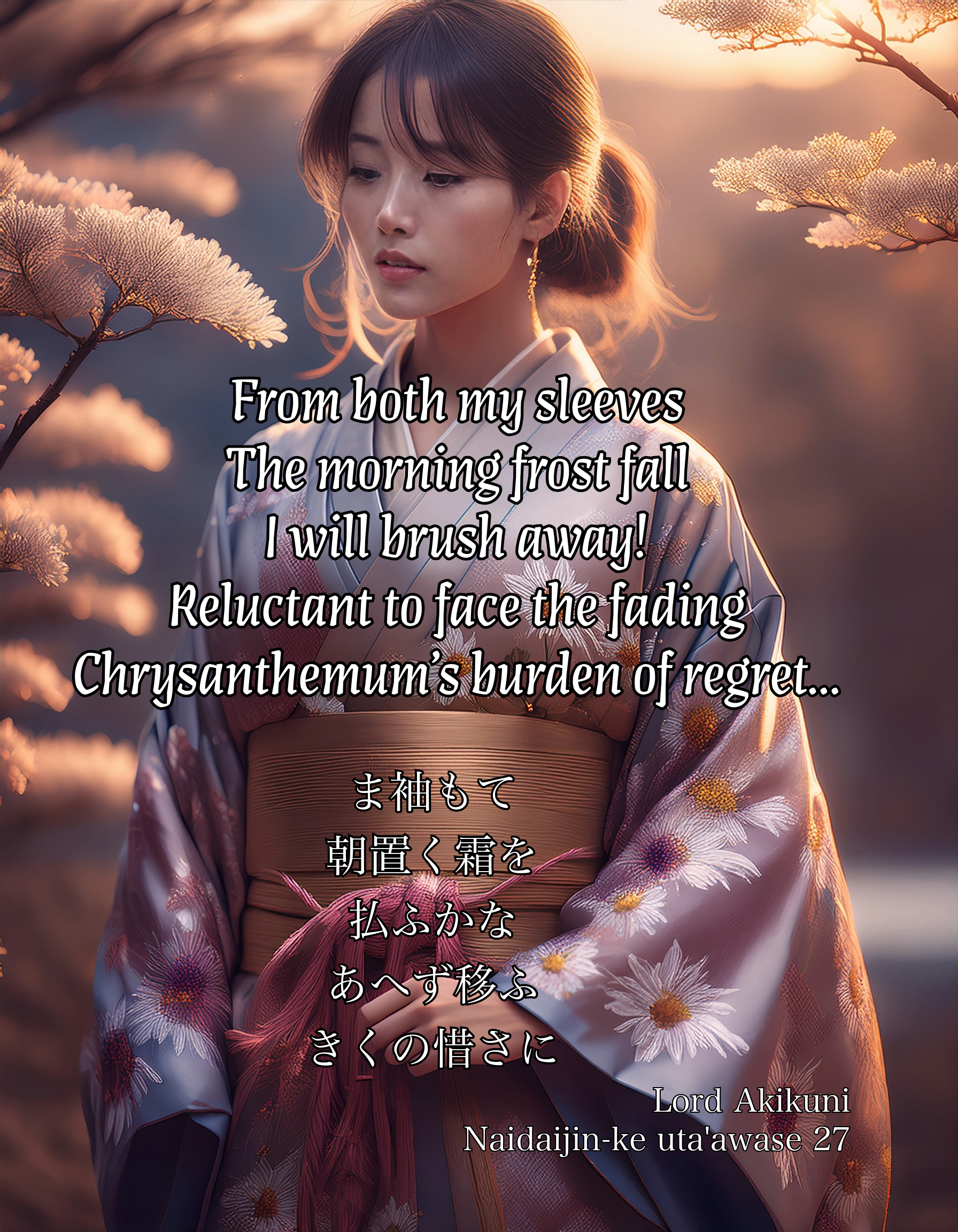
masodemote asa oku shimo o harau kana aezu utsurou kiku no oshisa ni
From both my sleeves The morning frost fall I will brush away! Reluctant to face the fading Chrysanthemum’s burden of regret…
Lord Akikuni 27
Right (Both Judges – Win)
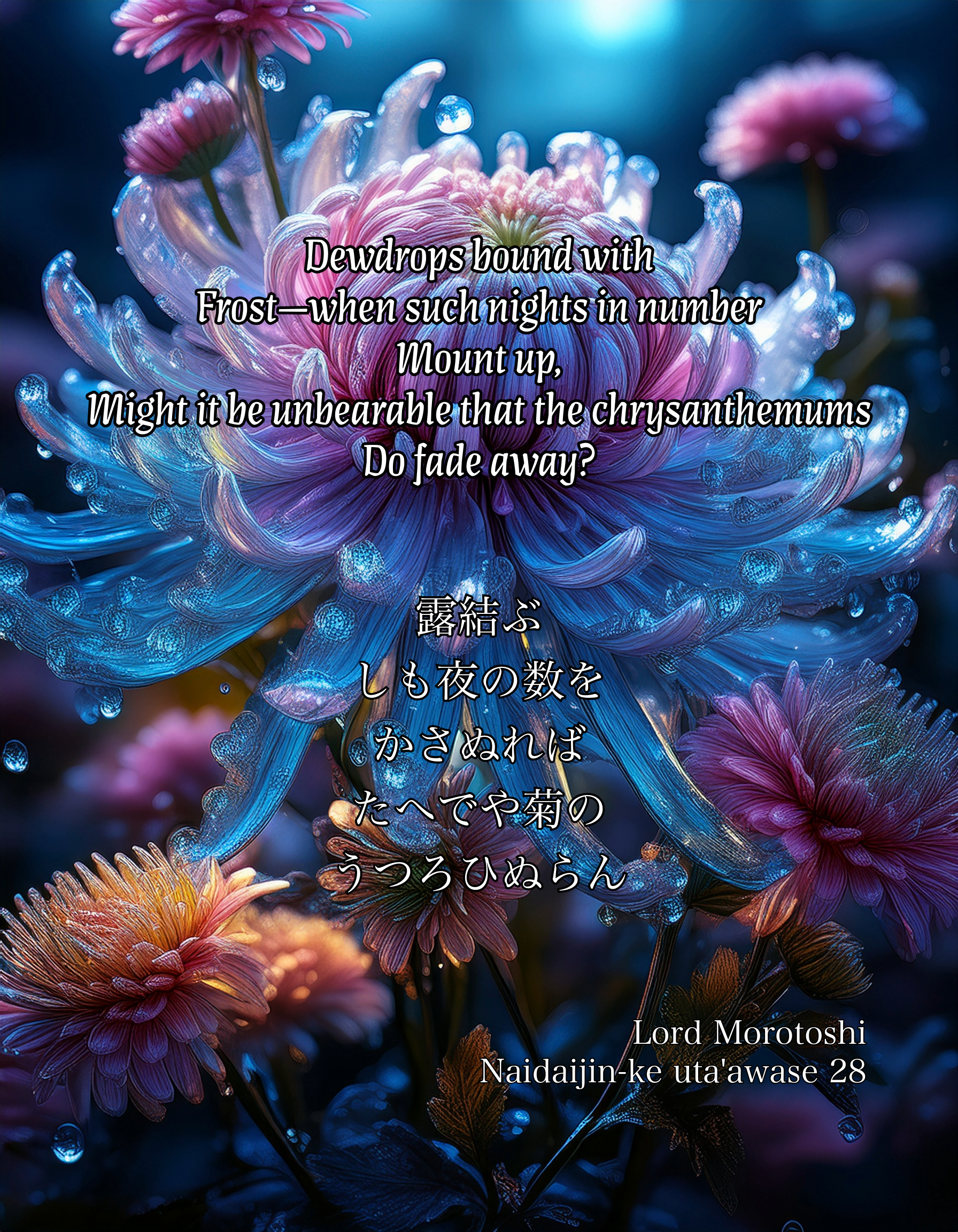
露結ぶしも夜の数をかさぬればたへでや菊のうつろひぬらん
tsuyu musubu shimo yo no kazu o kasanureba taede ya kiku no utsuroinuran
Dewdrops bound with Frost—when such nights in number Mount up, Might it be unbearable that the chrysanthemums Do fade away?
Lord Morotoshi 28
Toshiyori states: the first poem is extremely charming. Nevertheless, I must question the use of ‘reluctant to face the fading’ as I feel this is something I have not heard before. I can grasp the sense of diction such as ‘unable to do anything about’ or ‘without taking on autumn hues’, but did the poet mean to use the diction ‘unbearable’, perhaps? Even though this is somewhat archaic phrasing, it is used in composition. This poem’s expressions, though, I feel are somewhat unfamiliar. The conception and diction of the second poem are both extremely charming. However, this poem, too, is vague. What is going on with the initial ‘dewdrops bound’? Does it mean that the dewdrops get turned into frost? If so, then, from what is known of the calendar, this is something which only occurs on a single night, and from the following night there is only frost. It sounds as if the conception of this poem, though, is that night after night dew turns to frost, and this would be a fault. Despite this vagueness, however, its tone is elegant, so it seems superior.
Mototoshi states: the poem of the Left has a poetic configuration, but I strongly feel that it would have been preferable not to use the diction ‘both my sleeves’. It does seem as if this was used in the ancient Collection of a Myriad Leaves, but even given that was the case, in the preface to the Ancient and Modern, I recall it saying, ‘On examining the poems of ancient times, we find they use many archaic expressions. These were there not just to please the ear, but simply for moral instruction’. It appears that there are no instances of this piece of diction being used in poetry matches from the period of the Ancient and Modern, Later Selection and Gleanings, and these were all conducted for entertainment. Even in a poetry match conducted in Engi 12 [912], when the term ‘sleeve’ was used, I get the feeling that it was such a source of amusement that the poem was not recited. While the quality of the Right’s poem is not superb, the tone of ‘Dewdrops bound with / Frost—when such nights in number’ is not bad, so I feel the dew can still remain bound!