Tag Archives: toki

Tsurayuki uta’awase 02

Love.

Left

人知れぬ恋の涙はうぐひすの初声にこそながれいでぬれ

hito shirenu
koi no namida wa
uguisu no
hatsukoe ni koso
nagare’idenure
Unknown to all
My tears of love
With the warbler’s
First cry have
Burst into flow!

3

Right

いかならむときか忘れむ春霞たちゐる空も君ぞこひしき

ika naramu
toki ka wasuremu
harugasumi
tachi’iru sora mo
kimi zo koishiki
What is to become of me?
Can I forget the time, when
The spring haze
Rising into the skies, too,
Was dear to me as you?

4

Dairi kiku awase – Engi jūsan-nen 01

Poems from a Chrysanthemum Match held by the Senior Courtier Gentlemen in the presence of His Majesty, 13th day of the Tenth Month, Engi 13.


Left

ちりはててはななきときのはななればうつろふいろのをしくもあるかな

chirihatete
hakanaki toki no
hana nareba
utsurou iro no
oshiku mo aru kana
All scattered now,
For such a brief time are
These flowers here;
The fading of their hues
Is something I regret!

Okikaze
1

しらくものうへにしうつるきくなればいたくをにほへはなとみるべく

shiraku mo no
uenishi utsuru
kiku nareba
itaku o nioe
hana to mirubeku
A white cloud,
Planted is this gleaming
Chrysanthemum, so
Bright, indeed, shining
Does the bloom look to be…

Suetada[i]
2

あきすぎてはなざかりなるきくのはないろにたぐひてあきやかへれる

aki sugite
hanazakari naru
kiku no hana
iro ni taguite
aki ya kaereru
Autumn is past and
The flowers richly blooming are
Chrysanthemums:
With their hues
Autumn does return!

Korenori
3

なみとのみうちこそみゆれすみのえのきしにのこれるしらぎくのはな

nami to nomi
uchi koso miyure
suminoe no
kishi ni nokoreru
shiragiku no hana
Simply as waves
Do they, indeed, appear!
At Suminoe
Lingering on the shore
White chrysanthemum blooms.

Korenori
4

わぎもこがひもゆふぐれのきくなればあかずぞはなのいろはみえける

wagimoko ga
hi mo yūgure no
kiku nareba
akazu zo hana no
iro wa miekeru
My darling girl
Both day and eve is
As a chrysanthemum, so
Never sated am I with this flower’s
Hues I see.

Korenori
5

きくのはなふゆののかぜにちりもせでけふまでとてやしもはおくらん

kiku no hana
fuyu no kaze ni
chiri mo sede
kyō made tote ya
shimo wa okuran
Chrysanthemum blooms
In the winter wind
Scatter not;
Is it that up to today is when
Frost is said to fall?

Korenori
6

かげさへやこよひはにほふきくのはなあまてるつきにかのそはるらん

kage sae ya
koyoi wa niou
kiku no hana
ama teru tsuki ni
ka no sowaruran
Even their shape
Fills tonight with a scented glow;
Chrysanthemum blooms
To the heaven-shining moon
Seem to add their fragrance.

Korenori
7


[i] Fujiwara no Suetada/Suenawa 藤原季縄 (?-919). Little is known of Suetada’s life, other than that he was apparently close to Ise 伊勢 and exchanged poems with her. The circumstances of his death, however, are recorded in Yamato monogatari, which relates that he fell ill in Engi 19 (919) when he held the position of Minor Captain in the Inner Palace Guards, Right Division (Ukonoe shōshō右近衛少将). On a day when he was due to be in attendance at the palace, he sent a message to Minamoto no Kintada 源公忠 (889-948), a Chamberlain and the Assistant Director of the Bureau of Housekeeping, to say that illness prevented his being there. Kintada replied that he should attend without fail on the day after tomorrow, but when that day came, Suetada sent him the following poem:

くやしくぞ のちにあはむと 契りける 今日をかぎりと 言はましものを

kuyashiku zo
nochi ni awamu to
chigirikeru
kyō o kagiri to
iwamashi mono o
I am struck with bitterness!
Once more would we meet
Did I vow, but
Today I meet my end—
That is what I would say…

SKKS VIII: 854

Concerned, Kintada ordered up a carriage and went immediately to Suetada’s residence, only to find he had died before he arrived. Greatly downcast, he returned to the palace and reported Suetada’s death to the emperor.

Entō ōn’uta’awase 30

Round Thirty

Left (Tie)

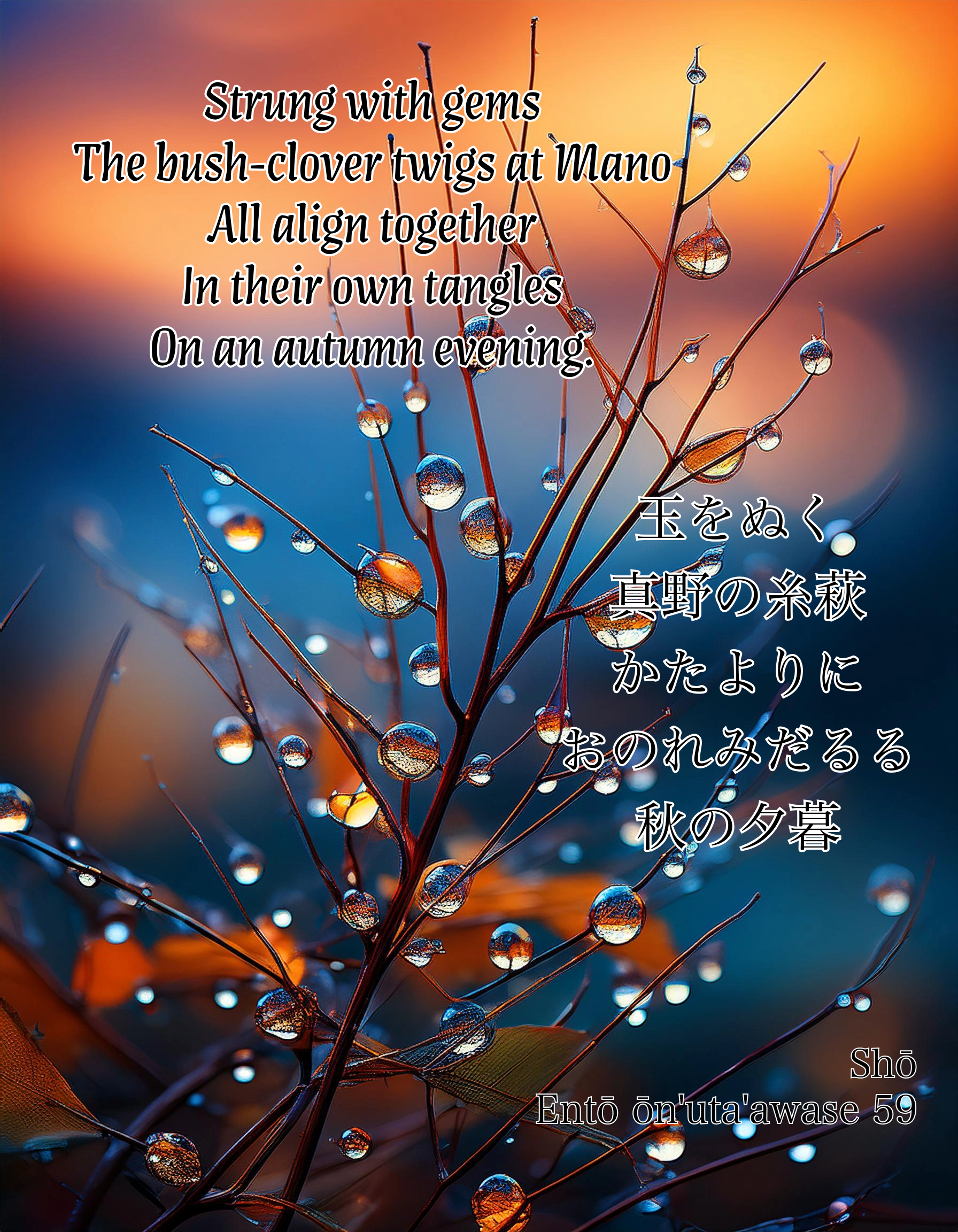
玉をぬく真野の糸萩かたよりにおのれみだるる秋の夕暮

tama o nuku
mano no itohagi
katayori ni
onore midaruru
aki no yūgure
Strung with gems
The bush-clover twigs at Mano
All align together
In their own tangles
On an autumn evening.

Shō
59

Right

待ちわたる時や来ぬらん白露の玉しく庭の秋はぎの花

machiwataru
toki ya konuran
shiratsuyu no
tama shiku niwa no
akihagi no hana
Has that long-awaited
Time arrived, perhaps?
When silver dewdrop
Pearls will spread o’er the grounds
From the autumn bush clover blooms…

Nagatsuna
60

The poems of Left and Right have different diction, but the same configuration.

Tōin senzai awase 10

Left – Pinks

もも草のときにつけつつさく中にいつともわかぬとこ夏の花

momokusa no
toki ni tsuketsutsu
saku naka ni
itsu tomo wakanu
tokonatsu no hana
A hundred grasses
Always with the season
Bloom and among them
Ever inseparable are
The flowering pinks.

17

Right

よろづよにぬるとこなつの花なればうつろふ秋もまたれざりけり

yorozuyo ni
nuru tokonatsu no
hana nareba
utsurou aki mo
matarezarikeri
For ten thousand ages
Have slept abed the pinks
In bloom, so
For the autumn when they fade
They have no need to wait!

18

Daikōtaigōgū no suke taira no tsunemori-ason ke uta’awase 13

Round One

Deer

Left (Tie)

さをしかも秋をかなしとおもへばやときしも声をたてて鳴くらん

saoshika mo
aki o kanashi to
omoeba ya
toki shimo koe o
tatete nakuran
Does the stag, too,
Autumn’s sadness
Feel?
That at this time, of all, his cry
Should ring out so…

Lord Shige’ie
25

Right

嶺になく鹿の音ちかくきこゆなり紅葉吹きおろす夜はのあらしに

mine ni naku
shika no ne chikaku
kikoyu nari
momiji fuki’orosu
yowa no arashi ni
Crying upon the peak
The stag’s bell close by
Sounds, carried
With blown down scarlet leaves
On the midnight storm…

Lord Tsunemori
26

The Left truly sounds as if it grasps the conception with its use of ‘of all, his cry’. The Right, too, is poetic with ‘blown down scarlet leaves’. There may be some who say that one should not compose using a subsidiary topic, yet in the poetry match held in Tentoku[i] and the poetry match held by Emperor Kazan[ii], this was judged not to be a fault.


[i] This was the Dairi uta’awase Tentoku yo-nen 内裏歌合 天徳四年 (‘Palace Poetry Match Tentoku 4’) held by Emperor Murakami on the 30th day of the Third Month, Tentoku 4 [28.4.960].

[ii] This was the Dairi uta’awase Kanna gan-nen 内裏歌合 寛和元年 (‘Palace Poetry Match Kanna 1’) held by Emperor Kazan the 10th day of the Eighth Month, Kanna 1 [28.8.985].

Teiji’in tenjōbito uta’awase 03

Left (Tie)

あふことをまつとなげきしときよりもたなばたつめはいまやわぶらむ

au koto o
matsu to nagekishi
toki yori mo
tanabatatsume wa
ima ya waburamu
For a meeting
Did she pine and grieve,
But from that moment
The Weaver Maid
Now seems filled with lonely sadness.

5

Right

ながきよにつくすともなきたなばたのこひはそらにやもりわたるらん

nagaki yo ni
tsukusu tomo naki
tanabata no
koi wa sora ni ya
moriwataruran
The long night through
Did not exhaust at all
The Weaver Maid’s
Love into the skies
Seems to overflow.

6

Entō ōn’uta’awase 13

Round Thirteen

Left (Win)

桜花空にあまぎる白雲の棚引きわたるかづらきの山

sakurabana
sora ni amagiru
shirakumo no
tanabikiwataru
kazuragi no yama
The cherry blossoms,
As sky-sweeping
Clouds of white
Drape all across
Kazuragi Mountain.

Takasuke
25

Right

さくらさくながらの山のながき日も昔をこひぬ時のまぞなき

sakura saku
nagara no yama no
nagaki hi mo
mukashi o koinu
toki no ma zo naki
The cherries bloom
Changeless on Nagara Mountain;
The lengthy days to
Those beloved bygone
Moments do not compare.

Shimotsuke
26

Neither Left nor Right has any faults worth mentioning. The Right’s poem appears tranquil, with an artless quality. It has a moving sensibility of longing for the past, but the Left’s poem should just about win, I think.

Teiji-in uta’awase 29

Left

うつつにもゆめにもひとによるしあへばくれゆくばかりうれしきはなし

utsutsu ni mo
yume ni mo hito ni
yoru shi aeba
kureyuku bakari
ureshiki wa nashi
In reality and
In dreams both, ‘tis her
I meet at night, so
Until the twilight comes
I have no joy, at all.

Mitsune
57

Right (Win)

たまもかるあまとはなしにきみこふるわがころもでのかわくときなき

tamamo karu
ama to wa nashi ni
kimi kouru
wa ga koromode no
kawaku toki naki
Reaping gemweed,
A seaman, I am not, but
Loving you, my lady,
My sleeves are
Dry for not a moment.

58