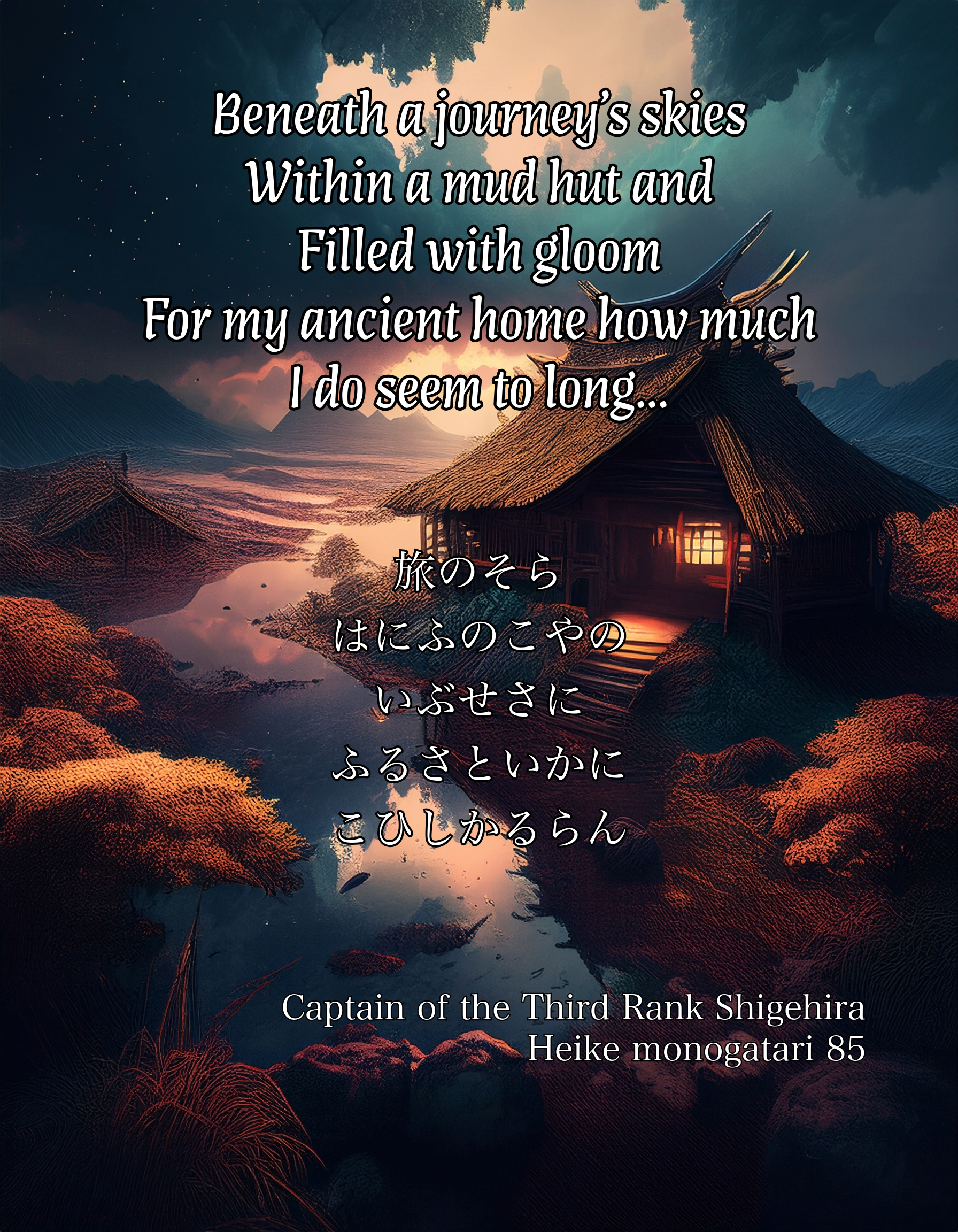
稀にきて稀にやどかる人もあらじ哀とおもへ庭のまつ風
| mare ni kite mare ni yado karu hito mo araji aware to omoe niwa no matsukaze | Even rarely coming, and Rarely borrowing my hut— There’s no such man, it seems, so Pity me, Pinewinds through my garden! |
590
Composed on a large number of travellers being at mountain retreat surrounded by pine trees.
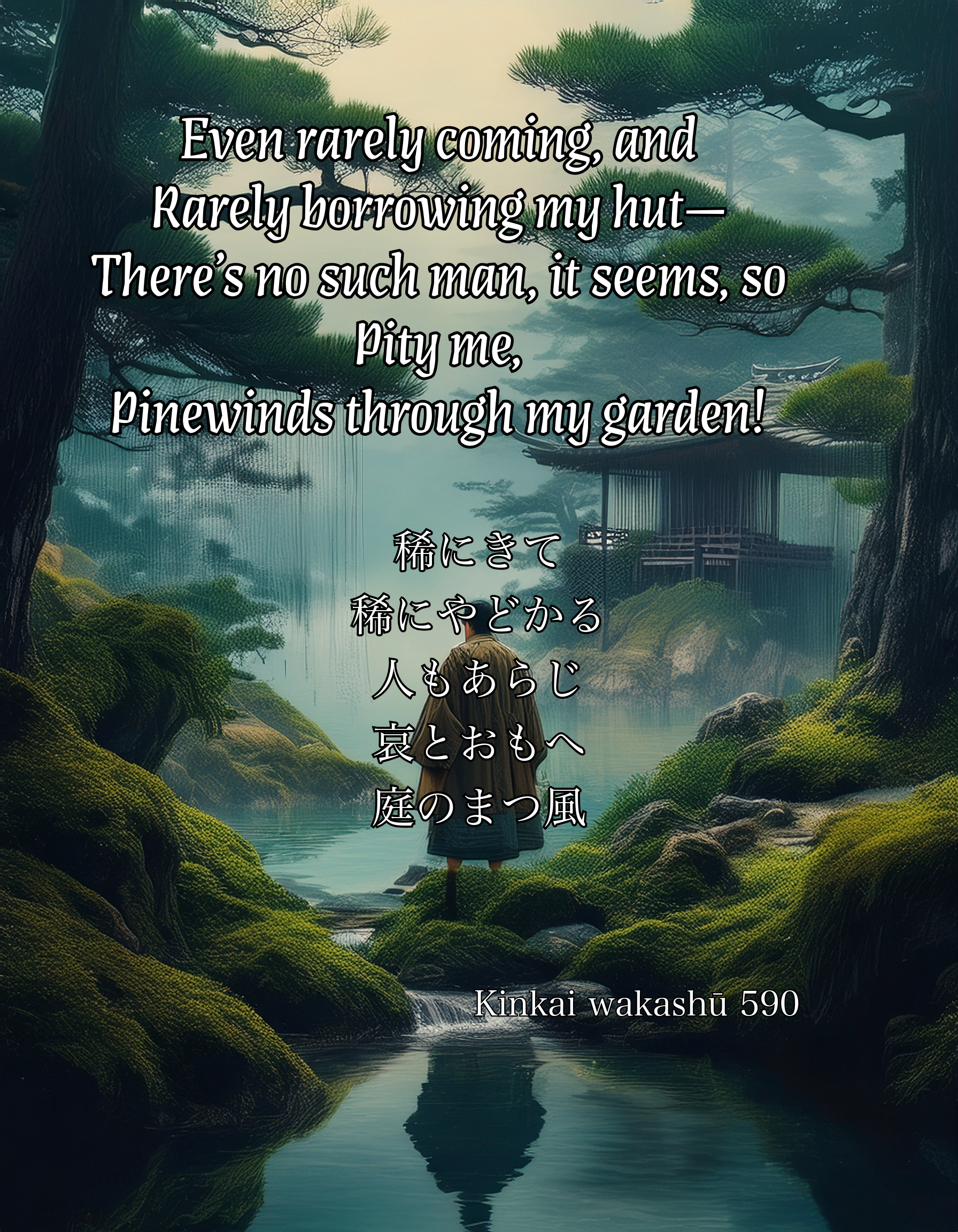
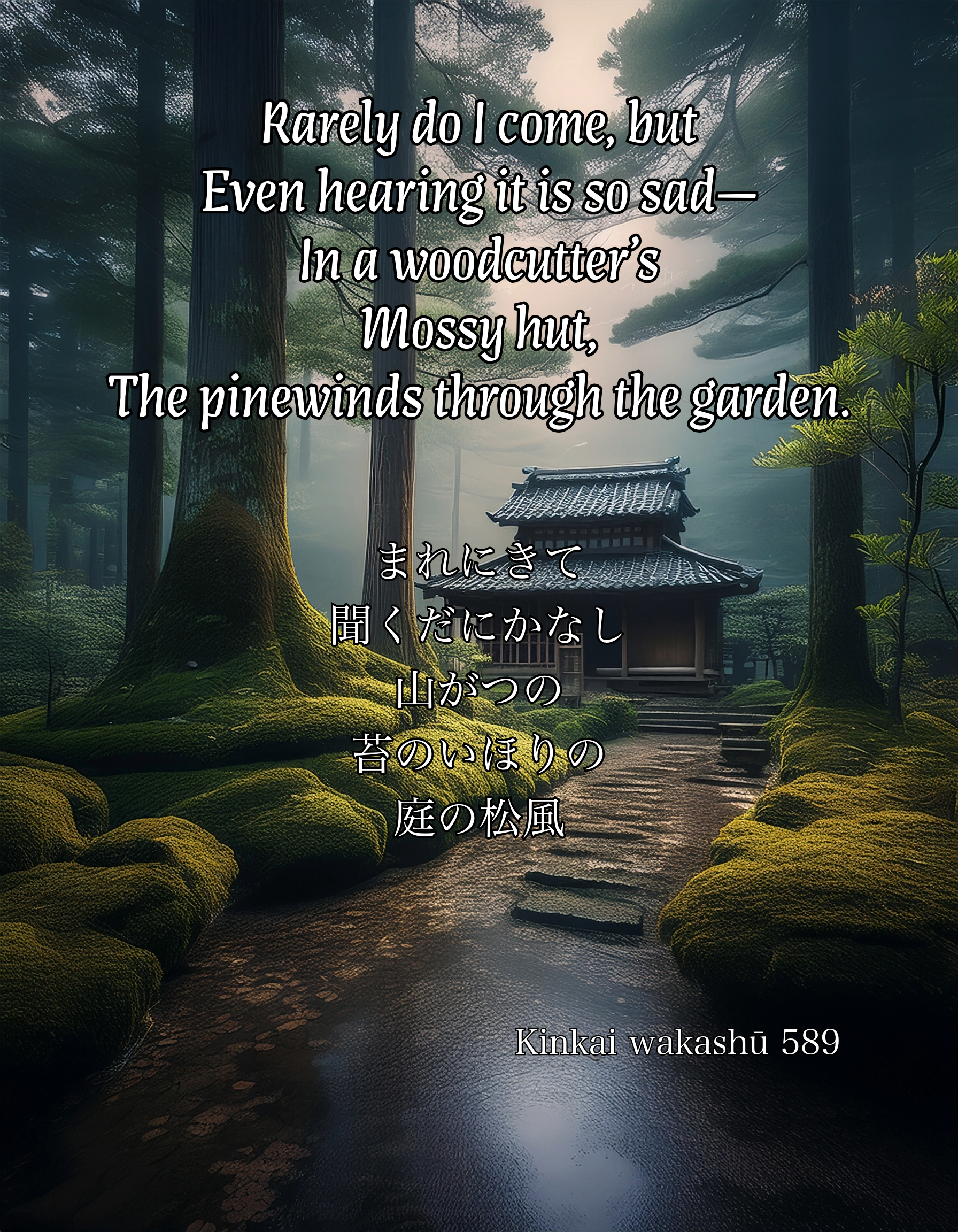
まれにきて聞くだにかなし山がつの苔のいほりの庭の松風
| mare ni kite kiku dani kanashi yamagatsu no koke no iori no niwa no matsukaze | Rarely do I come, but Even hearing it is so sad— In a woodcutter’s Mossy hut, The pinewinds through the garden.[i] |
589
[i] See: After the death of Sada’ie’s mother, around autumn time he was staying at a temple near her grave and composed this. まれにくる夜はもかなしき松風をたえずやこけのしたにきくらん mare ni kuru / yo wa mo kanashiki / matsu kaze o / taezu ya koke no / shita ni kikuran ‘Rarely did I come / At nights now I sorrowfully / Pine trees in the wind / Unceasingly beneath the moss / I wonder will you hear it?’ Master of the Dowager Empress’ Household Office Toshinari (Shinkokinshū VIII: 796)
Snow amidst a journey
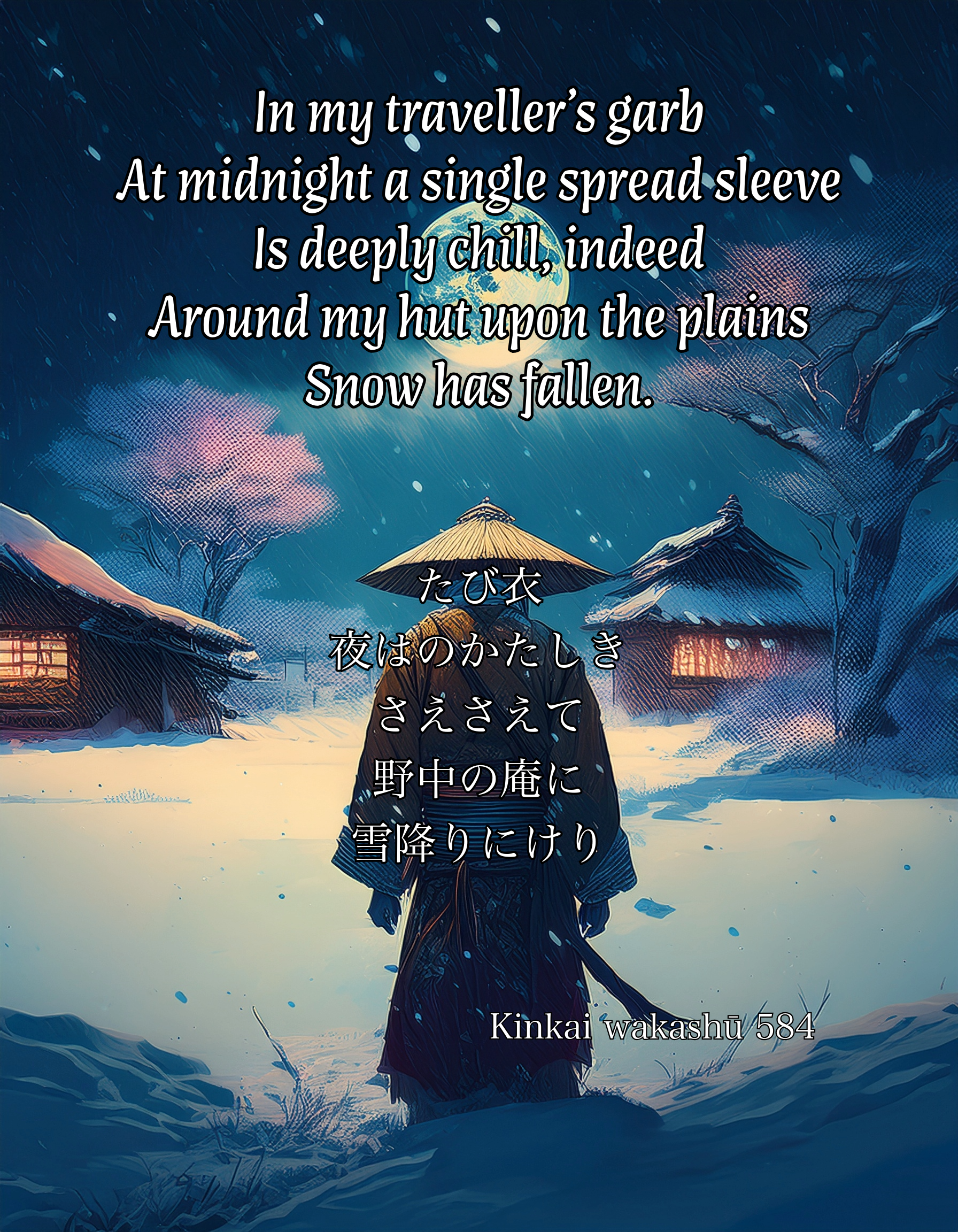
たび衣夜はのかたしきさえさえて野中の庵に雪降りにけり
| tabigoromo yowa no katashiki saesaete nonaka no io ni yuki furinikeri | In my traveller’s garb At midnight a single spread sleeve Is deeply chill, indeed Around my hut upon the plains Snow has fallen.[i] |
584
[i] See: In a hundred poem sequence: さむしろのよはの衣手さえさえてはつ雪しろしをかのべの松 samushiro no / yowa no koromode / saesaete / hatsuyuki shiroshi / oka no be no matsu ‘Alone in my meagre bedding, / My nightgown’s sleeves / Are deeply chill, indeed; / The first snows lie white / Upon the pines along the hillside.’ Princess Shokushi (Shinkokinshū VI: 662)
Round Ten
Left (T – Tie)
波よする蜑の苫やのひまをあらみもるにてぞしるよはのしぐれは
| nami yosuru ama no tomaya no hima o arami moru nite zo shiru yowa no shigure wa | Waves break near A sedge-thatched hut’s Crude gaps The leaks reveal A midnight shower… |
Lord Tadafusa
19
Right (M – Win)
ゆふ月よいるさの山の高根よりはるかにめぐる初しぐれかな
| yūzukuyo irusa no yama no takane yori haruka ni meguru hatsushigure kana | On a moonlit night From Irusa Mountain’s High peak In the distance circles A first shower! |
Lord Kanemasa
20
Toshiyori states: in the first poem, the shower sounds chilly! A shower is not something that one hears after getting up at dawn, yet this poem says that one first gets to know about it from the leaks, it seems that the poet has gone to bed, been leaked on, had his garments soaked and then got up and made a fuss. If he has not been leaked upon is this something he heard from someone else the following day? It really is very unclear. There’s a poem ‘Together with me / On my mountain pilgrimage’ which refers to showers falling on this mountain. The poem here refers to the same peak, so it sounds as if it’s referring to monks going around. Is that what it’s about? I am not just finding fault for the sake of it—these poems are unclear. As there’s only so much that can be understood from hearing them, they should tie.
Mototoshi states: one can compose about a shower falling anywhere and there’s no need to bring up a fisherman’s sedge-thatch hut, is there! Furthermore, one gets to know about a shower from the sound of it falling constantly on something like a roof of cedar boards, surely? Would one really be startled by rain of varying intensity falling soundlessly in spring? As for the poem of the Right, while it does not display a playfulness which would please the eye, ‘In the distance circles / A first shower’ is a bit better in the current context.


Round Twenty-Four
Left (Win)
かぜのおとにわきぞかねましまつがねのまくらにもらぬしぐれなりせば
| kaze no oto ni waki zo kanemashi matsu ga ne no makura ni moranu shigure nariseba | The gusts of wind I cannot tell apart from The rustle of the pines roots For my pillow should no drips From the shower fall… |
Lord Sanefusa
97
Right
たびのいほはあらしにたぐふよこしぐれしばのかこひにとまらざりけり
| tabi no io wa arashi ni taguu yoko shigure shiba no kakoi ni tomarazarikeri | My traveller’s hut Is lashed by the storm wind’s Sideways showers— The brushwood walls Halt it not at all. |
Lord Yorimasa
98
The conception and configuration of the poem of the Left, starting ‘I cannot tell apart from / The rustle of the pines’ and continuing ‘For my pillow should no drips / From the shower fall’ is, once again, truly exceptional! As for the poem of the Right, while it appears to have a charming style and use of diction, even if it is the case that ‘sideways showers’ are a genuine phenomenon, it fails to sound particularly elegant, doesn’t it. In addition, the latter section of the poem, ‘the brushwood walls’, feels slightly lacking in conception. Thus, I make the Left the winner.


Round Twenty-Three
Left (Win)
もしほぐさしきつのうらのねざめにはしぐれにのみやそではぬれける
| moshiogusa shikitsu no ura no nezame ni wa shigure ni nomi ya sode wa nurekeru | Salt-seaweed grasses grow On the beach at Shikitsu where On waking is it By the showers alone That my sleeves have dampened? |
Dharma Master Shun’e
95
Right
たびねにははにふのこやのいたびさししぐれのするぞさやにきこゆる
| tabine ni wa hanyū no koya no itabisashi shigure no suru zo saya ni kikoyuru | Sleeping on my travels On an ochre clay hut’s Veranda boards The falling of a shower Sounds striking! |
Lord Sanekuni
96
The Left’s ‘Salt-seaweed grasses grow / On the beach at Shikitsu’ is certainly particularly charming, and really what one should say. The concluding section’s ‘By the showers alone?’, too, does not seem simplistic in conception and diction. As for the Right, while it is not the case that at ‘an ochre clay hut’s…a shower..would sound striking’ has no point to it, the Left’s poem is particularly pleasant. Thus, it wins.


Round Twenty-One
Left (Tie)
かきくもりたびねのいほにしぐれしてつゆけさまさるくさまくらかな
| kakikumori tabine no io ni shigureshite tsuyukesa masaru kusamakura kana | Clouds claw in above The hut where I doze upon my travels, and Showers fall— Dew-drenched, above all, is My grassy pillow! |
Lord Shigenori
91
Right
まばらなるいほよりもりてむらしぐれをりしくならのはにぞおとする
| mabara naru io yori morite murashigure orishiku nara no ha ni zo otosuru | Leaky is My hut, so dripping through come The cloudbursts; Plucked and spread the oak Leaves make such a sound! |
Lord Morikata
92
The Left sounds very straightforward. The Right appears heart-rendingly desolate, but I wonder if it isn’t a bit excessive to go so far as the poet reclining on spread oak leaves which are making a sound due to the shower dripping through the hut’s roof? Then again, the Left’s latter section appears to contain little feeling, so comparing the two poems’ together, they should tie, I feel.