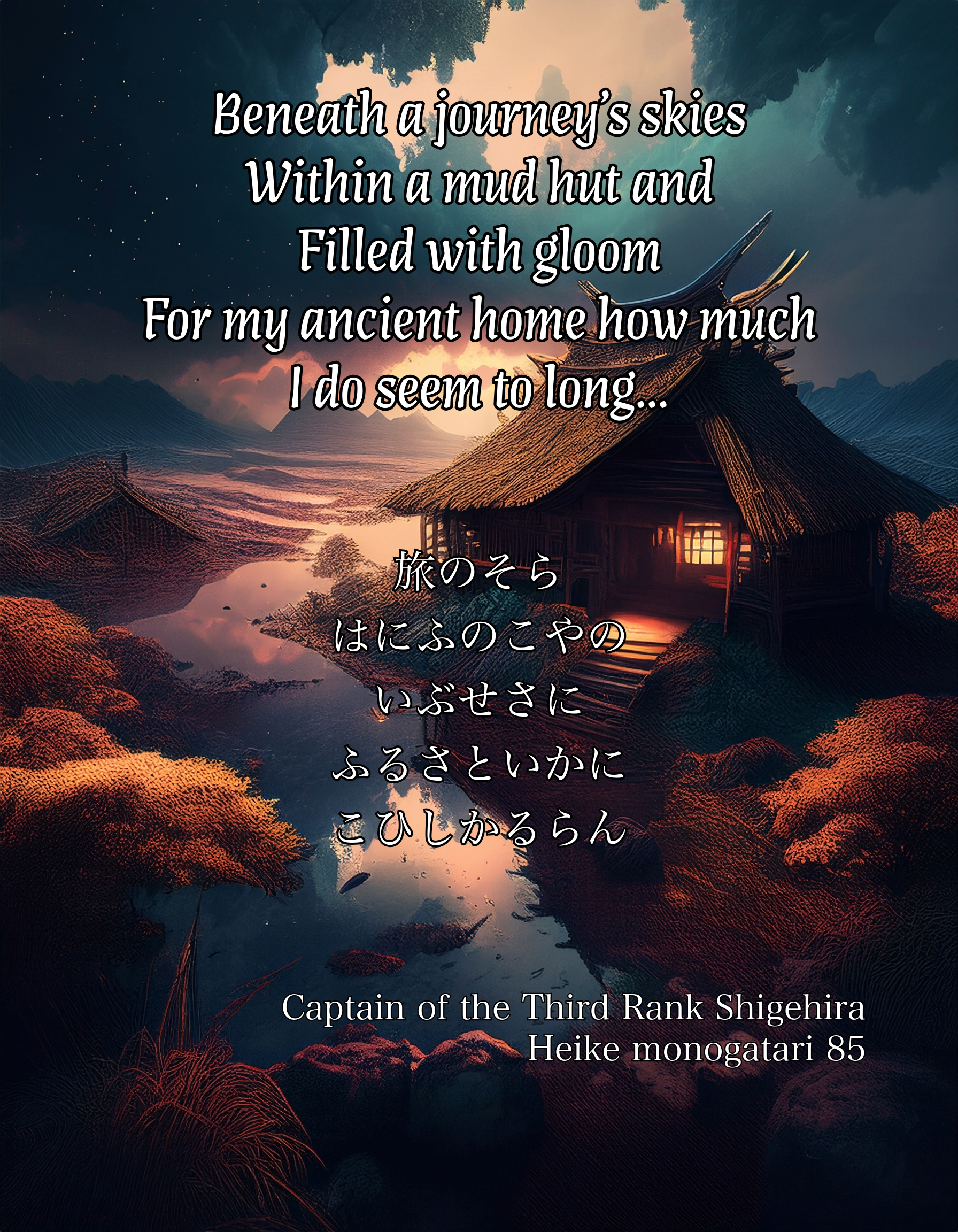
kusamakura onaji tabine no sode ni mata yowa no shigure mo yado wa karikeri
Needing a grassy pillow When travelling just the same as I, dozing I find my sleeves drenched even more, For the midnight shower, too, Has found lodging.
Kojijū 87
Right
いほりさすやまぢはすぎぬはつしぐれふるさとまでやめぐりゆくらむ
iori sasu yamaji wa suginu hatsushigure furusato made ya meguriyukuramu
I put up my hut Upon the mountain path that you passed by, O, first shower! As far as my ancient home I wonder, will you make your way?
Lord Sanemori 88
The poem of the Left, saying ‘When travelling just the same as I dozing, / I find my sleeves drenched even more’ and then following this with ‘For the midnight shower, too, / Has found lodging’, has an extremely charming conception and configuration. In addition to the poem of the Right also having a charming conception, it begins with ‘O, first shower!’ and then continues, ‘As far as my ancient home’, which is an effective use of diction. Nevertheless, the conception of the Left’s poem is even better and it wins.
yamahime ya kite furusato e kaeruran nishiki to miyuru koromode no mori
Does the mountain princess Wear it, when to her ancient home Returning? As brocade does seem The sacred grove at Koromode…
Lord Shige’ie
73
Right
色色の木木のにしきを立田川ひとつはたにもおりながすかな
iroiro no kigi no nishiki o tatsutagawa hitotsu hata ni mo orinagasu kana
Many hued is The trees brocade that The Tatsuta River’s Loom into one Does weave and float along!
Shun’e 74
The Left’s ‘mountain princess’ is normally used, but where is the ‘ancient estate’? As for the Right, when the trees’ brocade is scattered, only then, indeed, can it be woven and made to flow along by a river. A long time ago there was a poem composed which, indeed, began, ‘The scarlet leaves in such confusion / Drift’ and then continued, ‘Were I to ford across, this brocade / Would be split in two, I’d say…’[1] Furthermore, what are we to make of ‘Tatsuta River’s / Loom into one’? There should be reference to a location which has some connection with looms, but to simply shoehorn in ‘Tatsuta River’s / Loom into one’ smacks of pleasing oneself. There is the earlier poem ‘Without a loom / Are brocade’,[2] too. The way in which this poem is constructed is charming, but these features are difficult to ignore, so thus the Left should win, I think.
[1] The poem is Kokinshū V: 283, with the headnote, ‘Topic unknown’. It is officially anonymous, but is accompanied by an endnote stating ‘It is said by some that this poem was composed by the Nara Emperor.’
[2] Topic unknown. から衣たつたの山のもみぢばははた物もなき錦なりけり karakoromo / Tatsuta no yama no / momijiba wa / hatamono mo naki / nishiki narikeri ‘A Cathay robe— / Tatsuta Mountain’s / Scarlet leaves, / Without a loom / Are brocade.’ Anonymous (GSS VII: 386)
hagi ga hana wakeyuku hodo wa furusato e kaeranu hito mo nishiki o zo kiru
When through the bush-clover blooms He forges his way, To his ancient home Never to return—that man, too, Wears a fine brocade!
Minamoto no Arifusa, Minor Captain in the Inner Palace Guards, Right Division
13
Right
声たてて鳴くむしよりも女郎花いはぬ色こそ身にはしみけれ
koe tatete naku mushi yori mo ominaeshi iwanu iro koso mi ni wa shimikere
They lift their songs in Plaintive cries, but far more than the insects ‘Tis the maidenflower’s Wordless hue that truly Pierce my soul!
Junior Assistant Minister of Central Affairs Sadanaga 14
The Left is well-composed, but what is the Right’s ‘wordless hue’? Are we supposed to imagine that the expression means ‘silent yellow’? This is difficult to grasp, isn’t it. Whatever way you look at it, the Left seems to win.
This poem says ‘generation’ when it should be composed about a year—it loses.
[i] This poem is included in Shinchokusenshū (I: 36), attributed to Sakanoue no Korenori, with the headnote, ‘From Former Emperor Uda’s Poetry Contest’.
[ii] A minor variant of this poem, which changes the first phrase to ‘For three thousand years’ (michi tose ni), is included in Shūishū (V: 288), attributed to Mitsune, with the headnote ‘From Former Emperor Uda’s Poetry Contest’.