kusamakura tabi ni shi areba karikomo no omoimidarete i koso nerarene
A pillow of grass I have on my travels, and Reaped wild rice My thoughts are scattered, Unable ever to sleep![i]
566
[i] See: Topic unknown. かりこもの思ひみだれて我こふといもしるらめや人しつげずは karikomo no/ omoimidarete / ware kou to / imo shirurame ya / hito shi tsugezu wa ‘As cut wild-rice / Are my scattered thoughts: / That I do love her, / I wonder, can she know, / With no one to tell her?’ Anonymous (Kokinshū XI: 485)
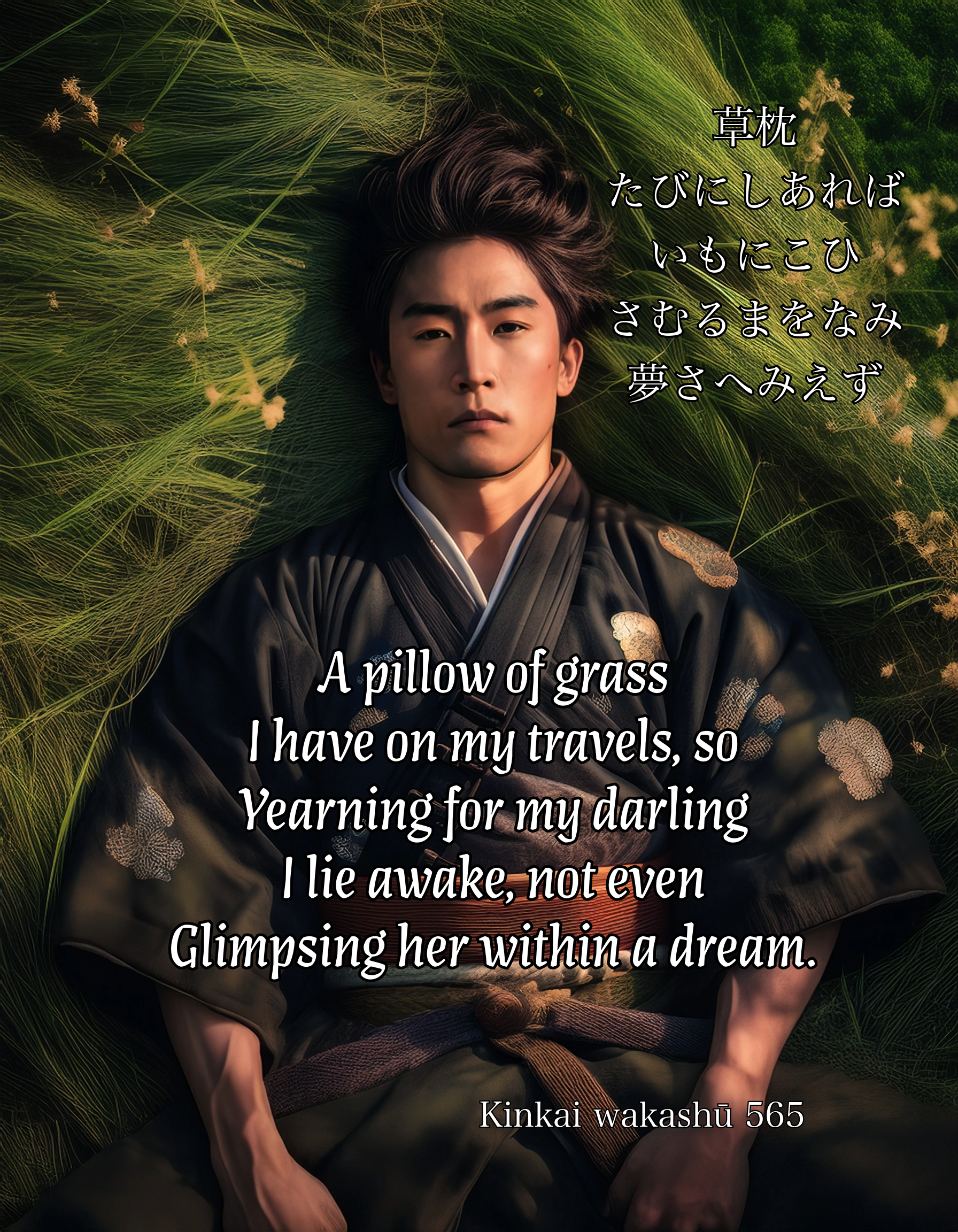
kusamakura tabi ni shi areba imo ni koi samuru ma o nami yume sae miezu
A pillow of grass I have on my travels, so Yearning for my darling I lie awake, not even Glimpsing her within a dream.[i]
565
[i] See: 家有者 笥尓盛飯乎 草枕 旅尓之有者 椎之葉尓盛 ie ni areba/ ke ni moru ii o / kusamakura / tabi ni shi areba / shii no ha ni moru ‘When I am at home / The pots are full of rice, but / Pillowed on the grass / On this journey now / Only the chinquapin leaves are plentiful…’ Prince Arima (Man’yōshū II: 142)
kakikumori tabine no io ni shigureshite tsuyukesa masaru kusamakura kana
Clouds claw in above The hut where I doze upon my travels, and Showers fall— Dew-drenched, above all, is My grassy pillow!
Lord Shigenori 91
Right
まばらなるいほよりもりてむらしぐれをりしくならのはにぞおとする
mabara naru io yori morite murashigure orishiku nara no ha ni zo otosuru
Leaky is My hut, so dripping through come The cloudbursts; Plucked and spread the oak Leaves make such a sound!
Lord Morikata 92
The Left sounds very straightforward. The Right appears heart-rendingly desolate, but I wonder if it isn’t a bit excessive to go so far as the poet reclining on spread oak leaves which are making a sound due to the shower dripping through the hut’s roof? Then again, the Left’s latter section appears to contain little feeling, so comparing the two poems’ together, they should tie, I feel.
kusamakura onaji tabine no sode ni mata yowa no shigure mo yado wa karikeri
Needing a grassy pillow When travelling just the same as I, dozing I find my sleeves drenched even more, For the midnight shower, too, Has found lodging.
Kojijū 87
Right
いほりさすやまぢはすぎぬはつしぐれふるさとまでやめぐりゆくらむ
iori sasu yamaji wa suginu hatsushigure furusato made ya meguriyukuramu
I put up my hut Upon the mountain path that you passed by, O, first shower! As far as my ancient home I wonder, will you make your way?
Lord Sanemori 88
The poem of the Left, saying ‘When travelling just the same as I dozing, / I find my sleeves drenched even more’ and then following this with ‘For the midnight shower, too, / Has found lodging’, has an extremely charming conception and configuration. In addition to the poem of the Right also having a charming conception, it begins with ‘O, first shower!’ and then continues, ‘As far as my ancient home’, which is an effective use of diction. Nevertheless, the conception of the Left’s poem is even better and it wins.
koyoi shimo ayaniku ni furu shigure kana mabara ni saseru shiba no iori ni
Of all nights How unfortunate it is that falls A shower! Upon my crudely erected Brushwood hut!
Lord Kinshige 83
Right
くさまくらつゆけきたびのくれはとりあやにくにまたしぐれふるなり
kusamakura tsuyukeki tabi no kurehatori akaniku ni mata shigure furu nari
My grassy pillow is Dew-drenched on my travels At Kurehatori—the weaver’s town! How warped that still A shower falls here!
Enjitsu 84
Both Left and Right have their showers falling unfortunately, and the poem of the Right starts with ‘Kurehatori’ and continues with ‘warped’ which sounds charming, but to mention ‘dew-drenched travels’ and follow this with Kurehatori give a somewhat unexpected impression. The Left lacks anything as individual as Kurehatori’s warp, but ‘crudely erected’ is a direct description and, thus I could make the Left the winner.
kusamakura tabine sabishiki yamakage ni ko no ha sasoite shigure furunari
On a grassy pillow, Dozing on my travels, lonely In a mountain’s shade, The rustling of the leaves invites A shower to fall.
Hyōenosuke 81
Right (Win)
すみのえのまつがはひねをまくらにてなみうちそふるしぐれをぞきく
suminoe no matsu ga haine o makura nite nami uchisouru shigure o zo kiku
At Suminoe Upon the crawling pine roots Have I made my pillow, while Laced with the breaking waves I listen to the showers.
Lord Naganori 82
The Left’s configuration of ‘the rustling of the leaves invites’, while dozing on one’s journey in the shadow of a mountain, sounds pleasant. While I do wonder about the Right’s diction—concluding with ‘listen to the showers’—in addition to ‘laced with the breaking waves’ sounding pleasant, it also adds the conception of waves beneath ‘the pines of Suminoe’, doesn’t it. I make the Right the winner.
shigure ni wa iori mo sasaji kusamakura oto kiku tote mo nurenu sode ka wa
Caught in a shower, I’d not erect my hut, for Upon a grassy pillow Listening to the sound, still Would my sleeves be soaked!
Tsunemasa 73
Right (Win)
たまもふくいそやがしたにもるしぐれたびねのそでもしほたれよとや
tamamo fuku isoya ga shita ni moru shigure tabine no sode mo shiotareyo to ya
Thatched with gemweed is My roof upon the rocky shore, beneath it Drips a shower, so My sleeves, as I doze upon my travels, Wet with the salty tides – should I say that?
Nakatsuna 74
The Left wonders whether his sleeves would be soaked, listening to the sound of a shower after abandoning all thought of a hut and grassy pillow—this seems extremely charming, but the configuration and sequencing of the Right, beginning with ‘thatched with gemweed’ and continuing with ‘my sleeves, as I doze upon my travels, / Wet with salty tides’, is extremely moving, isn’t it! Thus I have to award a win, once more, to the poem of the Right.
kusamakura shigure mo sode o nurashikeri miyako o kouru namida naranedo
On a pillow of grass The showers, too, my sleeves Have soaked; Longing for the capital These tears are not, yet…
Hiromori 69
Right
かりいほさすならのからはのむらしぐれあはれはまきのおとばかりかは
kari’io sasu nara no karawa no murashigure aware wa maki no oto bakari ka wa
Erecting a crude hut, The withered leaves of oak are Struck by cloudbursts; Does sadness in the evergreens’ Sound solely lie?
Dharma Master Chikyō 70
Both Left and Right appear to have elegant configuration and diction, but the Left seems to presents the soaking of sleeves by showers as something novel, while the Right gives a feeling that it is only the sound of evergreens that makes one sad. Thus, these tie.
shiguresuru momiji no nishiki yukashiki ni akete o tatamu futamura no yama
Under the showers The scarlet leaves’ brocade I long to see, so With the dawn let’s set forth To Mount Futamura!
Jakunen 51
Right (Win)
みやこにもおもひやすらむくさまくらうちしぐれたるよはのねざめを
miyako ni mo omoiyasuramu kusamakura uchishiguretaru yowa no nezame o
Even in the capital Might you think of me? On a grassy pillow With a shower Awoken at midnight…
Suke 52
The Left poem’s ‘With the dawn let’s set forth / To Mount Futamura’ sounds charming, but as we can see from Lord Kanesuke’s poem ‘Futami Bay / Let’s see with the dawn’, it is quite pedestrian. Then there is the expression ‘long to see’—this really isn’t appropriate diction for poetry. I will admit that it appears from time to time in imperial anthologies, and so it is certainly permissible depending upon the style of the poem, though. There’s also the term ‘long to know’—one really shouldn’t use diction in a poetry match which doesn’t express the poet’s true feelings. As for the Right’s poem, it’s also quite pedestrian to say that showers fall on one’s way on a journey, but don’t necessarily fall in the capital, but saying that folk there might think of you waking on your journey, well, why wouldn’t they do that? The conception of the poem is pleasant, and I make it the winner.