[One of] two poems composed to express his grief and sorrow by Kawabe no Miyahito when he saw the coffin of a young girl in the pine groves of Himeshima in Wadō 4 [711].
妹之名者 千代尓将流 姫嶋之 子松之末尓 蘿生万代尓
いもがなは ちよにながれむ ひめしまの こまつがうれに こけむすまでに
imo ga na pa tiyo ni nagaremu pimesima no komatu ga ure ni kokemusu made ni
This maiden’s name Will drift down a thousand ages Until Himeshima’s Pine seedling shoots are Choked with hanging moss.
Composed on a large number of travellers being at mountain retreat surrounded by pine trees.
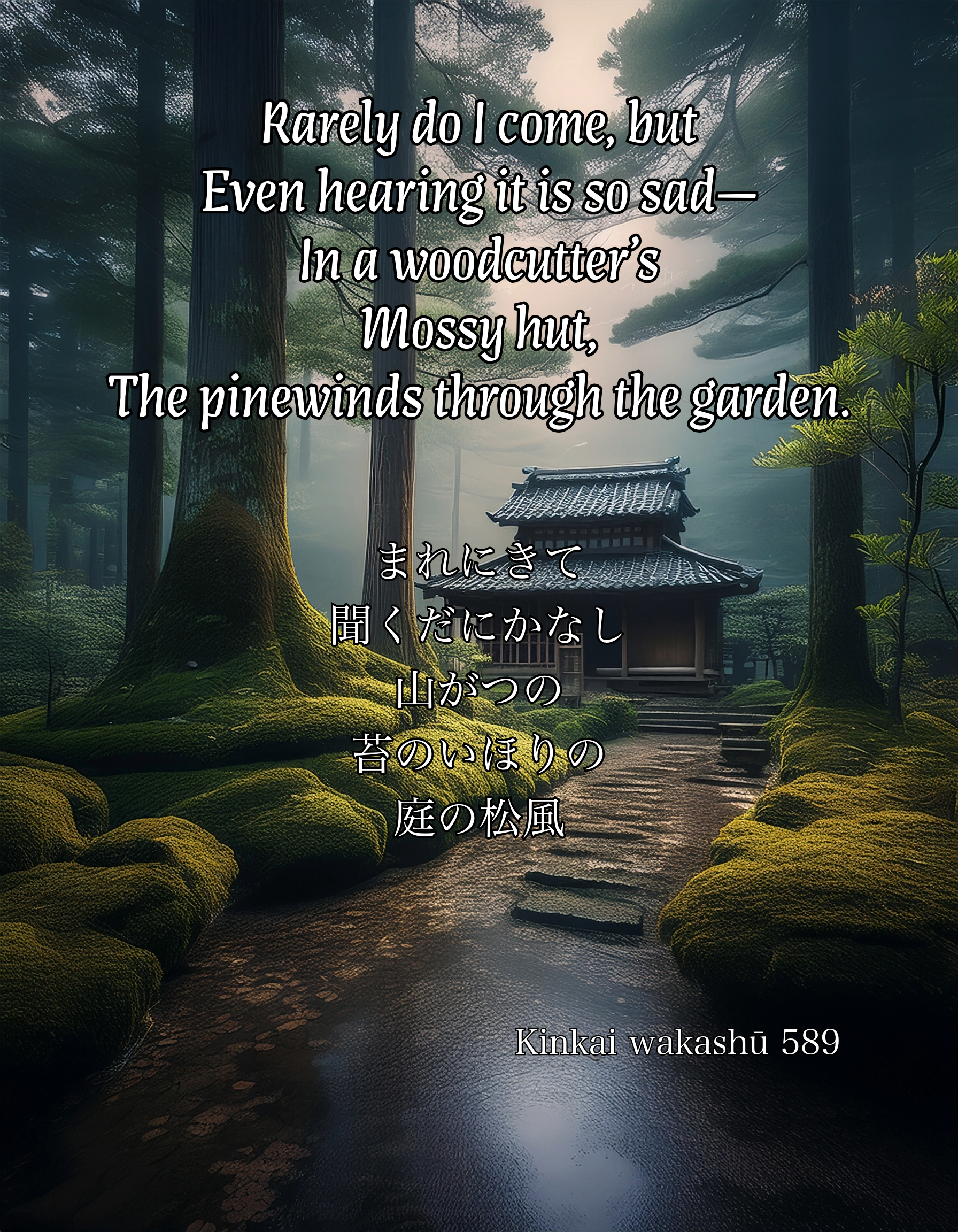
まれにきて聞くだにかなし山がつの苔のいほりの庭の松風
mare ni kite kiku dani kanashi yamagatsu no koke no iori no niwa no matsukaze
Rarely do I come, but Even hearing it is so sad— In a woodcutter’s Mossy hut, The pinewinds through the garden.[i]
589
[i] See: After the death of Sada’ie’s mother, around autumn time he was staying at a temple near her grave and composed this. まれにくる夜はもかなしき松風をたえずやこけのしたにきくらん mare ni kuru / yo wa mo kanashiki / matsu kaze o / taezu ya koke no / shita ni kikuran ‘Rarely did I come / At nights now I sorrowfully / Pine trees in the wind / Unceasingly beneath the moss / I wonder will you hear it?’ Master of the Dowager Empress’ Household Office Toshinari (Shinkokinshū VIII: 796)
sode makura shimo oku toko no koke no ue ni akasu bakari no sayo no nakayama
With my sleeve for my pillow, and Frost falling on my bed Atop the moss, Swiftly breaks the dawn At Sayo-no-Nakayama.[i]
582
[i] See: On a storm at one’s lodgings on a journey, for the Iwashimizu Poetry Match. 岩がねのとこに嵐をかたしきてひとりやねなんさよの中山 iwa ga ne no / toko ni arashi o / katashikite / hitori ya nenan / sayo no Nakayama ‘At the crags’ foot / Lies my bed with the storm wind / Alone, spread upon me— / Lonely, must I sleep? / At Sayo-no-Nakayama…’ Lord Ari’ie (Shinkokinshū X: 962)
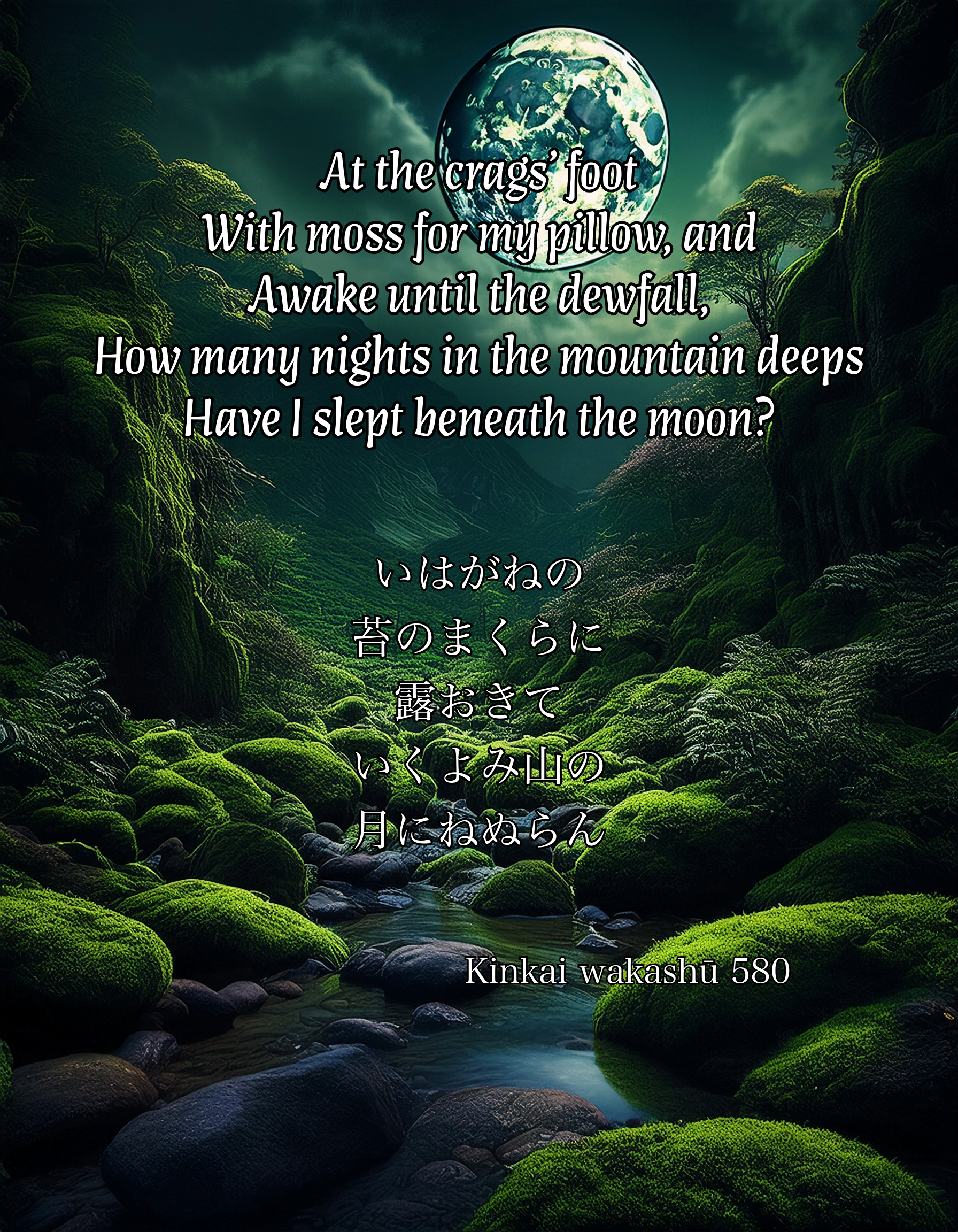
iwa ga ne no koke no makura ni tsuyu okite iku yo miyama no tsuki ni nenuran
At the crags’ foot With moss for my pillow, and Awake until the dewfall, How many nights in the mountain deeps Have I slept beneath the moon.[i]
580
[i] See: On the conception of seeing the moon while travelling, while at a place called the Barrier Gate Hall. 草枕ほどぞへにける都いでていくよかたびの月にねぬらむ kusamakura / hodo zo henikeru / miyako idete / ikuyo ka tabi no / tsuki ni nenuramu ‘Grassy pillows / For a while have been my lot! / Since departing the capital / For some days on my travels / Will I sleep beneath the moon.’ Ōe no Yoshitoki (Shinkokinshū X: 931)
koke no musu iwane ni nokoru yaegiku wa yachiyo saku tomo kimi zo mirubeki
Choked with moss are The crags where linger Eightfold chrysanthemums: E’en were they eight thousand ages a’bloom My Lord would have beheld them, no doubt!
Lady Shinano 45
Right
霜がれに我ひとりとや白菊の色をかへても人にみすらん
shimogare ni ware hitori to ya shiragiku no iro o kaetemo hito ni misuran
‘Burned by frost ‘Tis me alone!’ thinks A white chrysanthemum, Changing hue To show to folk, for sure.
Lord Tokimasa 46
Toshiyori states: I wonder if there is a poem as precedent for chrysanthemums lingering beneath moss-covered crags? If not, it’s a very crude expression. The ending of the poem is antiquated, too. As for the second poem ‘“Tis me alone!” thinks’ does not sound satisfactory. The assembled company settled the matter of the final ‘folk’, so I must make this a tie.
Mototoshi states: whether they are placed by a brushwood fence, or at the base of a crag, chrysanthemums feel like pines. As for the Right, having a chrysanthemum seem to think ‘‘tis me alone’ is speculative—had it been something like ‘this bloom opens’ then it would have been the poet’s thoughts. Neither of these is of quality to win or lose, so I make them a tie.