saohime no ito somekakuru aoyagi o fuki na midari so haru no yamakaze
Princess Sao Has dyed the dangling threads of Green willow— O, don’t blow them into tangles, Spring breeze from the mountains!
Kanemori 6
Warblers should have appeared here, but this is a poem about willows, so it loses.
しろたへの雪ふりやまぬ梅がえにいまぞうぐひす花となくなる
shirotae no yuki furiyamanu ume ga e ni ima zo uguisu hana to nakunaru
White as mulberry cloth The snow falls unceasing— Upon the branch of plum, Now, indeed, the warbler, Sings of the blossom!
Kanemori 7
Despite the mistaken composition, His Majesty required the original poem and it was located and recited.
Lord Hiromasa, the Reciter for the Right, mistakenly recited the willow poem. The Left raised an objection, saying, ‘He should have recited the warbler poem but, instead, erroneously recited the willow poem. Should he really be allowed to recite the correct poem now?’ The substance of the Left’s objection was conveyed to His Majesty, who instructed, ‘Provide a report based on prior precedent.’
This minor official advised His Majesty, ‘The Left’s objection is not unreasonable. However, matters such as this are best determined according to the circumstance of the occasion. As this was simply human error, why discriminate against the poem?’
Thus, His Majesty ordered that the poem be recited.
When he did so, Lord Hiromasa turned pale and was unable to recite the poem straight away. Although he finally managed to do so, his voice trembled and the Left laughed at him. Furthermore, the poem’s diction contained the nonsensical expression ‘sings of the blossom’, and thus this was still a loss.
[i] An allusive variation on: A poem from the Empress’ poetry competition held in the Kanpyō period. 花の香を風のたよりにたぐへてぞ鶯さそふしるべにはやる hana no ka o / kaze no tayori ni / taguete zo / uguisu sasou / shirube ni wa yaru ‘The blossoms’ scent / Messaged on the breeze / Brings / An invitation to the warbler / To try and bring him forth!’ Ki no Tomonori (Kokinshū I: 13)
[ii] This poem was included in Gyokuyōshū (I: 42), attributed to Asatada, with the headnote ‘On warblers, from the Palace Poetry Match in Tentoku 4’.
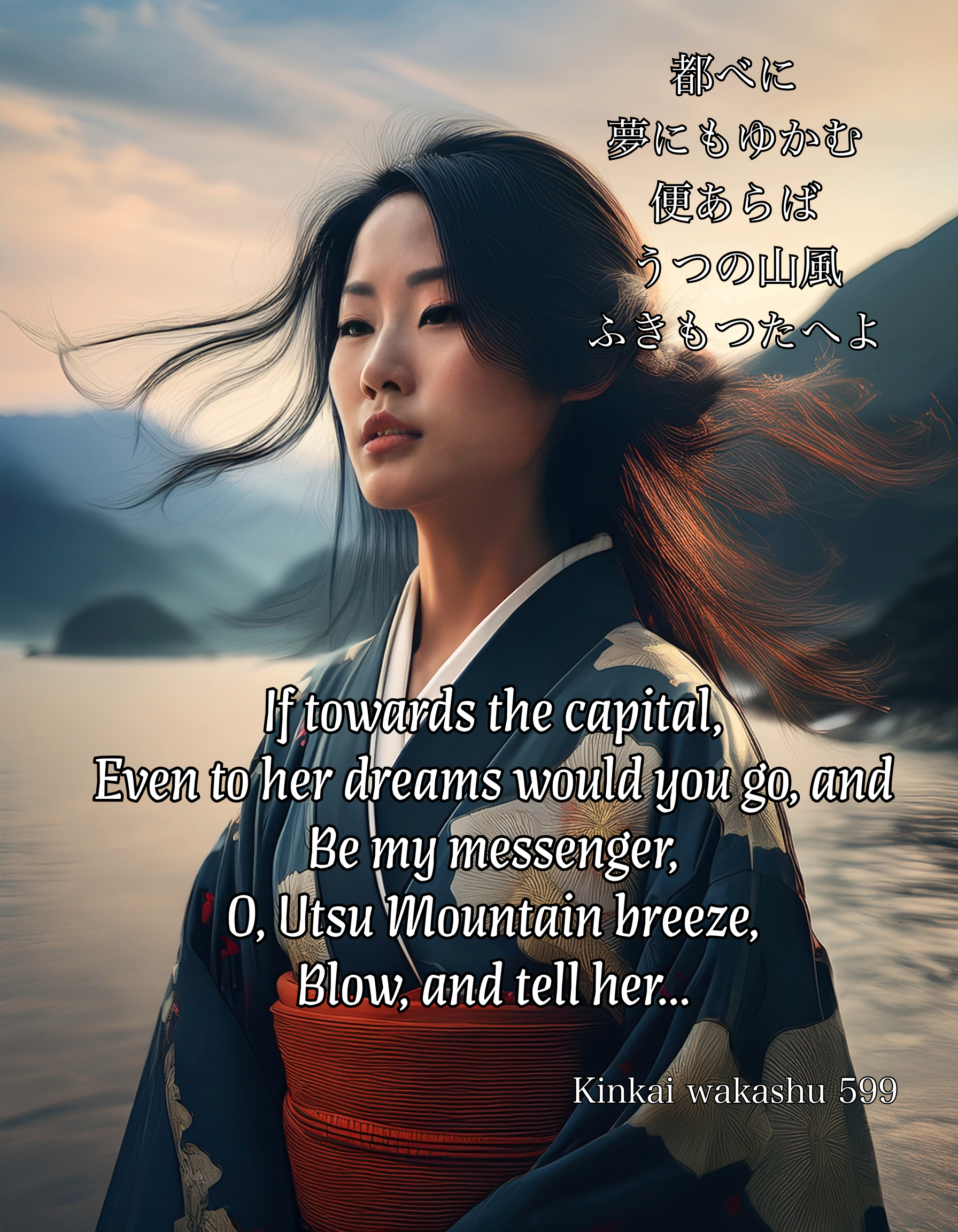
miyakobe ni yume ni mo yukamu tayori araba utsu no yamakaze fuki mo tsuteyo
If towards the capital, Even to her dreams would you go, and Be my messenger, O, Utsu Mountain breeze, Blow, and tell her…[i]
599
[i] See: While at Utsu Mountain in Suruga, he thought of someone he had been meeting and sent this to the capital. するがなるうつの山邊のうつゝにも夢にも人にあはぬなりけり suruga naru / utsu no yamabe no / utsutsu ni mo / yume ni mo hito ni / awanu narikeri ‘In Suruga / At the Utsu mountains / In truth and / In my dreams she / Is nowhere to be seen…’ Ariwara no Narihira (Shinkokinshū X: 904)
yamamoto no mori no shimenawa nagaki yo o aki no oshika no nakiakasuran
At the mountains’ foot lies A sacred grove with garlands Long as the nights In autumn when the stag Bells in the dawn.
Tomoshige 79
Right
なよ竹のよながき秋の山風に幾たび鹿のね覚しつらん
nayotake no yo nagaki aki no yamakaze ni ikutabi shika no nezameshitsuran
Green bamboo with Knots as apart as the autumn night is long, While with the mountain wind How many times might the stag Have awakened?[1]
Dharma Master Zenshin 80
The Left’s poem has ‘at the mountains’ foot lies a sacred grove with garlands long as the nights’ which sounds pleasant. The Right has ‘knots as apart as the autumn night is long, while with the mountain wind’—these, too, seem to have no clear winner or loser, yet still, the Left should be superior and should win.[2]
[1] An allusive variation on: Composed when the gentlemen in the Crown Prince’s service were presented with wine, on the occasion of Tadafusa being appointed Secretary of an embassy to China, during the reign of the Kanpyō emperor. なよ竹のよながきうへにはつしものおきゐて物を思ふころかな nayotake no / yo nagaki ue ni / hatsushimo no / oki’ite mono o / omou koro kana ‘Green bamboo with / Knots as far apart as the night is long / While the first frost settles on my active / Thoughts these days!’ Fujiwara no Tadafusa (KKS XVIII: 993)
yamakaze ni shioruru nobe no kusamura no neya samushi to ya shika no nakuran
The mountain wind Withers the meadow’s Clumps of grasses— Is it his chilly bedchamber That makes the stag cry out?
Moromitsu 39
Right (Win)
あはれとはねらふさつをも思ふらんをしか妻どふ秋の夕ぐれ
aware to wa nerau satsuo mo omouran oshika tsumadobu aki no yūgure
‘How sad,’ The aiming hunter, too, Seems to think, as The stag searches for his mate On an autumn evening…
Lay Priest Sanekiyo 40
The Left shows no technique from beginning to end, compounded by the fact that, while ‘although the stag does lie’ is a common expression in poetry, ‘bedchamber’ is something I am unaccustomed to hearing. As for the Right, ‘aiming hunter’ is distasteful to hear, but the poem is not bad overall, so it wins.
ukiyo oba mata nani ni ka wa nagusamen hana ni sakidatsu inochi to mogana
In this cruel world Is there yet anything else To console me? Before the blossoms’ departure I would my life do the same…
Court Lady Taifu 15
Right
桜さく春の山風みねこせば雪ふりつもる谷のほそみち
sakura saku haru no yamakaze mine koseba yuki furitsumoru tani no hosomichi
When in cherry-blooming Spring, the mountain breezes Cross the peaks Snow falls and piles high Upon the narrow valley paths.
Moromitsu 16
Both poems are smooth, and on that basis, I would say that the Right is superior, but it has an archaic element, while the Left lacks anything unusual about it, so this is a tie of quality.
sakura saku yoshino no yama no yamakaze ni fumoto o komete hana niourashi
Cherries bloom In the mountains of Yoshino, where The mountain breezes Make even the foothills Aglow with blossom.
Tomoshige 31
Right (Win)
花の色はあまりにけりなつくばねのこのもかのもにかかる白雲
hana no iro wa amarinikeri na tsukubane no kono mo kano mo ni kakaru shirakumo
The blossoms’ hues Have overflowed[1] The peak of Tsukuba— Near and far, both, Draped with clouds of white.[2]
Dharma Master Zenshin 32
The Left’s poem has no faults worth mentioning and, furthermore, is not particularly remarkable. The Right’s poem refers to the peak of Tsukuba; while this is generally thought of as a mountain, it is not necessarily limited to mountains and there are, I think, a bunch of instances where it means a place with lots of trees; however, because here it also conveys the conception of mountains, from the use of pleasant poetic technique, the Right should win.
[1] Zenshin is clearly referencing Ono no Komachi’s famous: Topic unknown. 花の色はうつりにけりないたづらにわが身世にふるながめせしまに hana no iro wa / utsurinikeri na / itazura ni / wa ga mi yo ni furu / nagame seshi ma ni ‘The blossoms’ hues / Have already faded away, / While in idle thoughts / My life goes by, / As I watch the long rains fall.’ (KKS II: 113).
[2] An allusive variation on: Eastern poem: a poem from Hitachi. 筑波嶺のこのもかのもに影はあれど君がみかげにます陰はなし tsukuba ne no / kono mo kano mo ni / kage aredo / kimi ga mikage ni / masu kage wa nashi ‘On the peak of Tsukuba / Here and there / Lie shadows, yet / To your shadow, my love (my Lord) / They cannot compare!’ Anonymous (KKS XX: 1095).