miyakobe ni yume ni mo yukamu tayori araba utsu no yamakaze fuki mo tsuteyo
If towards the capital, Even to her dreams would you go, and Be my messenger, O, Utsu Mountain breeze, Blow, and tell her…[i]
599
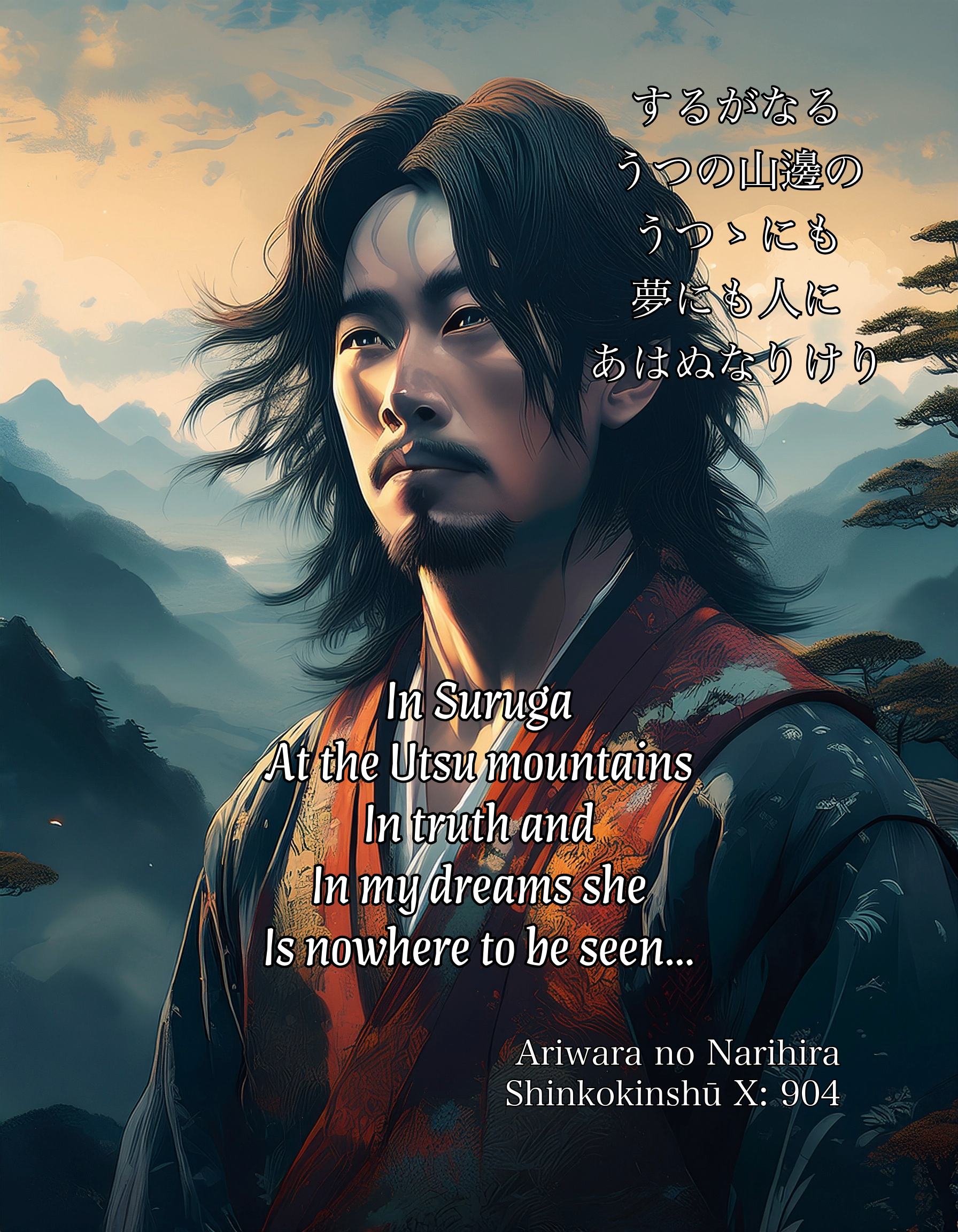
[i] See: While at Utsu Mountain in Suruga, he thought of someone he had been meeting and sent this to the capital. するがなるうつの山邊のうつゝにも夢にも人にあはぬなりけり suruga naru / utsu no yamabe no / utsutsu ni mo / yume ni mo hito ni / awanu narikeri ‘In Suruga / At the Utsu mountains / In truth and / In my dreams she / Is nowhere to be seen…’ Ariwara no Narihira (Shinkokinshū X: 904)
The Right find no faults with the Left’s poem. The Left merely say that the Right’s poem sounds old-fashioned [furumekashi].
Shunzei’s judgement: ‘The Left’s ‘I cannot dry my sleeves, on this lonely journey’ (sode hoshikanetsu aware kono tabi) has a strong sound of loneliness about it [sabite wa kikoehaberu], but there is a lack of anything connected to utsu no yama in this poem. In The Tales of Ise where it says ‘By Utsu Mount in reality‘ (utsu no yamabe no utsutsu ni mo), it does not seem that sleet was falling. If there is no reason for including utsu no yama to express the sense of sleet falling, there are many other places which could have been used to express a lonely journey. As there is no reason for including it, formally [sama de] there is a lack of connection to it. The Right’s katano no mino, too, as in the poem ‘To lend lodging to keep me dry, is there no one‘ is about hail, though hawking does take place there, so the poem does sounds slightly charming [sukoshi okashiku kikoyu]. Both Left and Right use utsu no yama and katano no mino, respectively, unnecessarily – anywhere would have done as well. Both poems are equal for this reason.’
Shunzei’s judgement: Both Left and Right seem superb in form and diction [sugata kotoba wa yoroshiku miehaberu], but the Right’s ‘cogon-grass grows’ (asaji tatsu) is pretentious [yauyaushiku], and I wonder what to make [ikaga to oboehaberu] of the final ‘wet with constant showers’ (uchishiguretsutsu), but the conception [kokoro] of the Left’s ‘Utsu Mountain’, with its ‘ancient ruins’ brought back to memory by ‘on the withered ivy leaves the winds of autumn a’blowing’, is particularly tasteful [en]. Thus, the Left certainly wins.