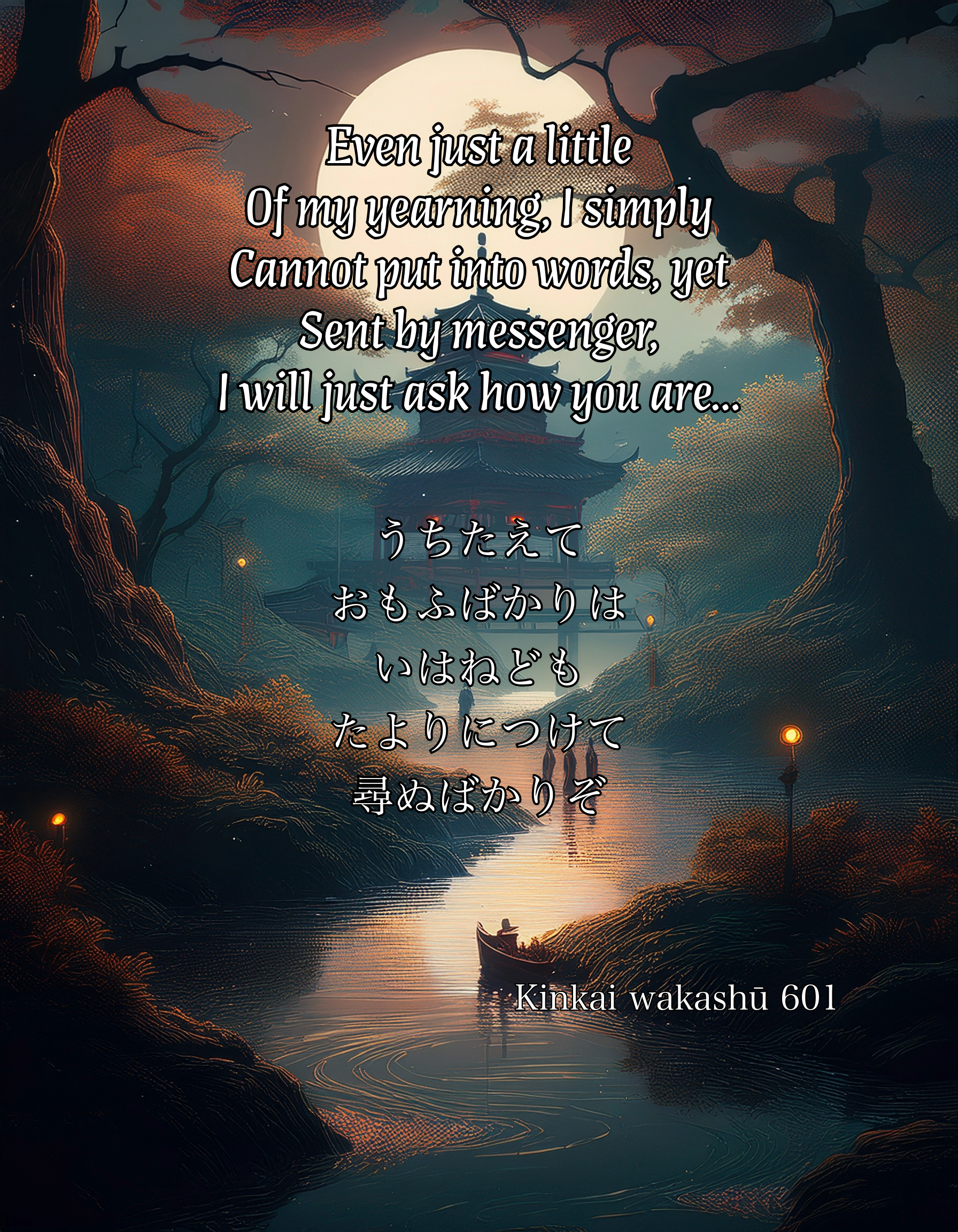
うちたえておもふばかりはいはねどもたよりにつけて尋ぬばかりぞ
| uchitaete omou bakari wa iwanedomo tayori ni tsukete tazunu bakari zo | Even just a little Of my yearning, I simply Cannot put into words, yet Sent by messenger, I will just ask how you are… |
601
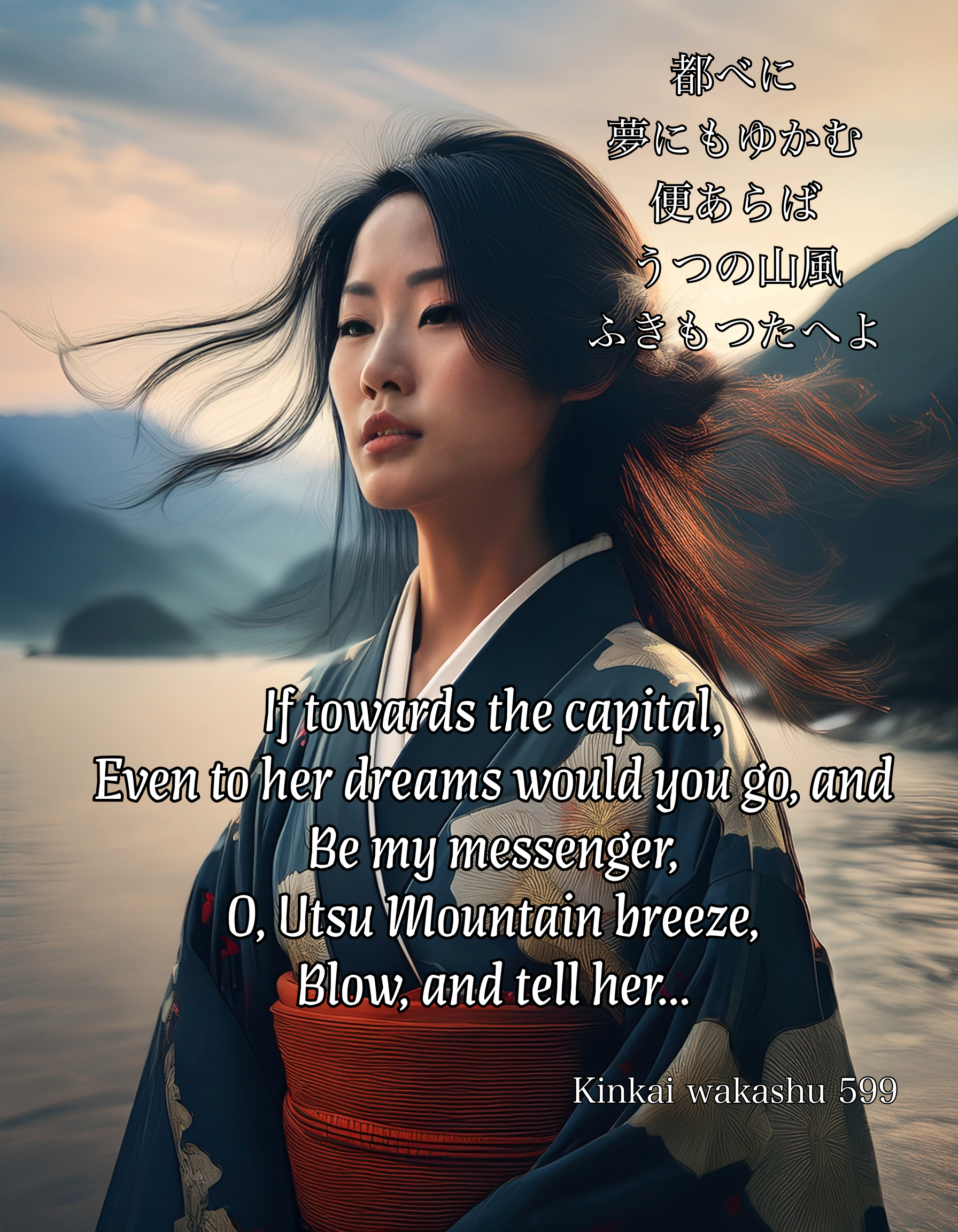
都べに夢にもゆかむ便あらばうつの山風ふきもつたへよ
| miyakobe ni yume ni mo yukamu tayori araba utsu no yamakaze fuki mo tsuteyo | If towards the capital, Even to her dreams would you go, and Be my messenger, O, Utsu Mountain breeze, Blow, and tell her…[i] |
599
[i] See: While at Utsu Mountain in Suruga, he thought of someone he had been meeting and sent this to the capital. するがなるうつの山邊のうつゝにも夢にも人にあはぬなりけり suruga naru / utsu no yamabe no / utsutsu ni mo / yume ni mo hito ni / awanu narikeri ‘In Suruga / At the Utsu mountains / In truth and / In my dreams she / Is nowhere to be seen…’ Ariwara no Narihira (Shinkokinshū X: 904)
I sent this to a lady after composing it.
春くれど人もすさめぬ山桜風のたよりにわれのみぞとふ
| haru kuredo hito mo susamenu yamazakura kaze no tayori ni ware nomi zo tou | The spring has come, yet There is no one to sing the praises of The mountain cherry blossom; A breeze-borne note Comes calling on my solitude. |

When he was passing the barrier at Shirakawa on the way to Michinoku.
たよりあらばいかでみやこへつげやらむけふしらかはの関はこえぬと
| tayori araba ikade miyako Fe tuge yaramu keFu sirakaFa no seki Fa koenu to | Had I but a messenger Somehow, to the capital I would send word— That today the Shirakawa Barrier I have passed through… |
Taira no Kanemori

On the conception of love, in a hundred poem sequence.
あふ事のむなしき空のうき雲は身をしる雨の便りなりけり
| au koto no munashiki sora no ukigumo wa mi o shiru ame no tayori narikeri | Meeting you is A vain hope—empty as the skies, where Drifting clouds are The rainfall of my misery’s Harbingers. |
Prince Kore’akira
惟明親王
An allusive variation on KKS XIV: 705.
Left (Tie).
戀しとは便りにつけていひやりつ年は返りぬ人は歸らず
| koishi to wa tayori ni tsukete iiyaritsu toshi wa kaerinu hito wa kaerazu |
I love you, I put in a letter, and Sent it off; The years have gone by, but He has not returned. |
A Servant Girl
875
Right.
遥かなり幾草枕結びてかその下紐の解けんとすらん
| harukanari iku kusamakura musubite ka sono shitahimo no token to sururan |
A great distance – How many times pillowed on the grass? Tied tight My under-belt – I wonder when I will undo it? |
Nobusada
876
The Right state: the Left’s poem seems comic. The Left state: the initial line of the Right’s poems does not seem to have much to say.
In judgement: I wonder if it really is comic? It’s just a poem in one particular style. The conception of the poem ‘I do not await / The new year, yet it is here; / The Winter plants’ is especially charming. As for the Right, the Gentlemen have stated that the first line ‘has nothing much to say’, but I feel it is appropriately placed. Furthermore, I wonder what to think about the final ‘my under-belt’ (sono shitahimo), but, then again, the configuration of ‘How many times pillowed on the grass’ (iku kusa makura) is evocative. The poems are comparable, and again, they tie. Alas, my judgement here suggests I know nothing of poetry. It is most difficult when one realises how times have changed. How sad it is…

