Topic unknown.
みなといづるあまのを舟のいかりなはくるしき物とこひをしりぬる
| minato iduru ama no wobune no ikarinaFa kurusiki mono to koFi o sirinuru | Leaving port, A fisher’s tiny boat Its anchor rope So painful it is To know passion’s yearning. |
Anonymous
Boats
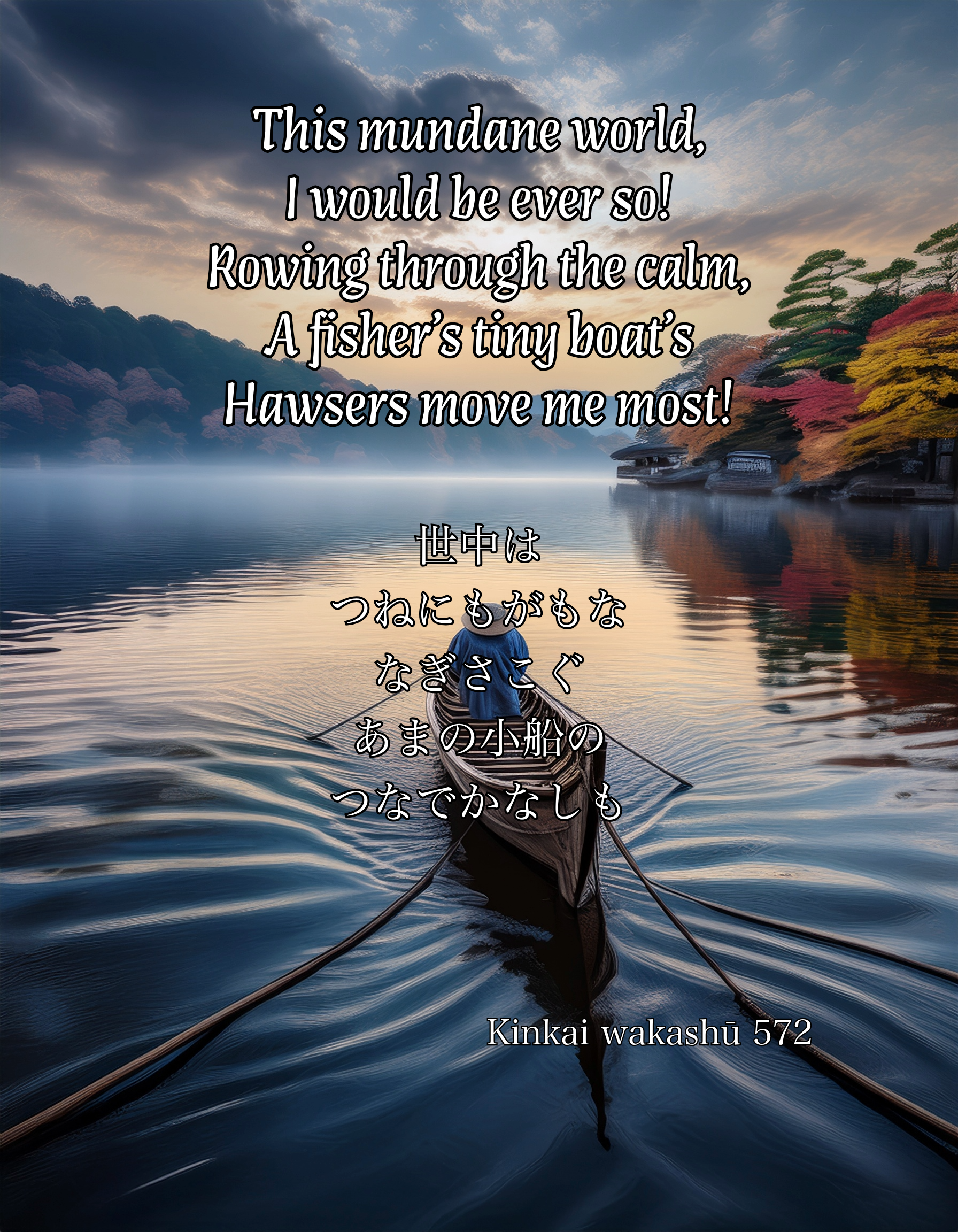
世中はつねにもがもななぎさこぐあまの小船のつなでかなしも
| yo no naka wa tsune ni mogamo na nagisa kogu ama no obune no tsunade kanashi mo | This mundane world, I would be ever so! Rowing through the calm, A fisher’s tiny boat’s Hawsers move me most! [i] |
572
[i] See: A poem from Michinoku. みちのくはいづくはあれどしほがまの浦こぐ舟のつなでかなしも michinoku wa / izuku wa aredo / shiogama no / ura kogu fune no / tsunade kanashi mo ‘O, Michinoku, / This may be true elsewhere, too, but / At Shiogama / Bay, a rowing boat’s / Hawsers move me most!’ Anonymous (Kokinshū XX: 1088)
Round Four
Left (M – Win)
水鳥の青葉の山やいかならん梢をそむる今朝のしぐれに
| mizutori no aoba no yama ya ika naran kozue o somuru kesa no shigure ni | Waterfowl fly above Aoba Mountain— O, what is to become Of the treetops dyed By this morning’s shower? |
Lord Akinaka
7
Right (T – Win)
かきくもり蜑の小ぶねにふく苫の下とほるまで時雨れしにけり
| kakikumori ama no obune ni fuku toma no shita tōru made shigureshinikeri | Clouds rake in above The fisher’s tiny boat— Through its rush-woven roof And even beneath A shower has fallen. |
Lord Michitsune
8
Toshiyori states: Continuing on from ‘Waterfowl fly above / Aoba Mountain’ with ‘the treetops dyed’ is simple and straightforward. The latter poem’s emphasis on the fisher’s tiny boat is an unexpected expression, yet because it is not a fault, I make this poem the winner.
Mototoshi states: saying ‘Waterfowl fly above / Aoba Mountain’ is extremely hackneyed, yet the poem of the Right has ‘Clouds rake in above / The fisher’s tiny boat— / Through its rush-woven roof’: both spring showers and summer ones, too, are not things which fall constantly, so it is difficult to believe that they could fall ‘even beneath’. So, I have to determine that a shower dyeing the treetops is a little better.


