Today, I paid a visit to the Royal Botanic Gardens at Kew, in London. My main purpose in going was to visit an exhibition there of Japanese botancical art, Flora Japonica, which has been running at their Shirley Sherwood Gallery. The exhibition ends on 5 March 2017, to be removed to Tokyo, I believe, so it was fortunate timing that I was able to be in London to see it (if you are interested in the contents, I recommend the accompanying catalogue, which is available for sale). Even more fortunate was that today was the day when a guided tour was offered about some of the objects from Kew’s Japanese collection, which are included in the exhibition.
 This tour ranged across early accounts of Japan’s botany by the likes of Engelbert Kaempfer (1651-1716) and Philipp von Siebold (1796-1866), pieces of demonstrative lacquerware which were produced in Japan, but exported to Britain to show how the manufacturing process was conducted, and some fascinating illustrated wooden panels – made from the wood of the trees pictured – produced to teach students about botany (if those sound interesting, I’m told that some other examples of them will be included in an upcoming exhibition in Manchester, Object Lessons). The tour was conducted by the knowledgeable Dr Mark Nesbitt, Curator of the Economic Botany Collection, although once it was discovered that I was a Japanese Studies expert, I was asked to add a few comments of my own! I hope that these were interesting to my fellow tour-members – I certainly found it interesting that one of the demonstration lacquer pieces was an illustration of Lady Yūgao from The Tale of Genji, gazing at the flower after which she is named.
As someone interested in Man’yō plants, however, it was a bit disappointing to see so few of them represented, although there were beautiful paintings of the Japanese Snowbell (ego-no-ki) and bush clover (hagi), as well as varieties of maple and wisteria (fuji). It shows, I think, how rare some of these plants have become, or how distant from contemporary Japanese awareness, and just serves to indicate what an important job of preservation the various Man’yō Botanical Gardens across Japan are doing.
After leaving the exhibition and gallery, I went to take a look at Kew’s Japanese Landscape, constructed around its Japanese Gateway. It’s perhaps a bit early in spring to see this at its best, as I noticed the trees were coming into bud, but not bloom yet. Again, as a waka-lover, I felt somewhat mixed feelings on seeing a haiku on display, but no tanka, and again, Man’yō plants in short supply – although its entirely possible I missed some out of ignorance.
Still, that’s not to say there weren’t some beauties present. The blooms here caught my eye, particularly liking the contrast between the white flowers and the brown and green of the bud-cases below them.
Similarly, the tiny splashes of scarlet amongst all the greenery drew my eye to these, although my poor photographic skills do not do them justice.
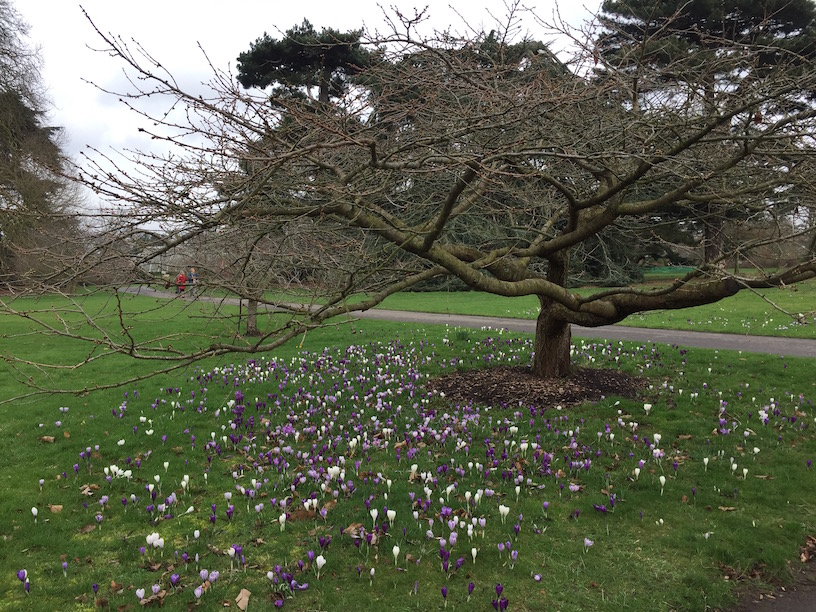
But for all that, Kew is, of course, a British garden, and it was a pleasure to see the carpets of crocus spread out at the feet of trees, announcing the coming of the new season to all and sundry.
It makes me look forward to seeing the Japanese spring once again, when I visit the country in a few week’s time. While I’m going for work reasons unrelated to poetry, or botany, I’m hoping to spend a few free moments looking at cherry blossom, and thinking of times gone by…