Tag Archives: naniwagata

Wake’ikazuchi-sha uta’awase 09

Round Nine

Left

さほ姫の霞の衣おりてけりあそぶいとゆふたてぬきにして

saohime no
kasumi no koromo
oritekeri
asobu itoyū
tatenuki ni shite
Princess Sao
Of mist a gown
Has woven;
The threads of haze
Make the warp and weft…

Naganori
17

Right

難波がたかすみたな引く春の夜は澳こぐ舟のみえみみえずみ

naniwagata
kasumi tanabiku
haru no yo wa
oki kogu fune no
mie mizu mi
At Naniwa Inlet
The haze lies o’er all
On a night in springtime
Boats rowing into the offing
Appear and disappear…

Narinaka
18

The Left’s haze, the conception of ‘threads of haze make the warp and weft’, puts me in mind of the line ‘touching the sky, they weave and set adrift their emerald netting of silk’, [1]and mentioning Princess Sao seems skillful; the poem is entrancing and charming. As for the Right, the configuration of saying ‘a boat rowing out into the haze of Naniwa Bay’, too, this entrances me so much that it’s something I would wish to show to folk with some sensitivity. I don’t feel there’s much between these, so, once more the round ties.


[1] The translation here comes from Rimer and Chaves (1997, 33) translation of a Sinitic poem in Wakan rōeishū (I: 22).

Chūgū nyōbō uta’awase 1

難波潟漕げど小舟は葦わかのえざるほどこそ久しかりけり

naniwagata
kogedo obune wa
ashiwaka no
ezaru hodo koso
hisashikarikeri
Through Naniwa Inlet
I row, yet my little boat
The reed shoots
Cannot navigate—the time
Lasts forever![i]

1[ii]


[i] This poem is an acrostic containing the hidden expression kanoesaru 庚申 (‘senior metal monkey’), which was the fifty-seventh in the Sinitic calendrical cycle. The Sino-Japanese reading of 庚申 is kōshin, and it was every sixty days when kanoesaru came up that kōshin was observed by Heian aristocrats (and others). Motozane cleverly works the reference into his poem, with the final line referring to how the time dragged when one had to stay up all night.

[ii] Motozane-shū (60) with the additional headnote (topic), ‘Kōshin’.

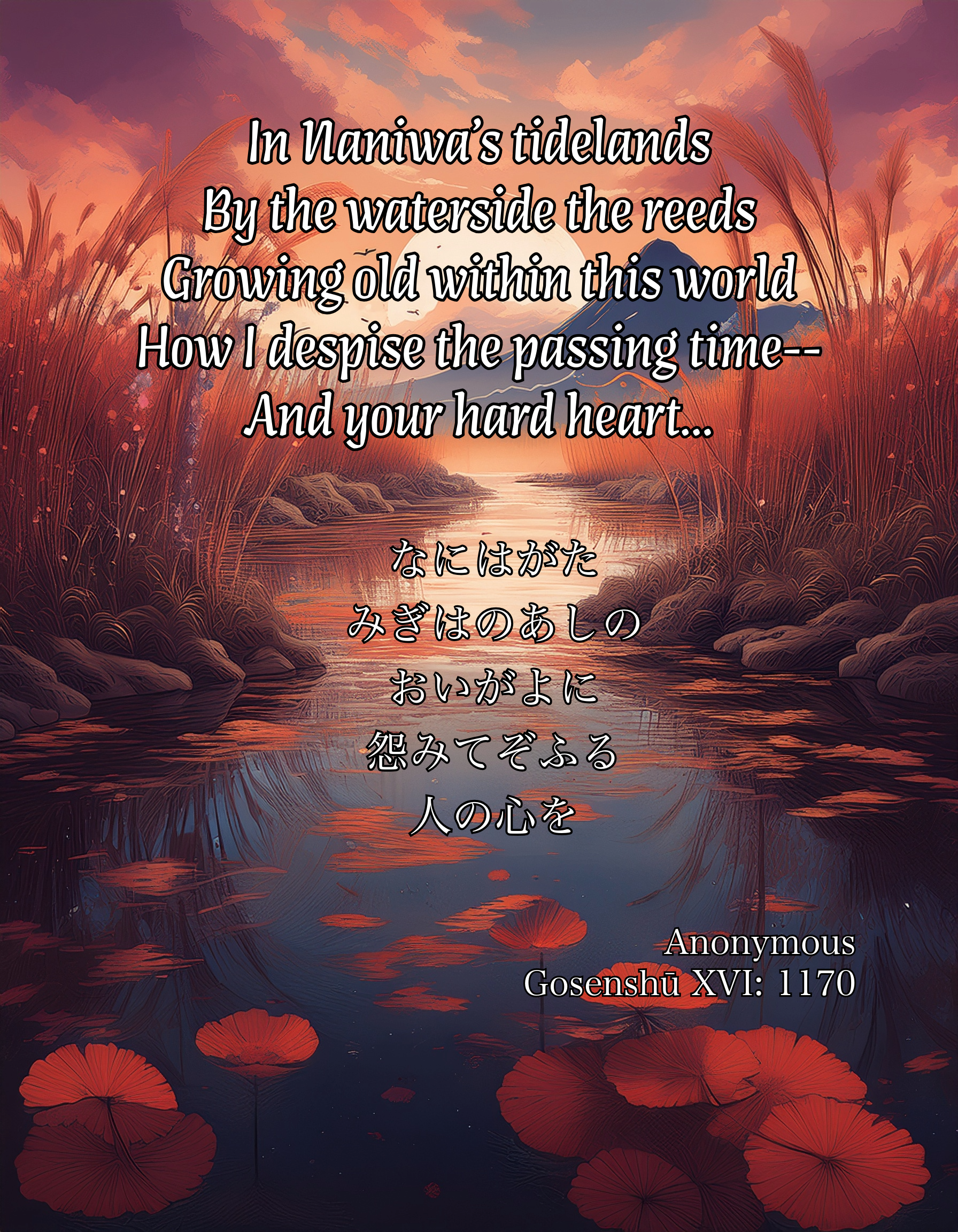
GSS XVI: 1170

When the heart of a woman whom he had been visiting frequently showed no sign of melting, he sent this to her to say that months and years had passed and they were still in such a state.

なにはがたみぎはのあしのおいがよに怨みてぞふる人の心を

naniFagata
migiFa no asi no
oFi ga yo ni
uramite zo Furu
Fito no kokoro wo
In Naniwa’s tidelands
By the waterside the reeds
Growing old within this world
How I despise the passing time–
And your hard heart…

Anonymous

Kinkai wakashū 563

なにはがたみぎはのあしのいつまでかほにいでずしも秋を忍ばん

naniwagata
migiwa no ashi no
itsu made ka
ho ni idezu shimo
aki o shinoban
In Naniwa’s tidelands,
By the waterside reeds
How long must I
Refrain from bursting out, and
Repress the surfeit of it?[i]

563


[i] See: When the heart of a woman whom he had been visiting frequently showed no sign of melting, he sent this to her to say that months and years had passed and they were still in such a state. なにはがたみぎはのあしのおいがよに怨みてぞふる人の心を naniwagata/ migiwa no ashi no / oi ga yo ni / uramite zo furu / hito no kokoro o ‘In Naniwa’s tidelands / By the waterside the reeds / Growing old within this world / How I despise the passing time– / And your hard heart…’ Anonymous (Gosenshū XVI: 1170)

Sumiyoshi-sha uta’awase kaō ni-nen 43

Round Eighteen

Left (Tie)

なにはがたあしのまろやのたびねにはしぐれはのきのしづくにぞしる

naniwagata
ashi no maroya no
tabine ni wa
shigure wa noki no
shizuku ni zo shiru
In Naniwa’s tidelands,
In a reed-roofed hut,
Dozing on my travels—
A shower by the eaves
Dripping droplets is revealed!

Lord Tsunemori
85

Right

つのくにのこやのたびねにしぐれしてなにかはもらむあしのやへぶき

tsu no kuni no
koya no tabine ni
shigureshite
nani ka wa moramu
ashi no yaebuki
In the land of Tsu
In Koya, in a hut dozing on my travels
During a shower—
Will anything drip through
My roof’s eightfold thatch?

Lord Yorisuke
86

Both Left and Right are set in a traveller’s lodge in Sesshū province, but the Left appears to lack configuration and conception, it has long been said that using four of the character in a poem in a poetry match is a fault, but it does not sound to me as if the four uses of no here are a particular problem. With that being said, starting with ‘dozing on my travels’ [tabine ni wa]and then having ‘a shower by the eaves’ [shigure ni wa] uses wa twice and this seems to sound a bit discordant. The Right, while it refers to the same sort of shower from a cloudless sky, starts with ‘during a shower’ and follows this with ‘will anything drip through?’, which seems to sound a bit contradictory. I can’t help but feel it would have been better had it been ‘even though it showers’ and then had ‘will anything’. However, both poems are about reed roofed huts during a shower and it really is difficult to distinguish between them. Thus, I make this a tie.