ukibito o wasurehatenade wasuregawa nani tote taezu koi wataruran
That cruel girl I am unable to ever forget, Even by Wasure—Forgetting—River Why is it that endlessly My love continues on?
Lord Tadafusa 67
Right
恋すてふこひはこれにて限りてん後にもかかる物をこそおもへ
koisu chō koi wa kore nite kagiriten nochi ni mo kakaru mono o koso omoe
Love, they say, Of love right here Let’s make an end! But later, still such Painful feelings will I have…
Lord Munekuni 68
Toshiyori states: the first poem has nothing special about it—poems of this quality are unremarkable. The later poem says, ‘Of love right here / Let’s make an end!’—is it saying that the poet will fall in love with someone else? It’s difficult to say that he’d do that from the following day. It’s vague and doesn’t sound clear. These poems are of the same quality, aren’t they.
Mototoshi states: while neither of these has any faults, the Right’s ‘right here let’s make an end’ seems particularly undesirable. ‘Why is it that endlessly’ is slightly more poetic in the current context, I feel.
au koto no ima wa katano to narinureba kari ni toikoshi hito mo toikozu
Meeting Now hard as crossing Katano Has become, so he who once Briefly hunted me out Never comes to call.
Lord Michitsune 65
Right (T – Win)
おさふればあまる涙はもる山のなげきにあたる雫なりけり
osaureba amaru namida wa moruyama no nageki ni ataru shizuku narikeri
I hold them in, but, Overflowing, my tears Drip down—on Mount Moru Gathering kindling—grief is plain In every droplet.
Lord Tadataka 66
Toshiyori states: the first poem says ‘hard as crossing Katano has become’, but emphasizes that the lover did come briefly. It’s a mistake to then say that he ‘never comes’. The second poem has ‘Overflowing, my tears / Drip down—on Mount Moru’—it’s certainly not the case that feeling is lacking in the conception here, and it does sound like this is what one feels, so it’s not difficult at all to say this is the winner.
Mototoshi states: neither of these poems has any particular faults or anything outstanding between them, but that there is no one to visit the poet briefly appears, at present, to be slightly more desolate.
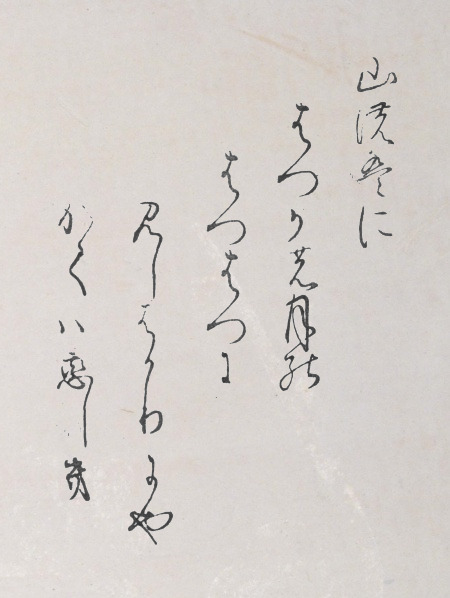
yama no ha ni hatsuka no tsuki no hatsuhatsu ni mishi bakari ni ya kaku wa koishiki
By the mountains’ edge The Twentieth’s moon Just for a moment Did I simply see, so how Am I so in love?
Lord Morikata 63
Right
恋すてふ皆人ごとにとひみばやいと我ばかりあらじとぞおもふ
koisu chō mina hito goto ni toimiba ya ito ware bakari araji to zo omou
Saying they are in love— To all those folk Would I enquire, for Surely, I, alone Do not endure such feelings?
Lord Nobutada 64
Toshiyori states: I may be mistaken, but I get the feeling the first poem resembles an earlier work, with only the ending changed somewhat. The second poem sounds stilted. They are of the same quality.
Mototoshi states: the poem of Left lacks originality, being based earlier poems from the emergence ‘the Twentieth’s moon’ at the beginning, then continuing with ‘for coarse cloth a bobbin turning’ and then finally ‘here at Isonokami, in the ancient’ at the end, yet this is more poetic than ‘To all those folk’, so this is still win for the Left.
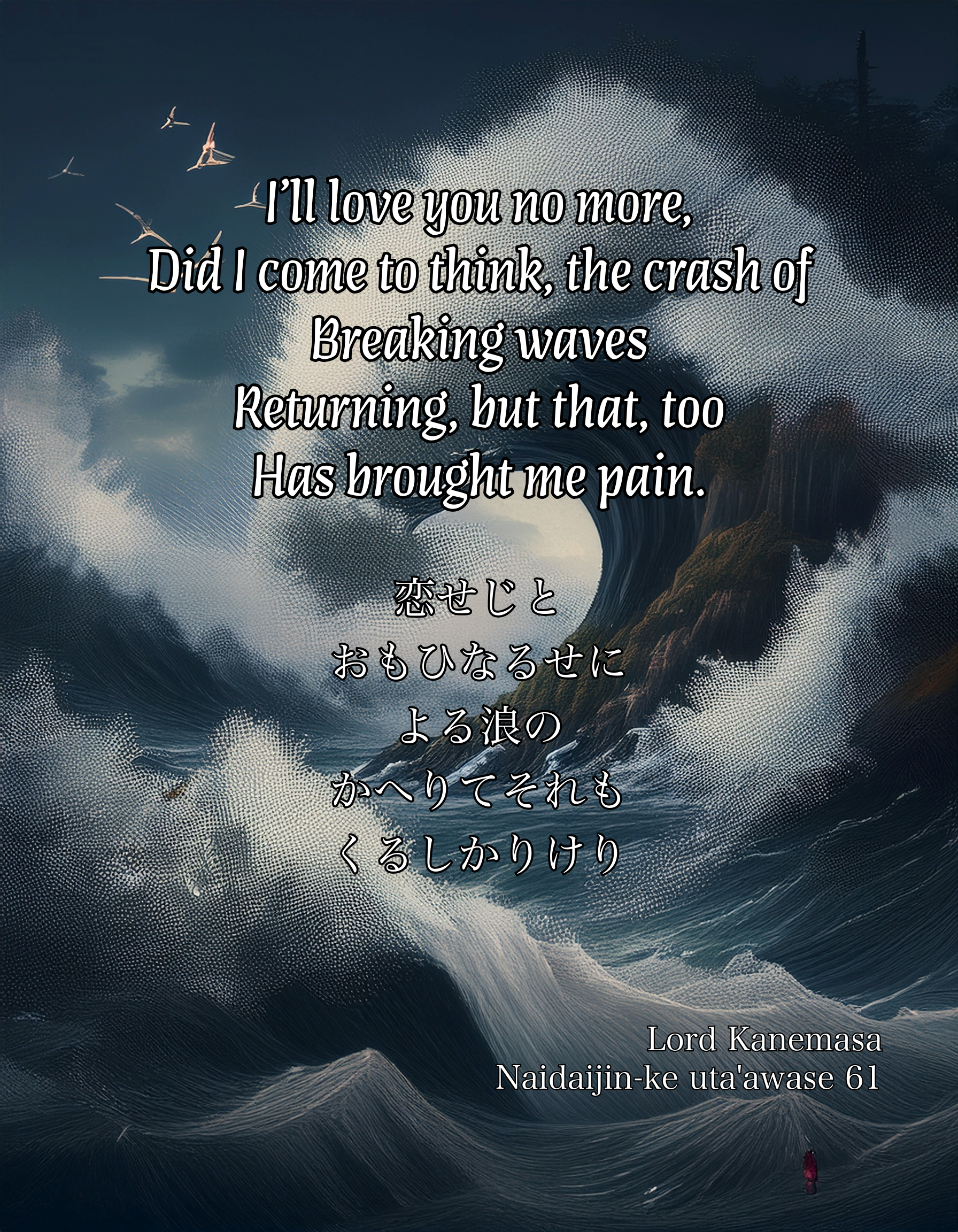
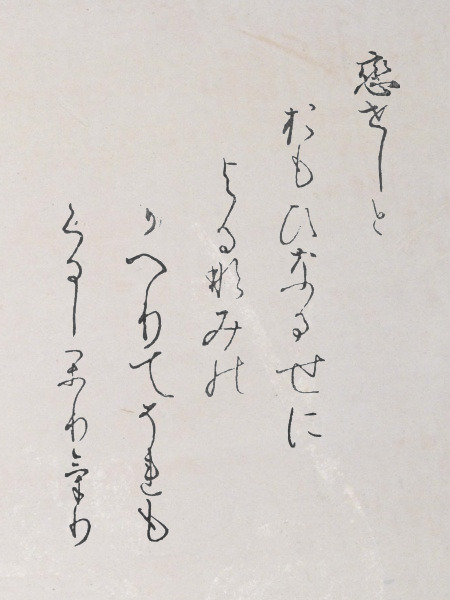
koiseji to omoinaru se ni yoru nami no kaerite sore mo kurushikarikeri
I’ll love you no more, Did I come to think, the crash of Breaking waves Returning, but that, too Has brought me pain.
Lord Kanemasa 61
Right (Both Judges – Win)
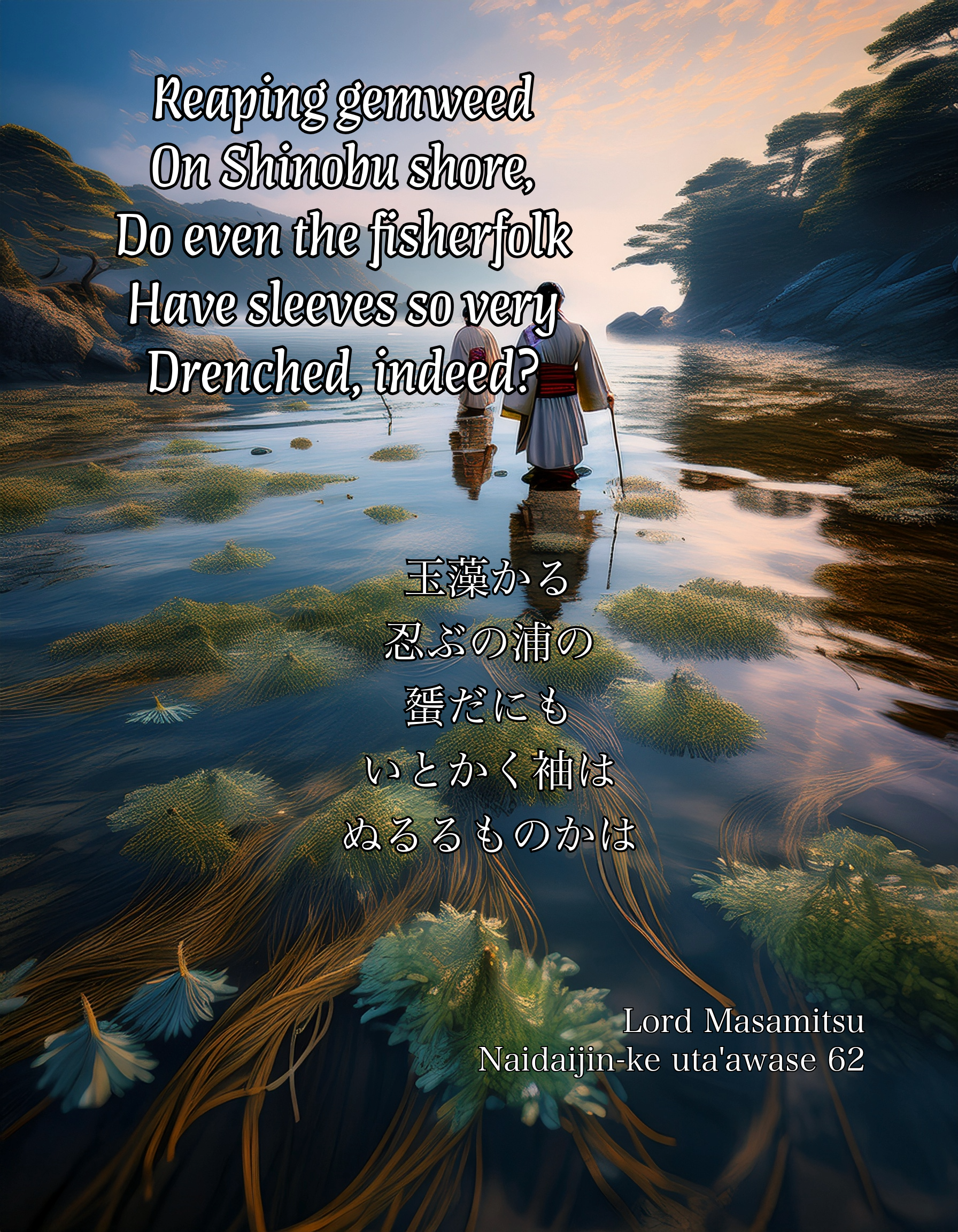
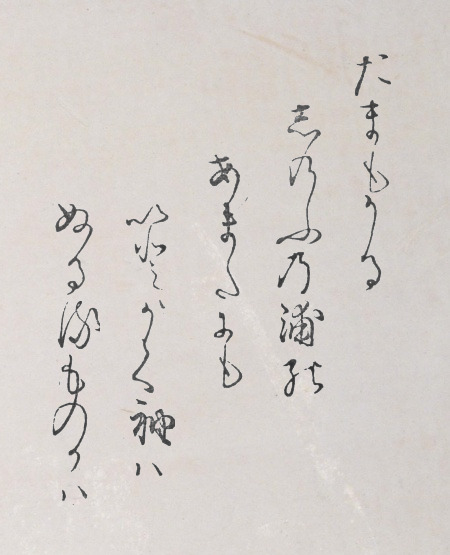
玉藻かる忍ぶの浦の蜑だにもいとかく袖はぬるるものかは
tamamo karu shinobu no ura no ama dani mo ito kaku sode wa nururu mono ka wa
Reaping gemweed On Shinobu shore, Do even the fisherfolk Have sleeves so very Drenched, indeed?
Lord Masamitsu 62
Toshiyori states: both of these are charming, however, a line from a famous poem is used for as the initial section, and in such cases the new poem should not closely evoke the source. Someone once said something similar, a long time ago. It’s a bit inferior, isn’t it.
Mototoshi states: neither of these contain any errors, yet the section following the central ‘crash of / Breaking waves’ seems intermittently painful, with sleeves damper than those of the fisherfolk on Shinobu shore. It seems a bit better at present.
tsurenasa no tameshi wa ta zo tare nite mo hito nagekasete hate wa yoshi ya wa
For cold cruelty Who is your exemplar? Whoever it might be, Is causing one such grief A good thing, in the end?
Lord Morotoshi 57
Right (M – Win)
逢ふ事をまつの汀に年ふればしづえに波のかけぬ日ぞなき
au koto o matsu no migiwa ni toshi fureba shizue ni nami no kakenu hi zo naki
For a meeting Pining by the waters’ edge As the years go by— Lower boughs by waves Washed not on any day, at all…
Lord Sadanobu 58
Toshiyori states: it is impossible to say that that the configuration and diction of the first poem is anything special. In the second poem, ‘For a meeting / Pining by the waters’ edge’ has poetic qualities, but continuing with ‘Lower boughs by waves / Washed not on any day, at all’ does not seem like a love poem, and if the poet had wanted to allude to tears here, well, it just doesn’t sound like it, does it. The Left has the conception of a Love poem, but it language lacks elegance; the Right is smooth, but has only a faint conception of love, and thus these tie.
Mototoshi states: this poem’s diction is particularly bizarre. What an objectionably unpleasant feeling of love! One does see this in the passage giving the reply by Nakatomi no Tokuin, and then there seems to have been the poem ‘go on then, you creeper’, but that one continues extremely charmingly, while this sounds ghastly. Then ‘For a meeting / Pining by the waters’ edge’, truly is a charming composition, and the subsequent ‘Lower boughs by waves / Washed not on any day, at all’ seems entirely clear. It seems to approach the quality of Komachi’s poem, to me! This is a win for the Right, I have to say.
koiwaburu kimi ga kumoi no tsuki naraba oyobanu mi ni mo kage wa mitemashi
So cruel in your love, My lord, above the clouds The moon were you, then Though it reaches me not I wish your light to see…
Lady Kazusa 55
Right
いのるらん神のたたりはなさるとも逢ふてふ事に身をばけがさじ
inoruran kami no tatari wa nasaru tomo au chō koto ni mi oba kegasaji
You seem to pray for it, and Even should a deity’s taboo This break, A meeting Would be no pollution, I feel…
Lord Akinaka 56
Toshiyori states: the first poem makes a person into the moon, and is different in sense from the poem in the Tentoku poetry match which also uses ‘Though it reaches me not’. The second poem appears to be one written after becoming close to another—if that’s what the composition is about, then it should include an element from a prior poem for precedent. Then again, one could compose like this as a response to a prayer received from a man’s residence, in which case it would resemble something sent between people who have yet to meet. It loses.
Mototoshi states: saying ‘My lord, above the clouds / The moon were you, then’ appears an elegant sequence. I wonder if it was composed with the poem by Nakatsukasa in a poetry match in Tenryaku, where she uses ‘above the clouds, the moon’? While the ‘beloved light’ in this poem is very well depicted, here the diction seems stilted. As for the Right, up to ‘You seem to pray for it, and /Even should a deity’s taboo’ is acceptable, but ‘A meeting / Would be no pollution, I feel’ is extremely difficult to understand. Would a meeting, of whatever sort, be a cause of pollution? It really makes me feel as if something like ‘ditch’ was going to be dropped in! Neither has a charming conception, yet ‘above the clouds, the moon’ is slightly better in the present context.
iwanuma no shitahau ashi no ne o shigemi himanaki koi o kimi shirurame ya
Silently beneath the marsh rocks Creep the reeds’ Roots in such profusion, Not a space free from love, but Does my lady know, I wonder?
A Court Lady 53
Right
身をつみて思ひや知るとこころみにながためつらき人もあらなん
mi o tsumite omoi ya shiru to kokoromi ni na ga tame tsuraki hito mo aranan
Pinching flesh, Would you know passion’s fire? To test it, I wish For you there was a cruel One, too…
Lord Masakane 54
Toshiyori states: the first poem is extremely charming. It seems to have no faults to mention. In the second poem, ‘For you there was a cruel one’ would be something quite impolite if said by a woman. Court ladies may lose their composure, yet they still appear to speak with dignity. In the absence of a prior poem as precedent, the first poem should win, I think.
Mototoshi states: this poem seems to have no faults to mention, and of the two, ‘beneath creep the reeds’ seems a bit more gently refined at present.
kuchi oshi ya kumoigakure ni sumu tatsu mo omou hito ni wa miekeru mono o
How bitter am I! Hidden ‘mongst the clouds Dwell dragons—even they To one thinking fondly of them Do appear, yet…
Lord Toshiyori 51
Right (M – Win)
かつみれど猶ぞ恋しきわぎもこがゆつのつまぐしいかでささまし
katsu miredo nao zo koishiki wagimoko ga yutsu no tsumagushi ikade sasamashi
I have seen her once, yet Even more desirable is My darling girl— As a fine comb How would I wear her in my hair?
Lord Mototoshi 52
Toshiyori states: the first poem is one which appears to be incomprehensible to a particularly limitless extent. In the second poem, the ‘fine comb’ referred to is the one which Susanoo transformed Princess Inada and placed in his divine locks upon their first meeting. This poem has ‘I have seen her once’ and thus appears to have a conception that they have already met. The final section has ‘How would I wear her in my hair?’, which makes it seem that the comb has yet to be placed there. This appears to differ from the original tale. One could ask the poet whether he has mistaken this ancient tale—perhaps he has simply remembered it wrong? It’s not possible to decide upon a winner or loser.
[N.B.: Mototoshi mistakes Toshiyori’s use of tatsu (‘dragon’) for tazu (crane)—the two words were written identically. Toshiyori didn’t bother to correct him at the time of the match, but when Tadamichi asked for judges’ thoughts in writing after the event, he simply wrote, ‘It’s not a crane, but a dragon!’]
Mototoshi states: composing ‘how bitter am I’ and suchlike is something which I have yet to encounter in a poem in a poetry match. Someone said long ago that in both the poems of Yamato and Cathay one should select diction as fruit develop from blossom, and bearing that in mind, well, I have never seen such diction used in many personal collections and poetry matches and, it goes without saying, certainly not in the initial section. On the matter of ‘hidden ‘mongst the clouds dwell cranes’: this is something which has yet to appear in poetry. I wonder whether it appears in texts from Cathay? Possibly composed on the conception of ‘cranes crying beneath the sun’ in the Account of the World? The subsequent line should be ‘clouds spread broadly blue I see cranes so white’. It seems to be saying ‘flying hidden in the clouds’—meaning that cranes should live in the clouds. The cocks of Huainan entered the clouds—again, maybe that is a reference to cranes? Moreover, in Master Fu Qiu’s Classic on the Aspect of Cranes it states that cranes, at the age of one hundred and eighty years, come together as males and females for mating—if that is the case, then how does this relate to human beings? Furthermore, I feel the poem is illogical in the absence of a location where they could live, hidden in the clouds. Overall, this poem has an inappropriate conception and diction, too. The poem of the Right has no errors of diction and its tone is not that bad, so perhaps it would not be mistaken to say it’s a little superior.
taezu taku muro no yashima no keburi ni mo nao tachimasaru koi mo suru kana
Endlessly kindled, At Muro no Yashima The smoke Yet rising more Is my love for you!
Lady Settsu 49
Right (M – Win)
杯のしひてあひみむとおもへども恋しきことのさむるよもなき
sakazuki no shiite aimimu to omoedomo koishiki koto no samuru yo mo naki
Over a cup of wine To press you to meet I thought, yet My love for you Will never cool in this world!
Lord Akikuni
50
Toshiyori states: the first poem’s ‘endlessly kindled’ is an error. Fires are not actually kindled at Muro no Yashima—vapour rising from clear waters in the land appears to be smoke, so I wonder about the use of ‘kindled’ in this context. Nevertheless, if one was referring to real smoke, why wouldn’t you compose in this way? The tone of the poem isn’t bad. The second poem is an interesting display of technique, but it doesn’t appear that one would have to compose like this. Saying ‘cup’ leads to ‘wine’ and emphasises the drinking of it, but then if there were no wine and no drinking, how could one press someone to do something? In addition, I wonder whether it’s appropriate to begin with ‘cup’? This is an excess of technique over substance. The Left is more poetic, so I say it’s the winner.
Mototoshi states: what are we to make of ‘Endlessly kindled, / At Muro no Yashima / The smoke’? And what do the fires kindled at this location resemble? There are two senses of ‘Muro no Yashima’: one is a location in Shimotsuke; the second refers to people’s dwellings—we know from earlier treatises that forges are described as ‘Muro’. Which of these two senses is being used here? Whichever it is, ‘endlessly’ does not appear to have been previously associated with either of them. For example, there’s Koreshige’s poem:
風ふけば室のやしまの夕煙心のうちに立ちにけるかな
kaze fukeba muro no yashima no yūkeburi kokoro no uchi ni tachinikeru kana
When the wind blows Across Muro no Yashima At eventide as smoke, Within my heart, My passion soars…
It does not appear that the smoke rises endlessly here. Exemplars of endlessly rising smoke are the peak of Asama, or Mount Fuji, and these seem to have long been the subject of compositions. It seeming that this poem sought to express the essential meaning of ‘endlessly kindled’, such enquiries need to be made and, if I may be so bold, do not appear, do they? The Right’s poem has ‘Over a cup of wine / To press you to meet / I thought, yet’—while the conception of ‘press’ here sounds extremely unusual, what does it mean that ‘My love for you / Will never cool in this world’? It seems that ‘cool’ as a piece of diction is being used to make drunkenness a metaphor for being in love. If that’s the case, then, well, there are many foundational texts on this. So, even if one gets drunk, what then happens? Is there a world where this never ‘cools’? There was the case of man in Cathay who spent a thousand nights drunk, but that was only three years and not without end. In the sutras there is the drunkenness of ignorance and that might be a world in which one would not find sobriety, but there is no way to make this applicable in this poem. It is a little better than the Left poem’s endless kindling and extremely charming.