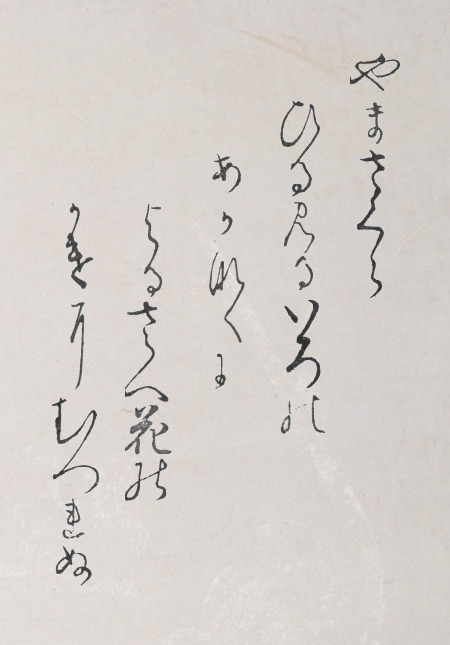
Category Archives: 1101-1150

Eien narabō uta’awase 06

Round Six

Left (Win)

やへざくらふるきみやこににほへどもふりずもはなのめづらしきかな

yaezakura
furuki miyako ni
nioedomo
furizu mo hana no
mezurashiki kana
Eightfold cherry
Around the ancient capital
Does glow, yet
Unfallen and anew, the blossoms
Are remarkable!

Cell of Fragrant Cloud
11

Right

みやこいでてかりそめにこし山ざとの花に心のからめられぬる

miyako idete
karisome ni koshi
yamazato no
hana ni kokoro no
karamerarenuru
Departing the capital
On occasion I make my way
To a mountain retreat where
The blossoms my heart
Have entangled.

Cell of Compassionate Light
12

The Left’s poem is a clear example of the overlayed diction fault. As for the Right’s poem, saying ‘have entangled’ is extremely overblown diction. Whatever sort of poem it might be, this expression would be unacceptable, wouldn’t it! Was this, perhaps, composed with an imperfect understanding of the Kawara Minister’s poem? That goes ‘For the scented / Breeze has yet to blow…’[1] Perhaps this is a misreading of a character in the poem’s text?[i] The Left has the fault of overlayed diction, and the Right…[ii]

The Left’s poem is extremely charming. I do have to say that having both ‘ancient’ (furuki) and ‘unfallen’ (furizu) is a fault and yet, this should not be criticized excessively. The poem of the Right’s ‘On occasion I make my way’, too, does not seem as if the poet is visiting the blossom, and so is lacking in sentiment. The concluding ‘have entangled’ is a piece of overblown diction, although it is not the case that it does not appear in prior poetry,[2] but I still feel that it grates on the ear a bit.


[1] When he participated in an archery display, during the reign of the Jōgan emperor [Seiwa]. けふ桜しづくにわが身いざぬれむかごめにさそふ風のこぬまに kyō sakura / shizuku ni wa ga mi / iza nuremu / kagome ni sasou / kaze no konu ma ni ‘Today let cherry blossom / Droplets my body / Drench! / For the scented / Breeze has yet to blow…’ The Kawara Minister of the Left (GSS II: 56)

[2] 美知乃倍乃 宇万良能宇礼尓 波保麻米乃 可良麻流伎美乎 波可礼加由加牟 michi no e no / umara no ure ni / haomame no / karamaru kimi o / hagareka yukamu ‘At the roadside / The briar rose tips / By bean vines / Are entangled, but from you / My love, I must depart…’ Hasetsukabe no Tori (MYS XX: 4352)


[i] Mototoshi is suggesting that Sōen has misread kagome かこめ in Minamoto no Tōru’s famous earlier poem as karame からめ, which would have been possible if reading a handwritten text.

[ii] There is a lacuna in Mototoshi’s judgement here, but it is clear from what he has said that he disapproved of both poems this round and so it would have been a tie.

Eien narabō uta’awase 05

Round Five

Left (Win)

さくらやまはなのさかりに風ふけばこずゑをこして白波ぞたつ

sakurayama
hana no sakari ni
kaze fukeba
kozue o koshite
shiranami zo tatsu
On the mount of Cherries
So fine is the blossom that
When the wind does blow,
Passing o’er the treetops,
Whitecaps arise!

Controller’s Graduate
9

Right

この春ははなにこころのあくがれてこのもとにてもくらしつるかな

kono haru wa
hana ni kokoro no
akugarete
ko no moto nite mo
kurashitsuru kana
This springtime
By the blossoms my heart
Is captivated, and
Beneath the trees
Does dwell!

Kerin’in Graduate
10

Both Left and Right, in terms of diction, tone and style are superb with no faults at all. Thus, this is a tie.

The final section of the Left’s poem lacks fluency, yet it has conception. As for the Right’s poem, in order for one’s heart to be captivated by the blossom on every single treetop, one would need to be walking around. If one is resting peacefully beneath the trees, then one should say that one’s heart is captured. This section sounds erroneous, so the Left should win.

Eien narabō uta’awase 04

Round Four

Left (Win)

春の日をなほながかれとおもふかなはな見ることのあかぬこころは

haru no hi o
nao nagakare to
omou kana
hana miru koto no
akanu kokoro wa
O, let the days of spring
Still linger lengthily on,
I wish! For
Gazing on the blossom
Has yet to sate my heart…

Cell of the Fragrant Elephant
7

Right

ことしもやあだにちりぬる山ざくらさもあさましきはなのくせかな

kotoshi mo ya
ada ni chirinuru
yamazakura
sa mo asamashiki
hana no kuse kana
This year, too, will
You swiftly scatter,
O, mountain cherry?
That is a wretched
Habit blossoms have!

Cell of the Everlasting Truth
8

The poem of the Left’s final section is that of a pre-existing older poem.[i] The poem of the Right’s final section is deplorable. Even so, I make the Right the winner.

Both Left and Right are elegant. With that being said, the Left also sounds charming, while the Right’s concluding ‘habit!’, although it is not a major fault, grates on the ear a bit. This is another win for the Left.


[i] The ending of this poem in the texts of this match with Mototoshi’s judgements is different, with the final line being akanu kagiri wa (‘have yet to sate’). This means it closely resembles: Topic unknown. ゆきとまるところぞはるはなかりける花に心のあかぬかぎりは yukitomaru / tokoro zo haru wa / nakarikeru / hana ni kokoro no / akanu kagiri wa ‘To go and stay / A place in springtime / Have I none / For the blossoms, my heart / Have yet to sate completely.’ Sugawara no Tamenobu (GSIS I: 90). Kubota et al. (2018, 223) suggest that as we know that the version of the match that Toshiyori judged was produced later, this poem may have been revised in the light of Mototoshi’s judgement.

Eien narabō uta’awase 03

Round Three

Left (Win)

うきよにもはなのさかりになりぬればものおもふ人はあらじとぞ思ふ

ukiyo ni mo
hana no sakari ni
narinureba
mono’omou hito wa
araji to zo omou
Even in this cruel world
The blossoms in profusion
Are, so
Folk sunk in gloomy thought
Are there likely not a one, I feel!

Retired from the world on Mount Uji
5

Right

ちらざらむことこそはなのかたからめわびてはさてもしばしあらなむ

chirazaramu
koto koso hana no
katakarame
wabite wa sate mo
shibashi aranamu
Not to scatter
For the blossoms is a thing
So hard—
It may be painful, but still
I would have them stay a while.

Senior Assistant Minister Past Lecturer
6

I fail to understand—at all—why there should be a large number of people for whom the world is cruel. This is deeply unpleasant. In connection with this there’s an older poem which says ‘innumerable, my sorry self alone has caused these woes’.[i] The poem of the Right has ‘It may be painful, but still / I would have them stay a while’—if the blossoms have not yet scattered, then how can this still be painful? I cannot grasp the diction and reasoning of these two poems, so they tie.

The poem of the Left has some conception—it appears to be expressing sentiments that are natural. It’s extremely charming how it links with the conception of the old expression ‘the heart of spring’.[ii] However, the diction ‘feel/think’ [omou] appears in two places. I do feel that in terms of the sequencing of the phrasing, that’s certainly how it is, so it’s not a fault as such, but I would have preferred to see the second usage at the beginning of its line. As for the poem of the Right, from ‘painful’ to the end, it is immature. It doesn’t sound like a poem and resembles prosaic speech. Thus, I have to say the Left is the winner.


[i] Mototoshi appears to be misremembering this poem: Topic unknown. おほかたのわが身ひとつのうきからになべての世をも怨みつるかな ōkata no / wa ga mi hitotsu no / uki kara ni / nabete no yo o mo / uramitsuru kana ‘In general / My sorry self, alone, / Has caused these woes, but / Still all of this common world / I do despise!’ Tsurayuki (SIS XV: 953).

[ii] Toshiyori is referring to this poem from Kokinshū here: Composed at the Nagisa Palace when he saw the cherries in bloom. 世中にたえてさくらのなかりせば春の心はのどけからまし yo no naka ni / taete sakura no / nakariseba / haru no kokoro wa / nodokekaramashi ‘If, in this world of ours / All the cherry blossom / Disappeared / The heart of spring / Might find peace.’ Ariwara no Narihira (KKS I: 53).

Eien narabō uta’awase 02

Round Two

Left

をちこちのちるはなごとにたぐひつつ春はこころのあくがるるかな

ochikochi no
chiru hana goto ni
taguitsutsu
haru wa kokoro no
akugaruru kana
Here and there
Every single scattered blossom
Enthralls me;
Spring within my heart
I hold so dear.

Lord Saburō
3

Right (Win)

やまざくらひる見るいろのあかなくによるさへ花のかげにむつれぬ

yamazakura
hiru miru iro no
akanaku ni
yoru sae hana no
kage ni mutsurenu
Mountain cherry,
Viewed in daytime has hues
That will not sate, so
Even at night the blossoms’
Glow entangles me.

Ushigimi
4

The Left’s poem has nothing remarkable about it. I say that, but it also has no particular faults. The Right’s phrase ‘’ feels curt, so I make the Left the winner.

The Left’s poem does not appear to have any particular faults—it describes the world as it is, so it seems to lack any novel phrasing.

The diction of the Right’s ‘Viewed in daytime has hues’ is extremely immature. With that being said, being entangled and lingering unsated has some conception to it.. I should say this is the winner.

Eien narabō uta’awase 01

Topics

CherryCuckoosMoonSnowFelicitations

Poets

LeftRight
Lord Dainagon [Kōkaku]Lord Chūnagon [Kyōen]
Lord SaburōUshigimi
Retired from the world on Mount Uji [Eien]Senior Assistant Minister Past Lecturer [Kakuyo]
Cell of the Fragrant Elephant [Shin’ei]Cell of the Everlasting Truth [Tanshū]
Controller’s Graduate [Shinkei]Kerin’in Graduate [Yūzen]
Cell of Fragrant Cloud [Shōchō]Cell of Compassionate Light [Sōen]
Lady KazusaLady Shikibu

Judge

Mototoshi

Former Director of the Bureau of Carpentry, Toshiyori[i]

Cherry

Round One

Left

みやまにはしひがかざをれはやけれどふもとのはなはことしさくめり

miyama ni wa
shii ga kaza’ore
hayakeredo
fumoto no hana wa
kotoshi sakumeri
Deep within the mountains,
Brushwood is broken by the wind
So swiftly, yet
In the foothills the blossom
Will bloom this year, it seems.[ii]

Lord Dainagon
1

Right

ちるはなをさそふとみつるはる風のうはのそらにもすててけるかな

chiru hana o
sasou to mitsuru
harukaze no
uwa no sora ni mo
sutetekeru kana
The scattered blossoms
Look to be beckoned by
The spring breezes,
Even high up in the skies
To be abandoned!

Lord Chūnagon
2

I would say there’s no reason to say that the poem of the Left is superb, yet it does have a little bit of interest. The poem of the Right’s ‘Even high up in the skies /To be abandoned!’ completely fails to exceed vulgar diction. Thus, I make the Left the winner.

The poem of the Left’s ‘Brushwood is broken by the wind’ and so forth cannot be called ordinary and is an extremely charming use of diction. However, if the branches are broken and lost, then it would appear difficult for them to bloom, yet the addition of ‘yet’ to ‘swiftly’ gives the impression that there are branches remaining, thus following this with ‘Will bloom this year, it seems’ appears clumsy.

The poem of the Right has nothing remarkable about it, and no particular errors. Even so, because except in exceptional circumstances, the Left must win the first round, I make the Left the winner.


[i] This match was initially judged by Fujiwara no Mototoshi, but at some point after this, one of the participants, Sōen, submitted an ‘Appeal’ (chinjō) claiming these were unfair, and Toshiyori was asked to re-judge the match. The result is that there are two manuscript traditions for this event, one with Mototoshi’s judgements and one with Toshiyori’s. I am including both sets of judgements here.

[ii] The end of winter-beginning of the Twelfth Month. みやまにははやまのあらしあらげなりしひのかざをれいくそかかれり miyama ni wa / hayama no arashi / aragenari / shii no kaza’ore / ikuso kakareri ‘Deep within the mountains / Across the timber slopes the storm wind / Rages; / Brushwood is broken by the wind / O’er countless tens of trees.’ Sone no Yoshitada (Yoshitada-shū 342)

Eien narabō uta’awase

Shinpen kokka taikan no.147
Heian-chō uta’awase taisei no.311
Title永縁奈良房歌合
Romanised TitleEien narabō uta’awase
Translated TitleEien’s Nara Cell Poetry Match
Alternative Title(s)Gon-sōjō eien kerin’in uta’awase 権僧正永縁花林院歌合 Supernumerary Archbishop Eien’s Kerin’in Poetry Match
DateSpring Tenji 1 [1124]
Extant Poems70
Identifiable ParticipantsY
JudgementsY
TopicsCherry [blossom] (sakura 桜); cuckoos (hototogisu 郭公); the moon (tsuki 月); snow (yuki 雪); felicitations (iwai 祝)

Naidaijin-ke uta’awase 36

Round Twelve

Left (T – Win)

わが恋はたかしの浜にゐる田鶴の尋ねてゆかん方もおぼえず

wa ga koi wa
takashi no hama ni
iru tazu no
tazuneteyukan
kata mo oboezu
My love is
Upon Takashi Beach
A resting crane—
He will go a’visting, but
Where? No one knows…

Lord Tamezane
71

Right (M – Win)

あふことのたのむる人のなきときはよをうき物と思ひぬるかな

au koto no
tanomuru hito no
naki toki wa
yo o uki mono to
omoinuru kana
To meet with me
Is there no one I can trust—
At such times
The world is such a cruel place
I feel!

Lord Tokimasa
72

Toshiyori states: the poems of both Left and Right seem to be of about the same standard. The first poem displays slightly better technique, but there’s nothing to point out about it. The later poem doesn’t do anything. I would say ‘A resting crane— / He will go a’visiting’ wins.

Mototoshi states: as for the poem about ‘My love is / Upon Takashi Beach’: it really seems to me that if you mention Takashi – heights – then you need to mention waves. After all, in reply to Tadafusa Tsurayuki composed, ‘The waves offshore / Rise high; on the beach at Takashi’, and while there are many beaches, I recklessly feel its mistaken not to have waves linked with Takashi Beach—although, of course, this may be a failing of my elderly mind. The poem of the Right’s ‘feeling in a cruel place’ seems a bit smoother in the current context.

Naidaijin-ke uta’awase 35

Round Eleven

Left (T – Win; M – Tie)

逢ふことをその年月と契らねば命や恋の限なるらむ

au koto o
sono toshitsuki to
chigiraneba
inochi ya koi no
kagiri naruramu
That we might meet
For months and years
She has not promised, so
My life will my love’s
Limit be, no doubt!

Lord Shigemoto
69

Right

よとともにもえこそわたれ我が恋は不二の高根のけぶりならねど

yo to tomo ni
moe koso watare
wa ga koi wa
fuji no takane no
keburi naranedo
With the coming of the night
Ever burning is
My love, though
From Fuji’s peak
Smoke it is not…

Lord Toshitaka
70

Toshiyori states: the first poem doesn’t seem bad. The second poem nothing but cliched. Thus, the first poem should win.

Mototoshi states: while love lasting lifelong without even a promise to meet over years and months is a painfully moving conception, someone burning every night is dear, too. Thus, it’s not inferior and these are of the same quality.