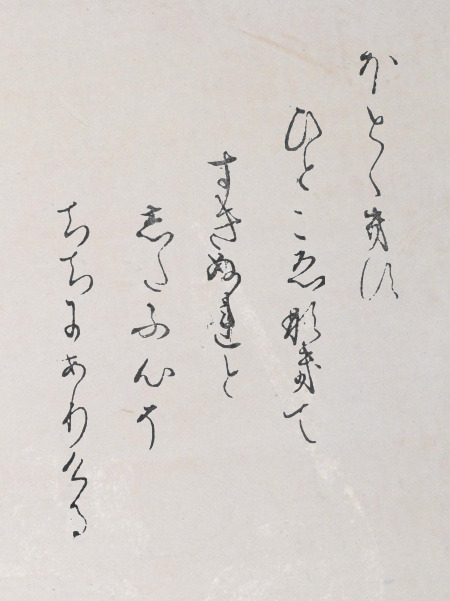
aki no yo no tsuki no hikari wa kawaranedo tabi no sora koso aware narikeri
On an autumn night The moon’s light Is unchanged, yet The sky above me on my travels Is so very sad, indeed.
Lord Saburō 31
Right
あきの夜はたのむる人もなきやどもありあけの月はなほぞまちいづる
aki no yo wa tanomuru hito mo naki yado mo ariake no tsuki wa nao zo machi’izuru
On an autumn night With no man even expected At my house, It is the dawntime moon’s Appearance that, indeed, I have awaited.
Ushigimi
32
The poem of the Left seems extremely well-trodden. It resembles a something sung as a popular song. As for the poem of the Right, ‘not…at my house’ is extraordinarily stilted, yet the poems are of the same quality, so I would say these tie.
The poem of the Left’s final ‘Is so very sad, indeed’ sounds pitiful and truly unskilled. The poem of the Right overemphasises ‘even’, and also appears to say that the dawntime moon is an element conveying a moving desolation. I wonder if this is appropriate for the topic of the ‘the moon’ in a poetry match? There needs to be a prior poem as precedent. It does say that the moon’s emergence after having waited for it is something precious, but the poem refers to the moon in the latter part of the month, after the twentieth day, doesn’t it? This would seem to be moving, for sure, but it’s something which doesn’t shed much light, so I would say that the Left wins.
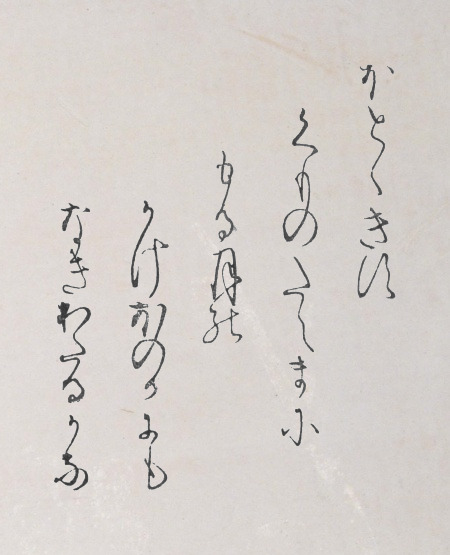
itama yori nezame no toko ni moru tsuki o koishiki hito to omowamashikaba
Between the boards, Waking me in my bed Drips moonlight— The man I love If only it did more than bring to mind…
Lord Dainagon 29
Right
くれはどりふたむらやまをきて見ればめもあやにこそ月も見えけれ
kurehadori futamurayama o kite mireba me mo aya ni koso tsuki mo miekere
When the weave of twilight Upon Futamura Mountain One comes to see, Another pattern fills the eye— Bright moonlight.
Lord Chūnagon 30
The poem of the Left has an extremely refined configuration, but is lacking much of a conception of the moon, and has a much greater one of love. The poem of the Right has a moving conception, but it is about scarlet leaves that one says ‘another pattern fills the eye’. There have been no compositions to date utilizing this about the moon. As both poems have dubious elements, I feel they are of the same quality.
I must say that the initial section of the poem of the Left, ‘between the boards’, is something that not even the poets of bygone days placed at the beginning of their poems. I would say that such expressions as ‘between the boards of a ruined house’ sound blended, implying that the appearance within is fine. Perhaps the poet mistook this? In addition, I do not feel that this is a moon poem, and would have to say that it’s a love one. It really is very odd, isn’t it—suddenly including a love poem here. The poem of the Right has nothing about it worth mentioning, yet it appears to be a moon poem superficially. There’s nothing for it but, faced with the poem of the Left, which beats the hastiest of hasty retreats and ignores the essential meaning of the topic, but to make it the winner!
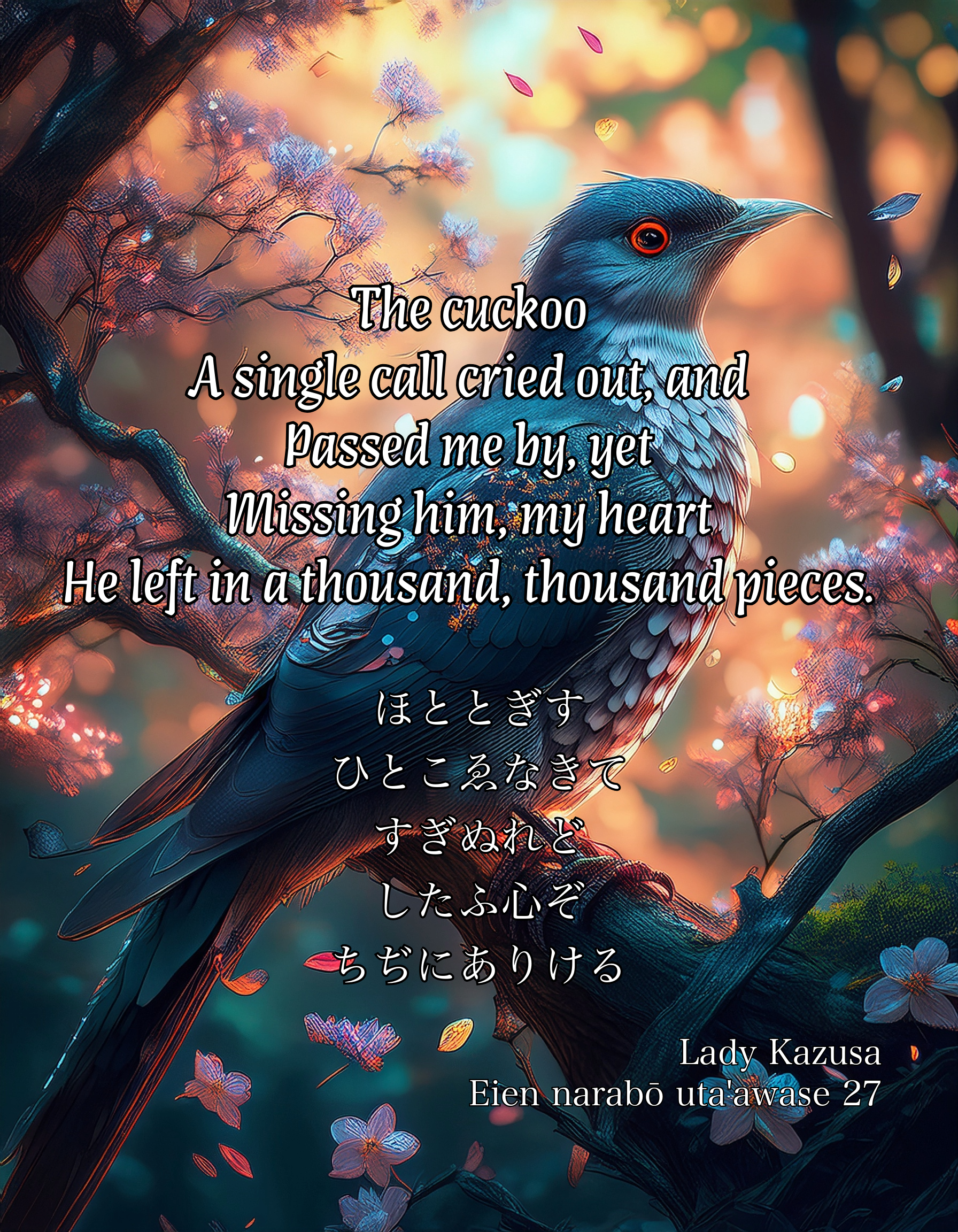
hototogisu hitokoe nakite suginuredo shitau kokoro zo chiji ni arikeru
The cuckoo A single call cried out, and Passed me by, yet Missing him, my heart He left in a thousand, thousand pieces.
Lady Kazusa 27
Right (Win)
ほととぎすくものたえまにもる月のかげほのかにもなきわたるかな
hototogisu kumo no taema ni moru tsuki no kage honoka ni mo nakiwataru kana
The cuckoo, as From a gap between the clouds Drips the moon’s Light, faintly Calls on!
Lady Shikibu 28
Both poems are of the same quality.
The Left’s poem really makes me wonder why that should be the case, with the final ‘he left’ putting me in mind of someone in court dress who has forgotten to put on his shoes! The Right’s poem appears rather more bright than it needs to be. Furthermore, if one says that the ‘light is faint’ then shouldn’t the moon be hidden by the clouds? It’s vague over that, but if there were a prior poem as precedent, then it would be a good composition. For the present, I will make it the winner.
yomosugara matsu ni wa nakade hototogisu ashita no hara ni hitokoe zo kiku
All through the night I pined without a song, O, cuckoo Then with the morn on Ashita plain I hear a single call!
Cell of Fragrant Cloud 25
Right (Win)
五月にはしばなくやとぞほととぎすなほうらまちにさぬるよもなし
satsuki ni wa shiba naku ya to zo hototogisu nao uramachi ni sanuru yo mo nashi
In the Fifth Month Incessantly might he sing—I think, so The cuckoo I am already eagerly awaiting, Sleeping not at all on any night!
Cell of Compassionate Light 26
The Left’s poem seems to have an extraordinary conception, yet its diction is insufficient. The Right’s poem is old-fashionedly artless and thus has elements which are entirely poetically backward-looking.
The Left’s poem is particularly oddly composed in that is fails to account for the essential meaning of Ashita Plain. Does saying a ‘single call now’[1] mean that that one could wait expectantly during the day, too?
As for the Right’s poem, a cuckoo is not something that calls incessantly, yet I wonder if this composition is not, in some form, a plea that it would? As for ‘eagerly await’, well, I feel that it would be better to have ‘awaited’ rather than ‘awaiting’—that sounds like something one would have done ‘nothing but’ first. It seems a bit distasteful, like a poem by someone who has been perusing the Collection of a Myriad Leaves.
[1] On a folding screen for the Coming-of-Age Ceremony of the Northern Princess. 行きやらで山ぢくらしつほととぎす今ひとこゑのきかまほしさに yukiyarade / yamaji kurashitsu / hototogisu / ima hitokoe no / kikamahoshisa ni ‘I cannot go ahead / As twilight falls upon the mountain paths / For a cuckoo’s / Single call now / Is what I long to hear…’ Minamoto no Kintada (SIS II: 106)
hototogisu hanatachibana ni yadoru to mo nanorazariseba ikade shiramashi
The cuckoo Among the orange blossom May make his lodging, but If he fails to announce himself How would one ever know?
Controller’s Graduate 23
Right
さよなかにみふねの山のほととぎすほのかになきてすぎぬなるかな
sayo naka ni mifune no yama no hototogisu honoka ni nakite suginu naru kana
In the midst of a night so brief Upon Mifune Mountain, A cuckoo, Faintly crying, Has passed his time!
Kerin’in Graduate 24
It is entirely impossible to decide between these two poems.
Neither of these poems is particularly bad. The Left flows smoothly and is elegant; the Right starts with ‘Mifune Mountain’ and then continues with ‘faintly’, which certainly does not lack skill. Thus, I would say that these should tie, although this will doubtless be a source of some dissatisfaction to the writer of the Right.
How deeply Moving might it be? For a cuckoo To have long awaited and He then comes to call…
Cell of Everlasting Truth 22
In regard to the Left’s poem, in the Poetry Match held in Engi 3, there was a compostion which went ‘Until in Kataoka / The plains of Ashita / Does resound / The mountain cuckoos / Are singing now!’[i] When this was recited, His Majesty laughed and so it was not read aloud all the way to the end. The expression ‘resound’ is poor. The diction of the Right’s poem is terribly stilted and really doesn’t trip off the tongue, but strictly speaking it has no particular faults. I make it the winner.
The Left’s poem seems move my heart to the greatest degree. However, it really is the case that ‘resounding with song’ is something which happens after hearing it—that’s when it would seem right to compose ‘come resound with song’. It’s extremely imprudent to guess and say that somewhere ‘might resound with song’ without hearing it. And yet, there is the conception of there being times, too, when the cuckoo doesn’t sing. In the Right’s poem ‘To have long awaited’ lacks harmony, and I would want there to be a break there, so I should say that the Left wins.
samidare ni nuru to mo yukamu hototogisu futakoe kinaku sato wa ari ya to
By the summer showers We will be drenched, yet let’s away! For the cuckoo Has come to sing and sing again At that estate, perchance…
Retired from the world 19
Right
さ月やみくらくはくらくほととぎすこゑはかくれぬ物にぞありける
satsuki yami kuraku wa kuraku hototogisu koe wa kakurenu mono ni zo arikeru
In the Fifth Month’s gloomy Darkness deep, The cuckoo Is unable to conceal his cry With anything at all!
Senior Assistant Minister Past Lecturer 20
Both Left and Right are workmanlike poems with little evidence of thought. With that being said, however, the conclusion of the Right’s poem is identical to that of a famous work by the Horikawa Minister. That poem is ‘The River Sao: / Mist rises, and from beyond / Come plover cries, / Their calls uninterrupted / By anything.’[1] And the Right here is, at the very least, extraordinarily redolent of it! Still, I feel the Left does linger in the heart.
The Left’s poem is not particularly remarkable, yet it has no faults worth mentioning. It doesn’t contain any distasteful expressions and resembles familiar compositions. The poem of the Right’s ‘darkness deep’ sounds like something said by a black-hearted scoundrel—I don’t feel it’s poetic diction at all! In addition, on the matter of the concluding ‘unable to conceal his cry’,[i] well, this appears in a range of earlier poems, as does ‘his cry uninterrupted’, so one should be hesitant about using it. I make the faultless Left the winner.
[1] Composed on plovers for a poetry competition in Eishō 4 [1050]. 佐保川の霧のあなたに鳴く千鳥聲は隔てぬ物にぞ有ける saogawa no / kiri no anata ni / naku chidori / koe wa hedatenu / mono ni zo arikeru ‘The River Sao: / Mist rises, and from beyond / Come plover cries, / Their calls uninterrupted / By anything.’ The Horikawa Minister of the Right [Fujiwara no Yorimune] (GSIS VI: 388)
[i] The only surviving example of this usage pre-dating this match is: Written on the edge of a folding screen by a painting of geese flying in the clouds, when His Majesty ordered a celebration for the Junior Principal Handmaid. 白雲の中にまがひてゆく雁もこゑはかくれぬ物にざりける shirakumo no / naka ni magaite / yuku kari mo / koe wa kakurenu / mono ni zarikeru ‘Within the clouds, so white, / Entangled / Goes a goose, / Unable to conceal his cry / With anything at all!’ Fujiwara no Kanesuke (Kanesuke-shū 48). There is also one further example in later poetry: Composed and sent when he heard that Inspector Kinmichi had had a number of people compose poems on the bush warbler at his residence. 春霞たちへだつれど鶯の声はかくれぬものとしらずや harugasumi / tachihedatsuredo / uguisu no / koe wa kakurenu / mono to shirazu ya ‘The haze of spring / Arising, interferes, yet / The warbler / Is unable to conceal his cry— / I wonder if he know it?’ Former Consultant Tsunemori (GYS I: 50)
ochikata ya kumoi no yama no hototogisu ama tsu yoso ni mo nakiwataru kana
From the distant Mount within the clouds A cuckoo In yonder heavens Sings his song!
Lord Saburō 17
Right
ほととぎすしのだのもりのしのびねをたづねざりせばいかできかまし
hototogisu shinoda no mori no shinobine o tazunezariseba ikade kikamashi
A cuckoo In Shinoda’s sacred grove Lets out a hushed cry; Had I not come to visit here, How might I have heard it?
Ushigimi 18
In regards the poem of the Left’s ‘from the distant’ and what follows, extremely recently and colloquially, at the Nakatomi purification ceremony it seems there was a composition, ‘in the distance, below the trees so lush’. This diction is contrary to the expected style of waka and something which occurs only extremely rarely. Truly, one does not compose using such diction in a poetry match. The poem of the Right has nothing of interest about it, yet it also lack faults to mention, so it wins.
This round, neither poem appears bad. The Left has a novel style, while the Right seems cliched, but its expression is smooth. I wonder if we could see these as a tie.
hototogisu maki no to bakari machitsuredo nakade akenuru natsu no shinonome
O, cuckoo, Briefly by my door of cedar wood Did I await you, yet No song, at all, brightened This summer edge of dawn.
Lord Dainagon 15
Right (Win)
ほととぎすなくうれしさをつつめどもそらにはこゑもとまらざりけり
hototogisu naku ureshisa o tsutsumedomo sora ni wa koe mo tomarazarikeri
At the cuckoo’s Song, my joy To hold fast did I try, yet In the skies, his cry Lingered not.
Lord Chūnagon 16
The Left’s poem, after careful consideration, has a graceful style. The diction of the Right’s poem is superb, and there is an excess of conception. Reading and reciting these leaves my aged heart at a loss. Thus, they tie.
In the Left’s poem, ‘briefly’ is an expression which means ‘just for a short time’, I think, and thus the sentiments are lacking. Saying ‘brightened…edge of dawn’ sounds as if the poet has only begun waiting at daybreak. One does see, apparently, a number of poems in prior matches where the poet has not heard the cuckoo. Nevertheless, I do wonder about whether this is appropriate, given that poems where the cuckoo has been heard are faultless. The Right’s poem is not that good, but it is poetic. Thus, it has to win.
shiranami no tatsuta no kawa ni shikiru kana yama no sakura wa chirinikerashi mo
Whitecaps On Tatsuta River Constant are! Upon it the mountain cherries Have scattered it seems…
Lady Kazusa 13
Right
花ざかりゆきとぞ見ゆるとしをへてよしのの山はふゆはふたたび
hanazakari yuki to zo miyuru toshi o hete yoshino no yama wa fuyu wa futatabi
The profusion of blossom Seems like snow, so Passing through the year To Mount Yoshino Winter comes twice!
Lady Shikibu 14
The poem of the Left’s ‘Whitecaps / On Tatsuta River / Constant are!’ is an expression I have not heard before. I have reviewed a large number of collections, and it has not been previously used. The Right’s poem is one from the Poetry Match held by the Sage of Ungo Temple.[i] Thus, it is difficult to determine a winner or loser.
The Left poem’s central line ‘constant are!’ sounds a bit distant. In addition, looking at the flowing of water is not part of the essential meaning of the topic. If one views the treetops, then one should say something like ‘Hidden in the mountains’ depths / These blossoms – would any wish to see them?’[1] –that’s an appropriate expression to be directed toward such blossoms. This poem is lacking in the sentiments required for a poetry match. The poem of the Right, stating that blossoms resemble snow, is something that has been used frequently and so sounds very well-worn, indeed. The final ‘Winter comes twice!’ also lacks elegance and, in addition, seems insufficient. I would think these should tie?
[1] A poem from a poetry competition held by Her Majesty, the Empress, during the Kanpyō period. 吹風と谷の水としなかりせば深山がくれの花を見ましや fuku kaze to / tani no mizu to shi / nakariseba / miyama gakure no / hana o mimashi ya ‘The gusting wind and / The valley’s waters / Were there none, then / Hidden in the mountains’ depths / These blossoms – would there be any chance to see them?’ Tsurayuki (KKS II: 118)
[i] It is unclear which poetry match Mototoshi is referring to here. The Sage of Ungo Temple (Ungoji no hijiri 雲居寺聖) was a sobriquet given to Senzai瞻西 (?-1127), after he reconstructed the temple in Higashiyama to the east of the capital after a long period of abeyance. There are surviving records of three poetry matches held at the temple in which Senzai took part: the ‘Poetry Match at the Ungo Temple’ (Ungoji uta’awase 雲居寺歌合); the ‘Poetry Match held at the Celebration after Sutra-copying at the Ungo Temple’ (Ungoji kechiengyō goen uta’awase 雲居寺結縁経後宴歌合); and the ‘Later Match Contest held at the Ungo Temple’ (Ungoji goban uta’awase 雲居寺後番歌合). All of these took place in Eikyū 4 (1116), but the first and last are fragmentary and only identifiable from the headnote to poems included in other collections. Ungoji kechiengyō goen uta’awase, however, is extant and was judged by Mototoshi, so we can definitively say that he was present. This match, though, took place in the Eighth Month, and so was devoted to autumn topics; Shikibu is also not listed among the participants, although a number of other court ladies well-known as poets do take part. The other two matches took place in the summer, or later in the autumn, and so it seems unlikely that a spring topic, such as cherry blossom, would have been assigned. The likelihood, therefore, is that either Mototoshi is referring to another match held at the temple in the spring, no record of which has survived, or that he has misremember the occasion on which he encountered Shikibu’s poem. A slight variant of this poem does occur in the anthology Konsen wakashū 今撰和歌集 (‘Anthology of Current Poetry’) (27), a private collection believed to have been put together by Kenshō in 1165-66, but the headnote there references this match, and there appear to be no records of this poem elsewhere in the canon.