Tag Archives: mountain cherry

Eien narabō uta’awase 04

Round Four

Left (Win)

春の日をなほながかれとおもふかなはな見ることのあかぬこころは

haru no hi o
nao nagakare to
omou kana
hana miru koto no
akanu kokoro wa
O, let the days of spring
Still linger lengthily on,
I wish! For
Gazing on the blossom
Has yet to sate my heart…

Cell of the Fragrant Elephant
7

Right

ことしもやあだにちりぬる山ざくらさもあさましきはなのくせかな

kotoshi mo ya
ada ni chirinuru
yamazakura
sa mo asamashiki
hana no kuse kana
This year, too, will
You swiftly scatter,
O, mountain cherry?
That is a wretched
Habit blossoms have!

Cell of the Everlasting Truth
8

The poem of the Left’s final section is that of a pre-existing older poem.[i] The poem of the Right’s final section is deplorable. Even so, I make the Right the winner.

Both Left and Right are elegant. With that being said, the Left also sounds charming, while the Right’s concluding ‘habit!’, although it is not a major fault, grates on the ear a bit. This is another win for the Left.


[i] The ending of this poem in the texts of this match with Mototoshi’s judgements is different, with the final line being akanu kagiri wa (‘have yet to sate’). This means it closely resembles: Topic unknown. ゆきとまるところぞはるはなかりける花に心のあかぬかぎりは yukitomaru / tokoro zo haru wa / nakarikeru / hana ni kokoro no / akanu kagiri wa ‘To go and stay / A place in springtime / Have I none / For the blossoms, my heart / Have yet to sate completely.’ Sugawara no Tamenobu (GSIS I: 90). Kubota et al. (2018, 223) suggest that as we know that the version of the match that Toshiyori judged was produced later, this poem may have been revised in the light of Mototoshi’s judgement.

Eien narabō uta’awase 02

Round Two

Left

をちこちのちるはなごとにたぐひつつ春はこころのあくがるるかな

ochikochi no
chiru hana goto ni
taguitsutsu
haru wa kokoro no
akugaruru kana
Here and there
Every single scattered blossom
Enthralls me;
Spring within my heart
I hold so dear.

Lord Saburō
3

Right (Win)

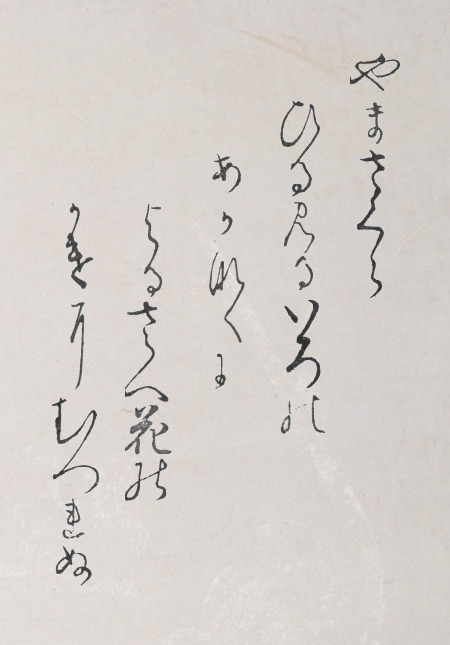
やまざくらひる見るいろのあかなくによるさへ花のかげにむつれぬ

yamazakura
hiru miru iro no
akanaku ni
yoru sae hana no
kage ni mutsurenu
Mountain cherry,
Viewed in daytime has hues
That will not sate, so
Even at night the blossoms’
Glow entangles me.

Ushigimi
4

The Left’s poem has nothing remarkable about it. I say that, but it also has no particular faults. The Right’s phrase ‘’ feels curt, so I make the Left the winner.

The Left’s poem does not appear to have any particular faults—it describes the world as it is, so it seems to lack any novel phrasing.

The diction of the Right’s ‘Viewed in daytime has hues’ is extremely immature. With that being said, being entangled and lingering unsated has some conception to it.. I should say this is the winner.

Kyōgoku no miyasudokoro uta’awase 13

Original

ちりまがふかすがのやまのさくらばなひかりにきえぬゆきと見えつつ

chirimagau
kasuga no yama no
sakurabana
hikari ni kienu
yuki to mietsutsu
Tangledly scattering on
The mount of Kasuga are
The cherry blossoms—as
Not fading with the sunlight
Does this snow, it ever seems…

37

Left

さくらばななにかはきえむしろたへのいろばかりこそゆきににるらめ

sakurabana
nanika wa kienu
shirotae no
iro bakari koso
yuki ni niruramu
Cherry blossoms—
Why should they fade away?
White as mulberry cloth,
In their hue alone
Do they resemble snow, I’d say!

38

Right (Win)

やまざくらゆきにまがひてちりくれどきえぬばかりぞしるしなりける

yamazakura
yuki ni magaite
chirikuredo
kienu bakari zo
shirushi narikeru
Mountain cherry blossoms
Tangle with the snowflakes, and
Come a’scattering, yet
‘Tis only that they fade not that’s
The sign of what they are!

39

Kinkai wakashū 74

Composed for a folding screen with a picture of cherry trees blooming in the middle of the mountains.

山ざくらちらばをらなんをしげなみよしや人みず花のなたてに

yamazakura
chiraba oranan
oshigenami
yoshi ya hito mizu
hana no na tate ni
O, mountain cherry!
If you scatter, then do it
Without regret, for,
Well, even should folk not see
Your blossoms’ fame will spread still!
A kuzushiji version of the poem's text.

KYS IX: 521

Composed on seeing cherry blossom unexpectedly at Ōmine.

もろともにあはれとおもへ山ざくらはなよりほかにしる人もなし

morotomo ni
aFare to omoFe
yamazakura
Fana yori Foka ni
siru Fito mo nasi
Won’t you as well
Feel kind,
O, mountain cherry?
For other than your blossom,
I have no acquaintances here at all…

Archbishop Gyōson

A kuzushiji version of the poem's text.
Created with Soan.

Teiji-in uta’awase 02

Left

さかざらむものならなくにさくらばなおもかげにのみまだきみゆらむ

sakazaramu
mono naranaku ni
sakurabana
nao mo kage ni nomi
madaki miyuramu
Wishing not to bloom
Will not remain
The cherry blossom, but
Even so their shape alone
Swiftly, I would wish to see!

Mitsune
3

Right

やまざくらさきぬるときはつねよりもみねのしらくもたちまさりけり

yamazakura
sakinuru toki wa
tsune yori mo
mine no shirakumo
tachimasarikeri
When the mountain cherry
Has bloomed,
Earlier than usual
Clouds of white around the peak
Do rise spectacularly!

Tsurayuki
4[i]

The Left uses ‘wish’[ii] twice; the Right places the mountain cherries at a distance—that make the round a tie.


[i] This poem is included in Gosenshū (I: 118), with the headnote, ‘A poem from Former Emperor Uda’s Poetry Contest’.

[ii] Uda is objecting to Mitsune’s double usage of the auxiliary verb -ramu in his judgement here.