The moon above the shrine.[i]
月のすむ北野のみやの小松原いく代をかけて神さびにけん
| tsuki no sumu kitano no miya no komatsubara ikuyo o kakete kamisabiniken | So clear the moon above Kitano Shrine’s[ii] Dwarf pine groves— Through how many ages Might they have been venerated?[iii] |
631
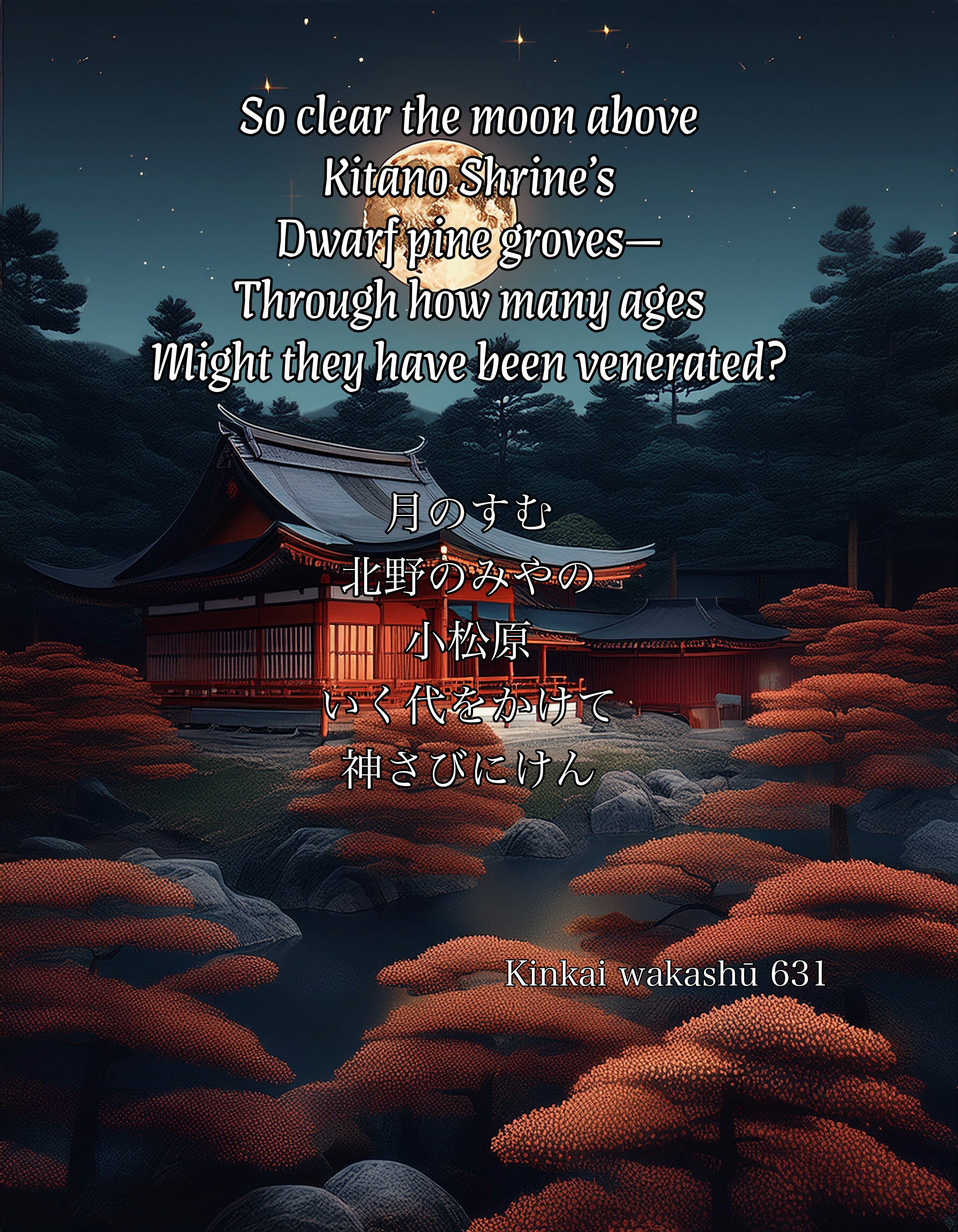
[i] The topic here, ‘the moon over the shrine’ (shatō no tsuki 社頭月) was a standard one which could be applied to any poem on this theme, but poets usually had a specific shrine in mind when using it—that is, their poems were intended to describe a specific scene rather than a generic one. Sometimes the context would be supplied by the time and place in which the poem was composed: for example, this is one of the topics used in the Sumiyoshi-sha uta’awase kaō ni-nen (‘Sumiyoshi Shrine Poetry Match – Kaō 2’) held in 1170, so all the poems on it can be understood as describing the moon over Sumiyoshi Grand Shrine. Alternatively, the poet could refer to the shrine in the poem itself, as Sanetomo does here.
[ii] This is Kitano Tenmangū 北野天満宮 in the north of Kyoto, dedicated to Sugawara no Michizane 菅原道真 (845-903), as the deity of learning, Tenman Tenjin 天満天神.
[iii] See: 和我伊能知乎 奈我刀能之麻能 小松原 伊久与乎倍弖加 可武佐備和多流 wa ga inochi / nagato no shima no / komatsubara / ikuyo o hete ka / kamusabiwataru ‘My life! / Upon the isle of Nagato / The dwarf pine groves / Have through how many ages passed? / Ever venerable…’ (Man’yōshū XV: 3621)