kusamakura tabine sabishiki yamakage ni ko no ha sasoite shigure furunari
On a grassy pillow, Dozing on my travels, lonely In a mountain’s shade, The rustling of the leaves invites A shower to fall.
Hyōenosuke 81
Right (Win)
すみのえのまつがはひねをまくらにてなみうちそふるしぐれをぞきく
suminoe no matsu ga haine o makura nite nami uchisouru shigure o zo kiku
At Suminoe Upon the crawling pine roots Have I made my pillow, while Laced with the breaking waves I listen to the showers.
Lord Naganori 82
The Left’s configuration of ‘the rustling of the leaves invites’, while dozing on one’s journey in the shadow of a mountain, sounds pleasant. While I do wonder about the Right’s diction—concluding with ‘listen to the showers’—in addition to ‘laced with the breaking waves’ sounding pleasant, it also adds the conception of waves beneath ‘the pines of Suminoe’, doesn’t it. I make the Right the winner.
michishiba no tsuyu wakekitsuru tabigoromo shigururu yowa wa hoshi zo wazurau
Through the roadside grasses Dew have I come forging— My traveller’s garb In a midnight shower I’d dry—what trouble ‘tis, indeed!
Hyōenokami 79
Right (Win)
しぐれするおとにいくたびねざめしてくさのまくらにあかしかぬらむ
shiguresuru oto ni iku tabi nezameshite kusa no makura ni akashikanuramu
The showers’ Sound, so many times Has wakened me, so On my grassy pillow It seems the dawn can never come!
Michichika 80
The Left’s ‘roadside grasses’ have nothing remarkable about them and, what’s more, fail to link to anything. The Right has a charming conception of feeling the dawn will never come to a grassy pillow, but as in the poem ‘On a winter’s night / How many times / Have I awakened, / Deep in thought, my dwelling’s / Door-crack letting in the light?’, it is more charming to refer to the difficulty of greeting the dawn at the end of a winter’s night. This poem has the speaker being woken countless times by the sound of a shower and seems to convey the feeling of dozing on a dew-drenched pillow, doesn’t it. With that being said, the Right does appear to have some genuine emotion behind it. I would say it wins.
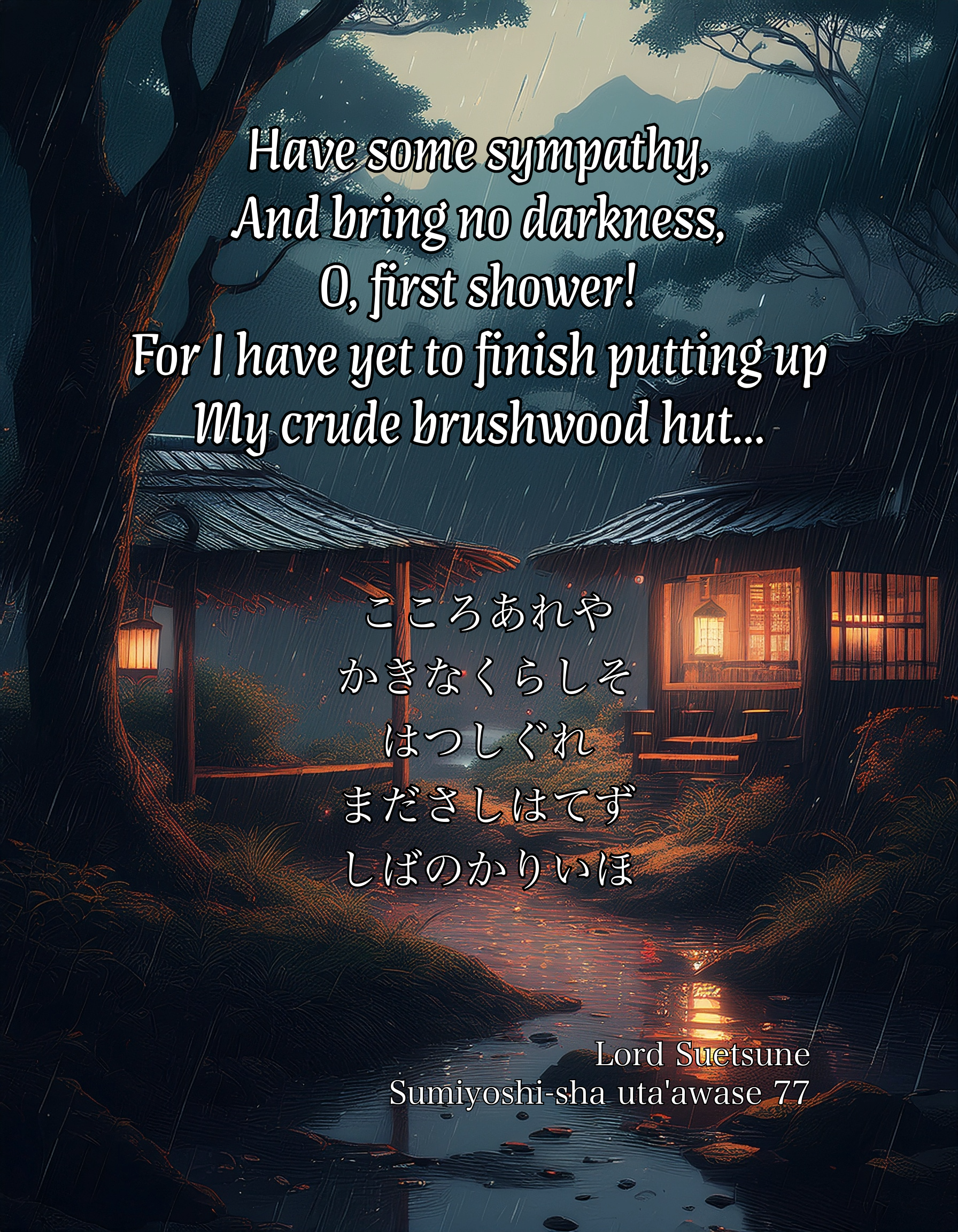
kokoro are ya kaki na kurashi so hatsushigure mada sashihatezu shiba no kari’io
Have some sympathy, And bring no darkness, O, first shower! For I have yet to finish putting up My crude brushwood hut…
Lord Suetsune 77
Right (Win)
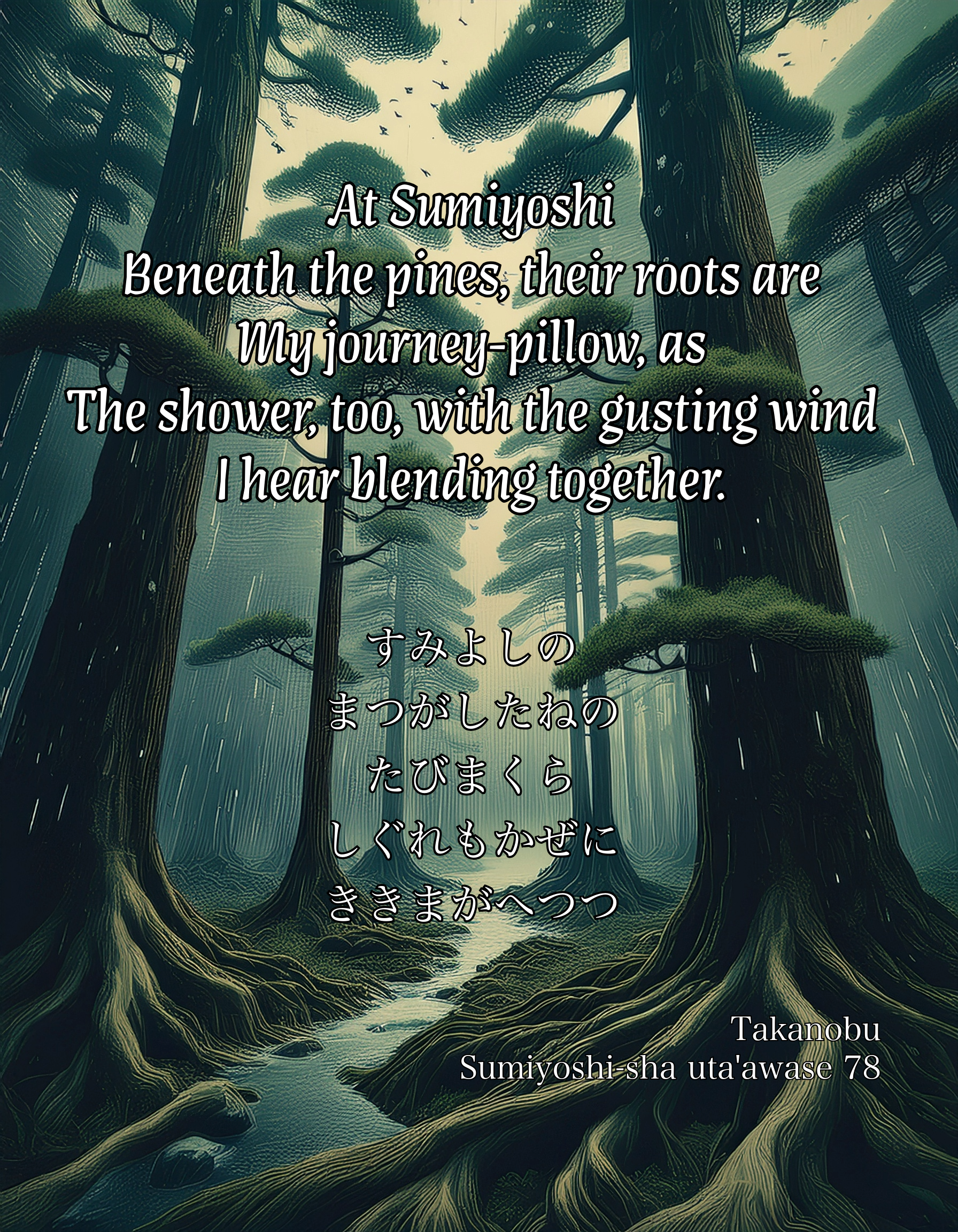
すみよしのまつがしたねのたびまくらしぐれもかぜにききまがへつつ
sumiyoshi no matsu ga shita ne no tabimakura shigure mo kaze ni kikimagaetsutsu
At Sumiyoshi Beneath the pines, their roots are My journey-pillow, as The shower, too, with the gusting wind I hear blending together.
Takanobu 78
The Left’s latter section, which states that the poet has ‘yet to finish putting up’ his hut, has a truly charming configuration as a poem on the conception of travel, but the phrase ‘have some sympathy’ does not appear to be a conception which has prior precedent. It could be a way of expressing the emotion through the shower. As for the Right, while I do question the sound of ‘journey-pillow’, it is the case that in Cathay-style poems this appears, but what are we do to about the fact that this is not ‘pillow on my journey’, I wonder? The sequencing of ‘the shower, too, with the wind’ is pleasant, isn’t it. Thus, I make the Right the winner.
shigure moru tabine no toko wa hanazome no tamoto zo saki ni mazu kaerikeru
A shower drips upon me As I doze upon my journey-bed; Blossom-dyed, My sleeves, before me, Have first returned to what they were!
Masahira 75
Right (Win)
はなれゆくみやこをおもふひとりねのなみだをさそふはつしぐれかな
hanareyuku miyako o omou hitorine no namida o sasou hatsushigure kana
Distant has grown The capital, but it fills my thoughts, Sleeping solo, My tears invited by The first shower!
Chikashige 76
The configuration of the Left’s poem appears charming, but it would have sounded more so had there been a reason why ‘my sleeves, before’ had returned to the capital on the journey. The diction and conception of the Right’s poem, beginning with ‘distant has grown’ and leading to ‘tears invited’, is extremely pleasant. It seems the Right wins.
shigure ni wa iori mo sasaji kusamakura oto kiku tote mo nurenu sode ka wa
Caught in a shower, I’d not erect my hut, for Upon a grassy pillow Listening to the sound, still Would my sleeves be soaked!
Tsunemasa 73
Right (Win)
たまもふくいそやがしたにもるしぐれたびねのそでもしほたれよとや
tamamo fuku isoya ga shita ni moru shigure tabine no sode mo shiotareyo to ya
Thatched with gemweed is My roof upon the rocky shore, beneath it Drips a shower, so My sleeves, as I doze upon my travels, Wet with the salty tides – should I say that?
Nakatsuna 74
The Left wonders whether his sleeves would be soaked, listening to the sound of a shower after abandoning all thought of a hut and grassy pillow—this seems extremely charming, but the configuration and sequencing of the Right, beginning with ‘thatched with gemweed’ and continuing with ‘my sleeves, as I doze upon my travels, / Wet with salty tides’, is extremely moving, isn’t it! Thus I have to award a win, once more, to the poem of the Right.
kari no io wa sosoku shigure mo tomaraneba tsuyuwakegoromo hoshi zo kanetsuru
Upon my crude hut, Dripping, the showers, too, Never cease, so My dew-soaked garb To dry is impossible!
Kyō 71
Right
さらぬだにたびねのとこはつゆけきにいかにせよとてうちしぐるらむ
saranu dani tabine no toko wa tsuyukeki ni ika ni seyo tote uchishigururamu
Even ‘twere not to be, My journey-bed is Drenched with dew, so What am I to do, Beneath these falling showers?
Suehiro 72
The Left has ‘dripping, the showers, too’, while the Right has ‘what am I to do’ and so forth—while neither of these is poor in terms of conception and diction, the initial section of the Right sounds extremely commonplace, thus the Left’s conception of agonizing over the being unable to dry dew-soaked garb is slightly superior in the current context.
The Chrysanthemum Match held during the Reign of the Daigo Emperor[1]
Topic
Poets
秋すぎてのこれるきくはかみな月くもをわけてぞにほふべらなる
aki sugite nokoreru kiku wa kaminazuki kumo o wakete zo niouberanaru
Autumn passes, and Lingering chrysanthemums In the Godless Month Seem to break apart the clouds With their glow.
His Majesty’s Composition 1
霜がれになりはてぬともきくの花をる人たれととはばこたへむ
shimogare ni narehatenu tomo kiku no hana oru hito tare to towaba kotaemu
Completely burned by frost They may have become, yet These chrysanthemum blooms, but Who was it plucked you, Should you ask, I wonder, would they reply?