A warbler at my hermitage.
鶯のこゑぞかすみにもれてくる人めともしき春の山ざと
| uguisu no koe zo kasumi ni moretekuru hitome tomoshiki haru no yamazato | A warbler’s Cry from out the haze Does drift to, Secluded from other’s eyes, My mountain retreat in springtime. |
25

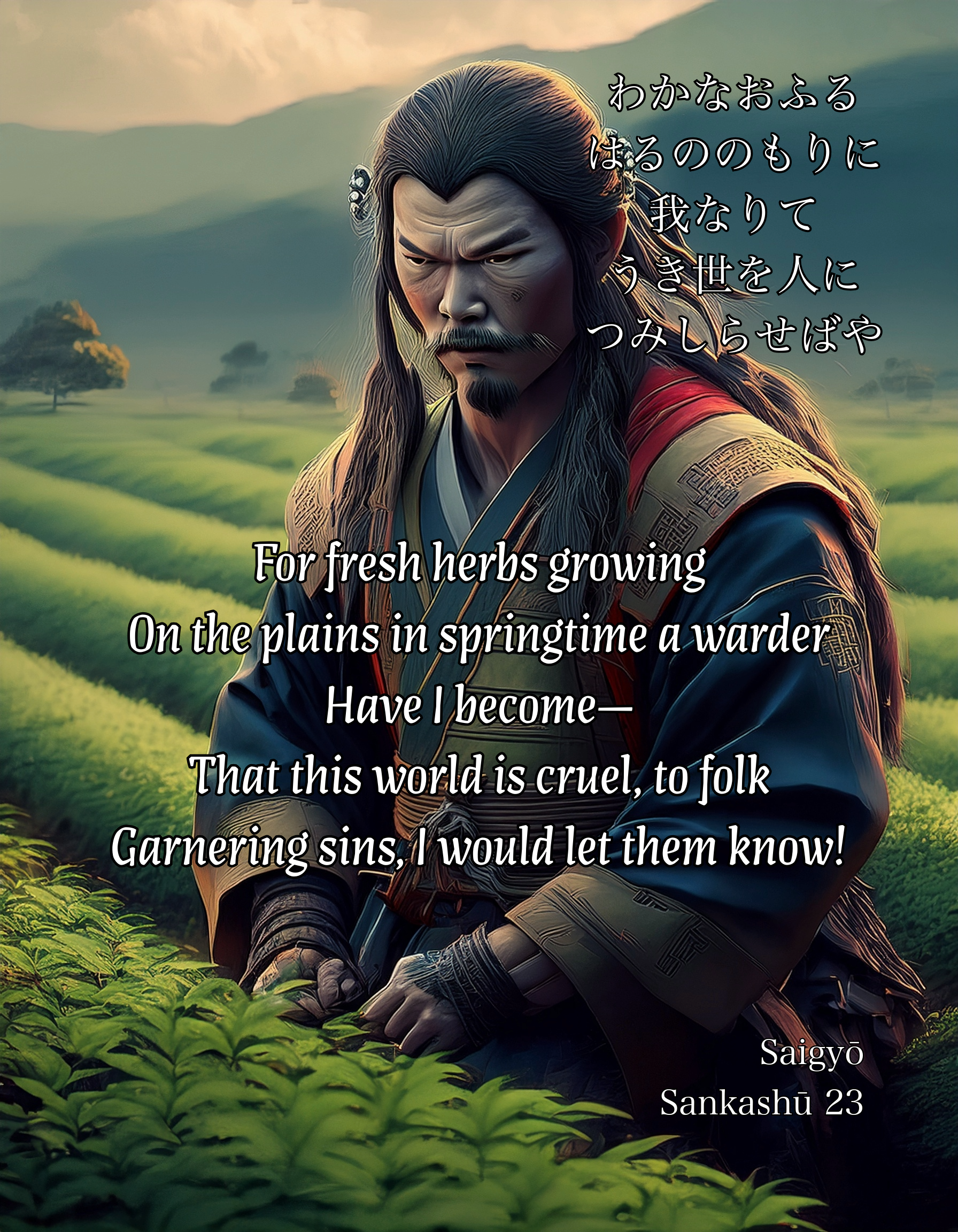
On a personal grievance and picking fresh herbs.
わかなおふるはるののもりに我なりてうき世を人につみしらせばや
| wakana ouru haruno no mori ni ware narite ukiyo o hito ni tsumi shiraseba ya | For fresh herbs growing On the plains in springtime a warder Have I become— That this world is cruel, to folk Garnering sins, I would let them know! |
23
On an old man picking fresh herbs.
うづゑつきななくさにこそおいにけれとしをかさねてつめるわかなに
| uzue tsuki nanakusa ni koso oinikere toshi o kasanete tsumeru wakana ni | With sacred staff in hand, Even with the Seven Herbs[i] He has grown old! The years have piled up While garnering fresh herbs… |
22

[i] The ‘Seven Herbs’ (nanakusa 七草) collected to brew a medicinal broth were: 春の7種の菜、すなわちseri 芹 (‘dropwort’; Oenanthe javanica); nazuna薺 (‘shepherd’s purse’; Capsella bursa-pastoris); gogyō 御形 (‘cudweed’; Gnaphalium affine); hakobe 蘩蔞 (‘chickweed’; Stellaria media); hotoke-no-za 仏座 (‘henbit’; Lamium amplexicaule); suzuna 菘 (turnip; Brassica campestris var. glabra); and suzushiro 蘿蔔 (‘radish’; Raphanus sativus)
Round Eleven
Left
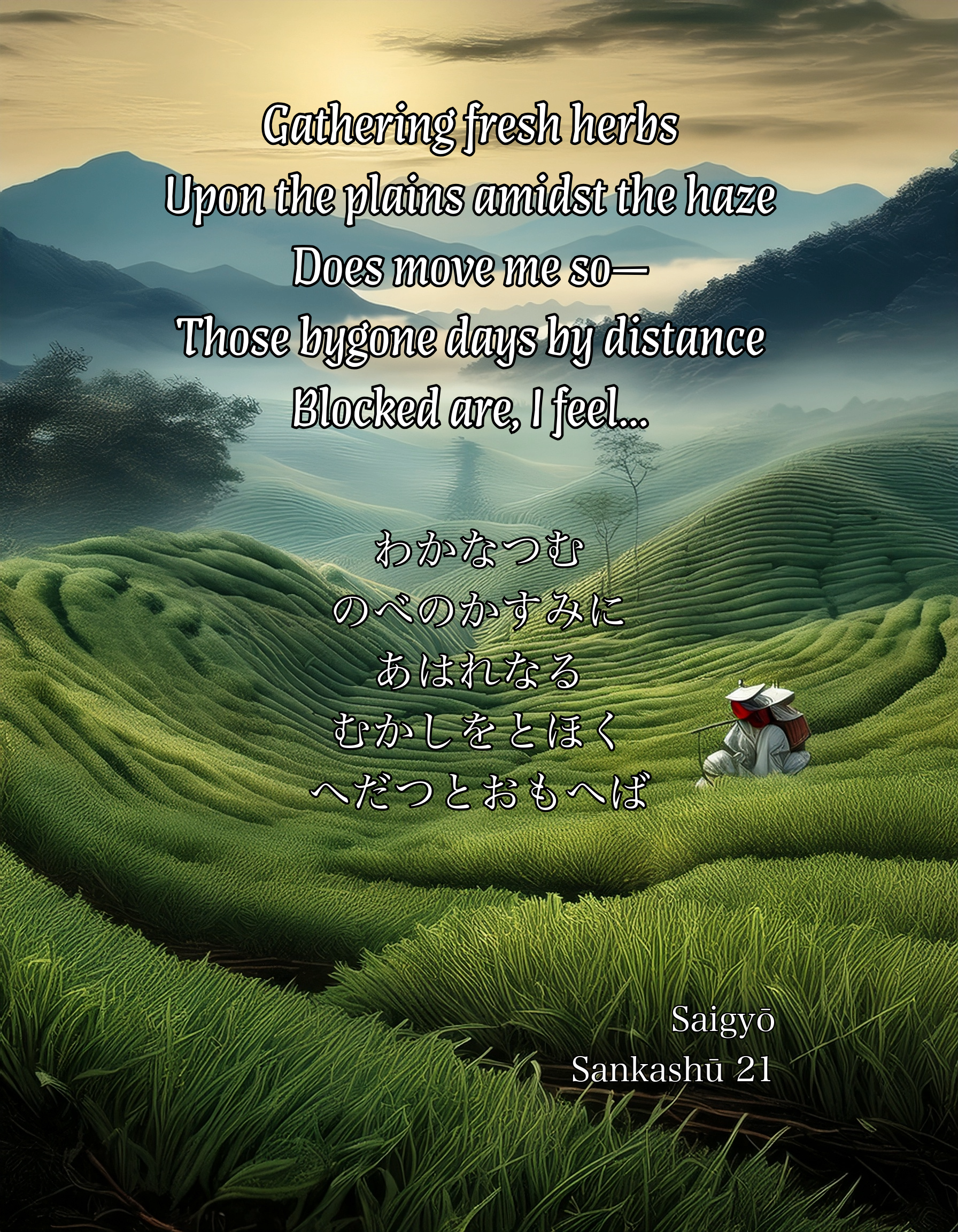
立ちかはる春をしれともみせがほに年をへだつる霞なりけり
| tachikawaru haru o shire tomo misegao ni toshi o hedatsuru kasumi narikeri | ‘The turn to Spring I would you know!’ Reveals, Standing at the year’s edge, The haze. |
21
Right (Win)
岩まとぢし氷もいまはとけ初めて苔の下水道もとむなり
| iwama tojishi kōri mo ima wa tokehajimete koke no shitamizu michi motomu nari | Cracks between the crags sealed By ice, now Beginning to melt, and The water ‘neath the moss Seeks to find its way. |
22
The poem of the Left appears to have suitable configuration and diction, but even though the expression ‘reveals’ is something which one and all, and even I, compose with, I still feel that it is a word which is better avoided in a poetry match. Victory should be awarded according to a poem’s style. The poem of the Right has charming conception and diction. I should say it wins.

Picking fresh herbs in the rain.
春雨のふるののわかなおひぬらしぬれぬれつまんかたみたぬきれ
| harusame no furuno no wakana oinurashi nurenure tsuman katami tanukire | In a spring shower Falling on Furu Plain,[i] the fresh herbs Have grown, it seems; Soaked, I’ll pick them, Putting my basket down…[ii] |
20

[i] Furu 布留 was an utamakura in Yamato, often used in poetry because of the place-name’s homophony with furu 古 (‘old’) or, as here furu 降る (‘fall [of rain]’). See McAuley (2020, 653–654) for details and example poems.
[ii] Gotō (1982, 15) notes that there is an alternate interpretation of the final line of the poem: a katami 筐 was a type of woven bamboo basket with particularly small holes between the strips used to make it, and tanukire can be interpreted as an elided version of ta nuki’ire 手貫き入れ (‘put [something] in threading it by hand’). If this is correct, then the final line of the poem would mean ‘Threading them into my basket’.
Fresh herbs
かすがのはとしのうちにはゆきつみてはるはわかなのおふるなりけり
| kasugano wa toshi no uchi ni wa yuki tsumite haru wa wakana no ouru narikeri | Kasuga Plain Within the year past Garnered snow, where In springtime fresh herbs Grow up.[i] |
19

[i] See: Composed for a painting on a folding screen, showing the picking of fresh herbs on a plain where the snow had fallen. かすが野の雪のむらぎえかきわけて誰がためつめるわかななるらん kasugano no / yuki no muragie / kakiwakete / ta ga tame tsumeru / wakana naruran ‘Across Kasuga Plain, / Spotted with snowmelt, / They push their way; / For who might he be garnering / Those fresh herbs?’ Minamoto no Toshiyori (Sanboku kikashū I: 28)
Picking fresh herbs in the snow.
けふはただおもひもよらでかへりなむゆきつむのべのわかななりけり
| kyō wa tada omoi mo yorade kaerinamu yuki tsumu nobe no wakana narikeri | Today, I will simply Think no more of it, and Head home! For on the plains snow garners Fresh herbs…[i] |
18

[i] There is further wordplay in this poem, with tsumu being both tsumu 摘む (‘pick [a plant]’) and tsumu 積む (‘drift [of snow]’).
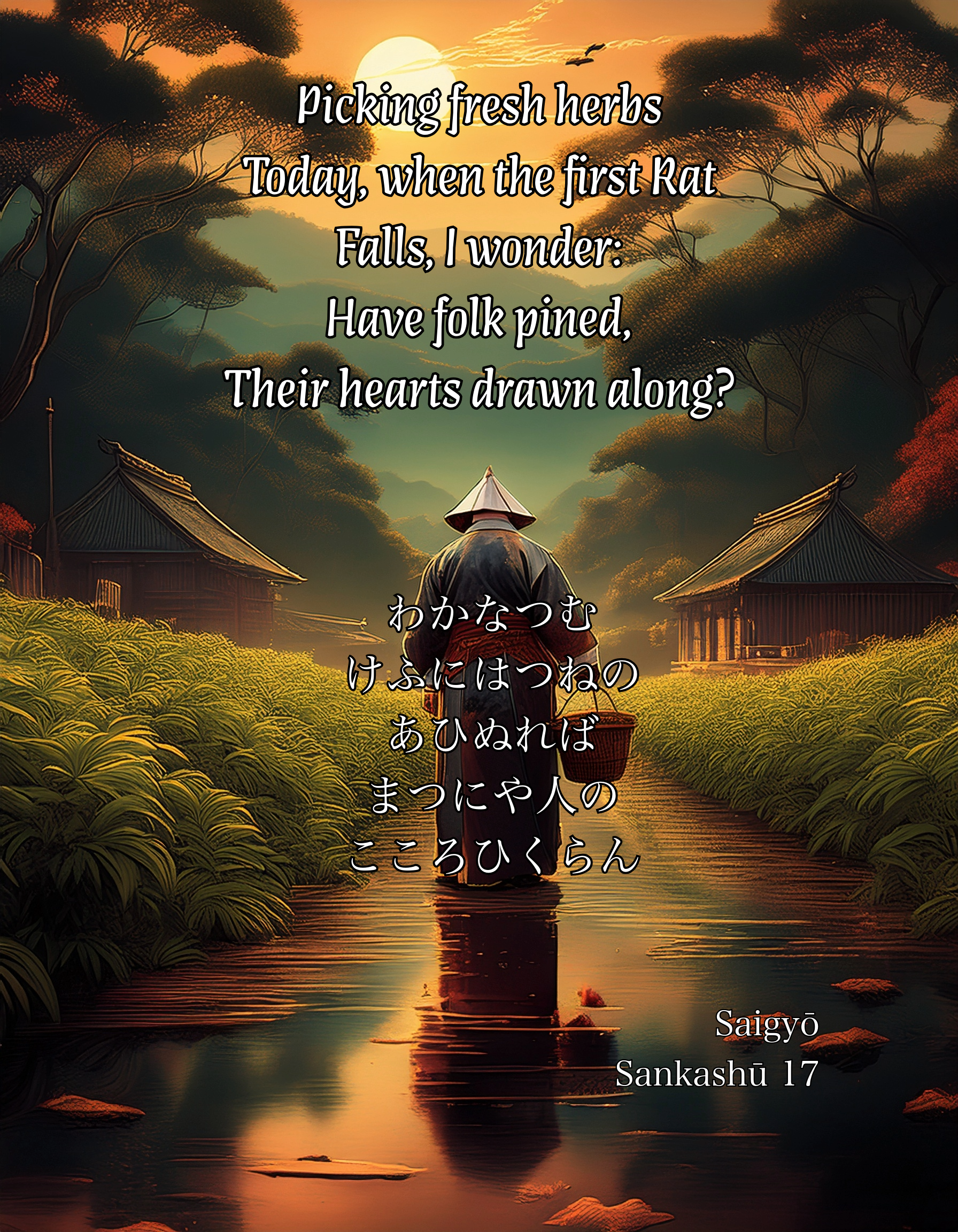
Sent to someone’s residence when the picking of fresh herbs took place on the Day of the Rat.[i]
わかなつむけふにはつねのあひぬればまつにや人のこころひくらん
| wakana tsumu kyō ni hatsune no ainureba matsu ni ya hito no kokoro hikuran | Picking fresh herbs Today, when the first Rat Falls, I wonder: Have folk pined, Their hearts drawn along?[ii] |
17
[i] The picking of ‘fresh herbs’ (wakana 若菜) was an important part of the New Year for both aristocrats and commoners alike. Traditionally, this took place on the first Day of the Rat in the First Month, but later, due to the need for a fixed date in the court’s annual calendar of observances—the beginning of the First Month was particularly busy—the celebration of picking fresh herbs was set on the 7th day of the First Month. This date was chosen because there were, in fact, seven ‘herbs’ which were picked for the event. The headnote to the poem means that in the year in which Saigyō wrote it, the 7th of the month happened to fall on the Day of the Rat, too (Gotō 1982, 13).
[ii] Saigyō employs a dual play-on-words in the poem with matsu standing for both matsu 松 (‘pine tree’), evoking the pine seedlings which were one of the plants being picked, and matsu 待つ (‘wait’)—here it is the Day of the Rat and its events which people have being awaiting. In addition, hiku is both hiku 引く (‘pull [up a seedling]’) and hiku 惹く (‘attract’; ‘charm’), here used to refer to the enjoyment which people derive from the Day of the Rat celebrations.