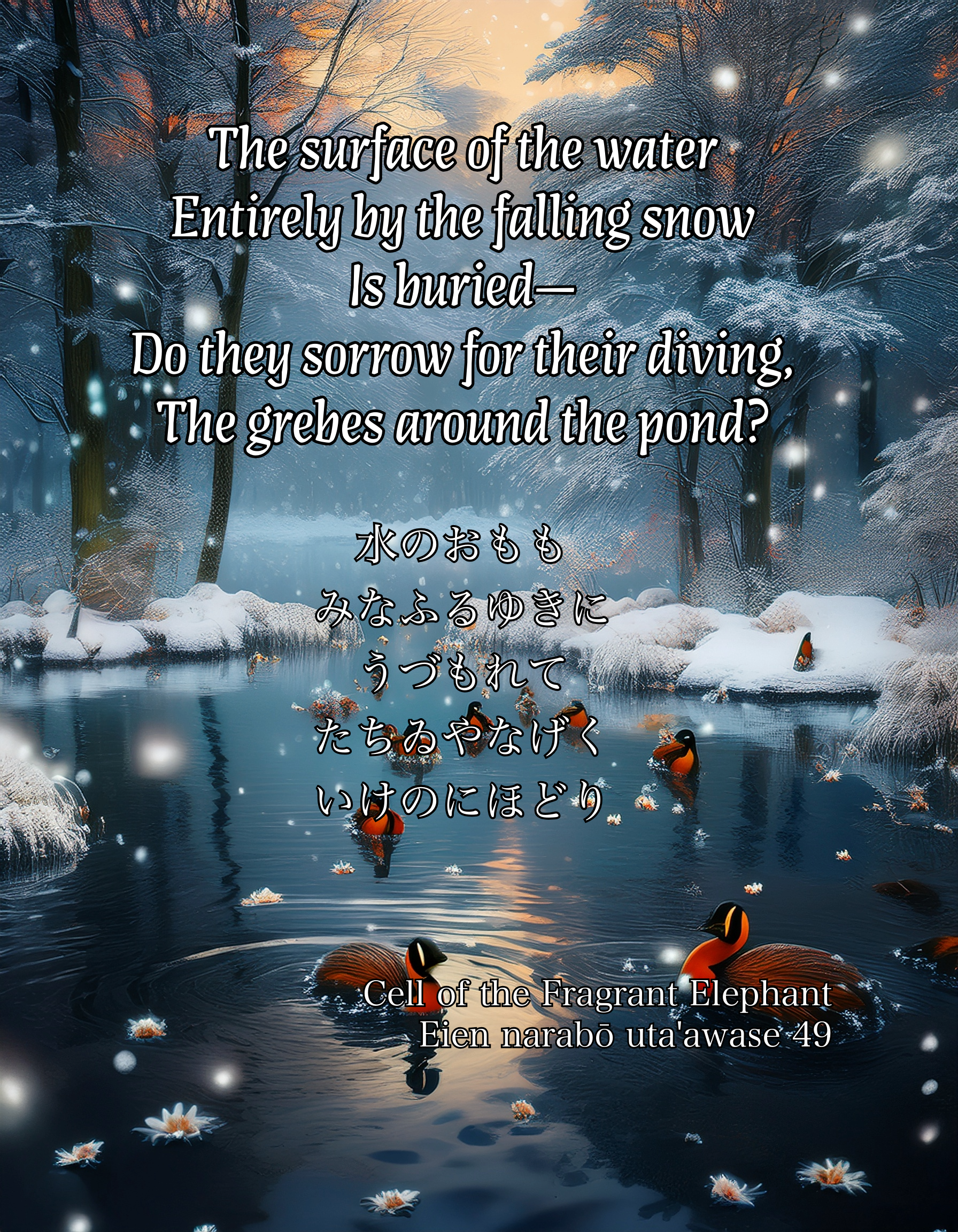
mizu no omo mo mina furu yuki ni uzumorete tachi’i ya nageku ike no niodori
The surface of the water Entirely by the falling snow Is buried— Do they sorrow for their diving, The grebes around the pond?
Cell of the Fragrant Elephant 49
Right (Win)
みよしのに雪ふりぬれば我がやどのならのかれ葉はいとどさびしも
miyoshino ni yuki furinureba wa ga yado no nara no kareba wa itodo sabishi mo
In fair Yoshino Snow has fallen, so At my house The withered oak leaves are All the more alone…
Cell of the Everlasting Truth 50
The poem of the Left’s ‘surface of the water entirely buried by snow’ is something that I have never heard before. ‘Grieving grebes’, too, are something I have yet to encounter. Really, what sort of poem is this? As for the poem of the Right, while ‘all the more alone’ and what precedes it fails to sound elegant, at the current time I feel it’s a little bit superior.
It’s extremely difficult to conceive of the surface of a body of what which hasn’t yet frozen being buried in snow. If snow fell extremely heavily, then, surely, the water would overflow, then freeze, and then get buried, wouldn’t it? I might be going a little too far here, though. As for the Right’s poem, is ‘my house’ in Yoshino? Or is it on an estate elsewhere? If it’s on an estate, is the poet looking at the falling snow and imagining Yoshino? It’s vague. Then again, as the poem doesn’t say explicitly that the oaks are buried by the snow, is it only imagining this? How might something be which has not been seen for sure? The oaks here, too, would be like that, as snow is something which doesn’t distinguish where it falls…
shigure ni wa suga no ogasa mo mizu morite ochi no tabibito nure ya shinuran
In such a shower A little hat of woven sedge, too, Drips with water; A distant traveller Is drenched, no doubt…
Lady Kazusa 9
Right (M – Win)
霜さえて枯行くをのの岡べなるならの朽葉にしぐれ降るなり
shimo saete kareyuku ono no okabe naru nara no kuchiba ni shigure furu nari
Chill the frost upon The sere meadows on The hillside where Upon the withered oak leaves A shower is falling.
Lord Mototoshi 10
Toshiyori states: In the first poem, ‘drips with water’ is vague. In the second poem, ‘hillside where’ lacks smoothness. What are we to make of ‘withered oak leaves’? If leaves have withered away, then they wouldn’t make any sound, would they. Is this even possible?
Mototoshi states: the diction of ‘In such a shower / A little umbrella of woven sedge, too, / Drips with water’ is something which lacks any prior precedent. ‘Dripping with water’ give the impression of a painted pot with a crack in it, so what kind of shower can this be? It would be more normal to refer to having to shelter beneath one’s sleeves. While it is lacking in any superlative features, I feel that the sound of a shower on withered oak leaves is somewhat more commonplace.
sa mo koso wa yorube no mizu ni mizukusa ime kyō no kazashi yo na sae wasururu
That may be, but In the jars of proffered water Waterweed grows old, perhaps, yet To say that the blossom in your hair today Has had its name forgotten? Really…
tsukikage wa saenikerashina kamigaki ya yorube no mizu ni tsurara’iru made
The moonlight Seems so chill, that In the sacred grounds Jars of proffered water Are rimmed with icicles…
Lord Fujiwara no Kiyosuke Junior Fourth Rank, Upper Grade Without Office[1] 7
Right
つきかげにかなづるきねがころもではゆきをめぐらすここちこそすれ
tsukikage ni kanazuru kine ga koromode wa yuki o megurasu kokochi koso sure
In the moonlight Dancing, the priests’ Sleeves Stir the snow— That’s how I feel…
Lord Consultant Fujiwara no Sanetsuna Major Controller of the Left Chief Inspector of the Records of Outgoing Officials Supernumerary Governor of Awa Exalted Junior Third Rank[1] 8
In the Left’s poem, the expression ‘Jars of proffered water / Are rimmed with icicles’ appears to make for a pleasant sequence but seems to have some dubious elements. First of all, I am aware that ‘proffered water’ is mentioned in the Tale of Genji in a poem on the day of the Kamo Festival: ‘That may be, but / Even in the jars of proffered water / Might not appear’[3], but beyond that, it is not used in prior poetry.[i] The water here sounds rather crude to these ears of mine; when one is using figurative language, although it seems possible to do so about any shrine, when referring to the moon before this one, to ignore a description of ice upon the surface of the sea or the beach being spread with pure white gemstones and simply to focus on ‘jars of proffered water’ and say one feels it ‘seems so chill’—well, I do wonder about that! As for the Right’s poem, the movements of a dance have long been described as ‘flurrying snow’ in the poetry of Cathay and now here we have the moonlight appearing to ‘stir the snow’—the conception here appears truly charming, but then we have the section saying ‘Dancing, the priests’: while it’s not that this turn of phrase has never been used before, it does not sound particularly elegant. While the Left does have vague sections, its configuration as a whole is fine. Thus, I think it has to win once more.
[2]Sangi jūsan’i-gyō sadaiben ken kageyu no kami awa gonkami Fujiwara ason Sanetsuna 参議従三位行左大弁兼勘解由長官阿波権守藤原朝臣実綱
[3] This poem appears in Maboroshi 幻, the forty-first chapter of the Tale of Genji (Genji monogatari 源氏物語). It is spoken by Chūjō, one of Genji’s ladies-in-waiting, after he has found her asleep, with her clothing in disorder one morning and flirtatiously suggested, as she has struggled to get dressed, that it has been so long since he has made love that he has forgotten how. She replies: さもこそはよるべの水に水草ゐめけふのかざしよ名さへ忘るる sa mo koso wa / yorube no mizu ni / mizukusa ime / kyō no kazashi yo / na sae wasururu ‘That may be, but / In the jars of proffered water / Waterweed grows old, perhaps, yet / To say that the blossom in your hair today / Has had its name forgotten? Really…’ (Genji monogatari 573). Genji is charmed by this reply and the narrator dryly notes, ‘He seemed not to have rejected her at least’ (Tyler 2001, 773) (hitori bakari wa oboshihanatanu keshiki nari 一人ばかりをば思し放たぬけしきなり (Imaizumi, Mori, and Wokazaki 1976, 872)). The version of the poem Shunzei quotes comes from an alternate version of the Genji text, which is now not regarded as authoritative.
[i] Kubota et al. (2024, 427) note that Shunzei is mistaken here, as there are prior examples of related expressions’ usage, by Izumi Shikibu, among others. For example: …she folded some paper into the shape of an offering, wrote this upon it and sent it.神かけてきみはあらがふたれかさはよるべにたまる水といひける kami kakete / kimi wa aragau / tare ka sa wa / yorube ni tamaru / mizu to iikeru ‘Before the Gods / My Lord, dispute with you / Who would? ‘Twould be as / Proffered jars filling / With water…’ (Izumi Shikibu-shū 109).