けふぞみるかざしの波の花のうへにいとはぬ風の吹上のはま
| kyō zo miru kazashi no nami no hana no ue ni itowanu kaze no fukiage no hama | Today, indeed, I see: A garland of waves As blossom, with above, Impossible to dislike, a breeze Blowing up Fukiage beach… |
159
Lingering Chrysanthemums
Round One
Left (Both Judges – Win)
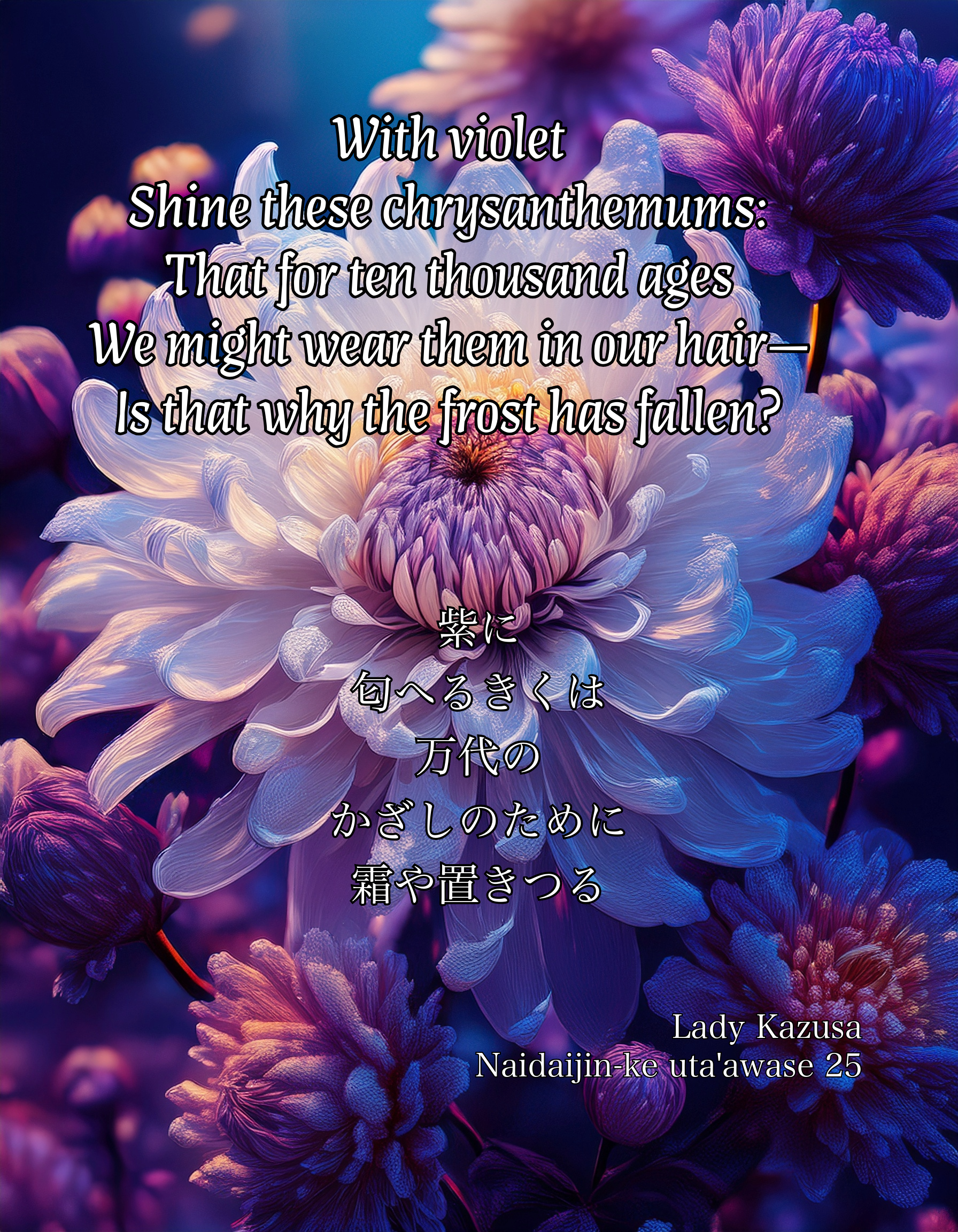
紫に匂へるきくは万代のかざしのために霜や置きつる
| murasaki ni nioeru kiku wa yorozuyo no kazashi no tame ni shimo ya okitsuru | With violet Shine these chrysanthemums: That for ten thousand ages We might wear them in our hair— Is that why the frost has fallen? |
Lady Kazusa
25
Right
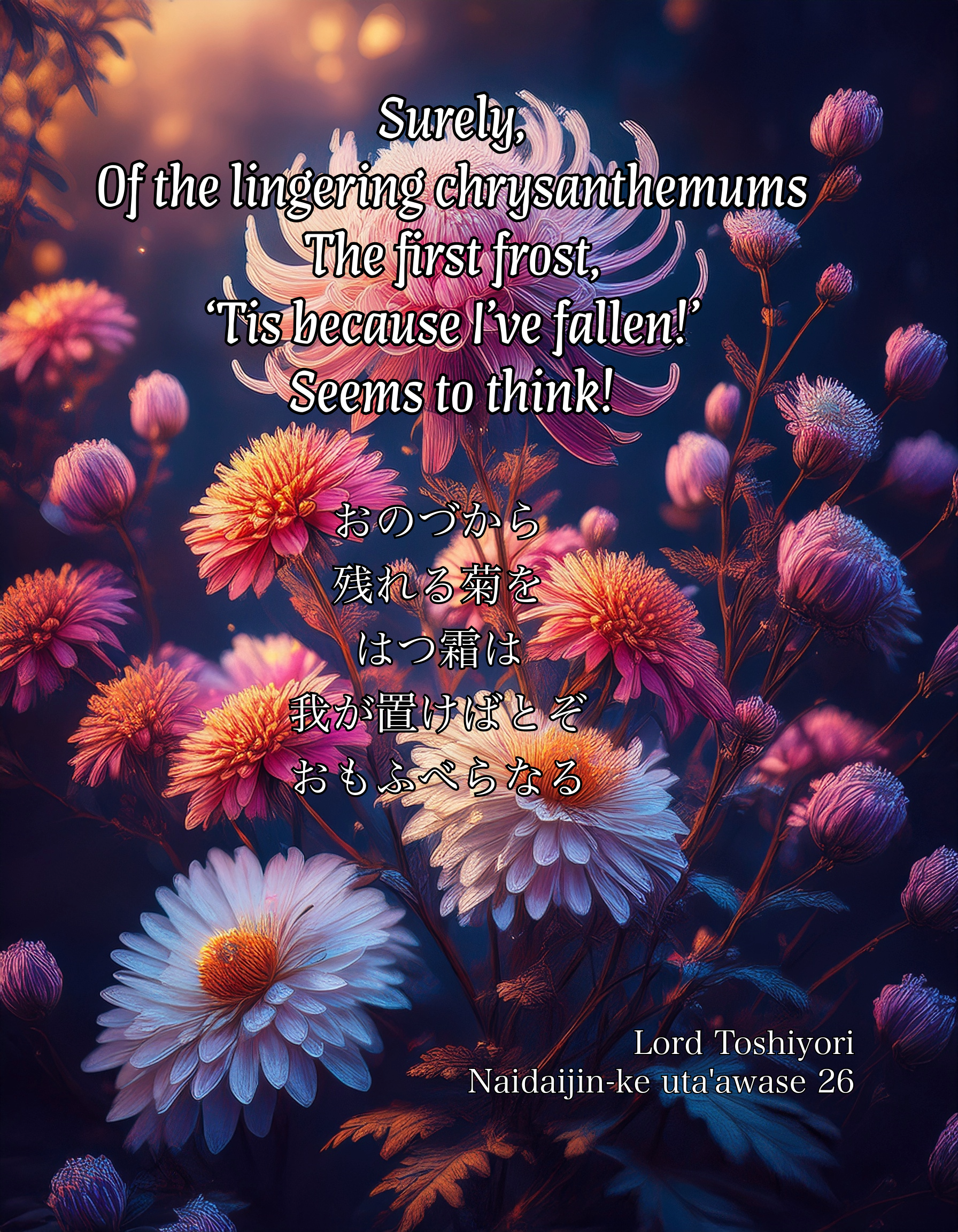
おのづから残れる菊をはつ霜は我が置けばとぞおもふべらなる
| onozukara nokoreru kiku o hatsushimo wa wa ga okeba to zo omouberanaru | Surely, Of the lingering chrysanthemums The first frost, ‘Tis because I’ve fallen!’ Seems to think! |
Lord Toshiyori
26
Toshiyori states: while the first poem is not remarkable, it does sound smooth. The concluding ‘has fallen’, though—would it be excessive to say that I feel it’s a bit grating? In the second poem, the assembled company have stated that ‘seems to’ is something that they have never heard before in their lives and given that they have said that this is what it sounds like, I make the Left the winner.
Mototoshi states: ‘With violet / Shine these chrysanthemums’ sounds appropriately poetic, but saying ‘that…we might wear them in our hair’ followed by the final ‘has fallen’ is a sequencing that is, in great part, inharmonious and lacking in gentle beauty. Nevertheless, I feel that the second poem’s ‘Surely, / Of the lingering chrysanthemums’ and the final ‘seems to’ is so unfamiliar that it makes me wonder what is going on with the sequencing there, so a single dipping in violet dye is superior and, I feel, all the sweeter!
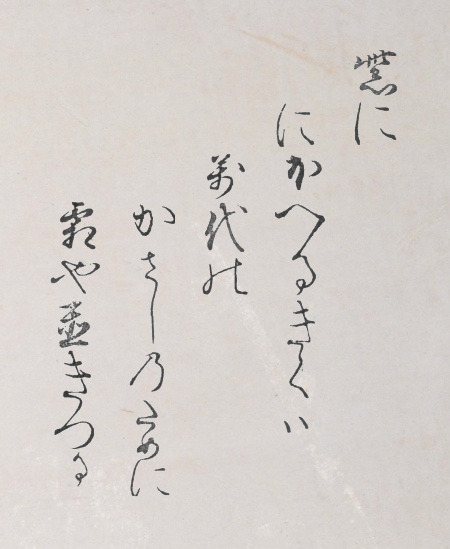
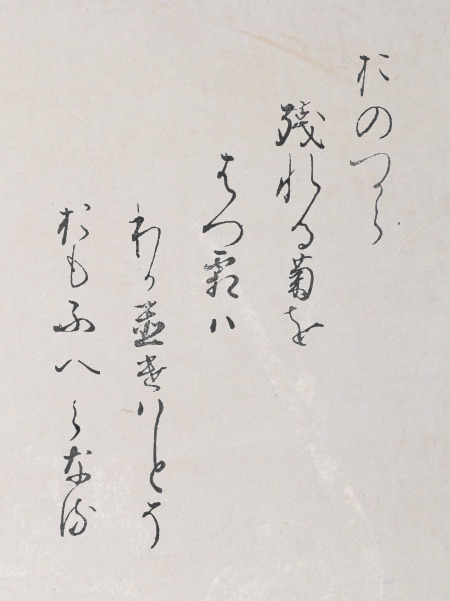
Original
ちはやぶるかすがのはらにこきまぜてはなともみゆるかみのきねかな
| chihayaburu kasuga no hara ni kokimazete hana tomo miyuru kami no kine kana | On mighty Kasuga plain All blend together Blossom seen with The God’s servitors! |
Mitsune
10
Left (Win)
かすがののはなとはまたも見えぬべしいまこむはるのかざしがてらに
| kasugano no hana to wa mata mo mienubeshi ima komu haru no kazashigatera ni | Kasuga Plain’s Blossom once more Could be seen, In the spring now lying ahead, As a garland in its hair… |
11
Right
はるがすみたちまじりつつゆくからにあだにもはなとみえにけるかな
| harugasumi tachimajiritsutsu yuku kara ni ada ni mo hana to mienikeru kana | Amidst the haze of spring Standing Have we come, so It might be untrue, but as blossom Do we seem! |
12
The Lady of the Right on this occasion mistook the word ‘plain’ in the original poem and wrote down ‘meadow’ instead. This was challenged by the Lady of the Left, saying, ‘That’s what we heard. When someone composes at variance with the conception of the topic, that’s a loss. Thus, the Lady of the Right loses.’
Tadafusa then said to His Majesty, ‘The character used to write “plain” can, in fact, also be used to write “field”. Even though the Right is inferior, it is still a fine poem, and so I would make this a tie.’
His Majesty responded, ‘The does not correspond to what has been said. You don’t seem to reached a logical conclusion.’
Tadafusa silently bowed his head, and after long while, eventually, said, ‘What the Lady of the Left has said is logical and appropriate.’
‘Well, then, judge again, based on this,’ His Majesty instructed, and the Lady of the Right lost, and was not permitted another composition.


A folk song about the village of Asahi in Ōmi Province, performed at the eastern celebration of the Great Thanksgiving Service in Chōwa 5 [1016].
あかねさす朝日のさとのひかげぐさ豊明のかざしなるべし
| akane sasu asahi no sato no hikagegusa toyo no akari no kazashi narubeshi | Shining madder red Morning sun rises over Asahi village, Sunlight upon the ground pines, for The banquets, ever lit, A fine hair decoration! |
Sukechika, Master of Service
祭主輔親
A poem by Kamō, the dancing girl.
雪嶋 巌尓殖有 奈泥之故波 千世尓開奴可 君之挿頭
ゆきのしま いはほにうゑたる なでしこは ちよにさかぬか きみがかざしに
| yuki no sima ipapo ni uwetaru nadesiko pa tiyo ni sakanu ka kimi ga kazasi ni | Snow lies heavy on the garden’s Rocks where grow The pinks: O, won’t you bloom a thousand years? That my Lord may wear you in his hair… |
Composed when he presented a Hundred Poem Sequence to former Emperor Sutoku.
たつたひめかざしのたまのををよわみみだれにけりとみゆるしらつゆ
| tatutaFime kazasi no tama no wo wo yowami midarenikeri to miyuru siratuyu | Princess Tatsuta’s Jewelled hairpin Has threads so frail that Confused do Appear the silver dewdrops. |
Lord Fujiwara no Kiyosuke

