Eien narabō uta’awase 20

Round Six

Left

あきの夜のありあけのつきはくまもなしあさくらやまもなのみこそあらめ

aki no yo no
ariake no tsuki wa
kuma mo nashi
asakurayama mo
na nomi koso arame
At an autumn night’s
Dawn, the moon
Has not a cloud before it;
The Mount of Morning Dark
May be so in name alone!

Cell of Fragrant Cloud
39

Right (Win)

秋の月あかしのうらはなびきもにすむわれからのかずも見つべし

aki no tsuki
akashi no ura wa
nabikimo ni
sumu warekara no
kazu mo mitsubeshi
The autumn moon is
Bright above Akashi Bay;
Among the trailing seaweed
Dwell tiny shrimp,
Their number now clear to my eyes.

Cell of Compassionate Light
40

The poem of the Left is an entirely tedious composition. It simply states that a cloudless autumn moon does not fit with the place name, Mount Asakura. The moon at ‘dawn’ is the same as the moon at ‘dawntime’, while Mount Asakura is used when dawn has completely finished. As for the poem of the Right, while the moon is described as bright, it doesn’t seem right to then make it a poem about trailing seaweed—this does not seem charming at all. This round, too, there’s not much more I can say than that.

As I have already mentioned, ‘moon at dawn’ in the poem of the Left is an expression which it is impossible to say is praiseworthy. Even more so, really, the concluding ‘may be so in name alone’ just says ‘is so in name alone’, doesn’t it? It’s contrary to reason to say that it’s fluent and thus, and I say this reluctantly, it’s difficult to understand. As for the Right’s poem, I don’t understand this either: it ought to be ‘their numbers, too, I have been able to see’—saying ‘their number now clear to my eyes’ implies that you haven’t previously been able to see them up to that point, and it’s vague about when you have. Even so, it’s getting light, so the light of the moon at dawn seems superior.

Eien narabō uta’awase 19

Round Five

Left

あきのよのふけゆくかぜにくもはれてはなだのそらにすめるつきかげ

aki no yo no
fukeyuku kaze ni
kumo harete
hanada no sora ni
sumeru tsukikage
As the autumn night
Wears on, the wind
Clears away the cloud, and
From the pale indigo sky
Comes clear moonlight.

Controller’s Graduate
37

Right

ふるさとのときぞともなきさびしさもなぐさむばかりすめる月かな

furusato no
toki zo tomonaki
sabishisa mo
nagusamu bakari
sumeru tsuki kana
In the ancient capital
Timeless is
The lonely sadness
Consoled only
By the clear, bright moon!

Kerin’in Graduate
38

The Left’s poem is a transparent copy of an older work. That poem is:

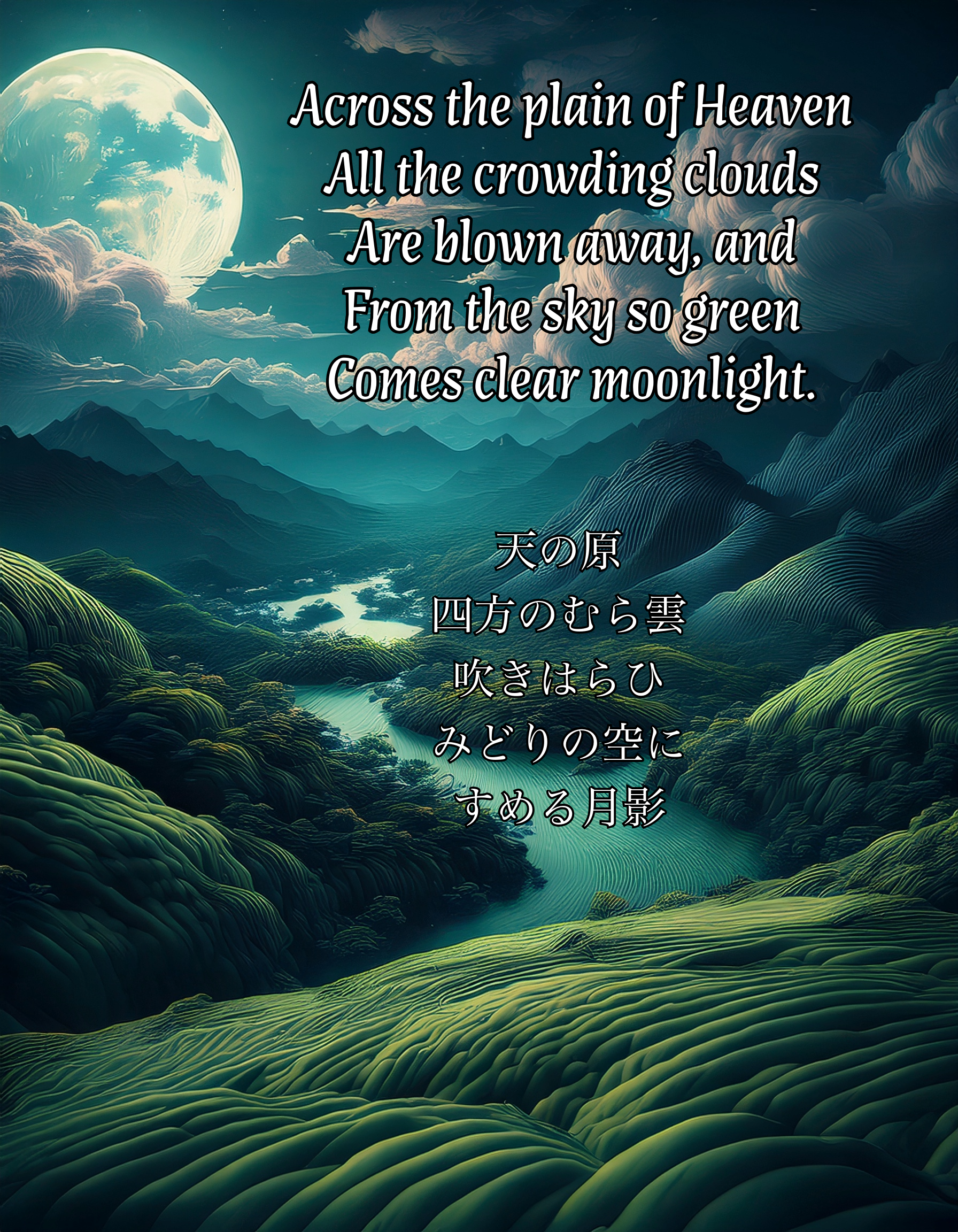
天の原四方のむら雲吹きはらひみどりの空にすめる月影

ama no hara
yomo no muragumo
fukiharai
midori no sora ni
sumeru tsukikage
Across the plain of Heaven
All the crowding clouds
Are blown away, and
From the sky so green
Comes clear moonlight.[i]

I don’t feel this is in any way different. As for the Right’s poem, while it is not the case that it is entirely without conception, it lacks any exemplary elements, so I don’t see how I can possibly recommend either of these.

The Left’s poem isn’t bad, but it should be revised to use ‘sky so green’, because using ‘pale indigo sky’ is vague. To decide in favour of it I would need there to be a prior poem as precedent. The Right’s poem is not particularly exemplary, but it does sound as if there are times like that. In the absence of a precedent for the Left, the poem of the Right wins.


[i] The source of this poem is unknown.

Eien narabō uta’awase 18

Round Four

Left

まくずはふ山ぢもはれてあきのよはこゆるたびびとやすき月かな

makuzu hau
yamaji mo harete
aki no yo wa
koyuru tabibito
yasuki tsuki kana
Kudzu vines crawl
Along the mountain paths, so clear
On an autumn night for
A traveller a’crossing
Lit by a clement moon!

Cell of the Fragrant Elephant
35

Right

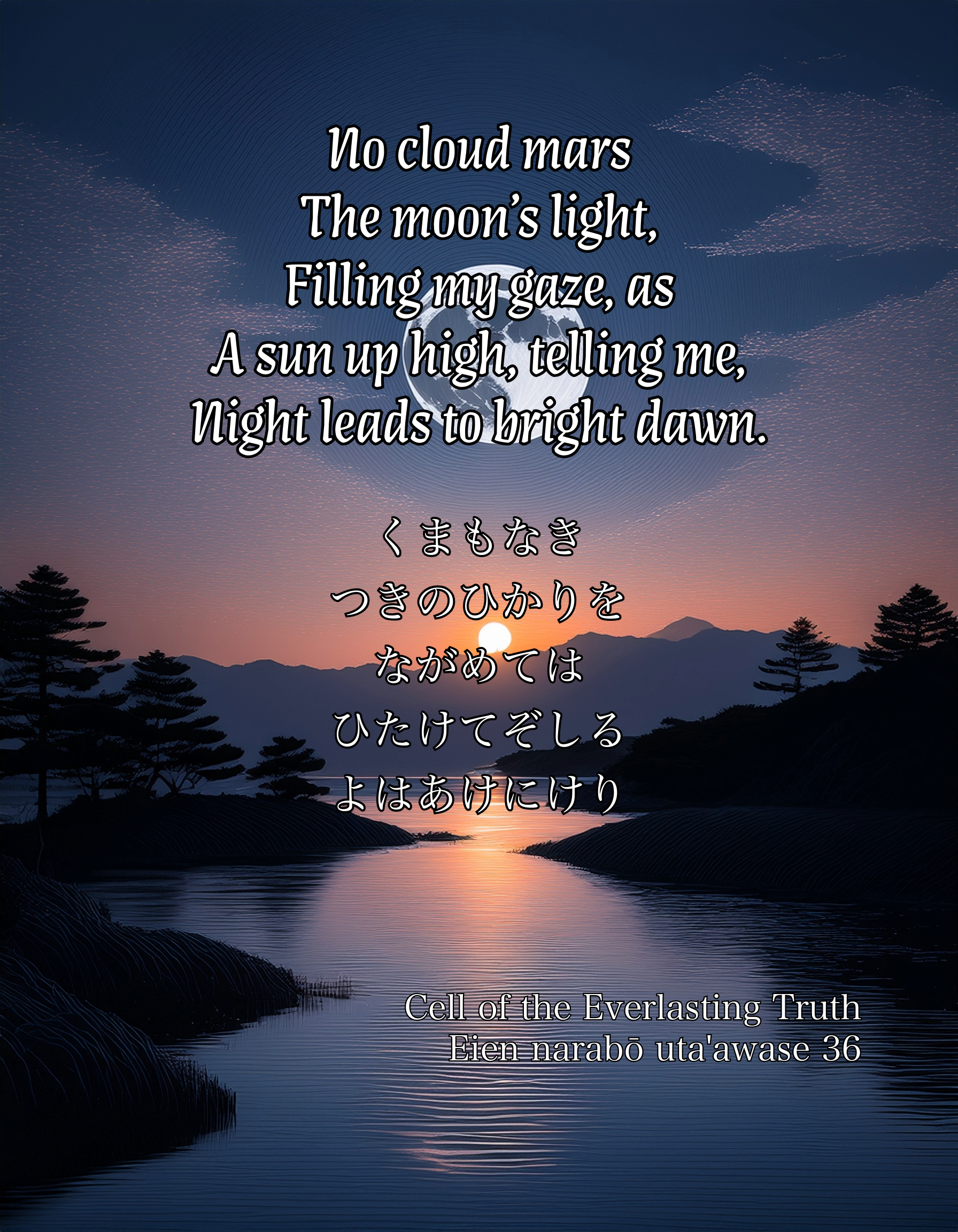
くまもなきつきのひかりをながめてはひたけてぞしるよはあけにけり

kuma mo naki
tsuki no hikari o
nagamete wa
hi takete zo shiru
yo wa akenikeri
No cloud mars
The moon’s light,
Filling my gaze, as
A sun up high, telling me,
Night leads to bright dawn.

Cell of the Everlasting Truth
36

The poem of the Left has nothing to present in all of its syllables. The poem of the Right resembles a composition by someone drunk out of his mind. As a result, it’s impossible to decide between them.

In the poem of the Left, does ‘clement moonlight’ mean that the moon’s light enables one to traverse a mountain path, which normally one would be unable to make one’s way along because one would expect it to be dark? The diction here is insufficient. As it says in the preface to the Ancient and Modern Collection of Narihira’s poems, ‘excessive conception but lacking in diction, like withered flowers lacking colours, but with a lingering fragrance’. This is a poem in that style, isn’t it. As for the poem of the Right, this, too, has ‘night leads to bright dawn’—the diction here is stilted and the conception lacks elegance. I have to say these poems are of about the same standard.

GSIS IV: 256

Composed for the Palace Poetry Match held on the 10th day of the Eighth Month, Kanna 1.

いつもみる月ぞとおもへどあきのよはいかなるかげをそふるなるらん

itumo miru
tuki zo to omoFedo
aki no yo Fa
ika naru kage wo
soFurunaruran
Always, do I see
The moon, I thought, yet
On an autumn night
What is this light
That trails over all?

Fujiwara no Nagayoshi

Eien narabō uta’awase 17

Round Three

Left (Win)

いかにしてあきはひかりのまさるらんおなじみかさの山のはの月

ika ni shite
aki wa hikari no
masaruran
onaji mikasa no
yama no ha no tsuki
Why is it that
In autumn your light
Should be best of all?
Though always upon Mikasa
Mountain’s edge you rest, O moon…

Retired from the world
33

Right

秋のよはくもるといへどこと月のさやけきよりもさやけかりけり

aki no yo wa
kumoru to iedomo
koto tsuki no
sayakeki yori mo
sayakarikeri
On an autumn night
Cloudy it may be, yet
Compared to another moon’s
Brightness, ‘tis still
More bright.

Senior Assistant Minister Past Lecturer
34

Both the configuration and diction of the Left’s poem seem comprehensible. The poem of the Right’s use of ‘moon’ is dubious and blameworthy. Thus, the Left wins.

The poem of the Left doesn’t sound bad. I feel it has a well-trodden ending for a poem and it reminds me of the old line ‘what is this light’[1]—it’s extremely charming. In the Right’s poem, I wonder if ‘another moon’ might be referring to the calendar month, but listening to it, it really does sound as if there are two moons in the sky! Furthermore, the poem lacks fluency and is further case of a hasty retreat from the topic, isn’t it.  It’s an excess of technique to say that the autumn moon is not inferior to any other, even if it’s covered with cloud.


[1] Composed for the Palace Poetry Match held on the 10th day of the Eighth Month, Kanna 1. いつもみる月ぞとおもへどあきのよはいかなるかげをそふるなるらん itsumo miru / tsuki zo to omoedo / aki no yo wa / ika naru kage o / sourunaruran ‘Always, do I see / The moon, I thought, yet / On an autumn night / What is this light / That trails over all?’ Fujiwara no Nagayoshi (GSIS IV: 256)

Eien narabō uta’awase 16

Round Two

Left (Win)

秋のよの月のひかりはかはらねどたびのそらこそあはれなりけれ

aki no yo no
tsuki no hikari wa
kawaranedo
tabi no sora koso
aware narikeri
On an autumn night
The moon’s light
Is unchanged, yet
The sky above me on my travels
Is so very sad, indeed.

Lord Saburō
31

Right

あきの夜はたのむる人もなきやどもありあけの月はなほぞまちいづる

aki no yo wa
tanomuru hito mo
naki yado mo
ariake no tsuki wa
nao zo machi’izuru
On an autumn night
With no man even expected
At my house,
It is the dawntime moon’s
Appearance that, indeed, I have awaited.

Ushigimi

32

The poem of the Left seems extremely well-trodden. It resembles a something sung as a popular song. As for the poem of the Right, ‘not…at my house’ is extraordinarily stilted, yet the poems are of the same quality, so I would say these tie.

The poem of the Left’s final ‘Is so very sad, indeed’ sounds pitiful and truly unskilled. The poem of the Right overemphasises ‘even’, and also appears to say that the dawntime moon is an element conveying a moving desolation. I wonder if this is appropriate for the topic of the ‘the moon’ in a poetry match? There needs to be a prior poem as precedent. It does say that the moon’s emergence after having waited for it is something precious, but the poem refers to the moon in the latter part of the month, after the twentieth day, doesn’t it? This would seem to be moving, for sure, but it’s something which doesn’t shed much light, so I would say that the Left wins.

Eien narabō uta’awase 15

The Moon

Round One

Left (Win)

いたまよりねざめのとこにもる月をこひしきひととおもはましかば

itama yori
nezame no toko ni
moru tsuki o
koishiki hito to
omowamashikaba
Between the boards,
Waking me in my bed
Drips moonlight—
The man I love
If only it did more than bring to mind…

Lord Dainagon
29

Right

くれはどりふたむらやまをきて見ればめもあやにこそ月も見えけれ

kurehadori
futamurayama o
kite mireba
me mo aya ni koso
tsuki mo miekere
When the weave of twilight
Upon Futamura Mountain
One comes to see,
Another pattern fills the eye—
Bright moonlight.

Lord Chūnagon
30

The poem of the Left has an extremely refined configuration, but is lacking much of a conception of the moon, and has a much greater one of love. The poem of the Right has a moving conception, but it is about scarlet leaves that one says ‘another pattern fills the eye’. There have been no compositions to date utilizing this about the moon. As both poems have dubious elements, I feel they are of the same quality.

I must say that the initial section of the poem of the Left, ‘between the boards’, is something that not even the poets of bygone days placed at the beginning of their poems. I would say that such expressions as ‘between the boards of a ruined house’ sound blended, implying that the appearance within is fine. Perhaps the poet mistook this? In addition, I do not feel that this is a moon poem, and would have to say that it’s a love one. It really is very odd, isn’t it—suddenly including a love poem here. The poem of the Right has nothing about it worth mentioning, yet it appears to be a moon poem superficially. There’s nothing for it but, faced with the poem of the Left, which beats the hastiest of hasty retreats and ignores the essential meaning of the topic, but to make it the winner!