When there was a heavy spring shower falling, on the way back after I had made a pilgrimage to the two places.[i]
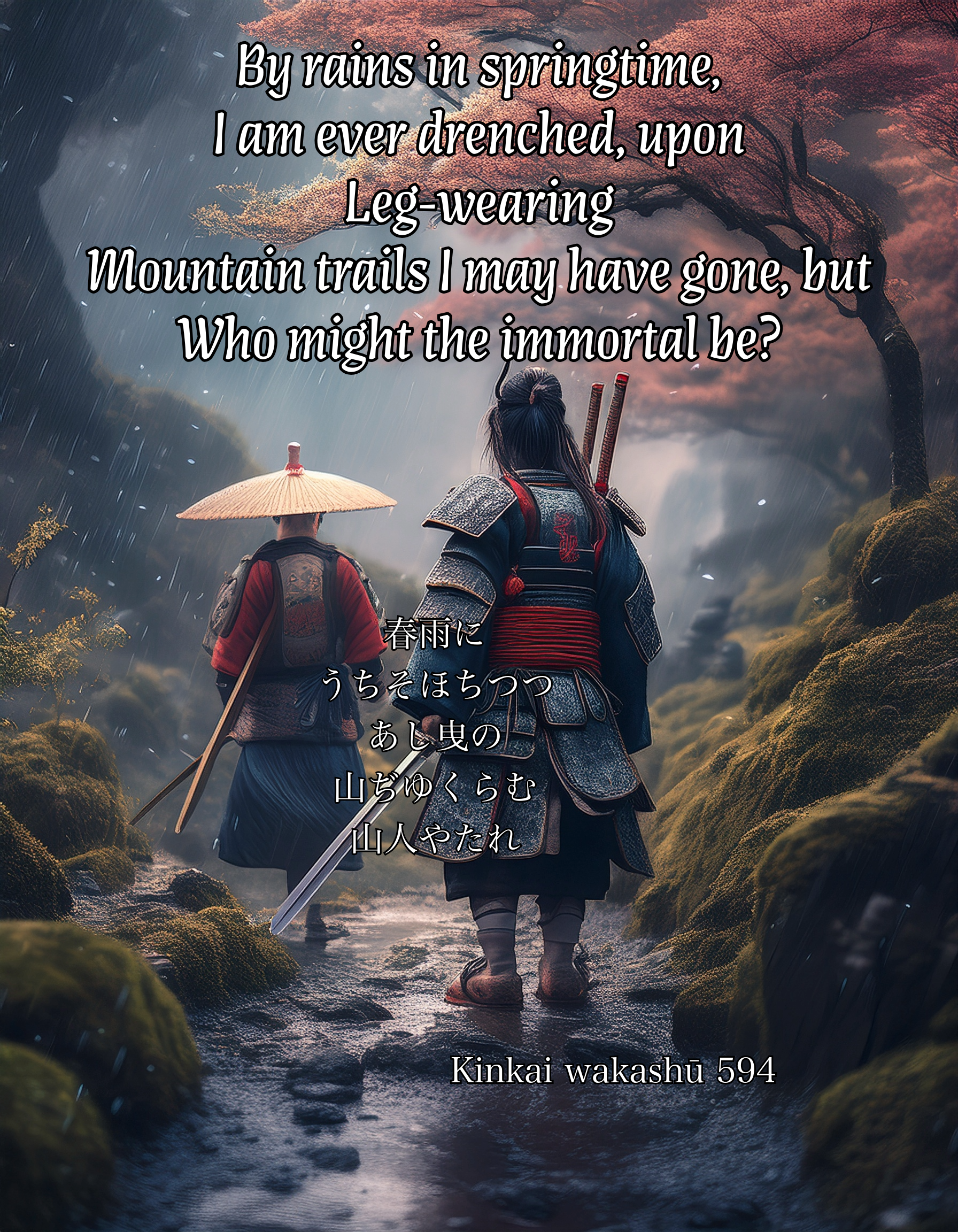
春雨にうちそほちつつあし曳の山ぢゆくらむ山人やたれ
harusame ni uchisōchitsutsu ashihiki no yamaji yukuramu yamabito ya tare
By rains in springtime, I am ever drenched, upon Leg-wearing Mountain trails I may have gone, but Who might the immortal be?[ii]
594
[i] ‘Two places’ (nisho 二所) was an abbreviation for ‘manifested deities of two shrines’ (nisho gongen 二所権現) which, in turn, was a reference to Hakone-gongen 箱根権現 and Izu-gongen 伊豆権現, the kami of Hakone shrine and Izuyama Shrine, manifesting as Buddhist deities. Both of these deities were venerated by Minamoto no Yoritomo 源頼朝 (1147-1199), the founder of the Kamakura shogunate, and his wife, Hōjō Masako 北条政子 (1157-1225) and after Yoritomo’s death, shogun’s continued to make an annual pilgrimage to both shrines.
[ii] See: A single poem presented in reply by Prince Toneri. 安之比奇能 山尓由伎家牟 夜麻妣等能 情母之良受 山人夜多礼 ashihiki no / yama ni yukikemu / yamabito no / kokoro mo shirazu / yamabito ya tare ‘To the leg-wearying / Mountains seeming to have gone / An immortal’s / Heart I cannot know, but / Who might that immortal be?’ (Man’yōshū XX: 4294)
Hidden in the grass on the path o’er the plains[i]
Left
なつくればのべのくさばもしげりあひていづれかみちとみえぞわかれぬ
natsu kureba nobe no kusaba mo shigeriaite izure ka michi to mie zo wakarenu
When the summer comes, The blades of grass upon the plains Grow lushly together, so Which is the path to take I cannot tell by looking!
9
Right
をちこちのみちみえぬまでなつののはくさばしげくもなりにけるかな
ochikochi no michi mienu made natsuno no wa kusaba shigeku mo narinikeru kana
Until both distant and nearby Paths I cannot see Across the summer plains Have the blades of grass so lushly Grown, indeed!
10
Do they not know the features of the summer plains conveyed by ‘Hidden in the grass on the path o’er the plains’? While both Left and Right use ‘blades of grass’, this puts one in mind of fresh grass sprouting in spring showers; and then of the two of them, the Right uses ‘distant and nearby’, which is nothing more than an archaic expression from the Age of Gods used for leg-wearying mountain paths, while at least the Left does not have a tangled argument.
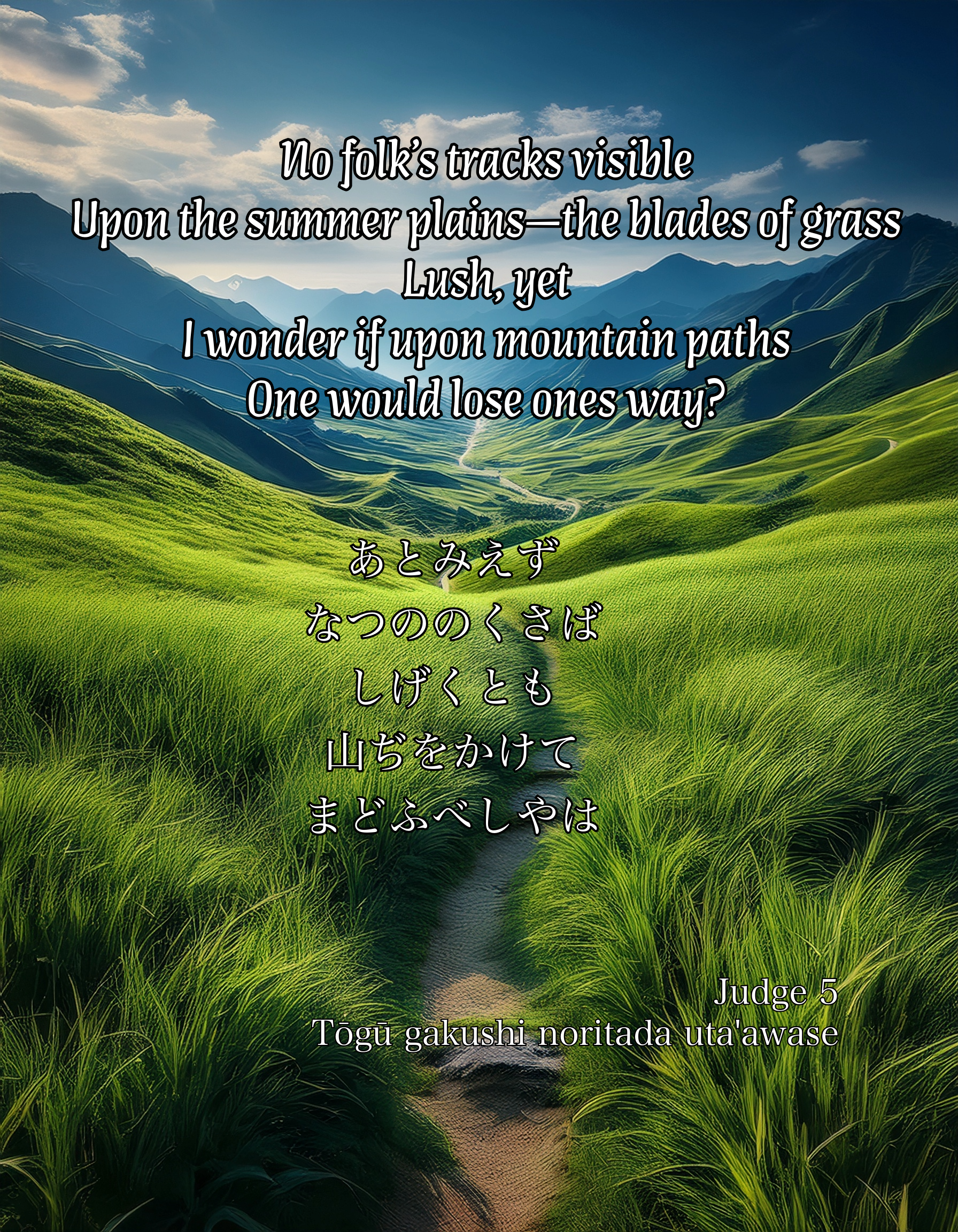
ato miezu natsuno no kusaba shigeku tomo yamaji o kakete madoubeshi ya wa
No folk’s tracks visible Upon the summer plains—the blades of grass Lush, yet I wonder if upon mountain paths One would lose ones way?
makuzu hau yamaji mo harete aki no yo wa koyuru tabibito yasuki tsuki kana
Kudzu vines crawl Along the mountain paths, so clear On an autumn night for A traveller a’crossing Lit by a clement moon!
Cell of the Fragrant Elephant 35
Right
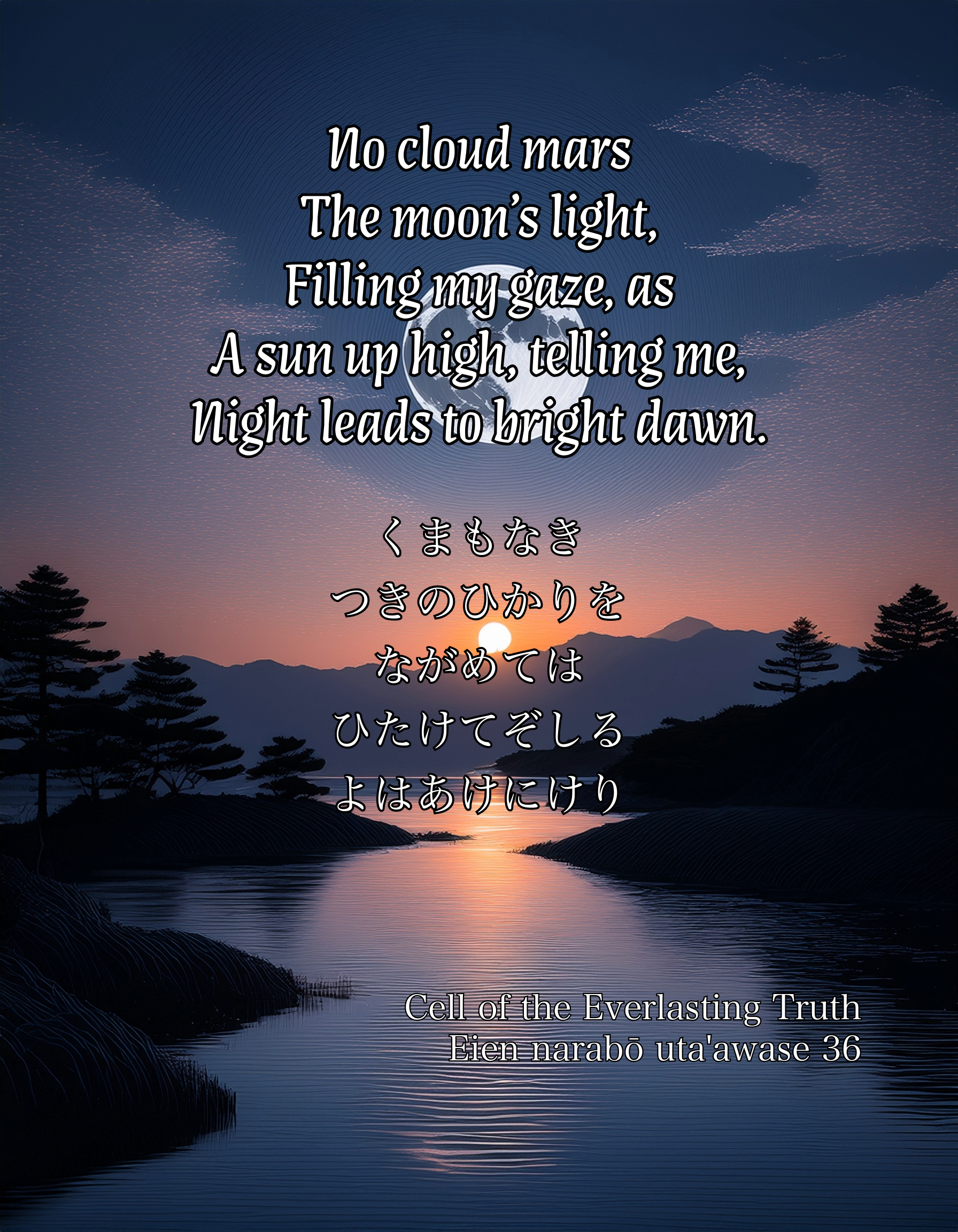
くまもなきつきのひかりをながめてはひたけてぞしるよはあけにけり
kuma mo naki tsuki no hikari o nagamete wa hi takete zo shiru yo wa akenikeri
No cloud mars The moon’s light, Filling my gaze, as A sun up high, telling me, Night leads to bright dawn.
Cell of the Everlasting Truth 36
The poem of the Left has nothing to present in all of its syllables. The poem of the Right resembles a composition by someone drunk out of his mind. As a result, it’s impossible to decide between them.
In the poem of the Left, does ‘clement moonlight’ mean that the moon’s light enables one to traverse a mountain path, which normally one would be unable to make one’s way along because one would expect it to be dark? The diction here is insufficient. As it says in the preface to the Ancient and Modern Collection of Narihira’s poems, ‘excessive conception but lacking in diction, like withered flowers lacking colours, but with a lingering fragrance’. This is a poem in that style, isn’t it. As for the poem of the Right, this, too, has ‘night leads to bright dawn’—the diction here is stilted and the conception lacks elegance. I have to say these poems are of about the same standard.
kusamakura onaji tabine no sode ni mata yowa no shigure mo yado wa karikeri
Needing a grassy pillow When travelling just the same as I, dozing I find my sleeves drenched even more, For the midnight shower, too, Has found lodging.
Kojijū 87
Right
いほりさすやまぢはすぎぬはつしぐれふるさとまでやめぐりゆくらむ
iori sasu yamaji wa suginu hatsushigure furusato made ya meguriyukuramu
I put up my hut Upon the mountain path that you passed by, O, first shower! As far as my ancient home I wonder, will you make your way?
Lord Sanemori 88
The poem of the Left, saying ‘When travelling just the same as I dozing, / I find my sleeves drenched even more’ and then following this with ‘For the midnight shower, too, / Has found lodging’, has an extremely charming conception and configuration. In addition to the poem of the Right also having a charming conception, it begins with ‘O, first shower!’ and then continues, ‘As far as my ancient home’, which is an effective use of diction. Nevertheless, the conception of the Left’s poem is even better and it wins.