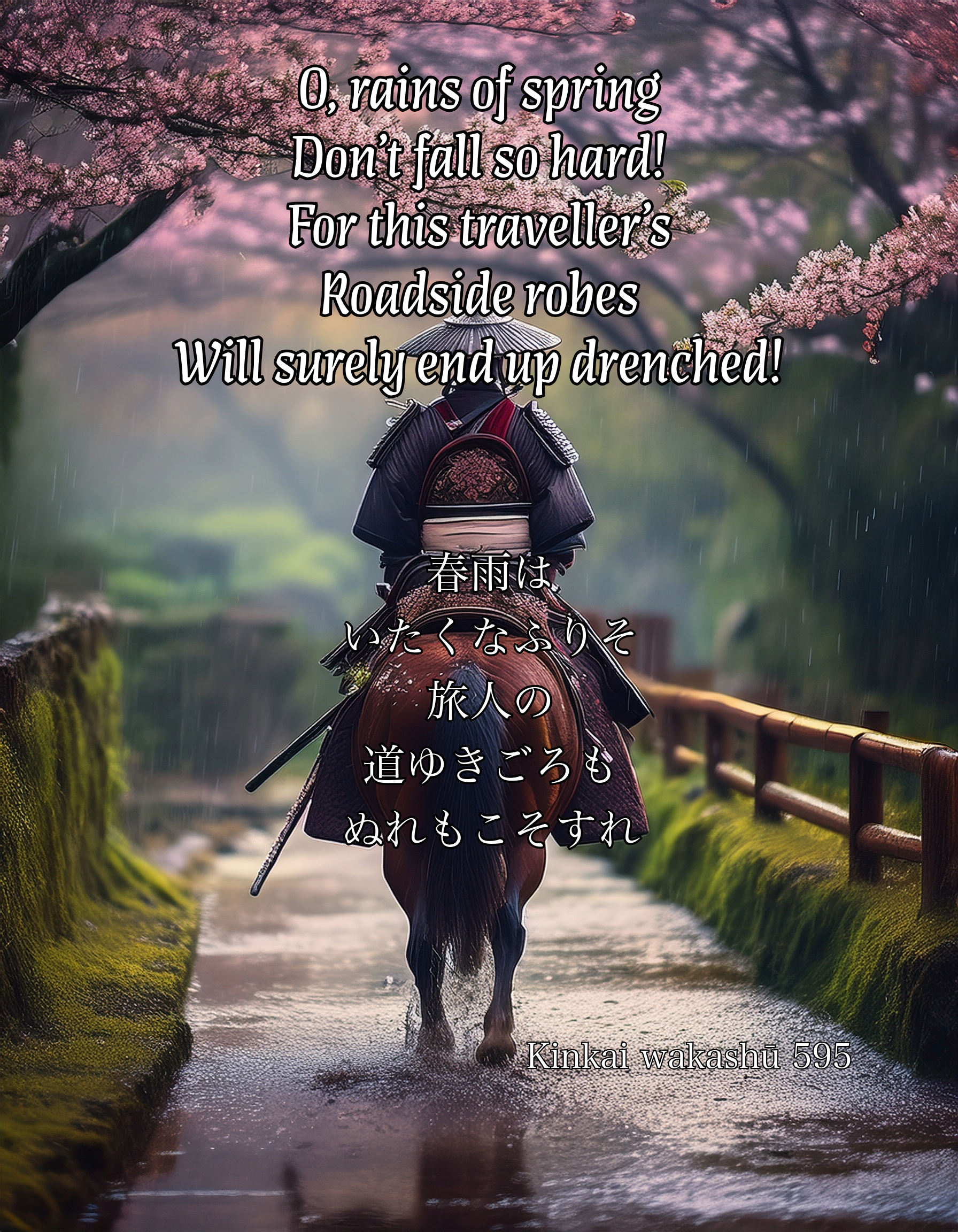
harusame wa itaku na furi so tabibito no michiyuki goromo nure mo koso sure
O, rains of spring Don’t fall so hard! For this traveller’s Roadside robes Will surely end up drenched![i]
595
[i] See: Topic unknown. 春雨はいたくなふりそ桜花まだみぬ人にちらまくもをし harusame wa / itaku na furi so / sakurabana / mada minu hito ni / chiramaku mo oshi ‘O, spring rains, / Fall not so hard! / The cherry blossom / Is yet unseen by folk who / Would regret its scattering’ Akahito (Shinkokinshū II: 110)
When there was a heavy spring shower falling, on the way back after I had made a pilgrimage to the two places.[i]
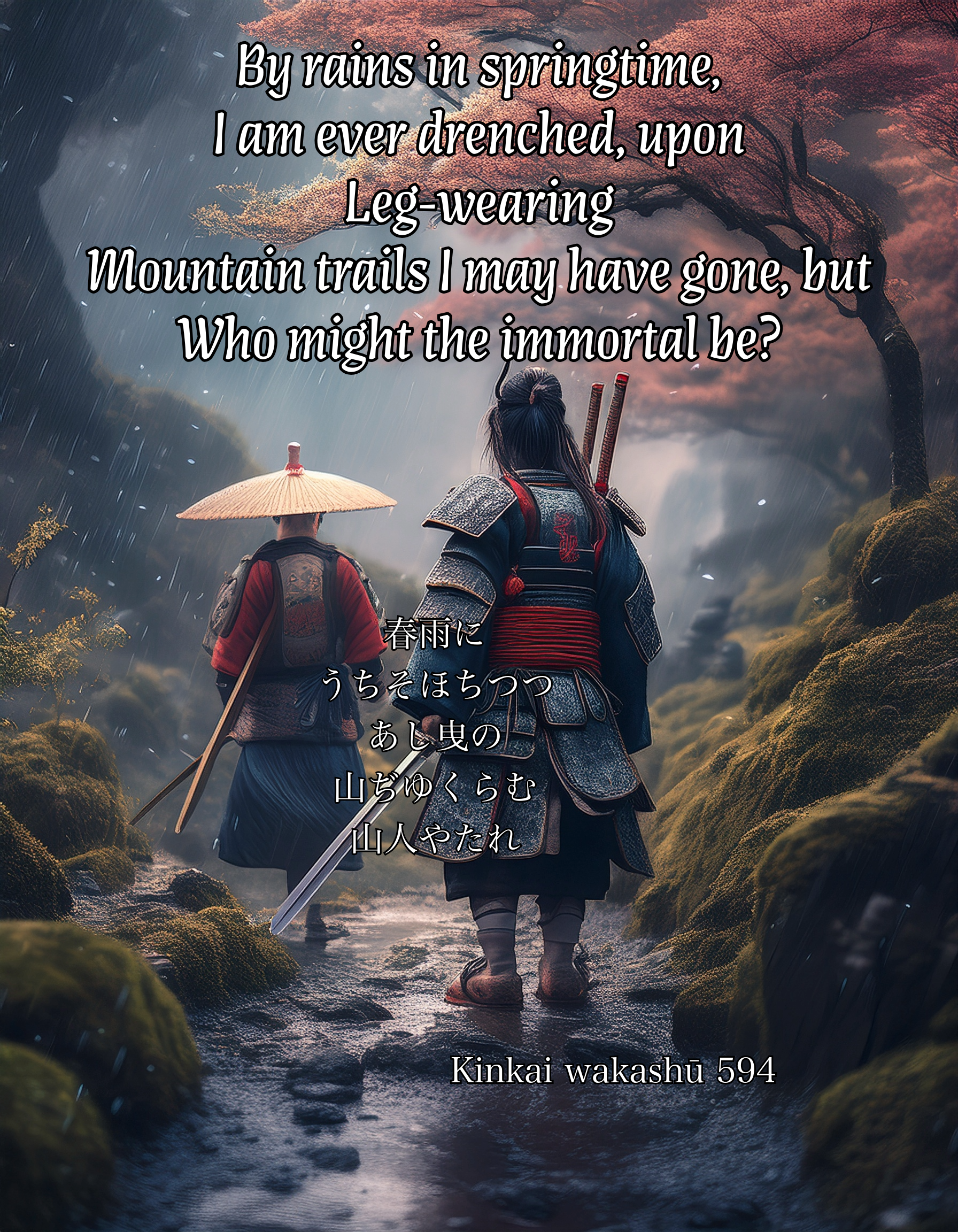
春雨にうちそほちつつあし曳の山ぢゆくらむ山人やたれ
harusame ni uchisōchitsutsu ashihiki no yamaji yukuramu yamabito ya tare
By rains in springtime, I am ever drenched, upon Leg-wearing Mountain trails I may have gone, but Who might the immortal be?[ii]
594
[i] ‘Two places’ (nisho 二所) was an abbreviation for ‘manifested deities of two shrines’ (nisho gongen 二所権現) which, in turn, was a reference to Hakone-gongen 箱根権現 and Izu-gongen 伊豆権現, the kami of Hakone shrine and Izuyama Shrine, manifesting as Buddhist deities. Both of these deities were venerated by Minamoto no Yoritomo 源頼朝 (1147-1199), the founder of the Kamakura shogunate, and his wife, Hōjō Masako 北条政子 (1157-1225) and after Yoritomo’s death, shogun’s continued to make an annual pilgrimage to both shrines.
[ii] See: A single poem presented in reply by Prince Toneri. 安之比奇能 山尓由伎家牟 夜麻妣等能 情母之良受 山人夜多礼 ashihiki no / yama ni yukikemu / yamabito no / kokoro mo shirazu / yamabito ya tare ‘To the leg-wearying / Mountains seeming to have gone / An immortal’s / Heart I cannot know, but / Who might that immortal be?’ (Man’yōshū XX: 4294)
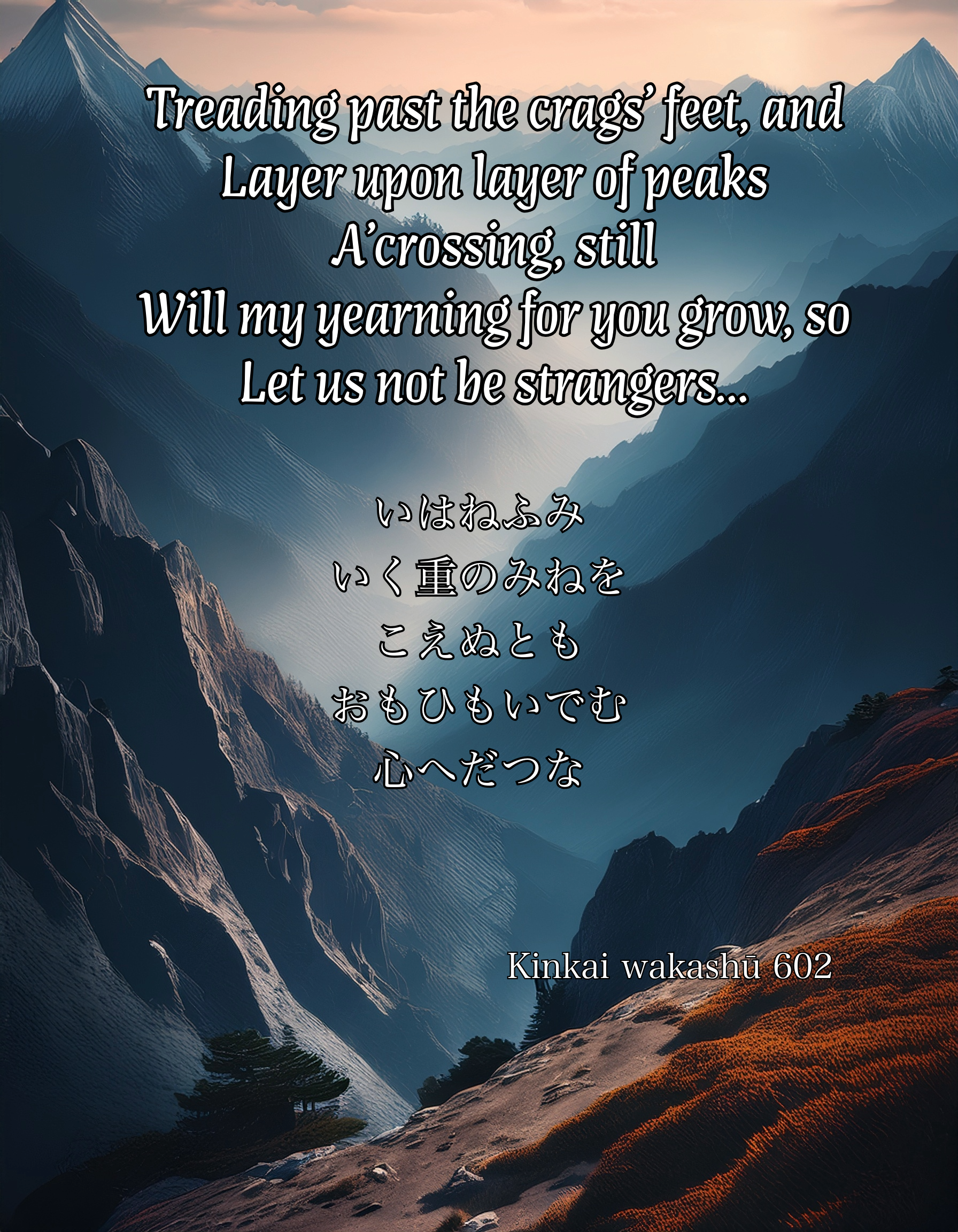
iwane fumi ikue no mine o koenu tomo omoi mo idemu kokoro hedatsu na
Treading past the crags’ feet, and Layer upon layer of peaks A’crossing, still Will my yearning for you grow, so Let us not be strangers…[i]
602
[i] See: Composed in the conception of parting when he took part in a hundred-poem sequence. 別れても心へだつな旅ごろも幾重かさなる山路なりとも wakarete mo / kokoro hedatsu na / tabigoromo / ikue kasanaru / yamaji naritomo ‘We may part, yet / Let us not be strangers; / Travellers’ robes / Place layer on layer, / Though mountain paths lie in-between.’ Fujiwara no Sada’ie (Senzaishū VII: 497)
miyako yori fukikomu kaze no kimi naraba wasuru na to dani iwamashi mono o
From the capital A’blowing, were the wind You made manifest, my love, ‘Forget me not!’ is all That I would wish to say…[i]
600
[i] See: On a day when there was an entertainment of launching some boats on the pond at the home of the Nakatsukasa Prince, the Priestly Retired Emperor came to watch. Towards evening, he prepared to leave, and Ise composed this poem for him. 水のうへにうかべる舟の君ならばここぞとまりといはまし物を mizu no ue ni / ukaberu fune no / kimi naraba / koko zo tomari to / iwamashi mono o ‘On the water / Float these boats: / If one were Your Majesty, / “Berth yourself here!” / Is what I would wish to say.’ Ise (Kokinshū XVII: 920)
miyakobe ni yume ni mo yukamu tayori araba utsu no yamakaze fuki mo tsuteyo
If towards the capital, Even to her dreams would you go, and Be my messenger, O, Utsu Mountain breeze, Blow, and tell her…[i]
599
[i] See: While at Utsu Mountain in Suruga, he thought of someone he had been meeting and sent this to the capital. するがなるうつの山邊のうつゝにも夢にも人にあはぬなりけり suruga naru / utsu no yamabe no / utsutsu ni mo / yume ni mo hito ni / awanu narikeri ‘In Suruga / At the Utsu mountains / In truth and / In my dreams she / Is nowhere to be seen…’ Ariwara no Narihira (Shinkokinshū X: 904)
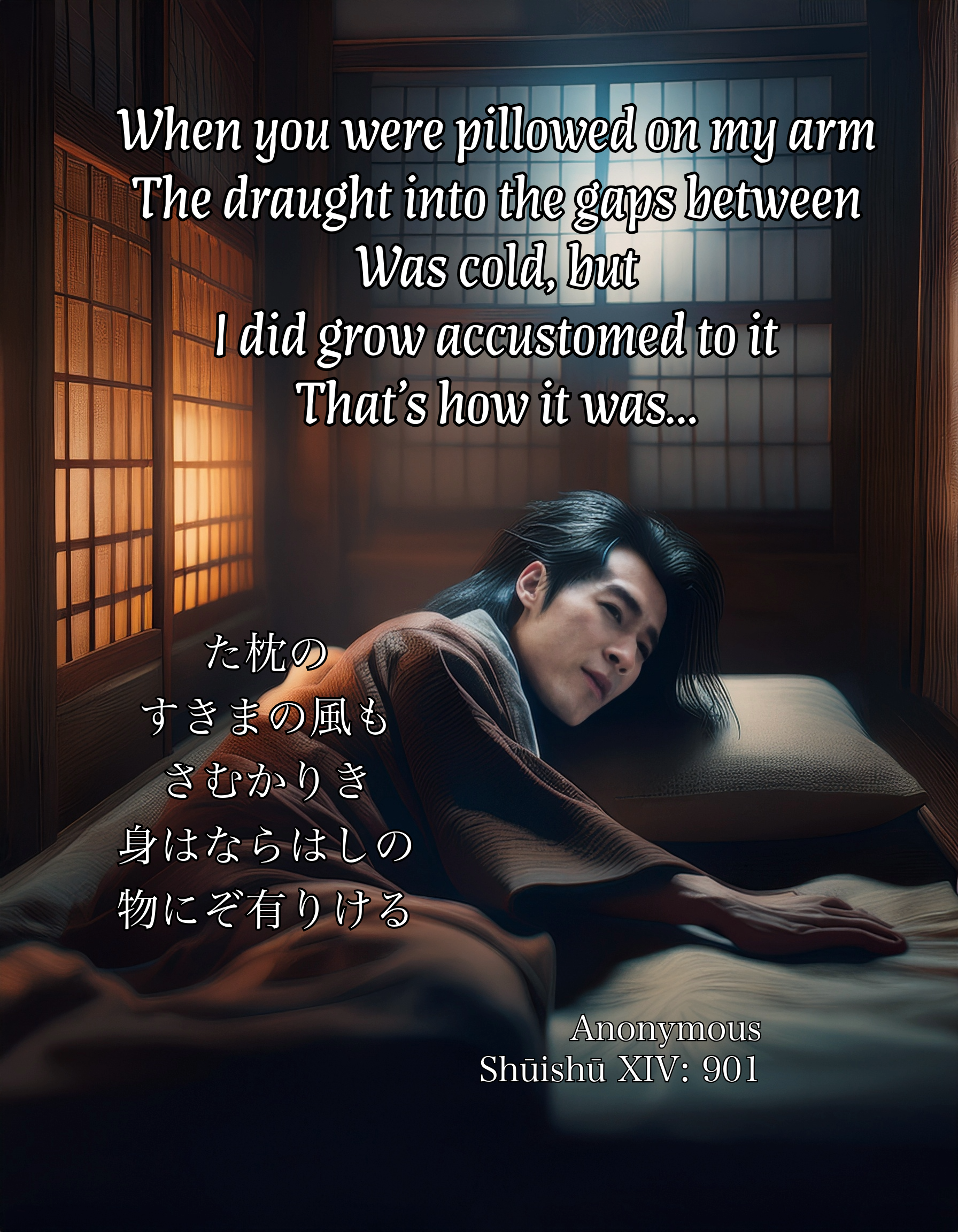
kakaru ori mo arikeru mono o tamakura no hima moru kaze o nani itoiken
At such times as these It comes to me: When you were pillowed on my arm, What about the draught slipping through the gaps Was so hateful?[i]
598
[i] See: Topic unknown. た枕のすきまの風もさむかりき身はならはしの物にぞ有りける tamakura no / sukima no kaze mo / samukariki / mi wa narawashi no / mono ni zo arikeru ‘When you were pillowed on my arm / The draught into the gaps between / Was cold, but / I did grow accustomed to it— / That’s how it was…’ Anonymous (Shūishū XIV: 901)
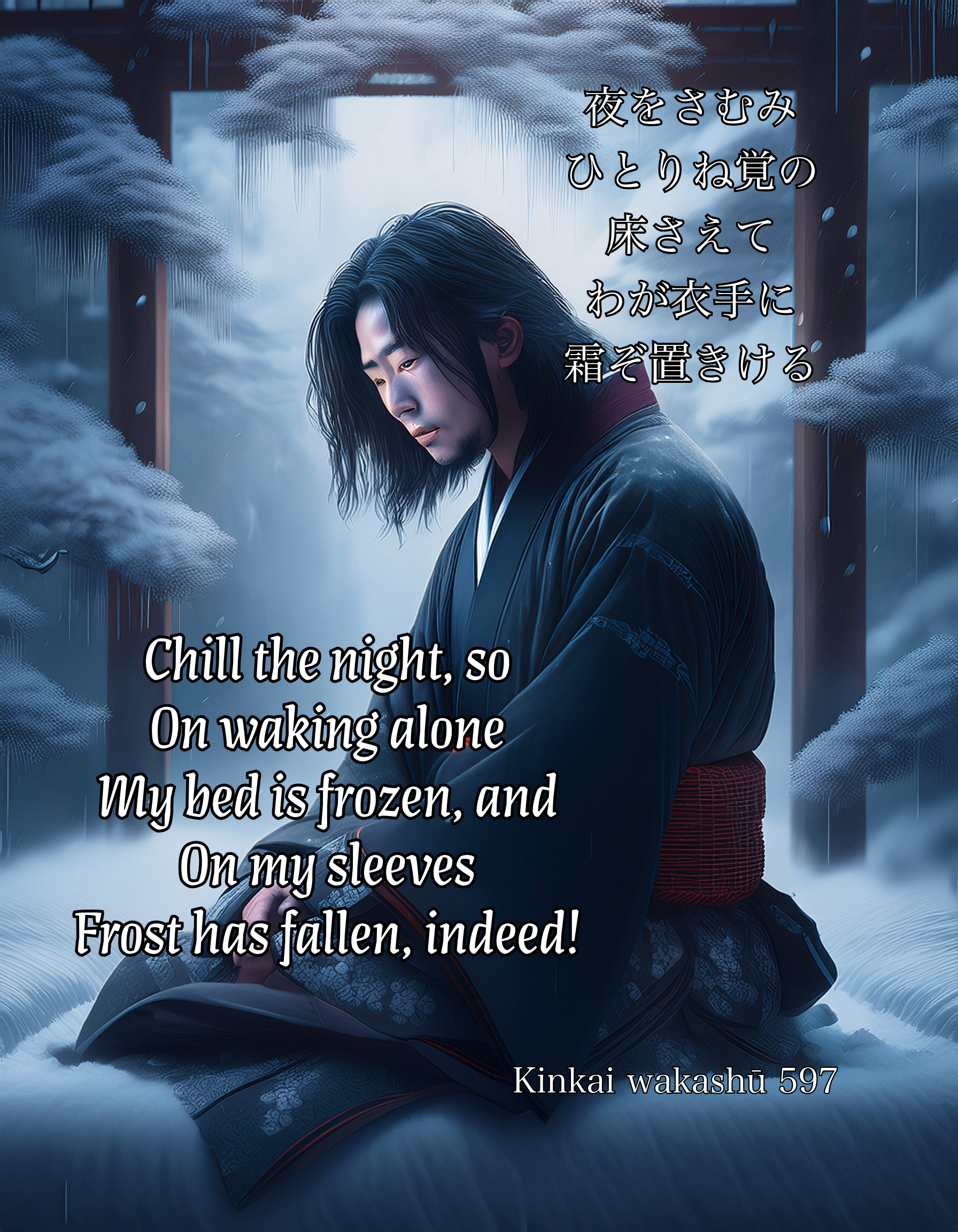
After a certain lady had set off up to the capital, I composed these and, attaching them to a letter, had it sent to her.
夜をさむみひとりね覚の床さえてわが衣手に霜ぞ置きける
yo o samumi hitori nezame no toko saete wa ga koromode ni shimo zo okikeru
Chill the night, so On waking alone My bed is frozen, and On my sleeves Frost has fallen, indeed![i]
597
[i] See: Topic unknown. 夜をさむみねざめてきけばをしぞなく払ひもあへず霜やおくらん yo o samumi / nezamete kikeba / oshi zo naku / harai mo aezu / shimo ya okuran ‘Chill the night and / On waking, I hear / A mandarin drake a’crying / For he cannot brush away / The fallen frost, it seems.’ Anonymous (Gosenshū VIII: 478)