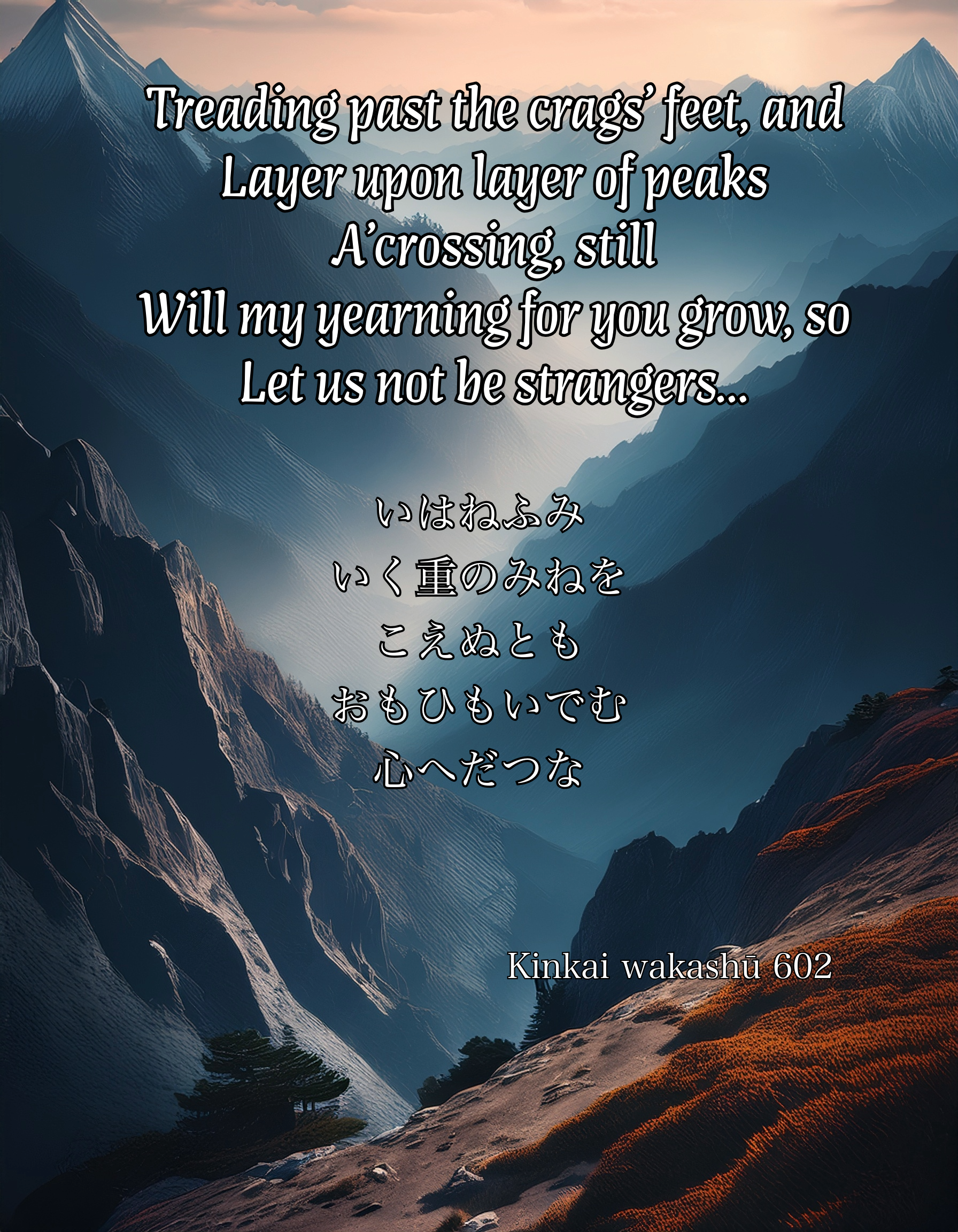
iwane fumi ikue no mine o koenu tomo omoi mo idemu kokoro hedatsu na
Treading past the crags’ feet, and Layer upon layer of peaks A’crossing, still Will my yearning for you grow, so Let us not be strangers…[i]
602
[i] See: Composed in the conception of parting when he took part in a hundred-poem sequence. 別れても心へだつな旅ごろも幾重かさなる山路なりとも wakarete mo / kokoro hedatsu na / tabigoromo / ikue kasanaru / yamaji naritomo ‘We may part, yet / Let us not be strangers; / Travellers’ robes / Place layer on layer, / Though mountain paths lie in-between.’ Fujiwara no Sada’ie (Senzaishū VII: 497)
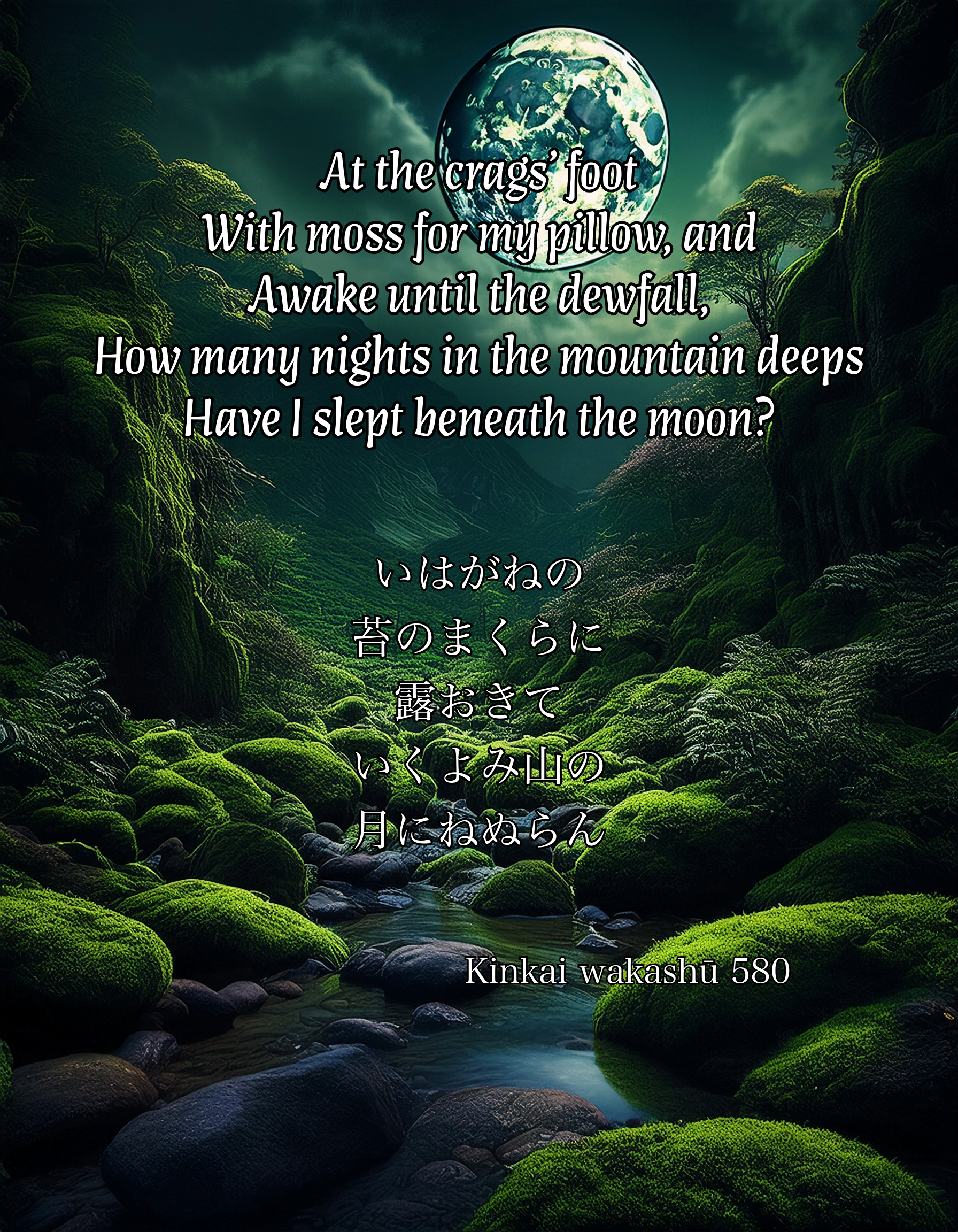
iwa ga ne no koke no makura ni tsuyu okite iku yo miyama no tsuki ni nenuran
At the crags’ foot With moss for my pillow, and Awake until the dewfall, How many nights in the mountain deeps Have I slept beneath the moon.[i]
580
[i] See: On the conception of seeing the moon while travelling, while at a place called the Barrier Gate Hall. 草枕ほどぞへにける都いでていくよかたびの月にねぬらむ kusamakura / hodo zo henikeru / miyako idete / ikuyo ka tabi no / tsuki ni nenuramu ‘Grassy pillows / For a while have been my lot! / Since departing the capital / For some days on my travels / Will I sleep beneath the moon.’ Ōe no Yoshitoki (Shinkokinshū X: 931)
hōriko ga shimeyū nobe no suzumushi wa yū tsukete koso furitatete nake
The priests have Garlanded the meadows where The bell crickets With the fall of evening Sing out so loud.
Major Archbishop 13
Right
神がきのいはねにさせる榊葉にゆふかけてなく鈴虫のこゑ
kamigaki no iwane ni saseru sakakiba ni yū kakete naku suzumushi no koe
Within the sacred precincts At the crags’ foot thrust Are leaves from the sacred tree To the garlands clinging, as crying Come the bell crickets’ songs.
Tadasue, Senior Assistant Minister of the Sovereign’s Household 14
I would say that both of these, Left and Right, are of the same quality in terms of diction and configuration.
uchimurete iwane ni nezasu komatsuba no kigi no chitose wa kimi zo kazoemu
Crowding At the crags’ foot, roots stretching, The dwarf pines’ needles with The trees’ thousand years— My Lord may count them all!
Cell of the Fragrant Elephant 63
Right (Win)
たとふべきものこそなけれ君がよははまのまさごもかずなからめや
tatoubeki mono koso nakere kimi ga yo wa hama no masago mo kazu nakarame ya
A suitable metaphor Is there none, at all! My Lord’s reign: Even the fair sands on the shore Would not exceed its number…
Cell of Everlasting Truth 64
Both of the Left poem’s expressions, ‘crowding’ and ‘dwarf pines’ needles’, seem to sound awkward. ‘Crowding’ is used of cranes, while it would have been preferable to say ‘the needles of the dwarf pines’. The poem of the Right is not especially charming, but it is in a familiar style, so I feel that ‘the fair sands’ number’ is superior.
I feel that ‘crowding’ is better applied to human beings. Perhaps there’s a conception here of looking down on each and every one? This is a mistake, isn’t it? In addition, what is ‘dwarf pines’ needles’? Maybe the poet is trying to say ‘the needles of the dwarf pines’? Is there a prior poem as precedent? It’s a piece of awkward-sounding diction! The Right’s poem appears straightforward, but without errors.
koke no musu iwane ni nokoru yaegiku wa yachiyo saku tomo kimi zo mirubeki
Choked with moss are The crags where linger Eightfold chrysanthemums: E’en were they eight thousand ages a’bloom My Lord would have beheld them, no doubt!
Lady Shinano 45
Right
霜がれに我ひとりとや白菊の色をかへても人にみすらん
shimogare ni ware hitori to ya shiragiku no iro o kaetemo hito ni misuran
‘Burned by frost ‘Tis me alone!’ thinks A white chrysanthemum, Changing hue To show to folk, for sure.
Lord Tokimasa 46
Toshiyori states: I wonder if there is a poem as precedent for chrysanthemums lingering beneath moss-covered crags? If not, it’s a very crude expression. The ending of the poem is antiquated, too. As for the second poem ‘“Tis me alone!” thinks’ does not sound satisfactory. The assembled company settled the matter of the final ‘folk’, so I must make this a tie.
Mototoshi states: whether they are placed by a brushwood fence, or at the base of a crag, chrysanthemums feel like pines. As for the Right, having a chrysanthemum seem to think ‘‘tis me alone’ is speculative—had it been something like ‘this bloom opens’ then it would have been the poet’s thoughts. Neither of these is of quality to win or lose, so I make them a tie.