tabi no sora narenu hanyū no yoru no toko wabishiki made ni moru shigure kana
Beneath a journey’s skies With unfamiliar mud walls Around my bed tonight, Sad and lonely have I become With the shower dripping through![i]
581
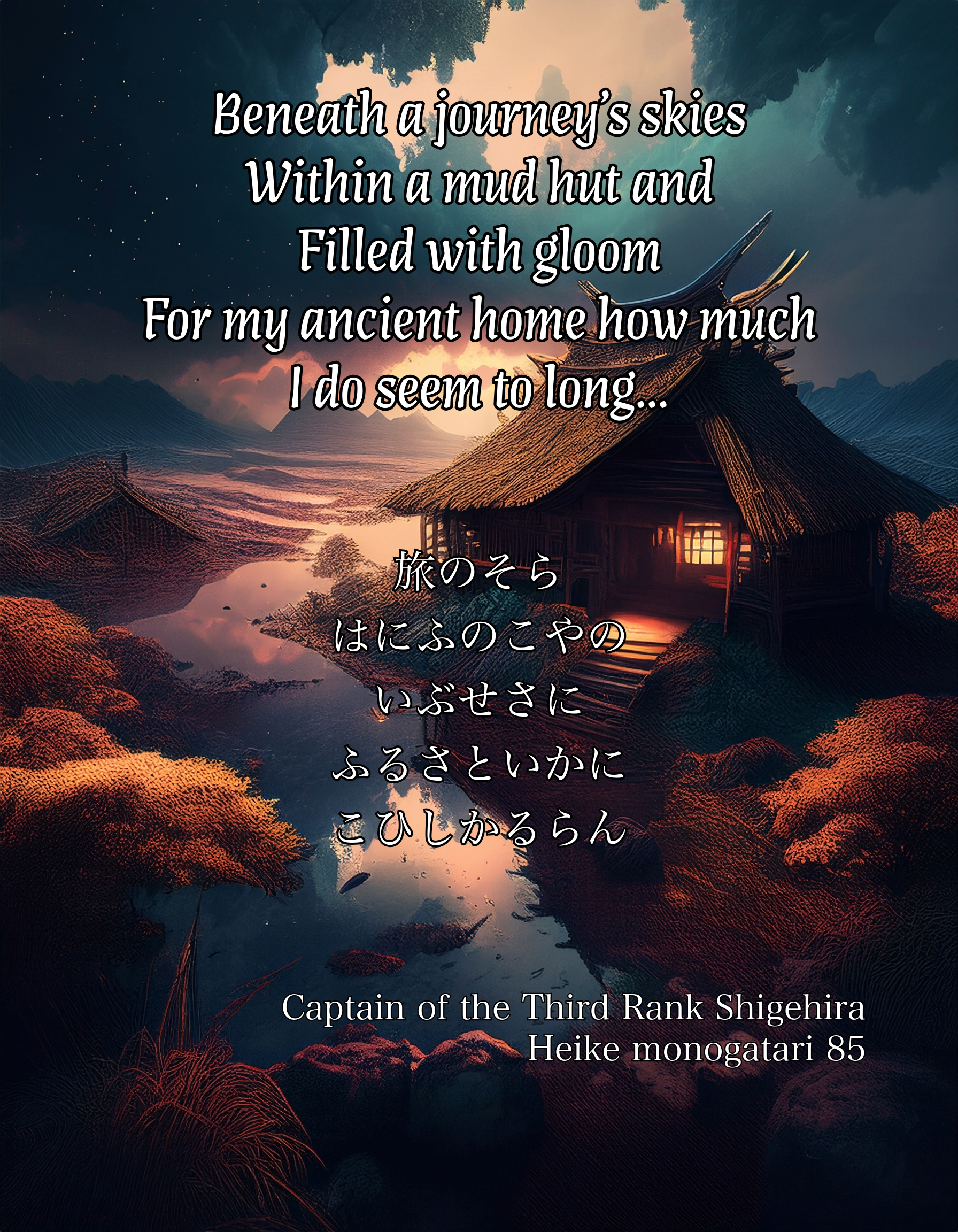
[i] See: On disembarking. 旅のそらはにふのこやのいぶせさにふるさといかにこひしかるらん tabi no sora / hanyū no koya no / ibusesa ni / furusato ika ni / koishikaruran ‘Beneath a journey’s skies / Within a mud hut and / Filled with gloom / For my ancient home how much / I do seem to long…’ Captain of the Third Rank Shigehira (Heike monogatari 85)
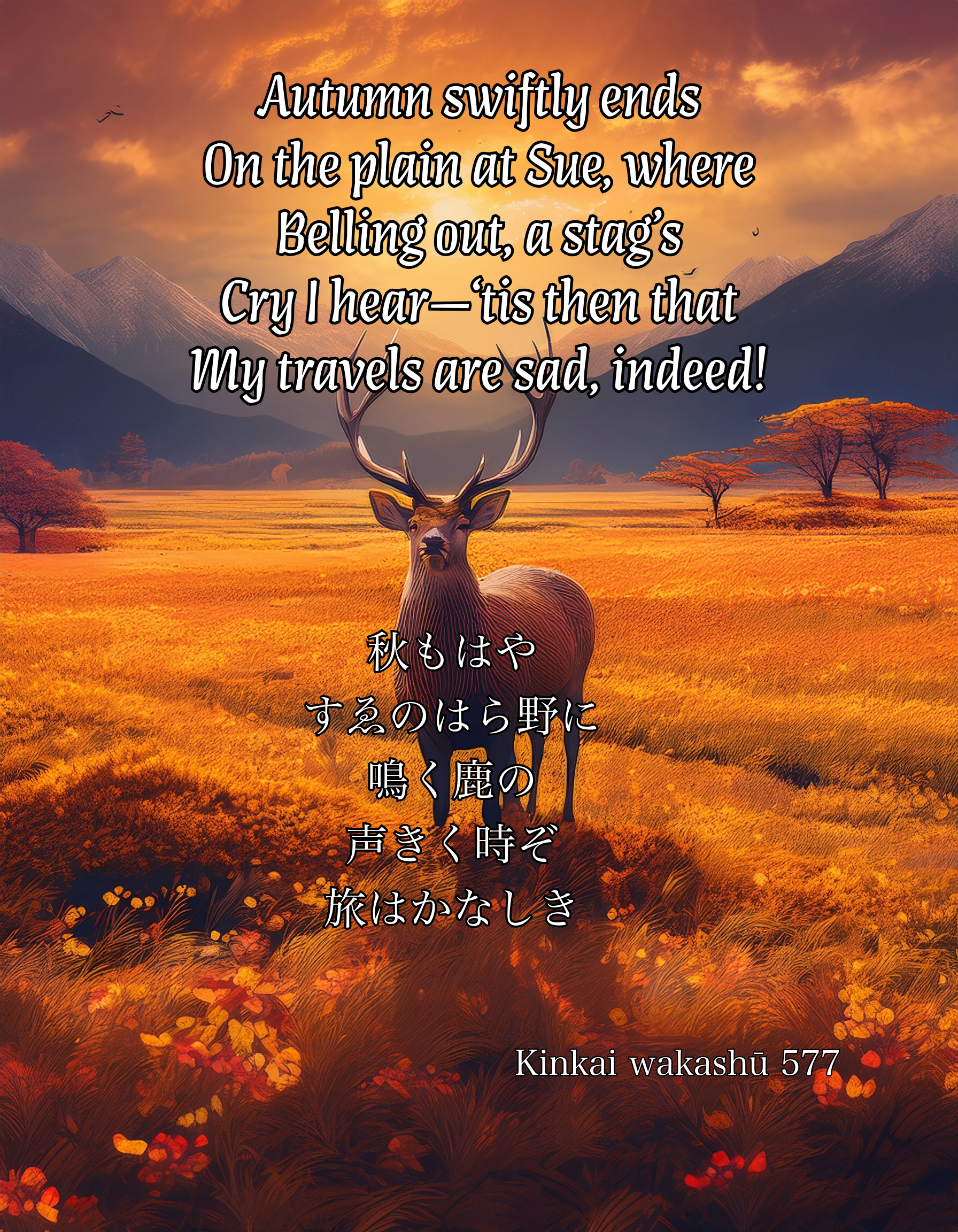
aki mo haya sue no harano ni naku shika no koe kiku toki zo tabi wa kanashiki
Autumn swiftly ends On the plain at Sue, where Belling out, a stag’s Cry I hear—‘tis then that My travels are sad, indeed![i]
577
[i] An allusive variation on: 梓弓 末之腹野尓 鷹田為 君之弓食之 将絶跡念甕屋 azusayumi / sue no harano ni / togarisuru / kimi ga yuzuru no / taemu to omoe ya ‘A catalpa bow / On the plain at Sue / A’hawking— / As your bowstring, / I wonder: will I be able to endure?’ Anonymous (Man’yōshū XI: 2638); and: A poem from the poetry competition at Prince Koresada’s house. おく山に紅葉ふみわけなく鹿のこゑきく時ぞ秋は悲しき okuyama ni / momiji fumiwake / naku shika no / koe kiku toki zo / aki wa kanashiki ‘In the mountains’ heart / Forging through the autumn leaves, / A calling stag: / When I hear his voice I feel, / Autumn is sorrowful, indeed.’ Anonymous (Kokinshū IV: 215)
kusamakura tabi ni shi areba karikomo no omoimidarete i koso nerarene
A pillow of grass I have on my travels, and Reaped wild rice My thoughts are scattered, Unable ever to sleep![i]
566
[i] See: Topic unknown. かりこもの思ひみだれて我こふといもしるらめや人しつげずは karikomo no/ omoimidarete / ware kou to / imo shirurame ya / hito shi tsugezu wa ‘As cut wild-rice / Are my scattered thoughts: / That I do love her, / I wonder, can she know, / With no one to tell her?’ Anonymous (Kokinshū XI: 485)
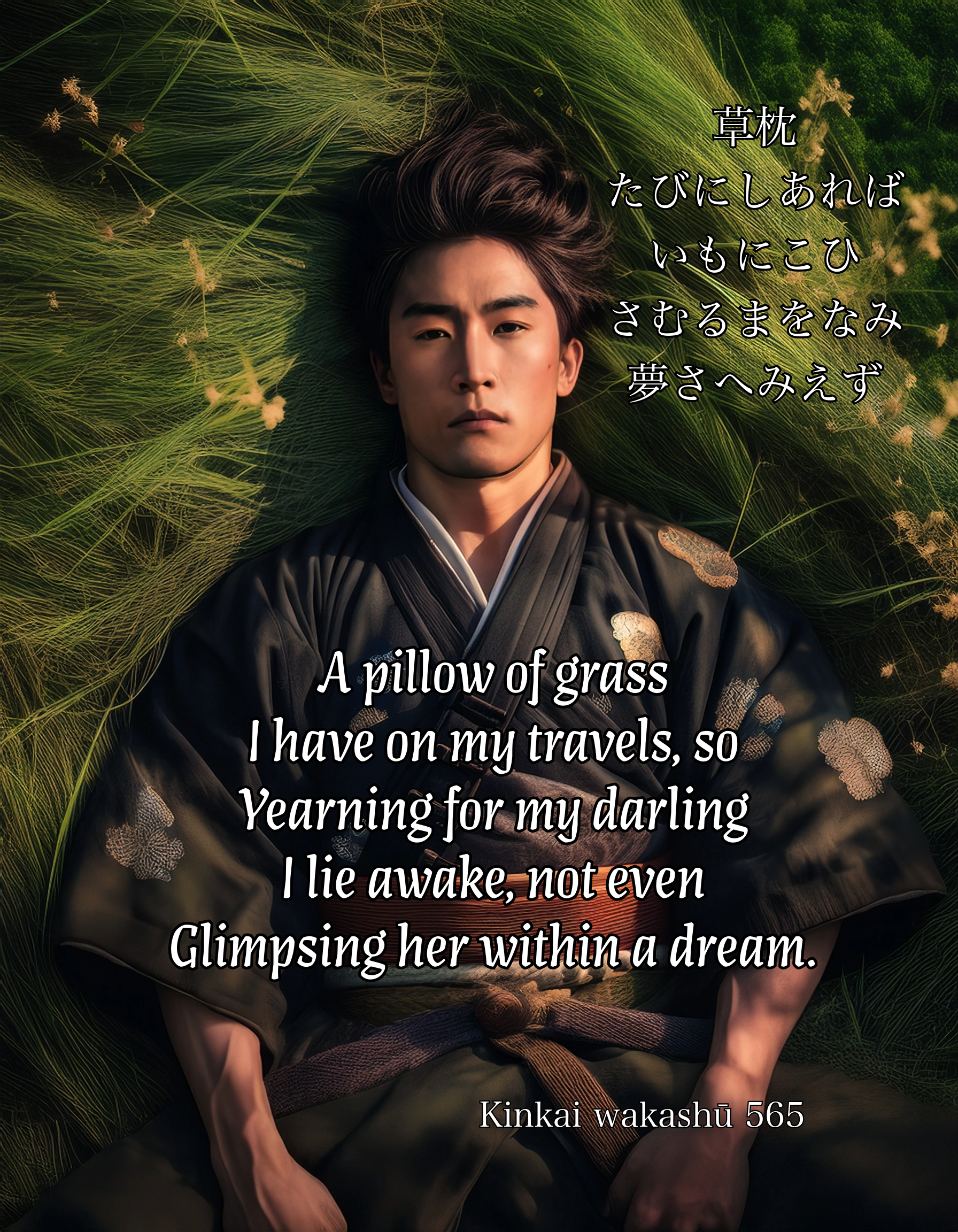
kusamakura tabi ni shi areba imo ni koi samuru ma o nami yume sae miezu
A pillow of grass I have on my travels, so Yearning for my darling I lie awake, not even Glimpsing her within a dream.[i]
565
[i] See: 家有者 笥尓盛飯乎 草枕 旅尓之有者 椎之葉尓盛 ie ni areba/ ke ni moru ii o / kusamakura / tabi ni shi areba / shii no ha ni moru ‘When I am at home / The pots are full of rice, but / Pillowed on the grass / On this journey now / Only the chinquapin leaves are plentiful…’ Prince Arima (Man’yōshū II: 142)
aki no yo no tsuki no hikari wa kawaranedo tabi no sora koso aware narikeri
On an autumn night The moon’s light Is unchanged, yet The sky above me on my travels Is so very sad, indeed.
Lord Saburō 31
Right
あきの夜はたのむる人もなきやどもありあけの月はなほぞまちいづる
aki no yo wa tanomuru hito mo naki yado mo ariake no tsuki wa nao zo machi’izuru
On an autumn night With no man even expected At my house, It is the dawntime moon’s Appearance that, indeed, I have awaited.
Ushigimi
32
The poem of the Left seems extremely well-trodden. It resembles a something sung as a popular song. As for the poem of the Right, ‘not…at my house’ is extraordinarily stilted, yet the poems are of the same quality, so I would say these tie.
The poem of the Left’s final ‘Is so very sad, indeed’ sounds pitiful and truly unskilled. The poem of the Right overemphasises ‘even’, and also appears to say that the dawntime moon is an element conveying a moving desolation. I wonder if this is appropriate for the topic of the ‘the moon’ in a poetry match? There needs to be a prior poem as precedent. It does say that the moon’s emergence after having waited for it is something precious, but the poem refers to the moon in the latter part of the month, after the twentieth day, doesn’t it? This would seem to be moving, for sure, but it’s something which doesn’t shed much light, so I would say that the Left wins.