Tag Archives: rains

Kinkai wakashū 719

In the Seventh Month, Kenrayku 1 [August 1211], there were very heavy rains and, thinking that this would cause suffering to the common folk, I prayed to an image of the Buddha and, shortly after, spoke this poem.

時によりすぐれば民のなげきなり八大竜王雨やめたまへ

toki ni yori
sugureba tami no
nageki nari
hachi dairyūō
ame yametamae
At this time,
Passing, the common folk
Suffer;
O, Eight Great Dragon Kings,[i]
Cease your rains!

719


[i] The eight Great Dragon Kings (hachi dairyūō 八大龍王) are referenced in the Lotus Sutra. They are: Ānanda 難陀 (Jp. Nanda); Upananda 跋難陀 (Jp. Batsunanda); Shāgara 娑伽羅 (Jp.Shagara); Vasuki 和修吉 (jp. Washikitsu); Takshaka 德叉迦 (Jp. Tokushaka); Anavatapta 阿那婆達多 (Jp. Anabadatta); Manasvin 摩那斯 (Jp. Manashi); and Utpalaka 優鉢羅 (Jp. Uhatsura). As can be seen from Sanetomo’s poem here, they were seen to have dominion over water—rains, rivers and the ocean—and were often invoked to either request rain or to ameliorate storms.
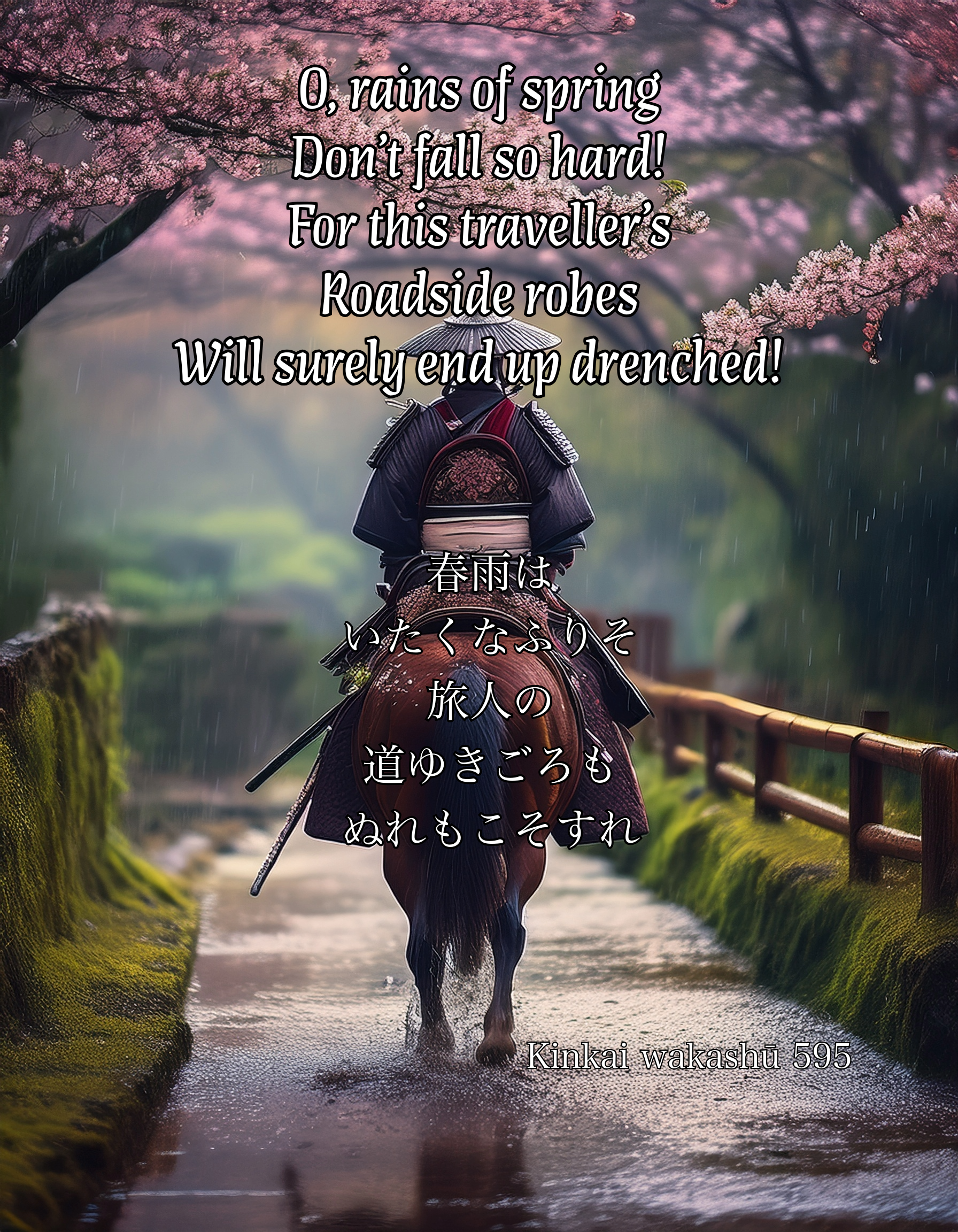
Kinkai wakashū 595

春雨はいたくなふりそ旅人の道ゆきごろもぬれもこそすれ

harusame wa
itaku na furi so
tabibito no
michiyuki goromo
nure mo koso sure
O, rains of spring
Don’t fall so hard!
For this traveller’s
Roadside robes
Will surely end up drenched![i]

595


[i] See: Topic unknown. 春雨はいたくなふりそ桜花まだみぬ人にちらまくもをし harusame wa / itaku na furi so / sakurabana / mada minu hito ni / chiramaku mo oshi ‘O, spring rains, / Fall not so hard! / The cherry blossom / Is yet unseen by folk who / Would regret its scattering’ Akahito (Shinkokinshū II: 110)

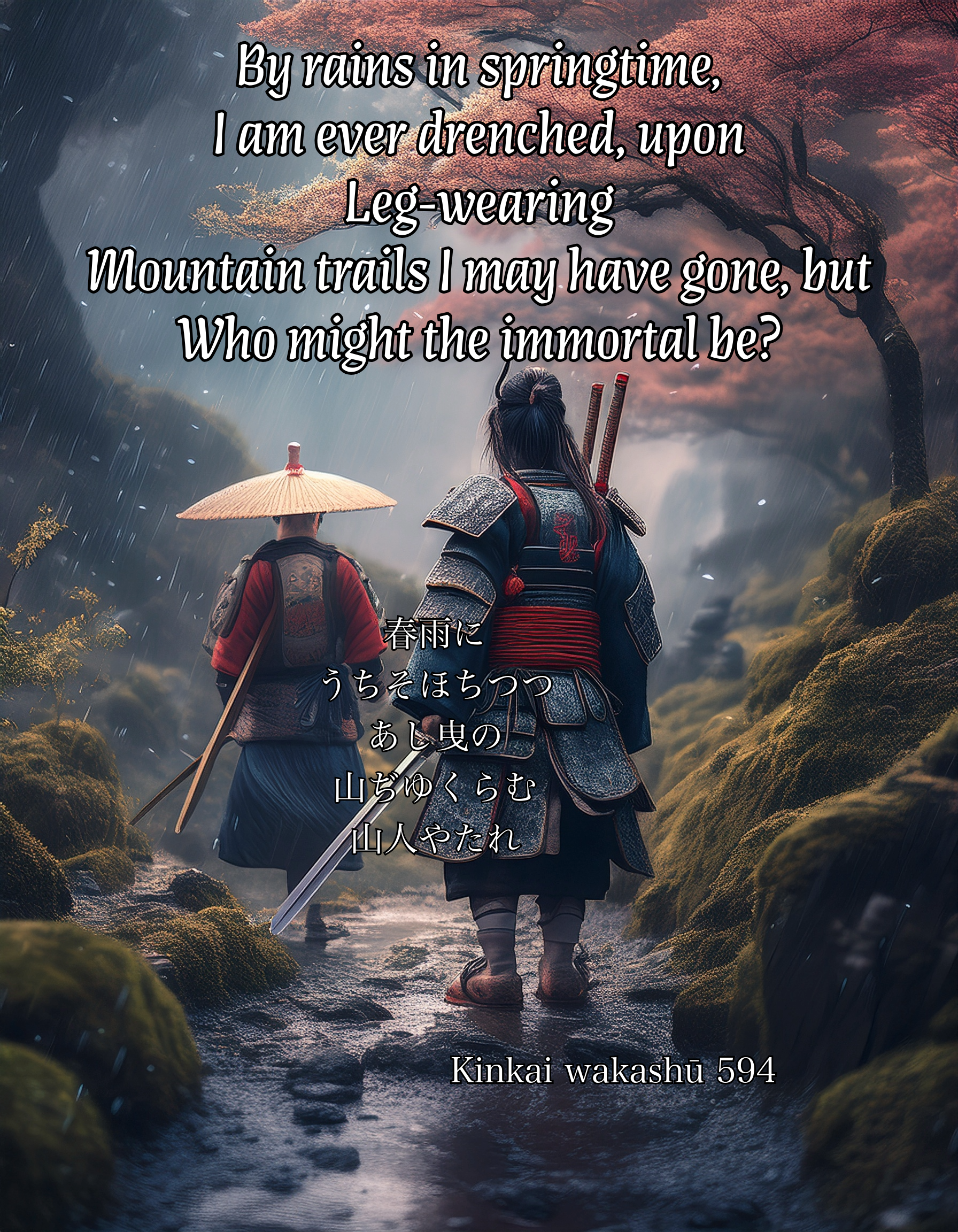
Kinkai wakashū 594

When there was a heavy spring shower falling, on the way back after I had made a pilgrimage to the two places.[i]

春雨にうちそほちつつあし曳の山ぢゆくらむ山人やたれ

harusame ni
uchisōchitsutsu
ashihiki no
yamaji yukuramu
yamabito ya tare
By rains in springtime,
I am ever drenched, upon
Leg-wearing
Mountain trails I may have gone, but
Who might the immortal be?[ii]

594


[i] ‘Two places’ (nisho 二所)  was an abbreviation for ‘manifested deities of two shrines’ (nisho gongen 二所権現) which, in turn, was a reference to Hakone-gongen 箱根権現 and Izu-gongen 伊豆権現, the kami of Hakone shrine and Izuyama Shrine, manifesting as Buddhist deities. Both of these deities were venerated by Minamoto no Yoritomo 源頼朝 (1147-1199), the founder of the Kamakura shogunate, and his wife, Hōjō Masako 北条政子 (1157-1225) and after Yoritomo’s death, shogun’s continued to make an annual pilgrimage to both shrines.

[ii] See: A single poem presented in reply by Prince Toneri. 安之比奇能 山尓由伎家牟 夜麻妣等能 情母之良受 山人夜多礼 ashihiki no / yama ni yukikemu / yamabito no / kokoro mo shirazu / yamabito ya tare ‘To the leg-wearying / Mountains seeming to have gone / An immortal’s / Heart I cannot know, but / Who might that immortal be?’ (Man’yōshū XX: 4294)