Kōshin, 4th day of the Fifth Month, Ōwa 2.[i] That evening, the Bureau of Palace Storehouses prepared the equipment for the kōshin vigil. At the hour of the Boar,[ii] I summoned retainers to my presence to play dice.[iii] Then, at the hour of the Ox,[iv] there was a performance of stringed instruments and songs. Around dawn, both the gentlemen and court ladies presented poetry, and I ordered Suketada, Middle Controller of the Right,[v] to recite all of the poems. At daybreak, I ordered Naritoki, Minor Captain in the Inner Palace Guards, Left Division,[vi] to call out the register of attendance.[vii]
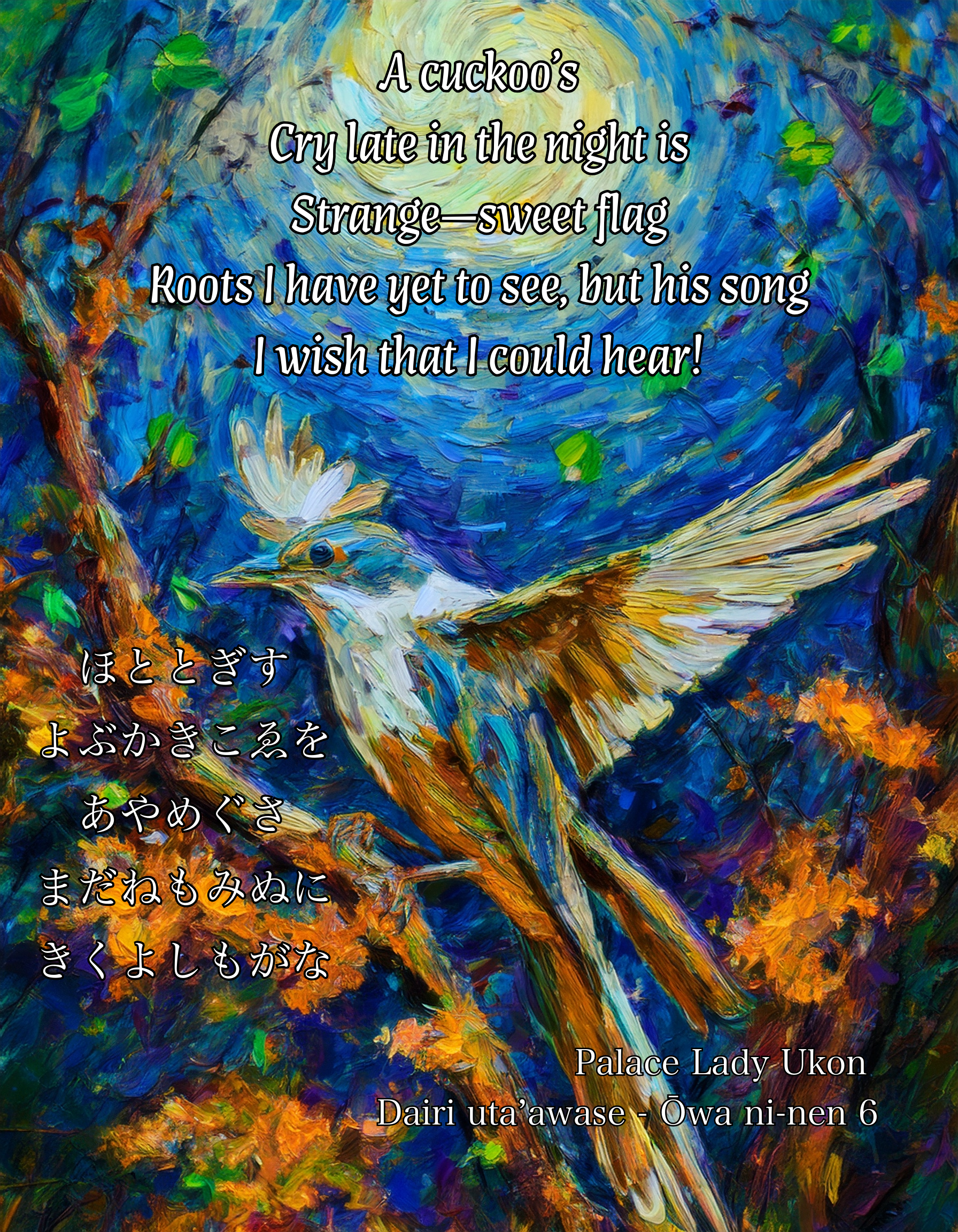
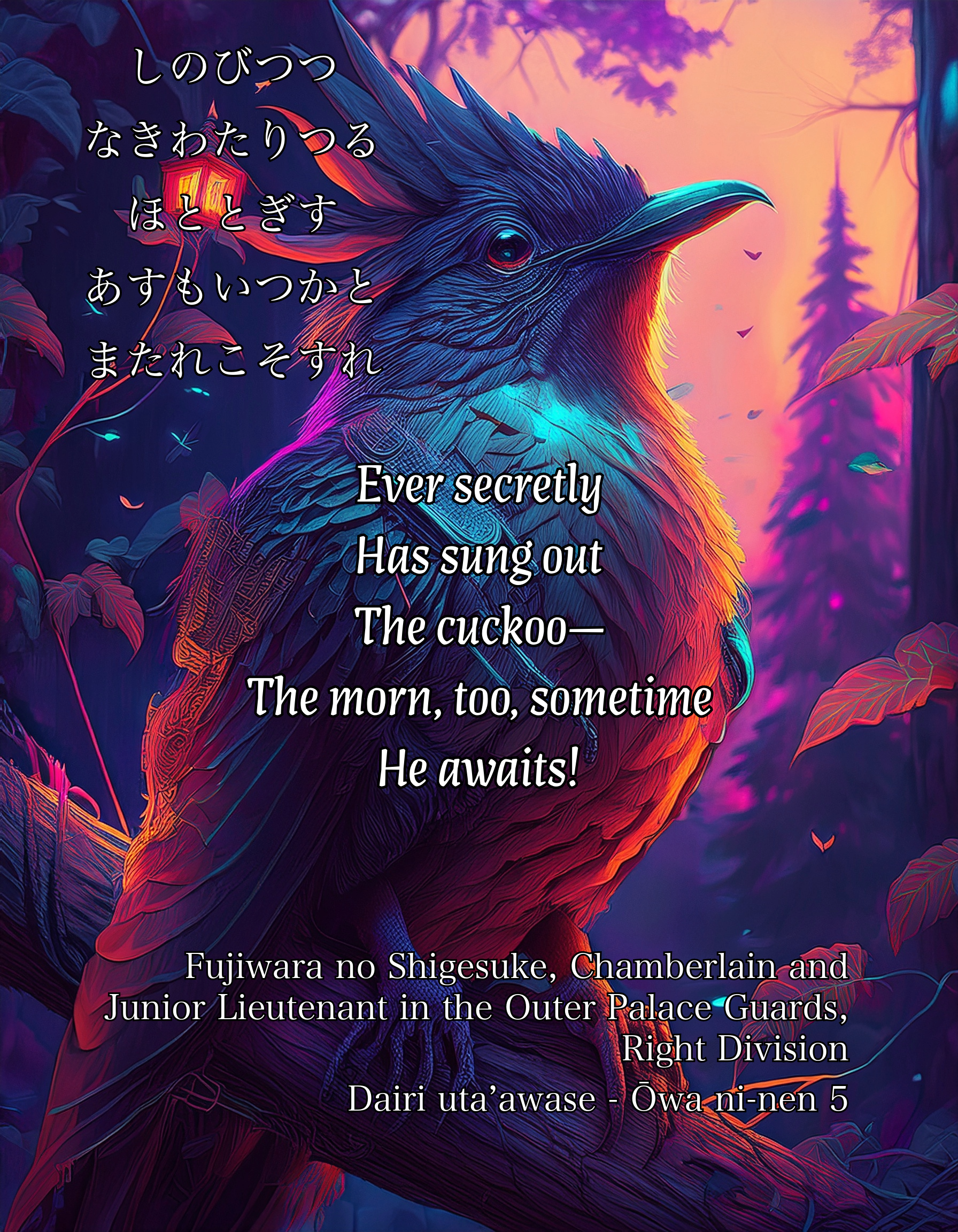
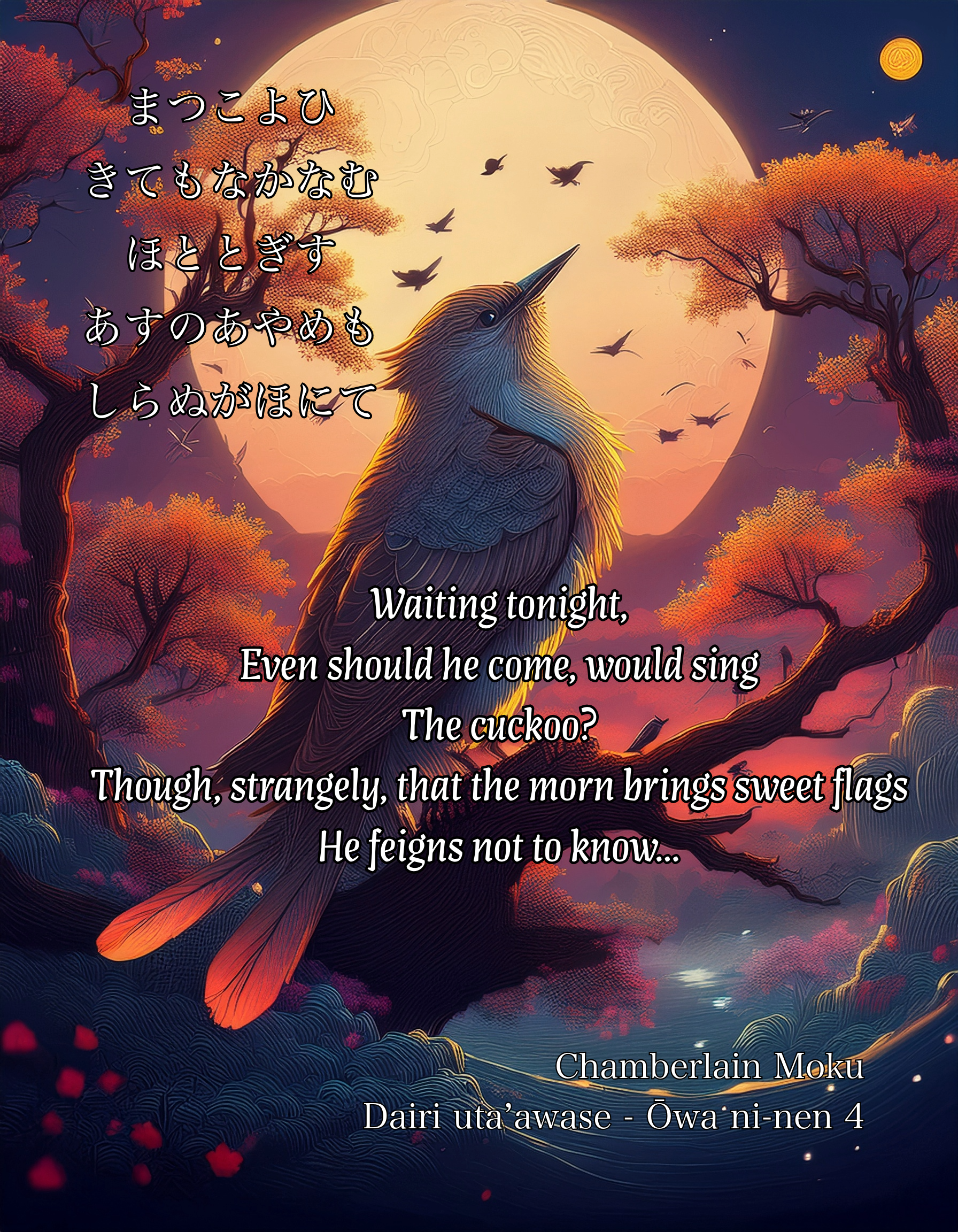
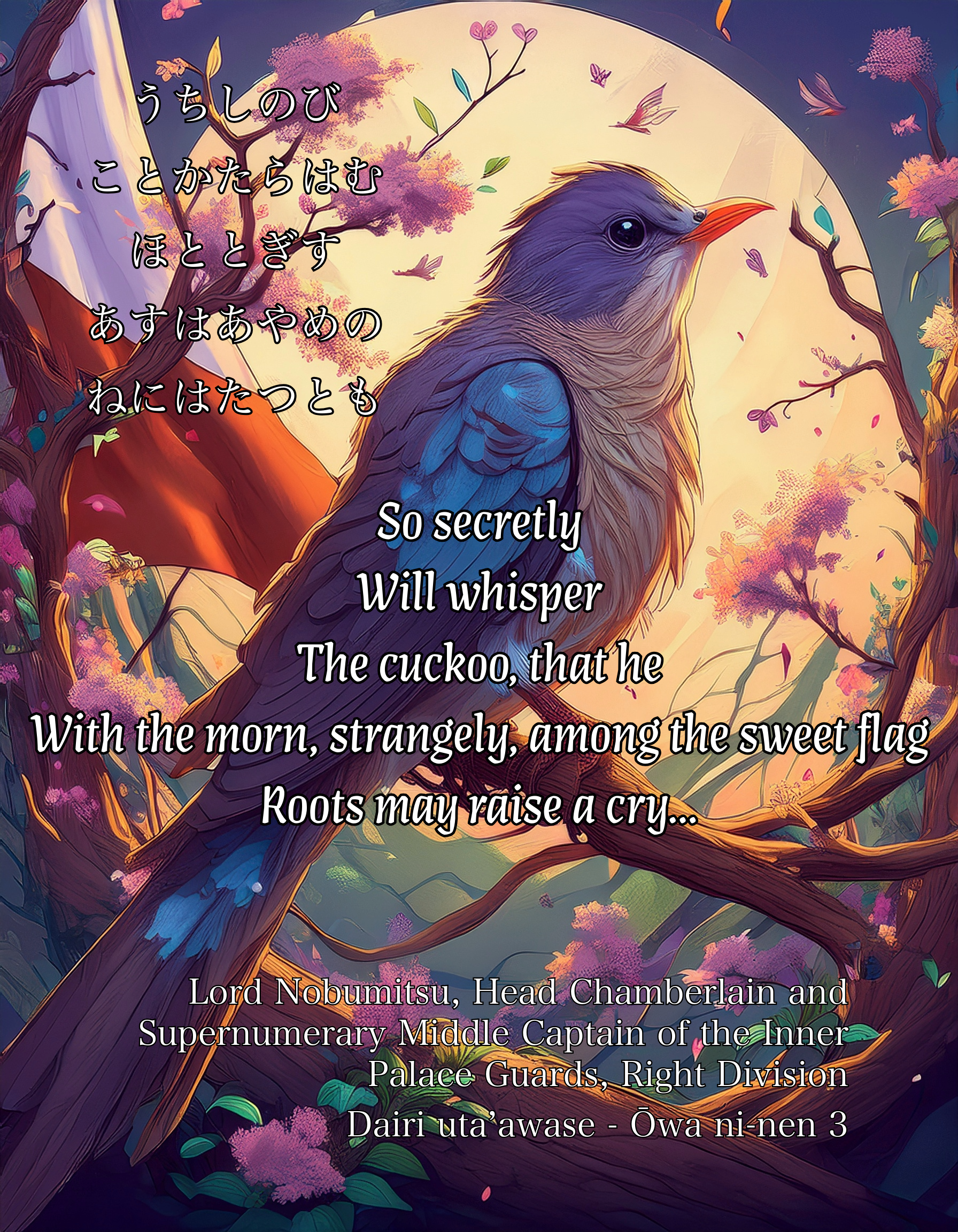
On the kōshin night of the 4th day of the Fifth Month, Ōwa 2, and the morning of the 5th day, His Majesty provided the topic ‘Waiting for the cuckoo’, and then had the poems matched; courtiers and court ladies took part.
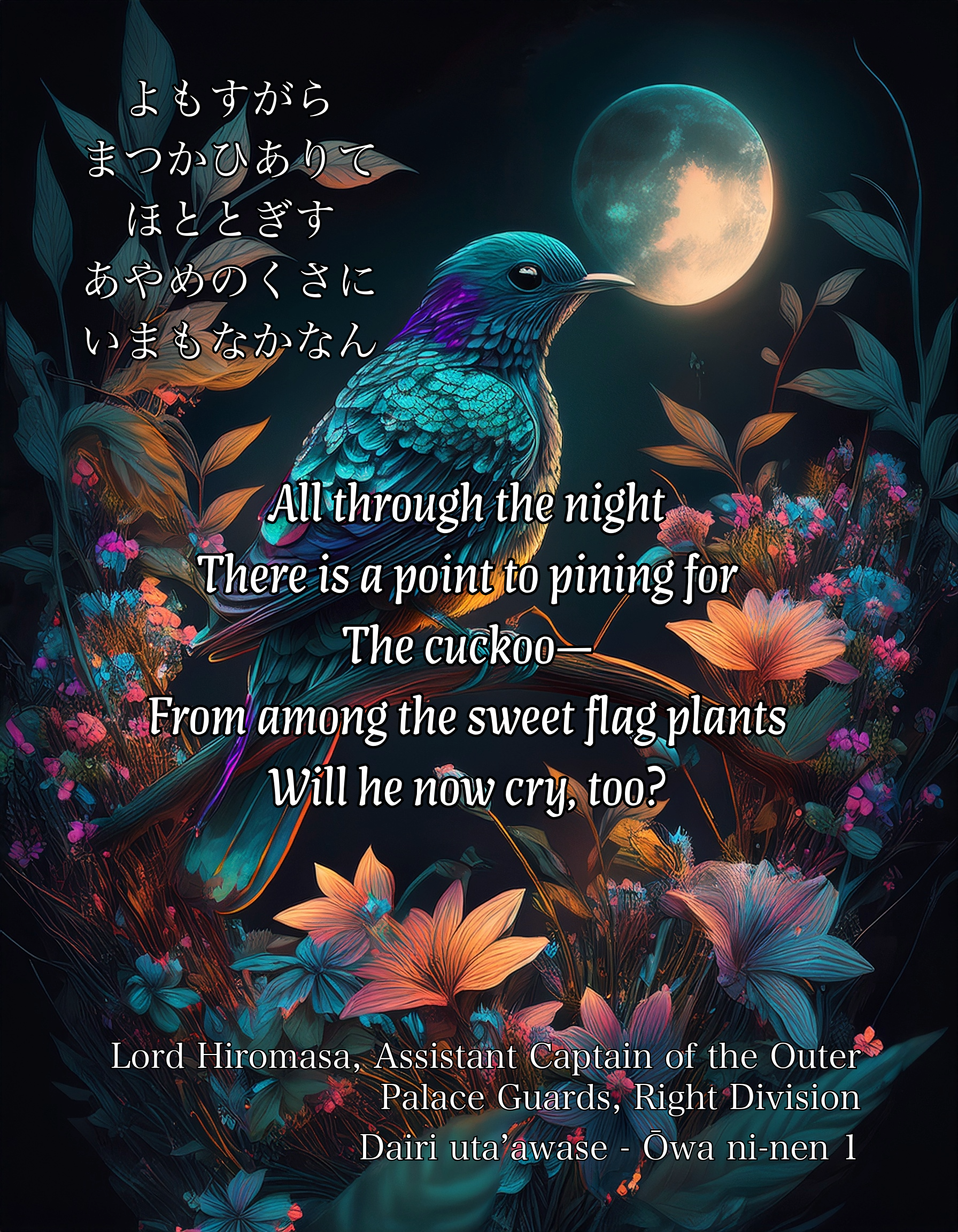
よもすがらまつかひありてほととぎすあやめのくさにいまもなかなん
yomosugara matsu kai arite hototogisu ayame no kusa ni ima mo nakanan
All through the night There is a point to pining for The cuckoo— From among the sweet flag plants Will he now cry, too?
Lord Hiromasa, Assistant Captain of the Outer Palace Guards, Right Division[viii] 1
I said this was not in keeping with the topic, so it lost.
[v] Fujiwara no Suketada 藤原佐忠 (?-973): a minor noble and poet. He was appointed Middle Controller of the Right in 961. He has a single poem in an imperial anthology: For a painting on a folding screen of the white mountains of Koshi. 我ひとりこしの山ぢにこしかども雪ふりにける跡を見るかな ware hitori / koshi no yamaji ni / koshikadomo / yuki furinikeru / ato o miru kana ‘I, alone, / To the mountain paths o’er Koshi / Have come, yet / Signs that snow has fallen / Do I see!’ (Shūishū IV: 248)
[vi] Fujiwara no Naritoki 藤原済時 (941-995): Naritoki was the second son of Fujiwara no Morotada 藤原師尹 (920-969), and was thus a member of the senior nobility. He was appointed Minor Captain in the Inner Palace Guards in 961 and held the position for the next six years. His highest ranking position in life was Major Counsellor (dainagon 大納言), to which he was appointed in 991, but after his daughter, Sukeko (Seishi) 娍子 (972-1025) became a consort of Emperor Sanjō 三条 (976-1017; r. 1011-1016), he was posthumously promoted to Minister of the Right (udaijin 右大臣). Ōkagami is rather uncomplimentary about him, accusing him of being overly vain and concerned with his reputation, as well as somewhat mean and a prodigious drinker (Yamagiwa 1967, 78–80; Ishikawa 2017, 100–102). This was something he often did to excess in the company of Fujiwara no Michitaka 藤原道隆 (953-995) and Fujiwara no Asamitsu/Asateru 藤原道隆 (951-995): when the three of them were riding in the same carriage they drank so much that they eventually raised the blinds and revealed themselves looking disheveled, having removed their headgear. ‘Although heavy drinking is considered to be one of the interests of a man, there are times when an excess of it is most harmful,’ the narrator remarks (Yamagiwa 1967, 154; Ishikawa 2017, 202). Naritoki is chiefly remembered today, however, for his role in the lives of others: he was the adoptive father of Fujiwara no Sanekata 藤原実方 (?-999), one of the Thirty-Six Poetic Immortals, and his second daughter, Koichijō no naka no kimi 小一条の中の君 (dates unknown), was the principal wife of Prince Atsumichi 敦道 (981-1007), who was famously neglected by him when he began a relationship with Izumi Shikibu 和泉式部 (976/78?-?).
[vii]Gensan 見参: at court occasions such as this, the names of those in attendance were written down and formally reported to the emperor.