Category Archives: Chūgū nyōbō uta’awase

Chūgū nyōbō uta’awase 7

まつむしのたえず鳴くなる女へし千歳の秋はたのもしきかな

matsumushi no
taezu nakunaru
ominaeshi
chitose no aki wa
tanomoshiki kana
Pine crickets
Cry endlessly;
The maidenflowers
For a thousand years of autumns
On them can rely!

7[i]


[i] Motozane-shū (66) with the headnote ‘Pine crickets’ (matsumushi 松虫).

Chūgū nyōbō uta’awase 6

秋風のをぎの下葉を吹きみだるそらにみちつるひぐらしの声

akikaze no
ogi no shitaba o
fukimidaru
sore ni michitsuru
higurashi no koe
The autumn gusts
The underleaves of cogon grass
Blow into confusion,
All filled with
Sunset cicadas’ songs…

6[i]


[i] Motozane-shū (65) with the headnote ‘Sunset cicadas’ (higurashi 日暮).

Chūgū nyōbō uta’awase 5

つゆむすぶあきはて方のきりぎりすくさのねごとにさむくこそなけ

tsuyu musubu
akihategata no
kirigirisu
kusa no ne goto ni
samuku koso nake
Drenched with dew
At the far edge of dawn
The crickets
Crying from the roots of every stalk,
So cold, do sing.[i]

5[ii]


[i] This poem is built around a wordplay in its final section, which has kusa no ne goto ni 草の根ごとに (‘the roots of every stalk of grass’) and ne goto ni samuku 音ごとに寒く (‘every chirp coldly’).

[ii] Motozane-shū (64) with the headnote ‘Crickets’ (kirigirisu きりぎりす).

Chūgū nyōbō uta’awase 4

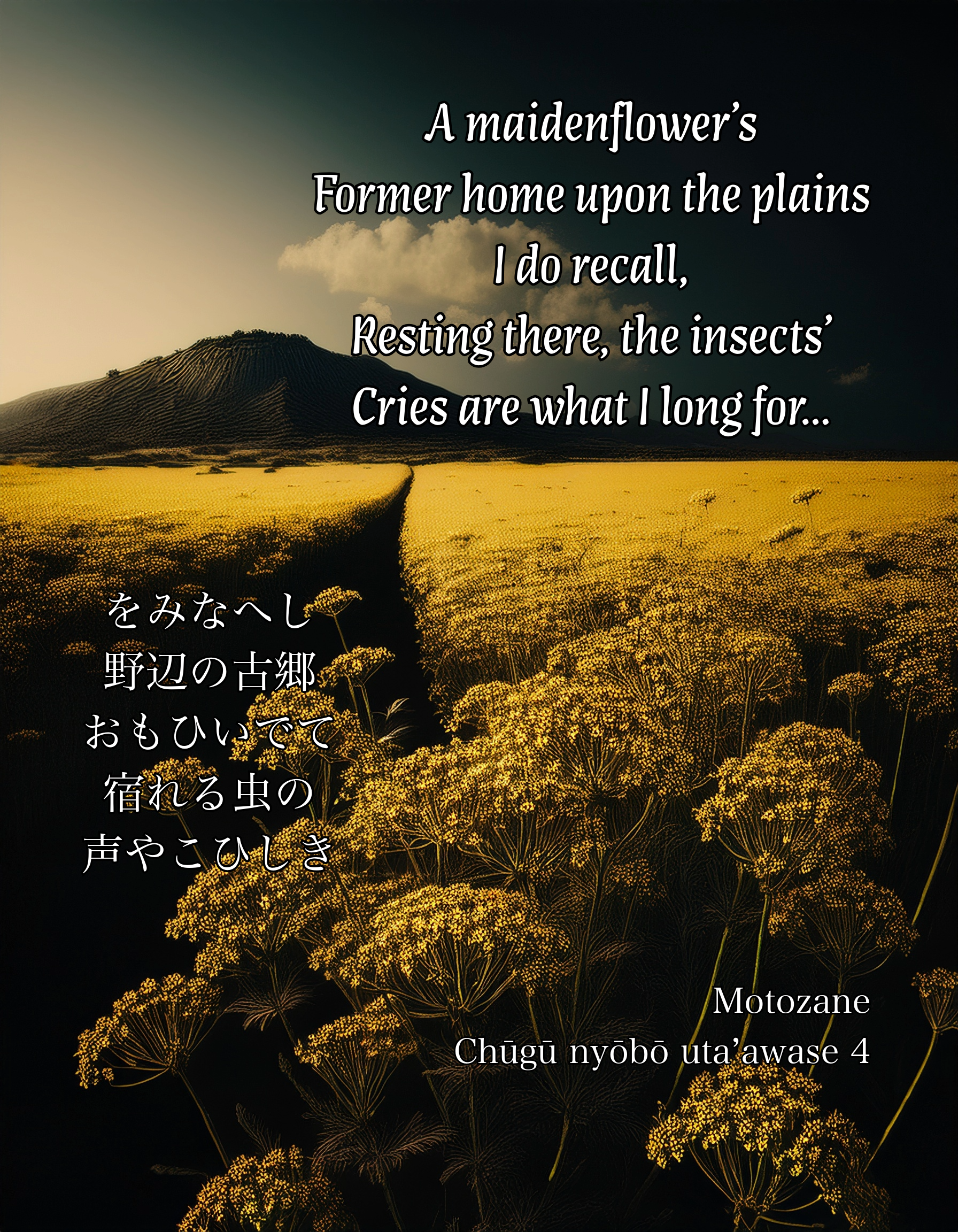
をみなへし野辺の古郷おもひいでて宿れる虫の声やこひしき

ominaeshi
nobe no furusato
omoi’idete
yadoreru mushi no
koe ya koishiki
A maidenflower’s
Former home upon the plains
I do recall,
Resting there, the insects’
Cries are what I long for…

4[i]


[i] Motozane-shū (63) with the headnote ‘Maidenflowers’ (ominaeshi 女郎花).

Chūgū nyōbō uta’awase 3

高砂の尾上の萩を折りつれば鹿の立どやうすくなるらむ

takasago no
onoe no hagi o
oritsureba
shika no tachido ya
usukunaruramu
When on Takasago
Peak, the bush-clover
I pick,
Does the stag’s resting place
Seem to fade away?

3[i]


[i] Motozane-shū (62) with the headnote ‘Bush clover’ (hagi 萩); the poem is also included in Fubokushō (XI: 4170), attributed to Motozane, with the headnote ‘Composed for the “Poetry Match held by the Empress’ Court Ladies” kōshin, night of the 13th day of the Ninth Month, Tentoku 3’. This is erroneous, as kōshin actually fell on the 18th of that month, as indicated by the headnote to poem (1) in Motozane-shū.

Chūgū nyōbō uta’awase 2

月影にほのかに見ゆる花すすき風のたよりに結びつるかな

tsukikage ni
honoka ni miyuru
hanasusuki
kaze no tayori ni
musubitsuru kana
In the moonlight
Faintly do I see
Blossoming silver grass:
A message from the breeze
Does it entangle!

2[i]


[i] Motozane-shū (61) with the headnote ‘Blossoming silver grass’ (hanasusuki 花薄).

Chūgū nyōbō uta’awase 1

難波潟漕げど小舟は葦わかのえざるほどこそ久しかりけり

naniwagata
kogedo obune wa
ashiwaka no
ezaru hodo koso
hisashikarikeri
Through Naniwa Inlet
I row, yet my little boat
The reed shoots
Cannot navigate—the time
Lasts forever![i]

1[ii]


[i] This poem is an acrostic containing the hidden expression kanoesaru 庚申 (‘senior metal monkey’), which was the fifty-seventh in the Sinitic calendrical cycle. The Sino-Japanese reading of 庚申 is kōshin, and it was every sixty days when kanoesaru came up that kōshin was observed by Heian aristocrats (and others). Motozane cleverly works the reference into his poem, with the final line referring to how the time dragged when one had to stay up all night.

[ii] Motozane-shū (60) with the additional headnote (topic), ‘Kōshin’.