Tag Archives: Kuma

Eien narabō uta’awase 20

Round Six

Left

あきの夜のありあけのつきはくまもなしあさくらやまもなのみこそあらめ

aki no yo no
ariake no tsuki wa
kuma mo nashi
asakurayama mo
na nomi koso arame
At an autumn night’s
Dawn, the moon
Has not a cloud before it;
The Mount of Morning Dark
May be so in name alone!

Cell of Fragrant Cloud
39

Right (Win)

秋の月あかしのうらはなびきもにすむわれからのかずも見つべし

aki no tsuki
akashi no ura wa
nabikimo ni
sumu warekara no
kazu mo mitsubeshi
The autumn moon is
Bright above Akashi Bay;
Among the trailing seaweed
Dwell tiny shrimp,
Their number now clear to my eyes.

Cell of Compassionate Light
40

The poem of the Left is an entirely tedious composition. It simply states that a cloudless autumn moon does not fit with the place name, Mount Asakura. The moon at ‘dawn’ is the same as the moon at ‘dawntime’, while Mount Asakura is used when dawn has completely finished. As for the poem of the Right, while the moon is described as bright, it doesn’t seem right to then make it a poem about trailing seaweed—this does not seem charming at all. This round, too, there’s not much more I can say than that.

As I have already mentioned, ‘moon at dawn’ in the poem of the Left is an expression which it is impossible to say is praiseworthy. Even more so, really, the concluding ‘may be so in name alone’ just says ‘is so in name alone’, doesn’t it? It’s contrary to reason to say that it’s fluent and thus, and I say this reluctantly, it’s difficult to understand. As for the Right’s poem, I don’t understand this either: it ought to be ‘their numbers, too, I have been able to see’—saying ‘their number now clear to my eyes’ implies that you haven’t previously been able to see them up to that point, and it’s vague about when you have. Even so, it’s getting light, so the light of the moon at dawn seems superior.

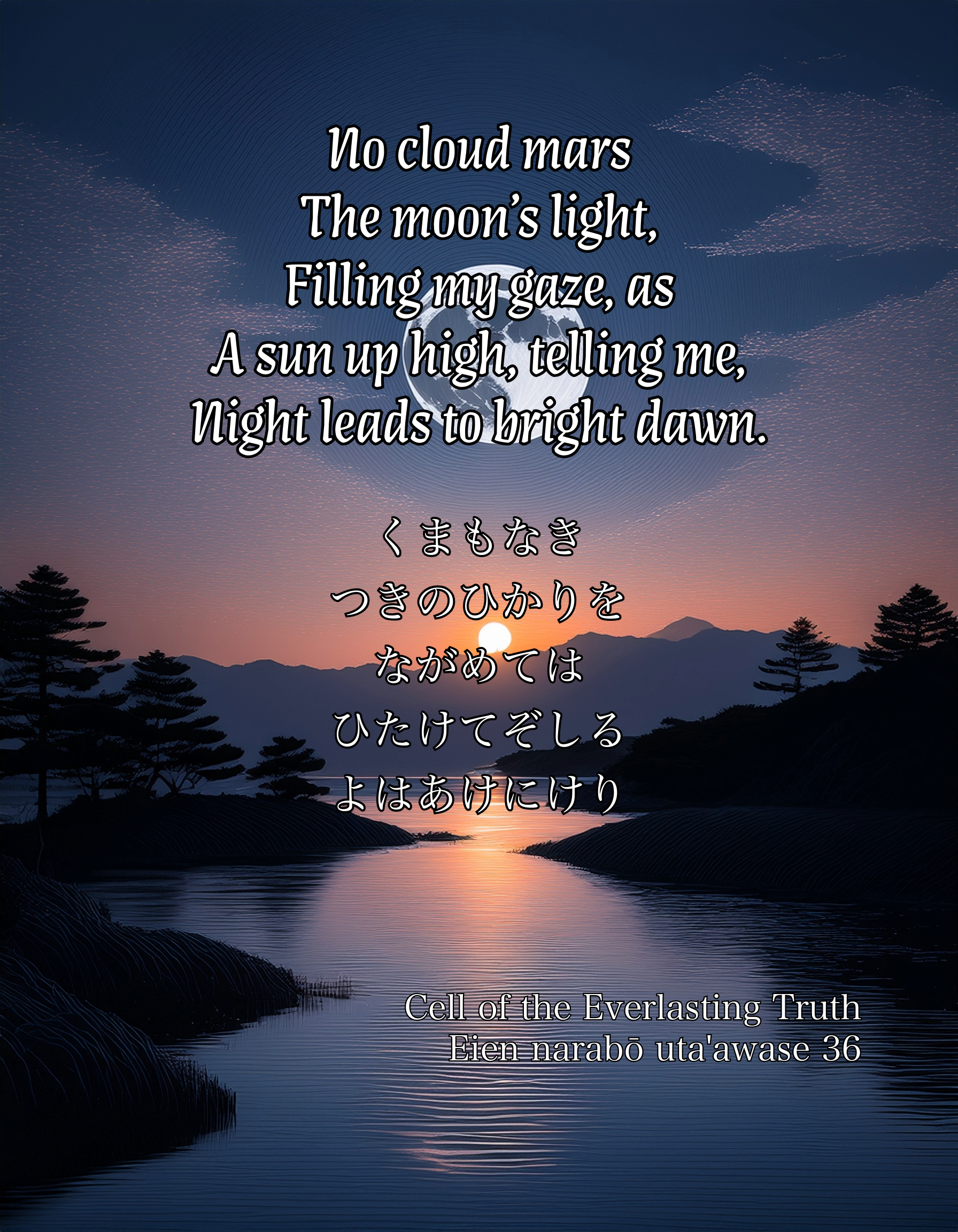
Eien narabō uta’awase 18

Round Four

Left

まくずはふ山ぢもはれてあきのよはこゆるたびびとやすき月かな

makuzu hau
yamaji mo harete
aki no yo wa
koyuru tabibito
yasuki tsuki kana
Kudzu vines crawl
Along the mountain paths, so clear
On an autumn night for
A traveller a’crossing
Lit by a clement moon!

Cell of the Fragrant Elephant
35

Right

くまもなきつきのひかりをながめてはひたけてぞしるよはあけにけり

kuma mo naki
tsuki no hikari o
nagamete wa
hi takete zo shiru
yo wa akenikeri
No cloud mars
The moon’s light,
Filling my gaze, as
A sun up high, telling me,
Night leads to bright dawn.

Cell of the Everlasting Truth
36

The poem of the Left has nothing to present in all of its syllables. The poem of the Right resembles a composition by someone drunk out of his mind. As a result, it’s impossible to decide between them.

In the poem of the Left, does ‘clement moonlight’ mean that the moon’s light enables one to traverse a mountain path, which normally one would be unable to make one’s way along because one would expect it to be dark? The diction here is insufficient. As it says in the preface to the Ancient and Modern Collection of Narihira’s poems, ‘excessive conception but lacking in diction, like withered flowers lacking colours, but with a lingering fragrance’. This is a poem in that style, isn’t it. As for the poem of the Right, this, too, has ‘night leads to bright dawn’—the diction here is stilted and the conception lacks elegance. I have to say these poems are of about the same standard.

Love VIII: 19

Left (Tie)
うち頼む人の心は荒熊のおそろしきまでつれなかりけり

uchitanomu
hito no kokoro wa
arakuma no
osoroshiki made
tsurenakarikeri
I placed all my trust
In her, but that heart is
As a wild bear,
Frightening in its
Cold cruelty!

Lord Kanemune
1057

Right
戀をのみすがの荒野にはむ熊のおぢられにける身こそつらけれ

koi o nomi
suga no arano ni
hamu kuma no
ojirarenikeru
mi koso tsurakere
Simply in love, but as
On the wild plain of Suga,
A hunting bear,
Fleeing in fear,
Pitiful am I, indeed!

Lord Tsune’ie
1058

Both Left and Right together state: the opposing poem is essentially the same as Toshiyori’s poem:

信濃なるすがの荒野にはむ熊のおそろしきまで濡るゝ袖哉

shinano naru
suga no arano ni
hamu kuma no
osoroshiki made
nururu sode kana
In Shinano
On the wild plain of Suga,
Of a hunting bear
I am so afraid
My sleeves are soaked!

In judgement: both poems are about ‘bears’ and sound old-fashioned, as the Gentlemen have said. They must tie.