Tag Archives: hatsushigure

Naidaijin-ke uta’awase 10

Round Ten

Left (T – Tie)

波よする蜑の苫やのひまをあらみもるにてぞしるよはのしぐれは

nami yosuru
ama no tomaya no
hima o arami
moru nite zo shiru
yowa no shigure wa
Waves break near
A sedge-thatched hut’s
Crude gaps
The leaks reveal
A midnight shower…

Lord Tadafusa
19

Right (M – Win)

ゆふ月よいるさの山の高根よりはるかにめぐる初しぐれかな

yūzukuyo
irusa no yama no
takane yori
haruka ni meguru
hatsushigure kana
On a moonlit night
From Irusa Mountain’s
High peak
In the distance circles
A first shower!

Lord Kanemasa
20

Toshiyori states: in the first poem, the shower sounds chilly! A shower is not something that one hears after getting up at dawn, yet this poem says that one first gets to know about it from the leaks, it seems that the poet has gone to bed, been leaked on, had his garments soaked and then got up and made a fuss. If he has not been leaked upon is this something he heard from someone else the following day? It really is very unclear. There’s a poem ‘Together with me / On my mountain pilgrimage’ which refers to showers falling on this mountain. The poem here refers to the same peak, so it sounds as if it’s referring to monks going around. Is that what it’s about? I am not just finding fault for the sake of it—these poems are unclear. As there’s only so much that can be understood from hearing them, they should tie.

Mototoshi states: one can compose about a shower falling anywhere and there’s no need to bring up a fisherman’s sedge-thatch hut, is there! Furthermore, one gets to know about a shower from the sound of it falling constantly on something like a roof of cedar boards, surely? Would one really be startled by rain of varying intensity falling soundlessly in spring? As for the poem of the Right, while it does not display a playfulness which would please the eye, ‘In the distance circles / A first shower’ is a bit better in the current context.

Sumiyoshi-sha uta’awase kaō ni-nen 44

Round Nineteen

Left (Win)

くさまくらおなじたびねのそでにまたよはのしぐれもやどはかりけり

kusamakura
onaji tabine no
sode ni mata
yowa no shigure mo
yado wa karikeri
Needing a grassy pillow
When travelling just the same as I, dozing
I find my sleeves drenched even more,
For the midnight shower, too,
Has found lodging.

Kojijū
87

Right

いほりさすやまぢはすぎぬはつしぐれふるさとまでやめぐりゆくらむ

iori sasu
yamaji wa suginu
hatsushigure
furusato made ya
meguriyukuramu
I put up my hut
Upon the mountain path that you passed by,
O, first shower!
As far as my ancient home
I wonder, will you make your way?

Lord Sanemori
88

The poem of the Left, saying ‘When travelling just the same as I dozing, / I find my sleeves drenched even more’ and then following this with ‘For the midnight shower, too, / Has found lodging’, has an extremely charming conception and configuration. In addition to the poem of the Right also having a charming conception, it begins with ‘O, first shower!’ and then continues, ‘As far as my ancient home’, which is an effective use of diction. Nevertheless, the conception of the Left’s poem is even better and it wins.

Sumiyoshi-sha uta’awase kaō ni-nen 39

Round Fourteen

Left

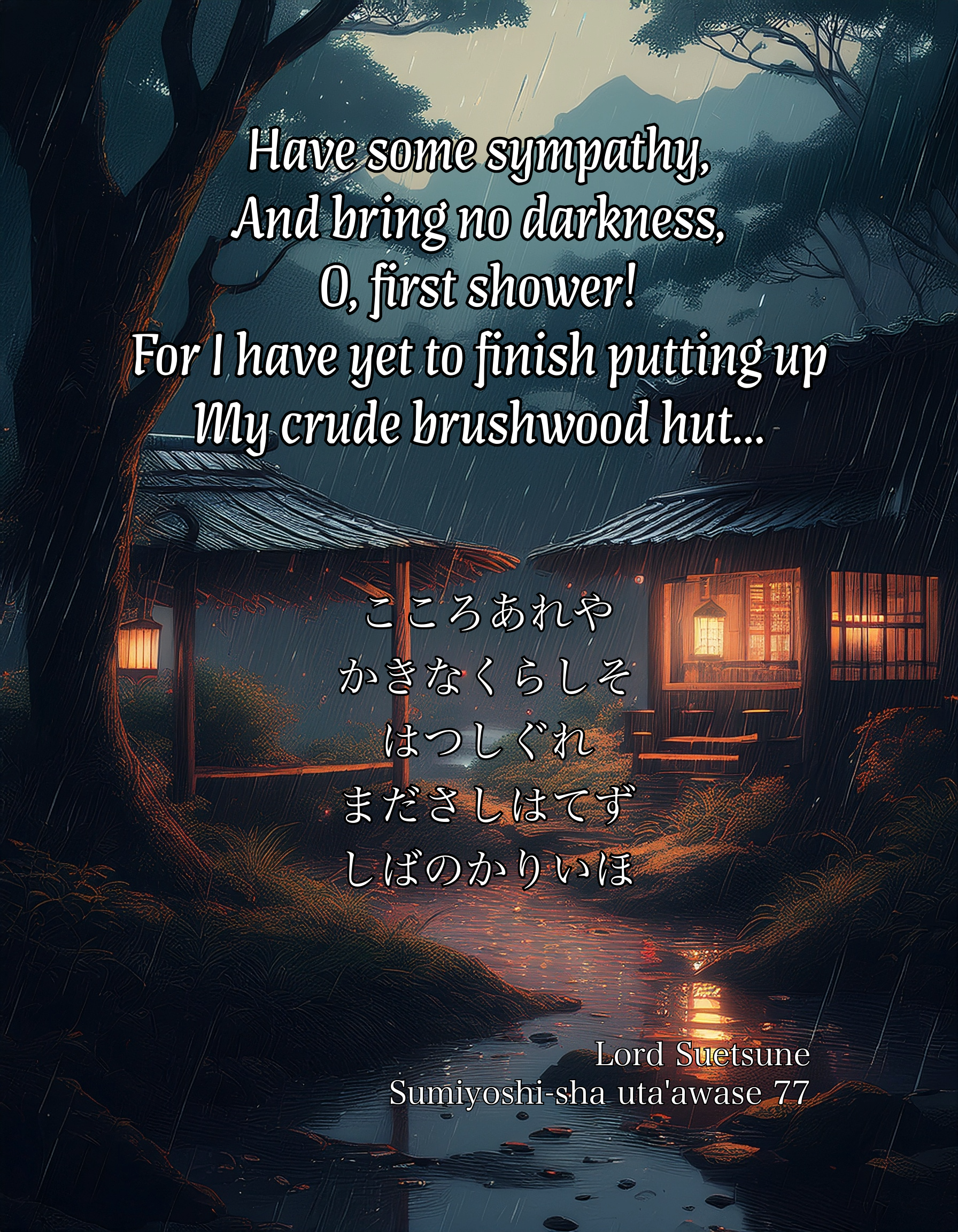
こころあれやかきなくらしそはつしぐれまださしはてずしばのかりいほ

kokoro are ya
kaki na kurashi so
hatsushigure
mada sashihatezu
shiba no kari’io
Have some sympathy,
And bring no darkness,
O, first shower!
For I have yet to finish putting up
My crude brushwood hut…

Lord Suetsune
77

Right (Win)

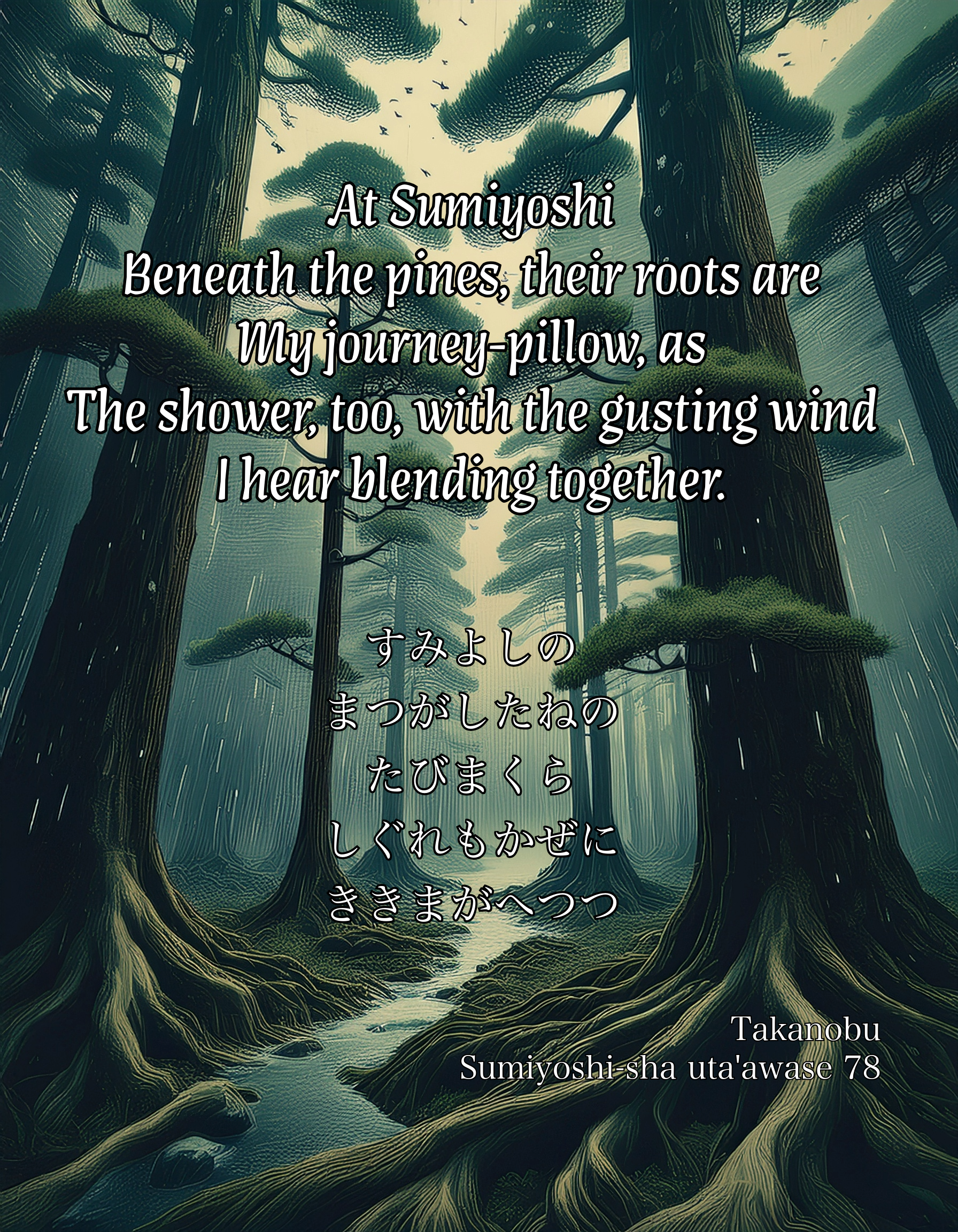
すみよしのまつがしたねのたびまくらしぐれもかぜにききまがへつつ

sumiyoshi no
matsu ga shita ne no
tabimakura
shigure mo kaze ni
kikimagaetsutsu
At Sumiyoshi
Beneath the pines, their roots are
My journey-pillow, as
The shower, too, with the gusting wind
I hear blending together.

Takanobu
78

The Left’s latter section, which states that the poet has ‘yet to finish putting up’ his hut, has a truly charming configuration as a poem on the conception of travel, but the phrase ‘have some sympathy’ does not appear to be a conception which has prior precedent. It could be a way of expressing the emotion through the shower. As for the Right, while I do question the sound of ‘journey-pillow’, it is the case that in Cathay-style poems this appears, but what are we do to about the fact that this is not ‘pillow on my journey’, I wonder? The sequencing of ‘the shower, too, with the wind’ is pleasant, isn’t it. Thus, I make the Right the winner.

Sumiyoshi-sha uta’awase kaō ni-nen 38

Round Thirteen

Left

しぐれもるたびねのとこははなぞめのたもとぞさきにまづかへりける

shigure moru
tabine no toko wa
hanazome no
tamoto zo saki ni
mazu kaerikeru
A shower drips upon me
As I doze upon my journey-bed;
Blossom-dyed,
My sleeves, before me,
Have first returned to what they were!

Masahira
75

Right (Win)

はなれゆくみやこをおもふひとりねのなみだをさそふはつしぐれかな

hanareyuku
miyako o omou
hitorine no
namida o sasou
hatsushigure kana
Distant has grown
The capital, but it fills my thoughts,
Sleeping solo,
My tears invited by
The first shower!

Chikashige
76

The configuration of the Left’s poem appears charming, but it would have sounded more so had there been a reason why ‘my sleeves, before’ had returned to the capital on the journey. The diction and conception of the Right’s poem, beginning with ‘distant has grown’ and leading to ‘tears invited’, is extremely pleasant. It seems the Right wins.

SKKS XII: 1087

On the conception of hidden love, when he held a poetry match in one hundred rounds at his house, while he was Major Captain of the Left.

もらすなよ雲ゐるみねのはつしぐれ木葉は下にいろかはるとも

morasu na yo
kumo’iru mine no
hatsushigure
ko no ha wa shita ni
iro kawaru tomo
O, don’t drip down,
Peak-clinging clouds
First shower!
For under you the trees’ leaves
Will yet change their hues…[i]

The Regent and Grand Minister

A kuzushiji version of the poem's text.
Created with Soan.

[i] An allusive variation on KKS V: 260.