Tag Archives: yorozuyo

Eien narabō uta’awase 35

Round Seven

Left

かすがやまちえにさかゆるさかきばはよろづよまでのきみがためか

kasugayama
chie ni sakayuru
sakakiba wa
yorozuyo made no
kimi ga tame ka
Upon Kasuga Mountain
A thousand branches grow,
Leafy, on the sacred tree—
Until ten thousand ages pass
Will they ward my Lord!

Lady Kazusa
69

Right

君がよはいふかぎりなしみよしののこがねがみねにみよをまつまで

kimi ga yo wa
iu kagiri nashi
miyoshino no
kogane ga mine ni
miyo o matsu made
My Lord’s reign—
Words cannot describe:
‘til fair Yoshino’s
Golden peak’s
Age one must await!

Lady Shikibu
70

The poem of the Left seems poetic to an extraordinarily outlandish degree! The poem of the Right’s ‘‘til fair Yoshino’s / Golden peak’s / Age one must await!’ has a sufficient conception of felicitation. Thus, these tie.

That the Left is addressed to Mount Kasuga is highly admirable. Is the Right’s ‘golden peak’ a reference to Mount Mitake? It’s very difficult to say anything profound here. Arbitrarily, I would make this a tie—the quality of the poems makes that seem right.

Eien narabō uta’awase 34

Round Six

Left (Win)

うれしさはおほつのはまにたつなみのかずもしられぬきみがみよかな

ureshisa wa
ōtsu no hama ni
tatsu nami no
kazu mo shirarenu
kimi ga miyo kana
My joy is
Great, as upon Ōtsu Beach
Break waves
In numbers quite unknown,
Such is my Lord’s reign most fair!

Cell of Fragrant Cloud
67

Right

かすがやまみねのしらがしよろづよをきみにといへばかみもいさめず

kasugayama
mine no shiragashi
yorozuyo o
kimi ni to ieba
kami mo isamezu
Kasuga Mountain has
White-barked evergreen oaks upon its peak:
‘Ten thousand generations
For my Lord!’—should I say that,
The God will surely not refuse!

Cell of Compassionate Light
68

The poem of the Left’s ‘Great, as upon Ōtsu Beach’ and what follows is something that sounds grievously prosaic. With that said, there are many parts of the poem which are not. What is the poem of the Right’s ‘White-barked evergreen oaks on its peak / Ten thousand generations’ linked with in the remainder of the poem? I wonder what it’s composed about… The Left doesn’t contain any errors, so I still say it wins.

The Left’s poem, as I have said in an earlier round, appears to lack smoothness. Is the poem of the Right’s ‘white-barked evergreen oaks’ a long-standing expression? I can’t seem to recall a prior precedent. ‘The God will surely not refuse’ is vague, too. Is it asking the deity’s favour for the speaker? While I am somewhat hesitant, given my appallingly constricted knowledge, I will, fearfully, say that this is inferior.

Naidaijin-ke uta’awase 15

Round Three

Left

万代の秋のかたみになす物はきみがよはひをのぶるしらぎく

yorozuyo no
aki no katami ni
nasu mono wa
kimi ga yowai o
noburu shiragiku
Of ten thousand ages’
Autumns a keepsake
I will make:
My Lord’s age
Extended by a white chrysanthemum!

Lord Akinaka
29

Right

今朝みればさながら霜をいただきて翁さびゆくしら菊の花

kesa mireba
sanagara shimo o
itadakite
okina sabiyuku
shiragiku no hana
When this morn I look
That’s how it is: with frost
Bestowed
A lonesome ancient seems
This white chrysanthemum bloom!

Lord Mototoshi
30

Toshiyori states: this first poem is strongly characterized by felicitation, and that’s about all the fault I can mention. As for the second poem, ‘a lonesome ancient seems’ is certainly an expression I don’t know. Still, if I think of examples from prior poems, ‘lone ancient’ could be interpreted as deriving from ‘dotaged ancient’, but then the conception seems different here, so this is most likely wrong. I can only give a decision once I am certain.

Mototoshi states: ‘Of ten thousand ages’ / Autumns a keepsake / Will make’ resembles Kanemori’s famous work,[1] which has often been alluded to in composition, I think. This poem is charming. ‘Will make’ is an extremely abbreviated expression, and so the final ‘age / Extended by a white chrysanthemum’ appears to have little connection to it. There is Tomonori’ s ‘Dew-dappled / Let us pluck and wear’[2], and also responses sent on the 9th day of the Ninth Month to the residences of Tadamine and Tsurayuki like ‘Bearing droplets / Age is extended by / Chrysanthemums’, aren’t there. Given that’s the case there would be many such keepsakes of extended age. As for the Right’s ‘That’s how it is: with frost / Bestowed / A lonesome ancient seems, well, it seems that just how I composed a poem about lingering chrysanthemums—have I done something wrong?


[1] SIS III: 214

[2] KKS V: 270

Naidaijin-ke uta’awase 13

Lingering Chrysanthemums

Round One

Left (Both Judges – Win)

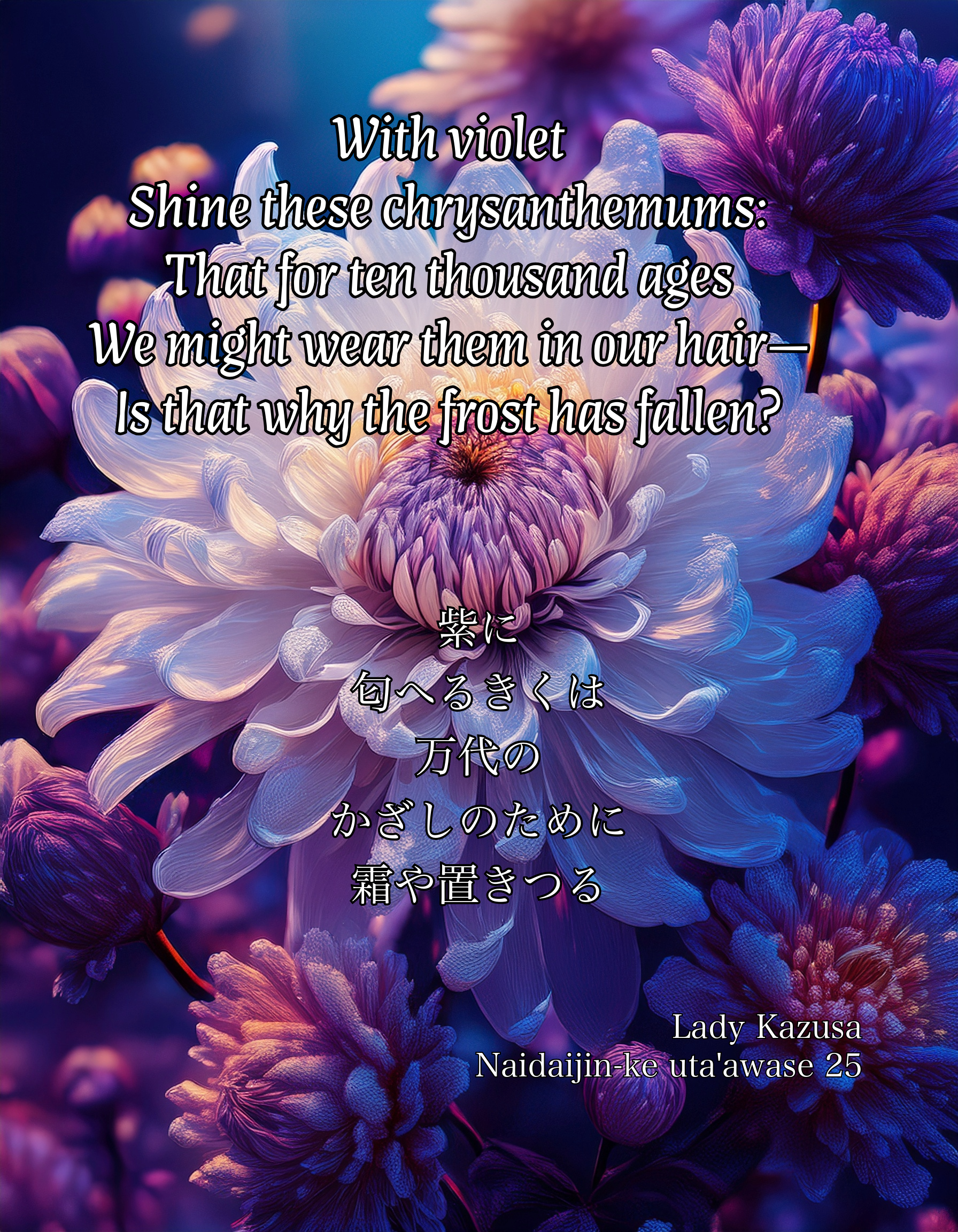
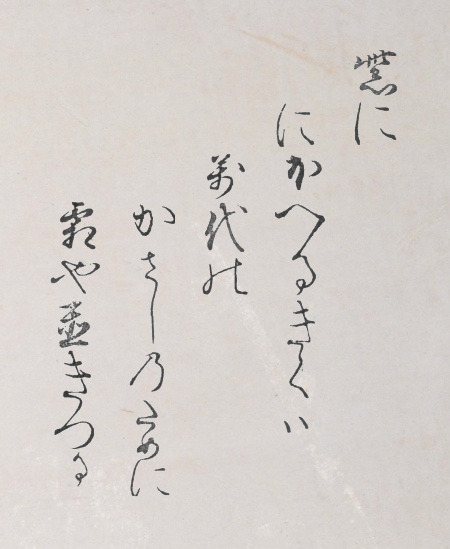
紫に匂へるきくは万代のかざしのために霜や置きつる

murasaki ni
nioeru kiku wa
yorozuyo no
kazashi no tame ni
shimo ya okitsuru
With violet
Shine these chrysanthemums:
That for ten thousand ages
We might wear them in our hair—
Is that why the frost has fallen?

Lady Kazusa
25

Right

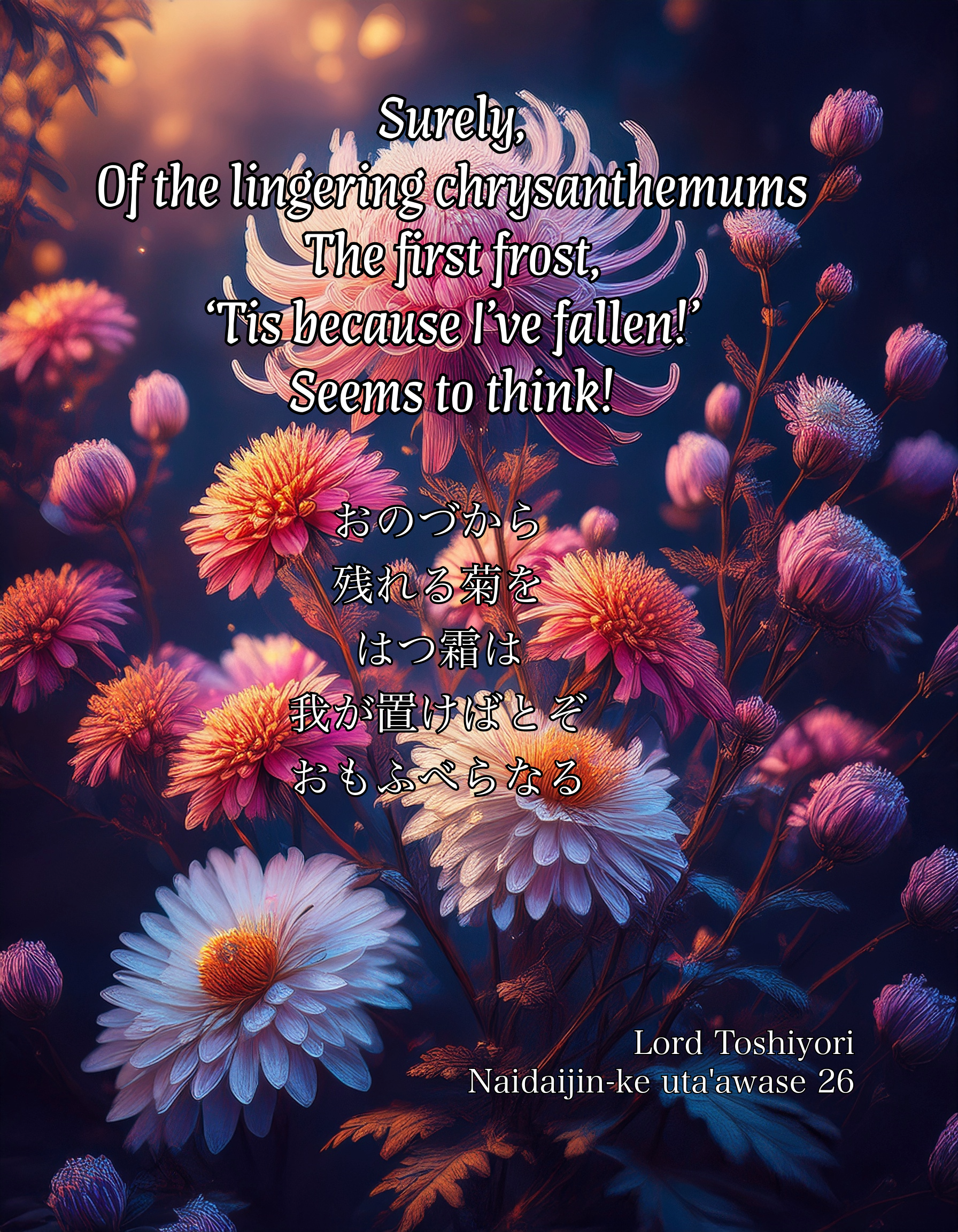
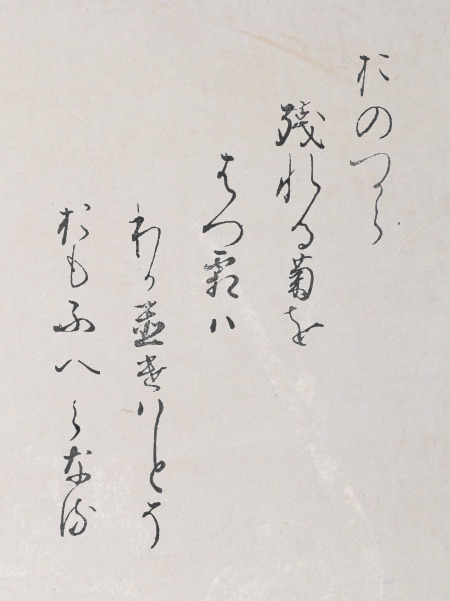
おのづから残れる菊をはつ霜は我が置けばとぞおもふべらなる

onozukara
nokoreru kiku o
hatsushimo wa
wa ga okeba to zo
omouberanaru
Surely,
Of the lingering chrysanthemums
The first frost,
‘Tis because I’ve fallen!’
Seems to think!

Lord Toshiyori
26

Toshiyori states: while the first poem is not remarkable, it does sound smooth. The concluding ‘has fallen’, though—would it be excessive to say that I feel it’s a bit grating? In the second poem, the assembled company have stated that ‘seems to’ is something that they have never heard before in their lives and given that they have said that this is what it sounds like, I make the Left the winner.

Mototoshi states: ‘With violet / Shine these chrysanthemums’ sounds appropriately poetic, but saying ‘that…we might wear them in our hair’ followed by the final ‘has fallen’ is a sequencing that is, in great part, inharmonious and lacking in gentle beauty. Nevertheless, I feel that the second poem’s ‘Surely, / Of the lingering chrysanthemums’ and the final ‘seems to’ is so unfamiliar that it makes me wonder what is going on with the sequencing there, so a single dipping in violet dye is superior and, I feel, all the sweeter!

Tōin senzai awase 10

Left – Pinks

もも草のときにつけつつさく中にいつともわかぬとこ夏の花

momokusa no
toki ni tsuketsutsu
saku naka ni
itsu tomo wakanu
tokonatsu no hana
A hundred grasses
Always with the season
Bloom and among them
Ever inseparable are
The flowering pinks.

17

Right

よろづよにぬるとこなつの花なればうつろふ秋もまたれざりけり

yorozuyo ni
nuru tokonatsu no
hana nareba
utsurou aki mo
matarezarikeri
For ten thousand ages
Have slept abed the pinks
In bloom, so
For the autumn when they fade
They have no need to wait!

18

GYS VII: 1093

A poem inscribed in cursive script on a lacquerware box from when he was absorbed in compiling the Collection of a Thousand Years.

和歌の浦にちぢのたまもをかきつめて万世までも君がみんため

waka no ura ni
chiji no tamamo o
kakitsumete
yorozuyo made mo
kimi ga min tame
In the Bay of Waka
Countless gemweeds
Have I raked together that
For ten thousand generations
My Lord may gaze upon them!

Master of the Dowager Empress’ Household Office Toshinari

A kuzushiji version of the poem's text.
Created with Soan.

MYS VIII: 1637

A poem by His Majesty, the Retired Emperor [Genshō].

波太須珠寸 尾花逆葺 黒木用 造有室者 迄萬代

はだすすき尾花逆葺き黒木もち造れる室は万代までに

hadasusuki
obana sakapuki
kuroki moti
tukureru muro pa
yoroduyo made ni
Silver
Grass, reversed, for thatch, and
With unbarked lumber
Made, this rude dwelling
For ten thousand generations, surely will endure…

SSIS X: 725

Composed at the Kameyama Palace in the Eighth Month, Kenji 2 [1276], when the first topic announced was ‘the shape of a pine tree floating in a pond’.

万代とかめのを山の松かげをうつしてすめるやどの池水

yorozuyo to
kame no oyama no
matsukage o
utsushite sumeru
yado no ikemizu
For ten thousand generations
On the mount of Kame
Is the pine tree’s shape,
Reflected, so clear in
This dwelling’s pond waters.

The Retired Emperor [Kameyama]