Tag Archives: shrine

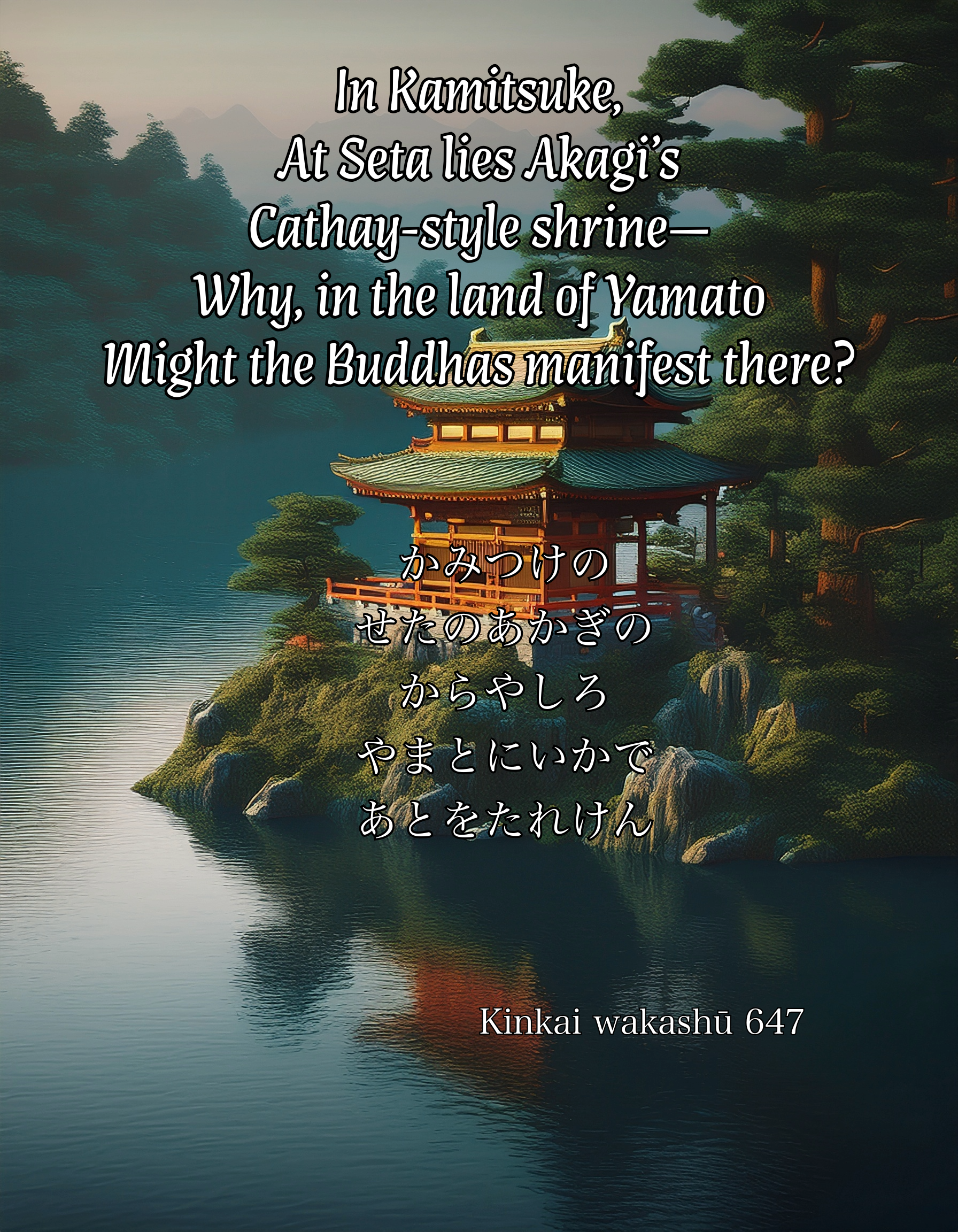
Kinkai wakashū 647

When I had composed a large number of poems on Shintō themes.

かみつけのせたのあかぎのからやしろやまとにいかであとをたれけん

kamitsuke no
seta no akagi no
karayashiro
yamato ni ikade
ato o tareken
In Kamitsuke,
At Seta lies Akagi’s
Cathay-style shrine—
Why, in the land of Yamato
Might the Buddhas manifest there? [i]

647


[i] Akagi Shrine (akagi jinja 赤城神社) lay (and still lies) on the banks of Lake Ōnuma 大沼 in Kōzuke (Kamitsuke) 上野 province (modern Gunma 群馬 prefecture). Under the belief that various Buddhist deities manifested themselves in Japan as Shintō kami in order to better provide salvation to the people there (honji suijaku-setsu 本地垂迹説) its principal deity, Akagi Daimyōjin 赤城大明神 was believed to be a manifestation of Thousand-Armed Avalokitesvara (Senju kannon 千手觀音), Ākāśagarbha (Kokuzō bosatsu 虛空藏菩薩) and Kṣitigarbha (Jizō bosatsu 地藏菩薩). Sanetomo’s poem queries why, if the bodhisattvas have chosen to manifest as kami, they should do so at a shrine built in a foreign style.

Kinkai wakashū 635

On the shrine at Miwa.[i]

いまつくるみわのはふりがすぎ社すぎにし事はとはずともよし

ima tsukuru
miwa no hafuri ga
sugi yashiro
suginishi koto wa
towazu tomo yoshi
Newly invested,
At Miwa, a junior priest
For the cedar shrine, but
What has occurred
It would be better not to ask!

635


[i] This is Ōmiwa Shrine (Ōmiwa jinja 大神神社) which is located on the western slopes of Mount Miwa 三輪山, in what is now Sakurai in Nara prefecture. Mount Miwa is covered by a cedar forest and the trees thus became an object of veneration at the shrine, something which was reinforced by: Topic unknown. 我が庵は三輪の山もと戀しくは訪らひ來ませ杉立てる門 wa ga io wa / miwa no yama moto / koishiku wa / toburaikimase / sugi tateru kado ‘My hut is / At Mount Miwa’s foot; / How I long / For you to come visiting / My gate where cedars stand.’ Anonymous (Kokinshū XVIII: 982). This poem was attributed to the deity of Ōmiwa Shrine, Miwa Myōjin 三輪明神, and firmly cemented the link between Miwa and cedars in poetry. See McAuley (2020, 577–578) for more details and example poems.

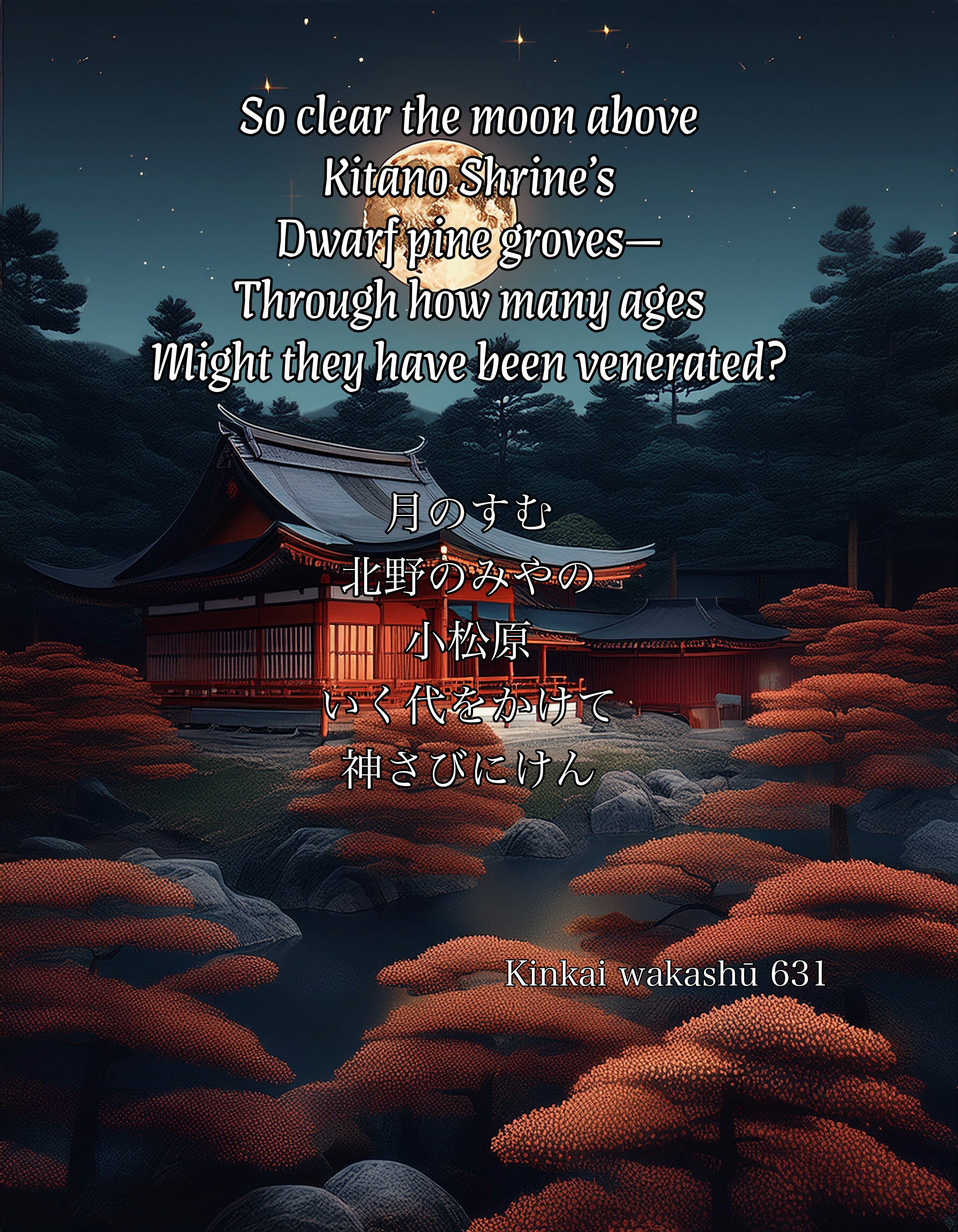
Kinkai wakashū 631

The moon above the shrine.[i]

月のすむ北野のみやの小松原いく代をかけて神さびにけん

tsuki no sumu
kitano no miya no
komatsubara
ikuyo o kakete
kamisabiniken
So clear the moon above
Kitano Shrine’s[ii]
Dwarf pine groves—
Through how many ages
Might they have been venerated?[iii]

631


[i] The topic here, ‘the moon over the shrine’ (shatō no tsuki 社頭月) was a standard one which could be applied to any poem on this theme, but poets usually had a specific shrine in mind when using it—that is, their poems were intended to describe a specific scene rather than a generic one. Sometimes the context would be supplied by the time and place in which the poem was composed: for example, this is one of the topics used in the Sumiyoshi-sha uta’awase kaō ni-nen (‘Sumiyoshi Shrine Poetry Match – Kaō 2’) held in 1170, so all the poems on it can be understood as describing the moon over Sumiyoshi Grand Shrine. Alternatively, the poet could refer to the shrine in the poem itself, as Sanetomo does here.

[ii] This is Kitano Tenmangū 北野天満宮 in the north of Kyoto, dedicated to Sugawara no Michizane 菅原道真 (845-903), as the deity of learning, Tenman Tenjin 天満天神.

[iii] See: 和我伊能知乎 奈我刀能之麻能 小松原 伊久与乎倍弖加 可武佐備和多流 wa ga inochi / nagato no shima no / komatsubara / ikuyo o hete ka / kamusabiwataru ‘My life! / Upon the isle of Nagato / The dwarf pine groves / Have through how many ages passed? / Ever venerable…’ (Man’yōshū XV: 3621)

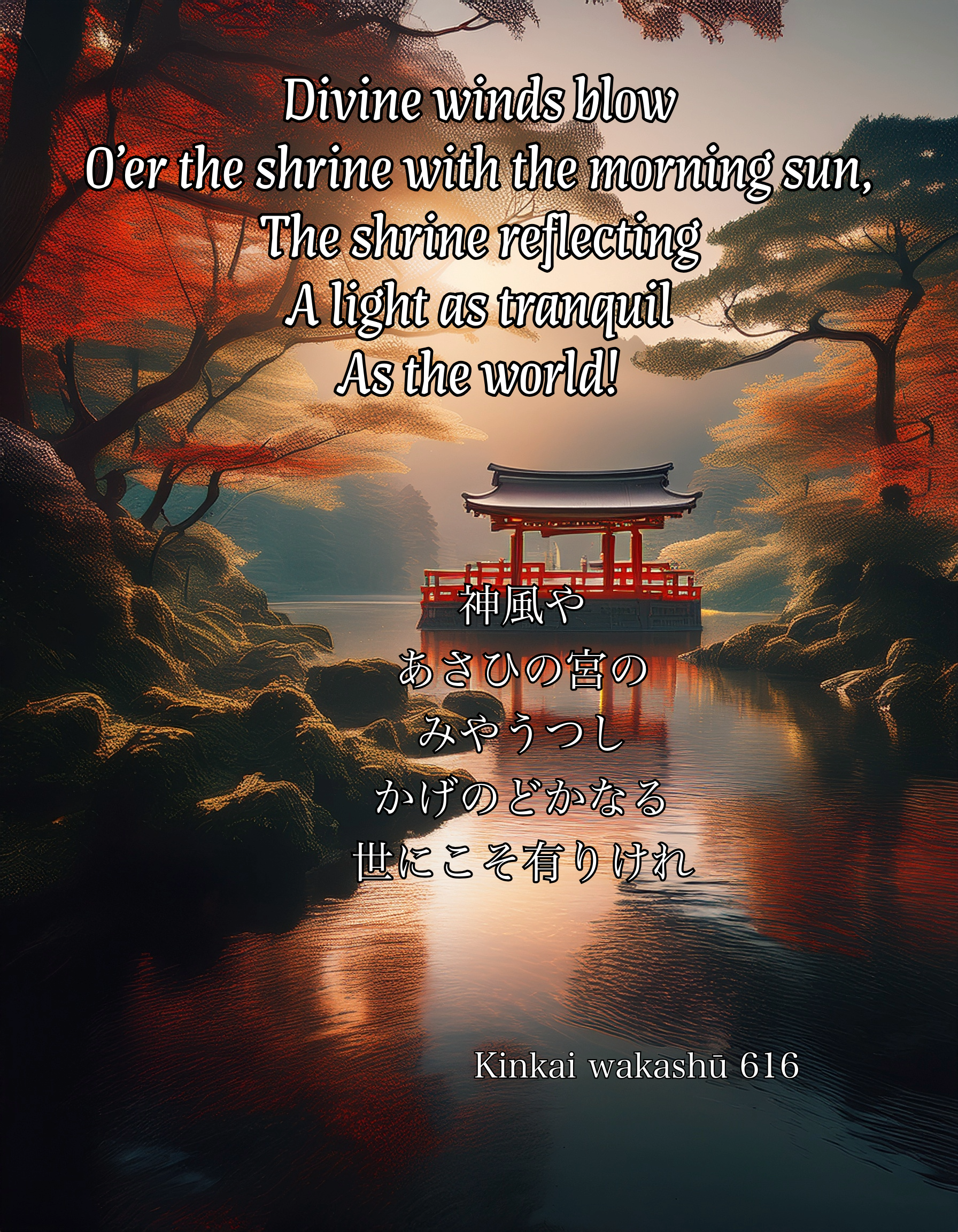
Kinkai wakashū 616

A poem composed during the year when the Ise Shrine was renewed.[i]

神風やあさひの宮のみやうつしかげのどかなる世にこそ有りけれ

kamikaze ya
asahi no miya no
miya utsushi
kage nodokanaru
yo ni koso arikere
Divine winds blow
O’er the shrine with the morning sun,
The shrine reflecting
A light as tranquil
As the world![ii]

616


[i] The Grand Shrine at Ise was demolished and rebuilt approximately every twenty years. The occasion Sanetomo is referring to here took place in the Ninth Month, Jōgen 3 [1209] (Higuchi 2016, 188).

[ii] See: In reply. 神風やいすずかは浪かずしらずすむべきみよに又かへりこん kamikaze ya / isuzukawanami / kazu shirazu / sumubeki miyo ni / mata kaerikon ‘Divine winds blow / Waves upon the Isuzu River / In numbers unknown, / So bright this age that / Ever will I return.’ Supernumerary Master of the Crown Prince’s Household Kintsugu (Shinkokinshū XIX: 1874)

Aru tokoro no uta’awase – Shōtai 4-nen 15-ya

Shinpen kokka taikan no.
Heian-chō uta’awase taisei no.12
Title或所歌合
Romanised TitleAru tokoro no uta’awase
Translated TitlePoetry Contest held in a Certain Place
Alternative Title(s)
DateNight, 15/8 Shōtai 4 [30.9.901]
Extant Poems2
Sponsor
Identifiable Participants
JudgementsN
TopicsAutumn

Only the date of this contest remains, along with two of its poems. Given the season, it would clearly have been an autumn-themed event and, as the 15th day of the Eighth Month was when conventionally the moon was at its brightest, it is not surprising that it seems to have been held at night, and contained at least some poems where the moon was a theme.

Of the two surviving poems, one was included in Fubokushō (XIV: 5840), while the other is only recorded here.

いそのかみふるのやしろにはふくずもあきにしなれば色かはりけり

isonokami
Furu no yasiro ni
haFu kuzu mo
aki ni shi nareba
iro kaFarikeri
In Isonokami
At the ancient shrine of Furu
Even the creeping kudzu vine
When the autumn comes
Does change its hues.

1

Right

山のはももみぢてちりぬ月影のかくるるところなくなりぬべし

yama no Fa mo
momidite tirinu
tukikage no
kakururu tokoro
nakunarinubesi
Along the mountains’ edge
Scarlet leaves have scattered
In the moonlight
A place concealed
Is there none, at all.

2

Love IX: 19

Left
戀衣いつか干るべき河社しるしも浪にいとゞしほれて

koigoromo
itsuka hirubeki
kawa yashiro
shirushi mo nami ni
itodo shiorete
My clothes of love,
When might they dry?
A river shrine
Has had no effect – the waves
Dampen them all the more…

Kenshō
1117

Right (Win)
いかで猶夜半の衣を返しても重ねしほどの夢をだに見ん

ikade nao
yowa no koromo o
kaeshitemo
kasaneshi hodo no
yume o dani min
What to do? Again
My night time garb
Inside out I turn –
As many layers
As dreams, if only I would see…

Takanobu
1118

The Right state: there are a number of different theories about the source poem ‘stems of bamboo wave freely the clothes I’d dry’ (shino ni orihae hosu koromo), so how should the allusion here be correctly understood? In response: this refers to a summer performance of sacred music and dance. In this, sprigs of sakaki are placed in clear water, and bamboo stems are hung from the shelf as offerings. This is the river shrine (kawa yashiro). It appears in the records about sacred music in summer. Standard sacred music is performed to pray to the gods. Thus, if one is made to bear the weight of something one has not done, the feeling is close to the conception of damp clothes, is it not? And this is associated with the clothes of lovers that will not dry. The Left state: the Right’s poem has no faults to mention.

In judgement:  the Left’s poem seems to be more about a ‘river shrine’ than ‘lovers’ clothing’ (koigoromo). While it is not entirely clear, the Left and Right’s criticism and response, are certainly unusual. There are two poems which are possible as sources for this, both of which appear in Tsurayuki’s Collection. These are: ‘At a river shrine / Stems of bamboo wave freely / The clothes I’d dry / How should I do so? / Seven days still damp…’  and:

行く水のうへにいはへる河社河浪高くあそぶなるかな

yuku mizu no
ue ni iwaeru
kawa yashiro
kawa nami takaku
asobunaru kana
The waters run, and
Above them in celebration is
A river shrine;
The river’s waves rise high,
Taking pleasure in their play!

This latter is a poem from a folding screen with pictures of each of the moons of the year, painted in the Tenryaku Era. Moreover, in a work by Lord Toshiyori, he says, ‘There is no one today who knows what a “river shrine” is. All we can do now is guess. So people say that it was a shrine on top of the water, where sacred music was performed in summer. The latter poem certainly does not seem to have this meaning. The former makes no mention of sacred music, and simply talks of clothing one has wanted to dry for a long time not drying.’ In addition, I have questioned a member of a household familiar with sacred music about this matter, and been told, ‘Where summer sacred music is concerned, there is a particular way of it. It is definitely absent from the records.’ Furthermore, Toshiyori played the double-reed flute. He would clearly have known all about sacred music, and around this time wrote, ‘first of all, there is no one who knows of this,’ and yet the Left’s response simply states, ‘it appears in the records about sacred music.’ This is something which requires greater proof. If the gentleman of the Left is able to provide some now, this would be a fine thing for the Way of Music! These, in brief, are my thoughts on this matter and, of course, the Left’s response.

First, it is a mistake to say that the river shrine is necessarily connected with summer sacred music. Summer sacred music is just what it sounds like: in summer, sacred music is performed, but not in any fixed way. However, here summer sacred music is done before a river shrine. Kawa yashiro shino ni is an old term for widely or ordinarily. It appears to have been used this way in the Collection of a Myriad Leaves. Orihaete has the same meaning. In the phrase ‘drying a robe / seven days undrying’ (hosu koromo / nanoka hizu) seven, or eight, days is simply a poetic convention for conveying that something was not dry after a long time. The ‘robe’ is not really a piece of clothing, but something which resembles it, and which is not dry. Ise said of the so-called Ryūmon Waterfall, ‘So why should the mountain’s princess rinse her cloth’ (nani yama hime no nuno sarasuramu) and also there are expressions such as ‘Nunohiki Falls’. Thus we have the Left’s argument for the summer sacred music platform, and then Lord Toshiyori’s writings; further, on the term shino ‘bamboo hung from the shelf as an offering to the gods’ and ‘clothing has the conception of damp clothing’. This is a remarkable way of interpreting the poem, indeed! The only way to settle the matter would be with the presentation of definite proof. So, this is certainly something which His Grace should request for review. In short, the Left’s poem, beginning with the idea that lovers’ clothing is to pray at a river shrine, and then saying ‘it has no effect’ (shirushi mo nami ni) seems like everlasting bitterness. The Right’s poem says ‘my night time garb inside out I turn’ (yowa no koromo o kaeshitemo), which is quite ordinary. In the absence of definite proof for the Left’s contentions, the Right must win.