ne no bisuru hito ni kasumi wa sakidachite komatsu ga hara o tanabikitekeri
On the Day of the Rat Before folk has the haze Arisen, and Across the pine seedling plains Drawn up.[i]
15
[i] See: Topic unknown. あさみどりのべのかすみのたなびくにけふのこ松をまかせつるかな asamidori / nobe no kasumi no / tanabiku ni / kyō no komatsu o / makaseturu kana ‘Pale green / Across the plains the haze / Does draw, so / Today, the pine seedlings / I will leave to it!’ Minister of Public Affairs Tsunenobu (Goshūishū I: 30). Both poems are built around a play-on-words: one of the Day of the Rat activities was to pull (draw) up (hiku 引く) pine seedlings (as mentioned above). This is echoed in the verb used to describe the haze spreading across the plains, tanabiku 棚引く (‘spread out at length horizontally’).
himeshima no komatsu ga ure ni iru tazu wa chitose furedomo toshi oizukeri
Among Himeshima’s[i] Pine seedling shoots Rest cranes: A thousand year may pass, yet They’ll not age through the years.[ii]
655
[i] Himeshima 姫島 (‘Princess Isle’) was a small island which is believed to have lain in the mouth of the Yodo River where it entered the inland sea south of modern Osaka. Due to changes in topography and the river’s course since ancient times, however, its exact location is now unknown.
[ii] See: [One of] two poems composed to express his grief and sorrow by Kawabe no Miyahito when he saw the coffin of a young girl in the pine groves of Himeshima in Wadō 4 [711]. 妹之名者 千代尓将流 姫嶋之 子松之末尓 蘿生万代尓 imo ga na wa / chiyo ni nagaremu / himeshima no / komatsu ga ure ni / kokemusu made ni ‘This maiden’s name / Will drift down a thousand ages / Until Himeshima’s / Pine seedling shoots are / Choked with hanging moss.’ (Man’yōshū II: 228)
[One of] two poems composed to express his grief and sorrow by Kawabe no Miyahito when he saw the coffin of a young girl in the pine groves of Himeshima in Wadō 4 [711].
妹之名者 千代尓将流 姫嶋之 子松之末尓 蘿生万代尓
いもがなは ちよにながれむ ひめしまの こまつがうれに こけむすまでに
imo ga na pa tiyo ni nagaremu pimesima no komatu ga ure ni kokemusu made ni
This maiden’s name Will drift down a thousand ages Until Himeshima’s Pine seedling shoots are Choked with hanging moss.
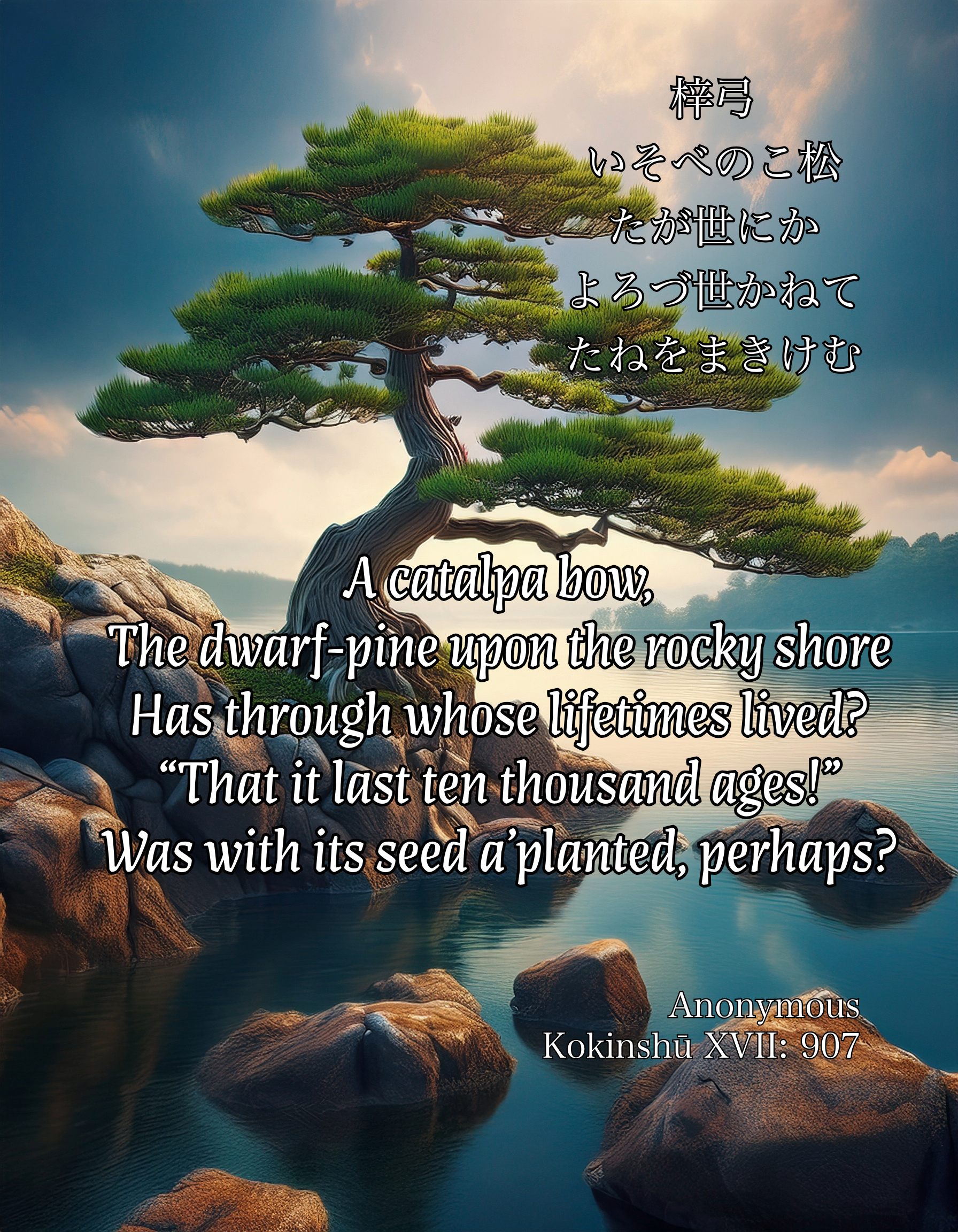
adusayumi isobe no komatu ta ga yo ni ka yoroduyo kanete tane wo makikemu
A catalpa bow, The dwarf pine upon the rocky shore Has through whose lifetimes lived? “That it last ten thousand ages!” Was with its seed a’planted, perhaps?