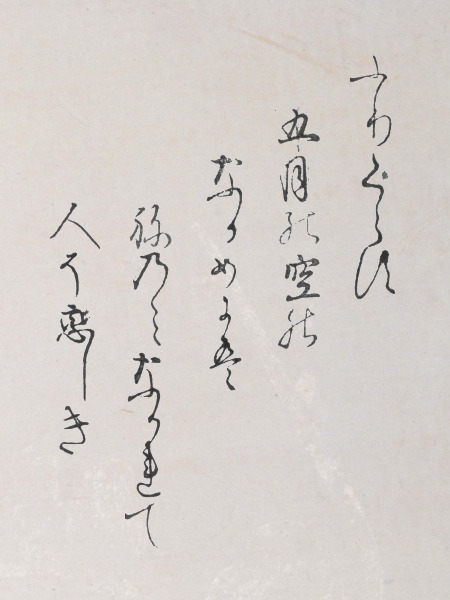
uchikirashi amagiru sora to mishi hodo ni yagate tsumoreru yuki no shirayama
Suddenly concealed By mist, the skies I glimpsed and In a moment drifted Snow covered Shira Mountain with white.
Controller’s Graduate 51
Right
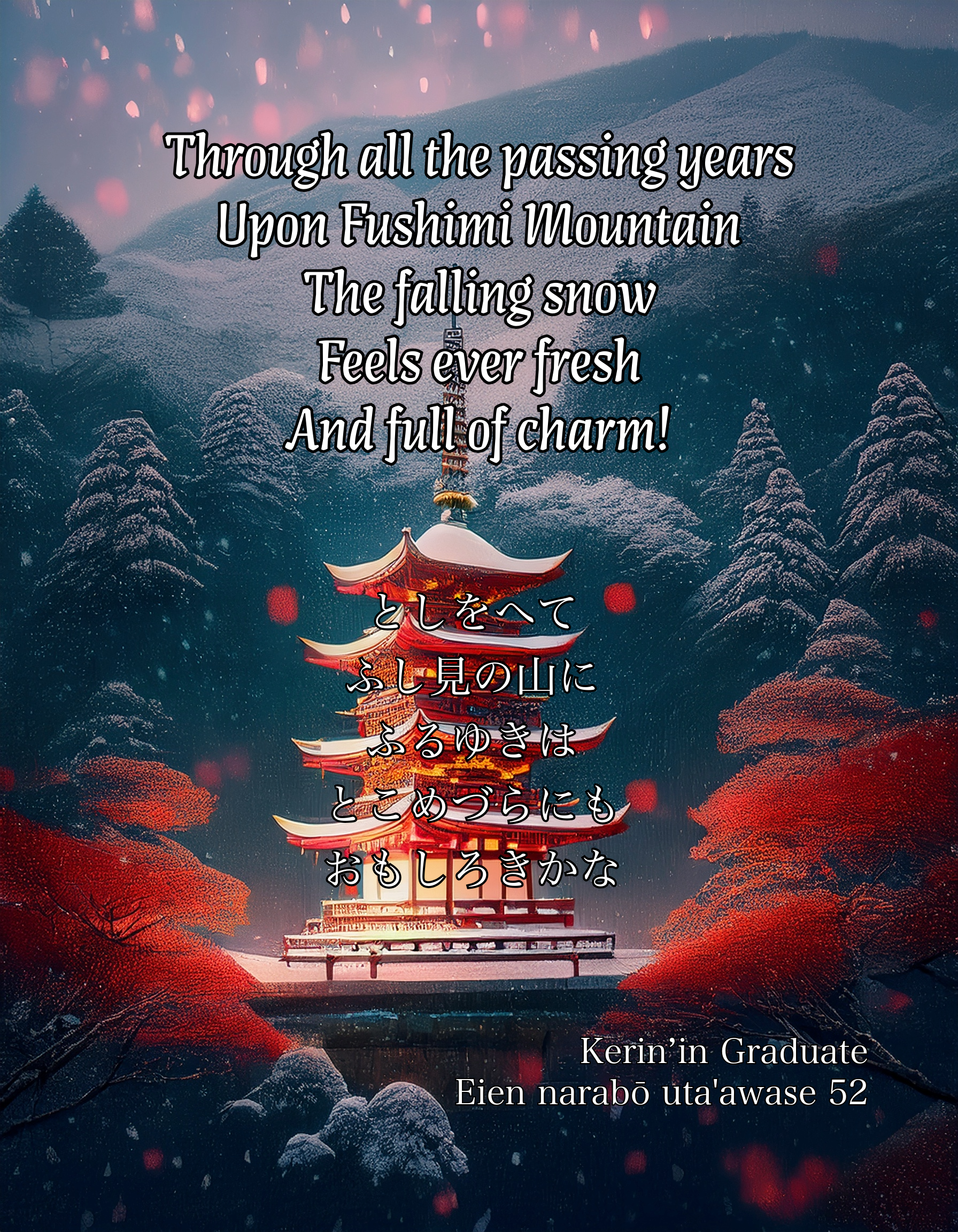
としをへてふし見の山にふるゆきはとこめづらにもおもしろきかな
toshi o hete fushimi no yama ni furu yuki wa tokomezura ni mo omoshiroki kana
Through all the passing years Upon Fushimi Mountain The falling snow Feels ever fresh And full of charm!
Kerin’in Graduate
52
The poem of the Left’s ‘Suddenly concealed / By mist, the skies’ is a clear case of repeating the same meaning. In addition, ‘snow covered Shira Mountain’ is one which is snow-capped regardless of whether it’s summer or winter. It’s not a mountain where one would be startled at seeing it ‘suddenly concealed’. The poem of the Right says that ‘through all the passing years the estate at Fushimi…feels ever fresh’, which seems as if this poem is specifying a period when this applies. It’s certainly a bit of a reach to say that this would be charming, but it’s not incongruous. Thus, I make this a tie.
I am unable to grasp the sense of the Left poem’s ‘suddenly concealed’. If it had been ‘concealed with falling’ then that would be better. In addition, I don’t understand the final ‘snow covered Shira Mountain’ either. I would have preferred it if the order had been ‘Shira Mountain’s snow’, but putting the ‘snow’ first seems to lack fluency and so, regretfully I would change this.
The Right’s ‘Fushimi Mountain’ is difficult to understand. It seems that ‘estate’ is a more standard composition, and ‘mountain’ is a novel usage. Having ‘Fushimi’ ‘feel fresh’ is evidence of thought, but even so, ‘mountain’ is vague.
aki no yo no fukeyuku kaze ni kumo harete hanada no sora ni sumeru tsukikage
As the autumn night Wears on, the wind Clears away the cloud, and From the pale indigo sky Comes clear moonlight.
Controller’s Graduate 37
Right
ふるさとのときぞともなきさびしさもなぐさむばかりすめる月かな
furusato no toki zo tomonaki sabishisa mo nagusamu bakari sumeru tsuki kana
In the ancient capital Timeless is The lonely sadness Consoled only By the clear, bright moon!
Kerin’in Graduate 38
The Left’s poem is a transparent copy of an older work. That poem is:
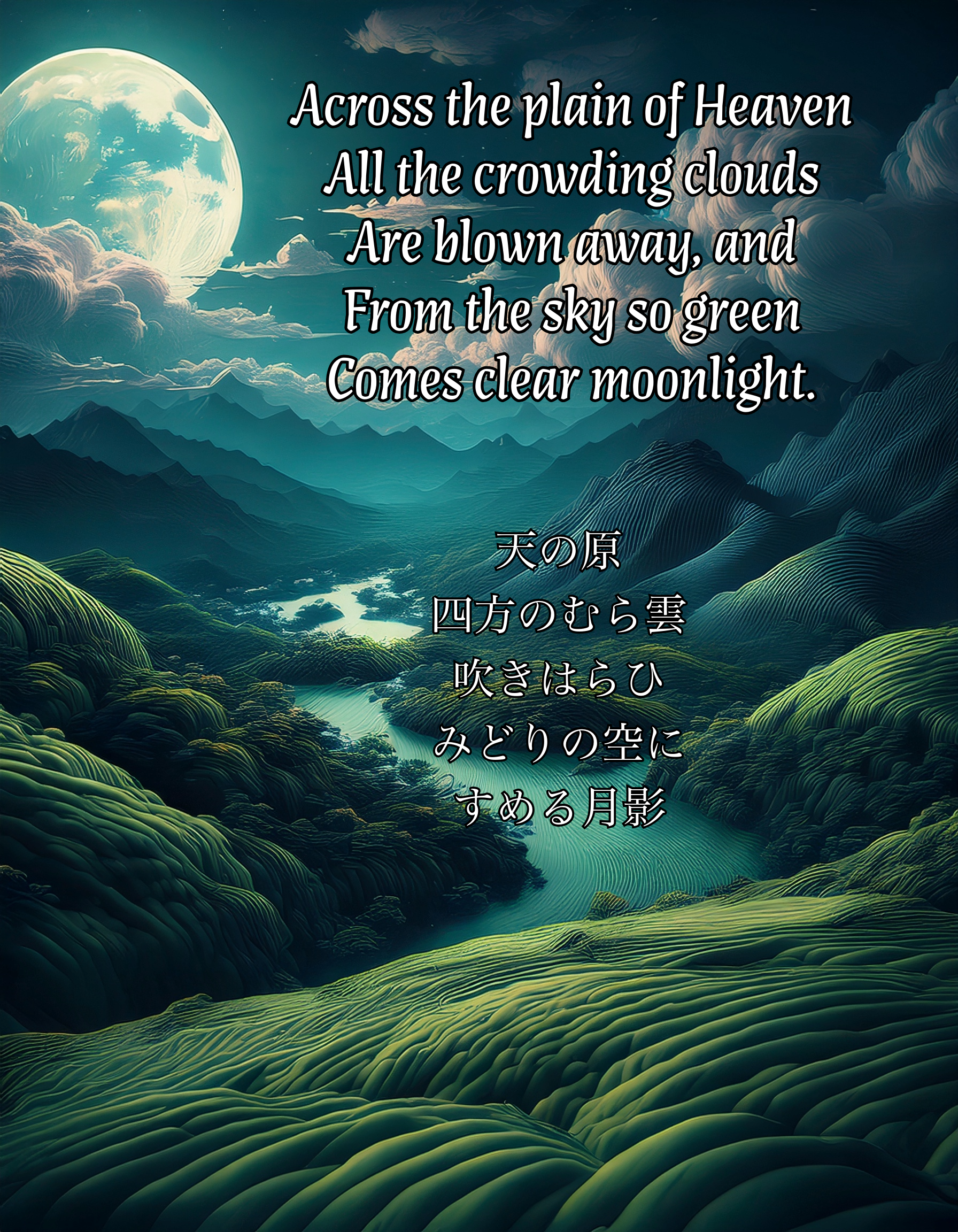
天の原四方のむら雲吹きはらひみどりの空にすめる月影
ama no hara yomo no muragumo fukiharai midori no sora ni sumeru tsukikage
Across the plain of Heaven All the crowding clouds Are blown away, and From the sky so green Comes clear moonlight.[i]
I don’t feel this is in any way different. As for the Right’s poem, while it is not the case that it is entirely without conception, it lacks any exemplary elements, so I don’t see how I can possibly recommend either of these.
The Left’s poem isn’t bad, but it should be revised to use ‘sky so green’, because using ‘pale indigo sky’ is vague. To decide in favour of it I would need there to be a prior poem as precedent. The Right’s poem is not particularly exemplary, but it does sound as if there are times like that. In the absence of a precedent for the Left, the poem of the Right wins.
aki no yo no tsuki no hikari wa kawaranedo tabi no sora koso aware narikeri
On an autumn night The moon’s light Is unchanged, yet The sky above me on my travels Is so very sad, indeed.
Lord Saburō 31
Right
あきの夜はたのむる人もなきやどもありあけの月はなほぞまちいづる
aki no yo wa tanomuru hito mo naki yado mo ariake no tsuki wa nao zo machi’izuru
On an autumn night With no man even expected At my house, It is the dawntime moon’s Appearance that, indeed, I have awaited.
Ushigimi
32
The poem of the Left seems extremely well-trodden. It resembles a something sung as a popular song. As for the poem of the Right, ‘not…at my house’ is extraordinarily stilted, yet the poems are of the same quality, so I would say these tie.
The poem of the Left’s final ‘Is so very sad, indeed’ sounds pitiful and truly unskilled. The poem of the Right overemphasises ‘even’, and also appears to say that the dawntime moon is an element conveying a moving desolation. I wonder if this is appropriate for the topic of the ‘the moon’ in a poetry match? There needs to be a prior poem as precedent. It does say that the moon’s emergence after having waited for it is something precious, but the poem refers to the moon in the latter part of the month, after the twentieth day, doesn’t it? This would seem to be moving, for sure, but it’s something which doesn’t shed much light, so I would say that the Left wins.
hototogisu maki no to bakari machitsuredo nakade akenuru natsu no shinonome
O, cuckoo, Briefly by my door of cedar wood Did I await you, yet No song, at all, brightened This summer edge of dawn.
Lord Dainagon 15
Right (Win)
ほととぎすなくうれしさをつつめどもそらにはこゑもとまらざりけり
hototogisu naku ureshisa o tsutsumedomo sora ni wa koe mo tomarazarikeri
At the cuckoo’s Song, my joy To hold fast did I try, yet In the skies, his cry Lingered not.
Lord Chūnagon 16
The Left’s poem, after careful consideration, has a graceful style. The diction of the Right’s poem is superb, and there is an excess of conception. Reading and reciting these leaves my aged heart at a loss. Thus, they tie.
In the Left’s poem, ‘briefly’ is an expression which means ‘just for a short time’, I think, and thus the sentiments are lacking. Saying ‘brightened…edge of dawn’ sounds as if the poet has only begun waiting at daybreak. One does see, apparently, a number of poems in prior matches where the poet has not heard the cuckoo. Nevertheless, I do wonder about whether this is appropriate, given that poems where the cuckoo has been heard are faultless. The Right’s poem is not that good, but it is poetic. Thus, it has to win.