名にしおはばその神山のあふひ草かけてむかしを思ひいでなん
| na ni shi owaba sono kamiyama no aoigusa kakete mukashi o omoi’idenan | It’s all in the name:[i] This sacred hill’s Hollyhocks were Hung on that day, long ago, that I wish you would remember…[ii] |
628
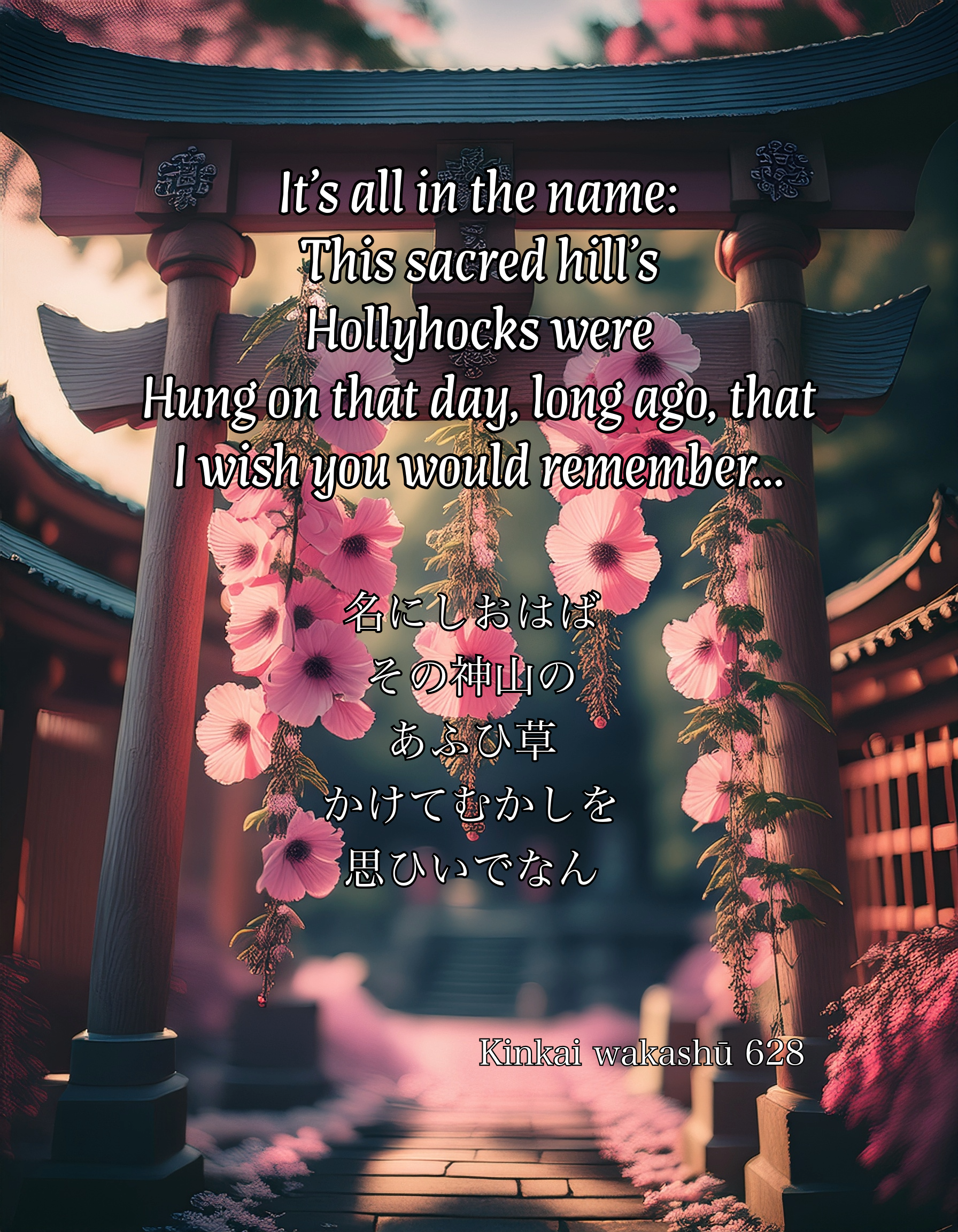
[i] This poem is built around a play-on-words: the ‘name’ of hollyhock, aoi 葵 or more precisely, afuhi as it was pronounced at the time Sanetomo was writing, was homophonous with afu hi 逢ふ日 (‘the day we met’). Thus, a more accurate paraphrase of the poem’s meaning would be: ‘Today is the Kamo Festival when “day-we-met” flowers are hung around. When you see them, I wish you would remember that day long ago…’
[ii] See: Composed on hollyhocks. いかなればそのかみ山のあふひぐさとしはふれどもふた葉なるらん ikanareba / sono kamiyama no / aoigusa / toshi wa furedomo / futaba naruran ‘Why is it that / Upon divine Kamo Hill / The hollyhocks / Though years do pass, / Have such twofold leaves?’ Kojijū (Shinkokinshū III: 183)


