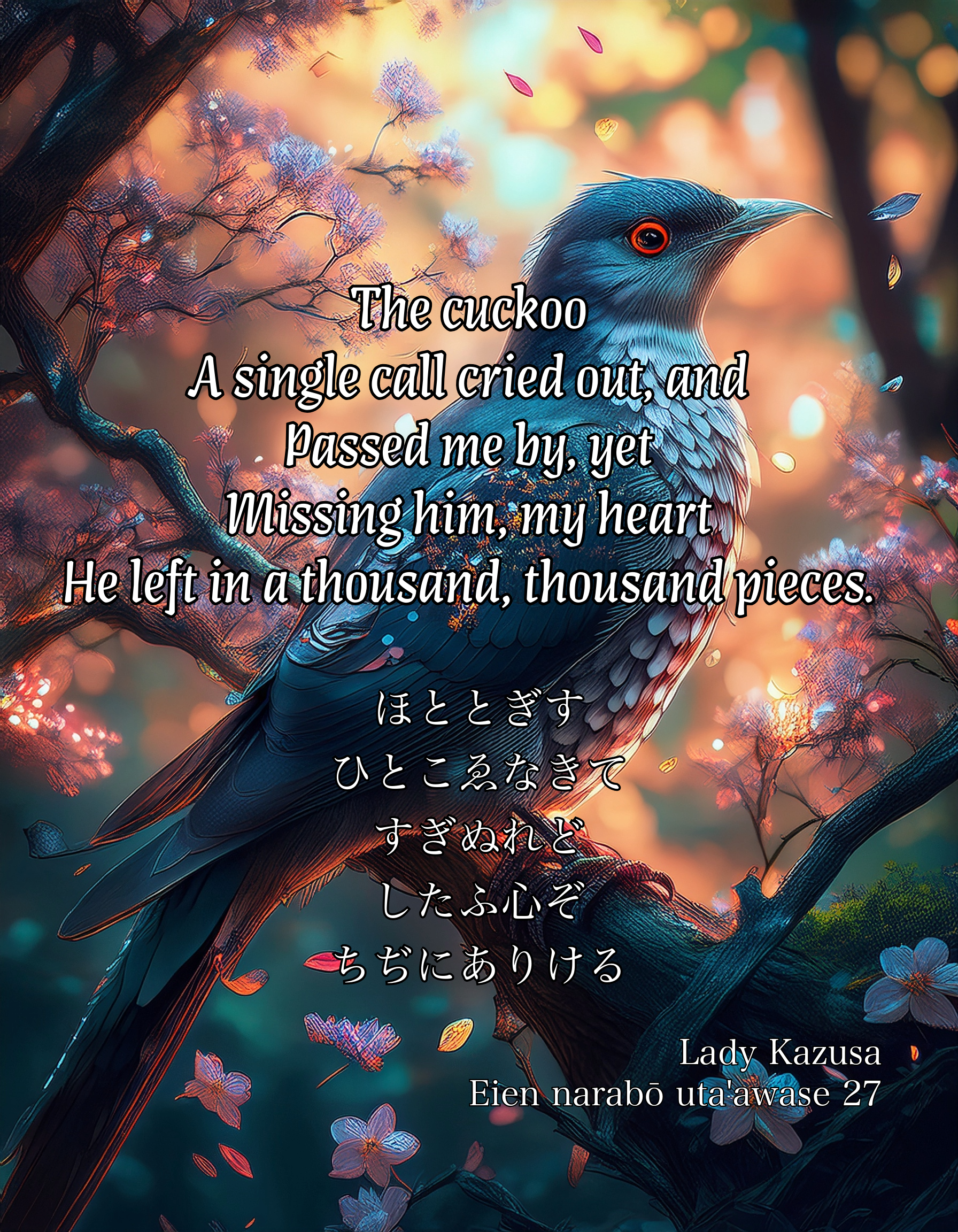
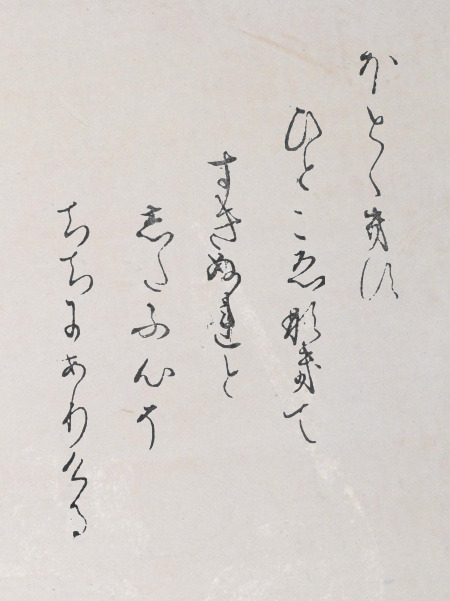
hototogisu hitokoe nakite suginuredo shitau kokoro zo chiji ni arikeru
The cuckoo A single call cried out, and Passed me by, yet Missing him, my heart He left in a thousand, thousand pieces.
Lady Kazusa 27
Right (Win)
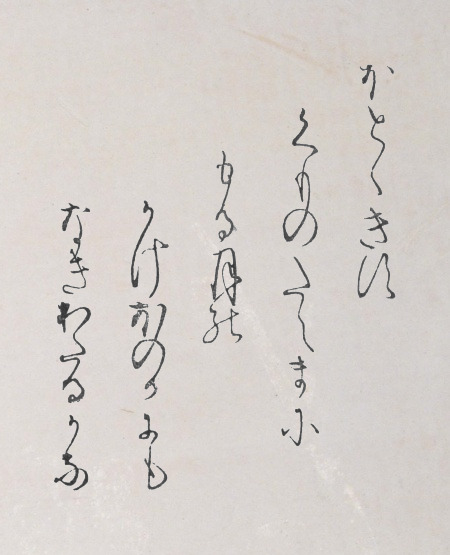
ほととぎすくものたえまにもる月のかげほのかにもなきわたるかな
hototogisu kumo no taema ni moru tsuki no kage honoka ni mo nakiwataru kana
The cuckoo, as From a gap between the clouds Drips the moon’s Light, faintly Calls on!
Lady Shikibu 28
Both poems are of the same quality.
The Left’s poem really makes me wonder why that should be the case, with the final ‘he left’ putting me in mind of someone in court dress who has forgotten to put on his shoes! The Right’s poem appears rather more bright than it needs to be. Furthermore, if one says that the ‘light is faint’ then shouldn’t the moon be hidden by the clouds? It’s vague over that, but if there were a prior poem as precedent, then it would be a good composition. For the present, I will make it the winner.
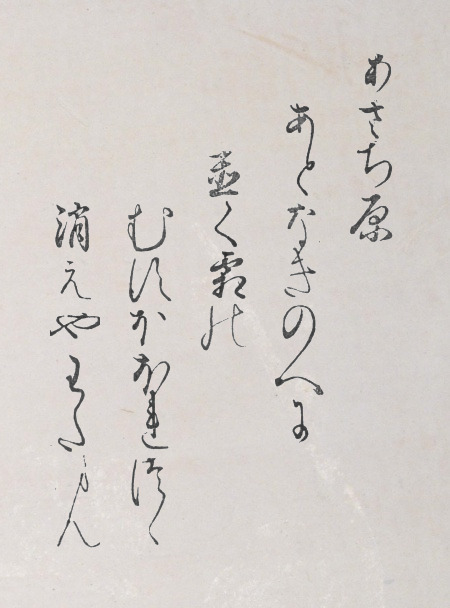
yomosugara matsu ni wa nakade hototogisu ashita no hara ni hitokoe zo kiku
All through the night I pined without a song, O, cuckoo Then with the morn on Ashita plain I hear a single call!
Cell of Fragrant Cloud 25
Right (Win)
五月にはしばなくやとぞほととぎすなほうらまちにさぬるよもなし
satsuki ni wa shiba naku ya to zo hototogisu nao uramachi ni sanuru yo mo nashi
In the Fifth Month Incessantly might he sing—I think, so The cuckoo I am already eagerly awaiting, Sleeping not at all on any night!
Cell of Compassionate Light 26
The Left’s poem seems to have an extraordinary conception, yet its diction is insufficient. The Right’s poem is old-fashionedly artless and thus has elements which are entirely poetically backward-looking.
The Left’s poem is particularly oddly composed in that is fails to account for the essential meaning of Ashita Plain. Does saying a ‘single call now’[1] mean that that one could wait expectantly during the day, too?
As for the Right’s poem, a cuckoo is not something that calls incessantly, yet I wonder if this composition is not, in some form, a plea that it would? As for ‘eagerly await’, well, I feel that it would be better to have ‘awaited’ rather than ‘awaiting’—that sounds like something one would have done ‘nothing but’ first. It seems a bit distasteful, like a poem by someone who has been perusing the Collection of a Myriad Leaves.
[1] On a folding screen for the Coming-of-Age Ceremony of the Northern Princess. 行きやらで山ぢくらしつほととぎす今ひとこゑのきかまほしさに yukiyarade / yamaji kurashitsu / hototogisu / ima hitokoe no / kikamahoshisa ni ‘I cannot go ahead / As twilight falls upon the mountain paths / For a cuckoo’s / Single call now / Is what I long to hear…’ Minamoto no Kintada (SIS II: 106)
niwa no omo ni shigerinikerashi yaemugura towade ikuyo noaki kaenuran
All around my grounds How thickly seems to have grown Mugwort in layer after tangled layer; With no visits from him how many times Has autumn come round and round?
hototogisu hanatachibana ni yadoru to mo nanorazariseba ikade shiramashi
The cuckoo Among the orange blossom May make his lodging, but If he fails to announce himself How would one ever know?
Controller’s Graduate 23
Right
さよなかにみふねの山のほととぎすほのかになきてすぎぬなるかな
sayo naka ni mifune no yama no hototogisu honoka ni nakite suginu naru kana
In the midst of a night so brief Upon Mifune Mountain, A cuckoo, Faintly crying, Has passed his time!
Kerin’in Graduate 24
It is entirely impossible to decide between these two poems.
Neither of these poems is particularly bad. The Left flows smoothly and is elegant; the Right starts with ‘Mifune Mountain’ and then continues with ‘faintly’, which certainly does not lack skill. Thus, I would say that these should tie, although this will doubtless be a source of some dissatisfaction to the writer of the Right.
How deeply Moving might it be? For a cuckoo To have long awaited and He then comes to call…
Cell of Everlasting Truth 22
In regard to the Left’s poem, in the Poetry Match held in Engi 3, there was a compostion which went ‘Until in Kataoka / The plains of Ashita / Does resound / The mountain cuckoos / Are singing now!’[i] When this was recited, His Majesty laughed and so it was not read aloud all the way to the end. The expression ‘resound’ is poor. The diction of the Right’s poem is terribly stilted and really doesn’t trip off the tongue, but strictly speaking it has no particular faults. I make it the winner.
The Left’s poem seems move my heart to the greatest degree. However, it really is the case that ‘resounding with song’ is something which happens after hearing it—that’s when it would seem right to compose ‘come resound with song’. It’s extremely imprudent to guess and say that somewhere ‘might resound with song’ without hearing it. And yet, there is the conception of there being times, too, when the cuckoo doesn’t sing. In the Right’s poem ‘To have long awaited’ lacks harmony, and I would want there to be a break there, so I should say that the Left wins.
Written on the edge of a folding screen by a painting of geese flying in the clouds, when His Majesty ordered a celebration for the Junior Principal Handmaid.
白雲の中にまがひてゆく雁もこゑはかくれぬ物にざりける
shirakumo no naka ni magaite yuku kari mo koe wa kakurenu mono ni zarikeru
Within the clouds, so white, Entangled Goes a goose, Unable to conceal his cry With anything at all!