tachikawaru haru o shire tomo misegao ni toshi o hedatsuru kasumi narikeri
‘The turn to Spring I would you know!’ Reveals, Standing at the year’s edge, The haze.
21
Right (Win)
岩まとぢし氷もいまはとけ初めて苔の下水道もとむなり
iwama tojishi kōri mo ima wa tokehajimete koke no shitamizu michi motomu nari
Cracks between the crags sealed By ice, now Beginning to melt, and The water ‘neath the moss Seeks to find its way.
22
The poem of the Left appears to have suitable configuration and diction, but even though the expression ‘reveals’ is something which one and all, and even I, compose with, I still feel that it is a word which is better avoided in a poetry match. Victory should be awarded according to a poem’s style. The poem of the Right has charming conception and diction. I should say it wins.
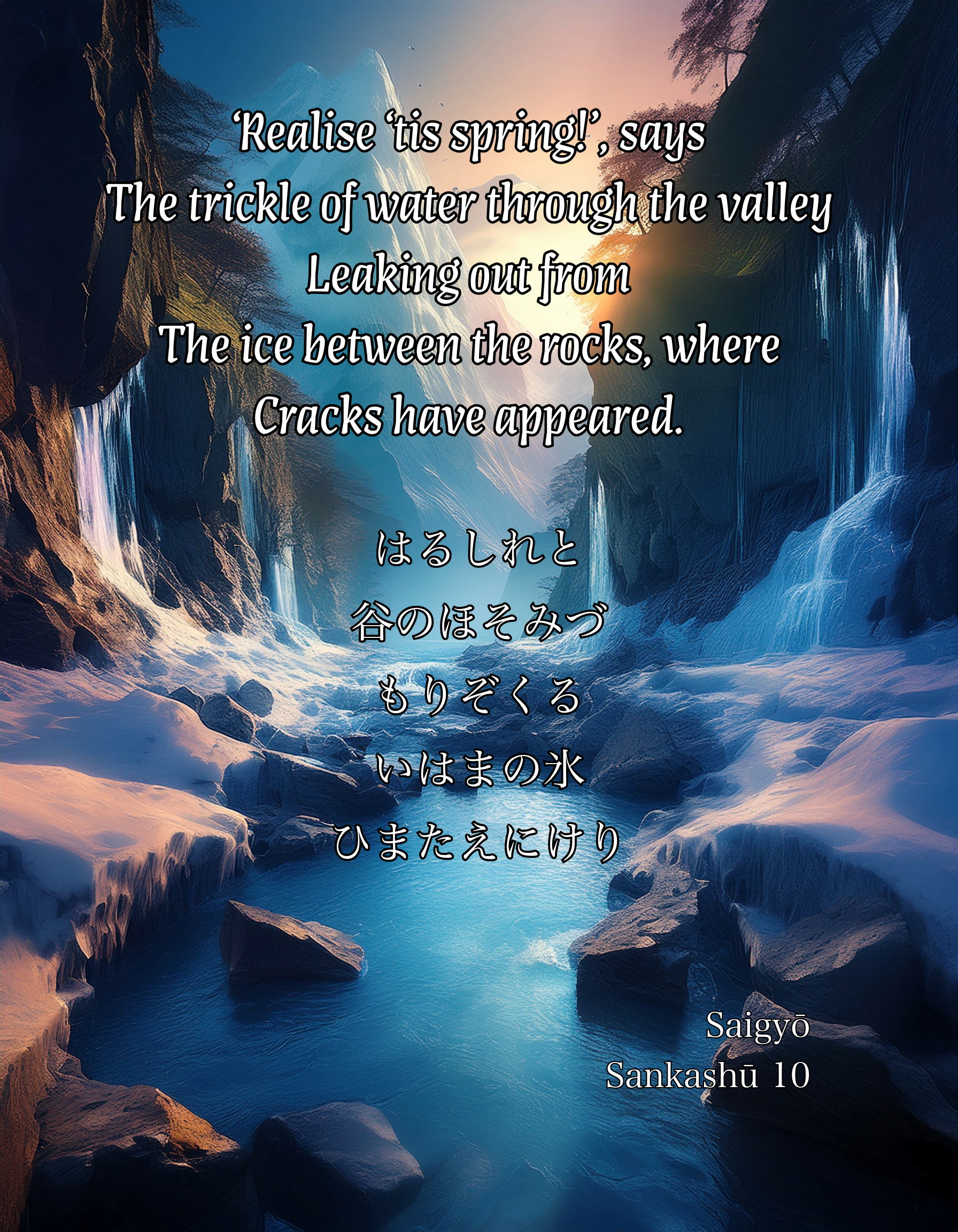
haru shire to tani no hosomizu mori zo kuru iwama no kōri hima taenikeri
‘Realise ‘tis spring!’, says The trickle of water through the valley Leaking out from The ice between the rocks, where Cracks have appeared.[ii]
[i] This poem has an alternate headnote: ‘On mountain waters announcing [spring], when various people were composing poems for the Bosatsu’in Ise Virgin.’ Gotō (1982, 12) notes that this is an erroneous reference to Imperial Princess Muneko (Tōshi) 統子内親王 (1126-1189), later known as Jōsaimon’in 上西門院, who, in fact, served as Kamo Virgin.
[ii] Saigyō composed on a similar theme for the Mimosugawa uta’awase 御裳濯河歌合 (‘Mimosugawa Poetry Match’; 1187) of his own poems: 岩まとぢし氷もいまはとけ初めて苔の下水道もとむなり iwama tojishi / kōri mo ima wa / tokehajimete / koke no shitamizu / michi motomu nari ‘Cracks between the crags sealed / By ice, now / Beginning to melt, and / The water ‘neath the ice / Seeks to find its way.’(Mimosugawa uta’awase 22)
Yet again, neither team has anything to say about the other’s poem.
Shunzei says, ‘Both Left and Right have composed on “rock cleft wine cups”, with a concept of “proffered to someone” (sashite tare ni) or “I would proffer, yet” (kokorozasedomo): these are truly identical in quality. The round must tie.’
Both teams have no particular comments to make about the other’s poem.
Shunzei remarks, ‘Both poems are of similar quality, as has been mentioned by the gentlemen present, however, the Left’s poem is clearly in the spirit of “With blossom the heavens are drunk, in the season of plentiful peaches.” (A well known Chinese poem composed by Sugawara no Michzane.) But the Right’s “Springtime dusk draws on, a crescent moon” captures the light better, I think. Thus, it seems to be the winner.’