Category Archives: Personal Collections

Sankashū I: 104

Around the time I had withdrawn from the world and was living in Higashiyama, I was invited to see the blossom in full bloom in Shirakawa by someone so I went, and when on my way home I was thinking about the past.

ちるをみでかへるこころやさくらばなむかしにかはるしるしなるらん

chiru o mide
kaeru kokoro ya
sakurabana
mukashi ni kawaru
shirushi naruran
Without seeing them scatter
I return; that my love for
Cherry blossom
Has changed since bygone days
Is marked by that, perhaps?

104

Sankashū I: 103

To someone looking out from their carriage, having stopped it beneath the blossom when it was raining.

ぬるともとかげをたのみておもひけん人のあとふむけふにも有るかな

nuru tomo to
kage o tanomite
omoiken
hito no ato fumu
kyō ni mo aru kana
‘I will get wet!’ he said, so
On the shade he did rely
As I seem to recall;
In his footsteps treading
Are you today! [i]

103


[i] See: Topic unknown.

さくらがり雨はふりきぬおなじくはぬるとも花の影にかくれむ

sakuragari
ame wa furikinu
onajiku wa
nuru tomo hana no
kage ni kakuremu
Out hunting cherries and
Caught in the rain—
What e’er I do
I will get wet, so in the blossoms’
Shade let me hide away!

Anonymous
Shūishū I: 50

Sankashū I: 102

Her reply.

いにしへをしのぶるあめとたれかみんはなもそのよのともしなければ

inishie o
shinoburu ame to
tare ka min
hana mo sono yo no
tomo shi nakereba
Times long gone
Recollected turn to rain, but
Who is it might see?
For the blossom, too, their former
Friend have not…

Hyōe
102

‘Her Highness’ other ladies are all young, and an old thing like me would suffer from the wind,[i] so I didn’t go,’ she said—how kind she is!


[i] Hyōe uses the word kaze here which could ambiguously mean kaze 風 (‘wind’) or kaze 風邪 (‘cold’/ ‘fever’), so she is either saying she wanted to avoid the still cool spring breezes, or that she was unwell.

Sankashū I: 101

When the court ladies of Her Highness, Jōsaimon’in,[i] went to Hosshōji[ii] to view the blossom, rain began to fall as it got dark so they returned to the palace. The following day, Lady Hyōe[iii] sent to me from her chambers, saying she had been remembering the imperial progress to view the blossom,[iv] and wished me to say something about it, so I sent this to her.

見るひとに花もむかしをおもひいでてこひしかるべしあめにしをるる

miru hito ni
hana mo mukashi o
omoi’idete
koishikarubeshi
ame ni shioruru
The folk a’viewing them and
The blossoms, too, bygone days
Recall, and
Fond thoughts bring on
The drenching rain.

101


[i] Jōsaimon’in 上西門院 was a title awarded to Imperial Princess Muneko (Tōshi) 統子内親王 (1126-1189), the second daughter of Emperor Toba.

[ii] Hosshōshi 法勝寺 was a temple established in Shirakawa by Emperor Shirakawa in 1077. It was famous for its cherry blossoms.

[iii] Hyōe 兵衛 (?-1183/84) was the daughter of the well-known poet, Minamoto no Akinaka 源顕仲 (1058-1138). She first served, along with her sister, Taikenmon’in no Horikawa 待賢門院堀河 (dates unknown), Emperor Toba’s empress, Fujiwara no Tamako (Shōshi) 藤原璋子 (1101-1145), but then entered Muneko’s service after Tamako’s death. Like her sister, she was renowned as a poet, and she and Saigyō were known to have been on friendly terms.

[iv] This was a famous progress by former Emperors Shirakawa and Toba, accompanied by Empress Taikenmon’in (Tamako) to Shirakawa to view the cherry blossom in the Second Month, Hōan 5 [Feb./March 1124].

Shūigusō 1895

A place where summer grasses grow lushly in a grove out on the plains.

わけ行けば夏のふかさぞしられける森の下草末もはるかに

wakeyukeba
natsu no fukasa zo
shirarekeru
mori no shitagusa
sue mo haruka ni
When I forge my way through,
The depths of summer, indeed,
I come to know!
The undergrowth within the grove has
Tips stretching into the distance…

Teika

Shunzei-kyō no musume-shū 40

ひととはぬ庭のよもぎの跡もなく茂りにけりな夏のふかさに

hito towanu
niwa no yomogi no
ato mo naku
shigerinikeri na
natsu no fukasa ni
No folk enquire, so
The mugwort in my garden
Is trackless and
Overgrown,
In the depths of summer…[i]

40


[i] See: Topic unknown.

なつくさはしげりにけりなたまぼこのみちゆき人もむすぶばかりに

natsu kusa wa
shigerinikeri na
tamaboko no
michi yuki hito mo
musubu bakari ni
The summer grasses
Have grown lush and thick, indeed –
Jewelled spear straight,
The road he travels –
The better he may braid them.

Fujiwara no Motozane
Shinkokinshū III: 188

And: Topic unknown.

夏草はしげりにけれどほとゝぎすなどわがやどに一聲もせぬ

natsu kusa wa
shigerinikeredo
hototogisu
nado wa ga yado ni
hito koe mo senu
The summer grasses
Have grown lush and thick, yet,
O, cuckoo
Why at my home
Do you not give a single call?

The Engi Emperor
Shinkokinshū III: 189

And: A place where summer grasses grow lushly in a grove out on the plains.

わけ行けば夏のふかさぞしられける森の下草末もはるかに

wakeyukeba
natsu no fukasa zo
shirarekeru
mori no shitagusa
sue mo haruka ni
When I forge my way through,
The depths of summer, indeed,
I come to know!
The undergrowth within the grove has
Tips stretching into the distance…

Teika
Shūigusō 1895

Shunzei-kyō no musume-shū 39

五月雨れて浪よせまさる須磨の浦の藻塩にくたす蜑の袖かな

samidarete
nami yosemasaru
suma no ura no
moshio ni kutasu
ama no sode kana
A summer shower
On surging waves
At the shore of Suma
Where brineweed rots away
The sleeves of fisherfolk! [i]

39


[i] See: During the reign of the Tamura Emperor, when he was confined to Suma in the province of Tsu for certain reasons, he sent this to someone in the capital.

わくらばにとふ人あらばすまの浦にもしほたれつつわぶとこたへよ

wakuraba ni
tou hito araba
suma no ura ni
moshio taretsutsu
wabu to kotaeyo
If of me
Folk should come enquiring, then as
On the beach at Suma
The brineweed ever drips,
I suffer—answer that!

Ariwara no Yukihira
Kokinshū XVIII: 962

And:

須磨の浦に心をよせし舟人のやがて朽たせる袖を見せばや

suma no ura ni
kokoro o yoseshi
funabito no
yagate kutaseru
sode o miseba ya
To the shore at Suma
Drawn is the heart
Of a fisher-girl,
Ever since her rotted
Sleeves to you she would show…

Gosechi
Genji monogatari 246

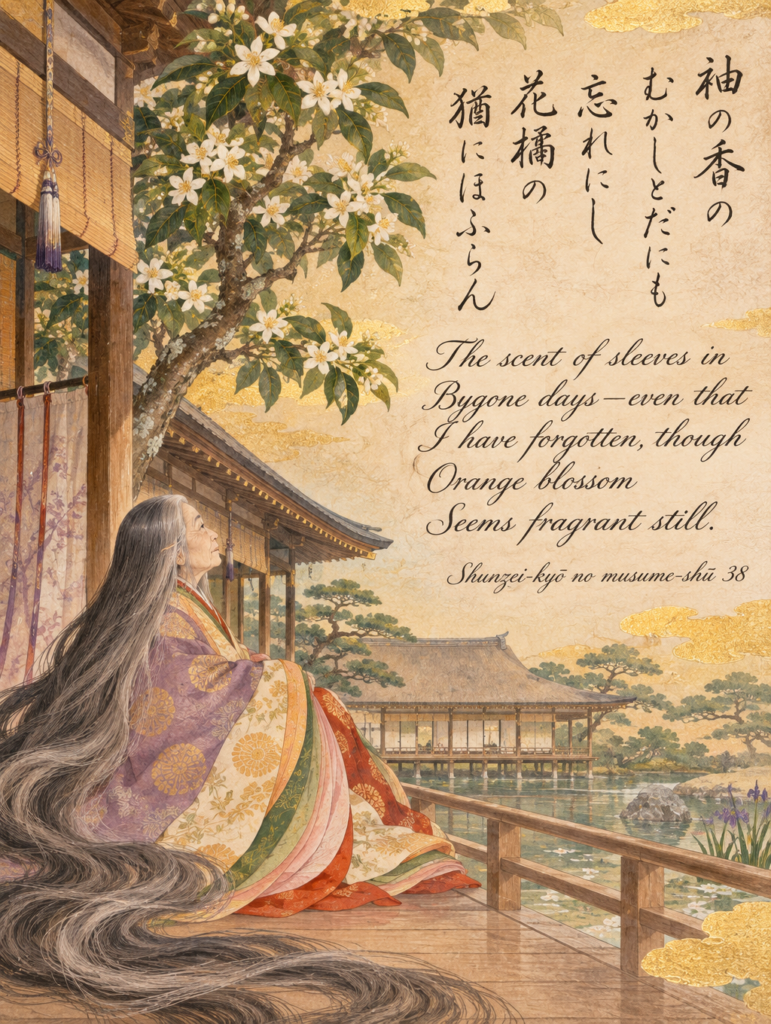
Shunzei-kyō no musume-shū 38

袖の香のむかしとだにも忘れにし花橘の猶にほふらん

sode no ka no
mukashi to dani mo
wasurenishi
hanatachibana no
nao niouran
The scent of sleeves in
Bygone days—even that
I have forgotten, though
Orange blossom
Seems fragrant still.[i]

38


[i] An allusive variation on: Topic unknown.

さつきまつ花橘のかをかげば昔の人の袖のかぞする

satsuki matsu
hana tachiibana no
ka o kageba
mukashi no hito no
sode no ka zo suru
Awaiting the Fifth Month
The orange blossoms’
Scent fills the air, and
Folk from long ago
With their perfumed sleeves come back to me.

Anonymous
Kokinshū III: 139