Tag Archives: katasogi

Sumiyoshi-sha uta’awase kaō ni-nen 25

Left (Tie)

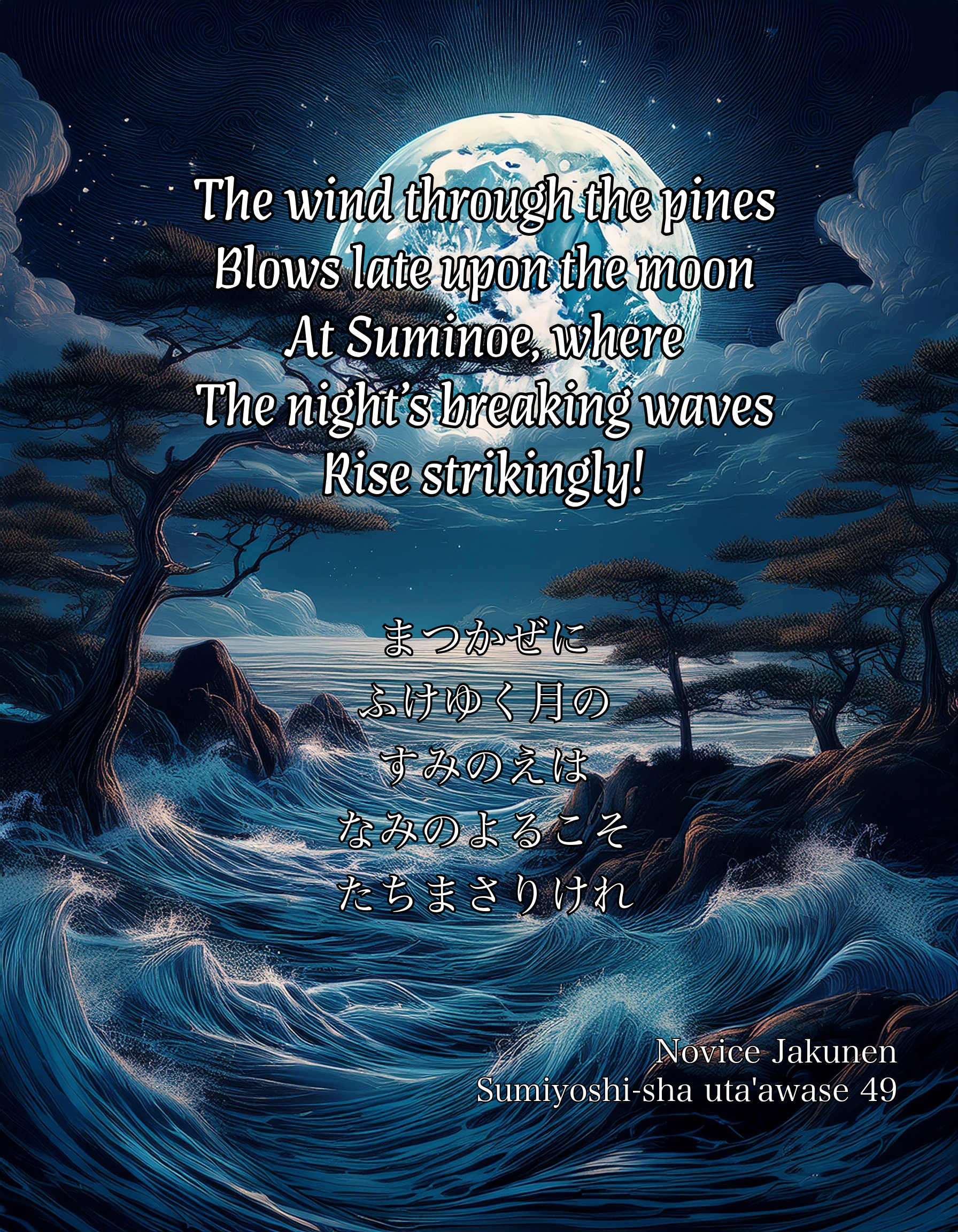
まつかぜにふけゆく月のすみのえはなみのよるこそたちまさりけれ

matsukaze ni
fukeyuku tsuki no
suminoe wa
nami o yoru koso
tachimasarikere
The wind through the pines
Blows late upon the moon
At Suminoe, where
The night’s breaking waves
Rise strikingly!

Novice Jakunen[1]
49

Right

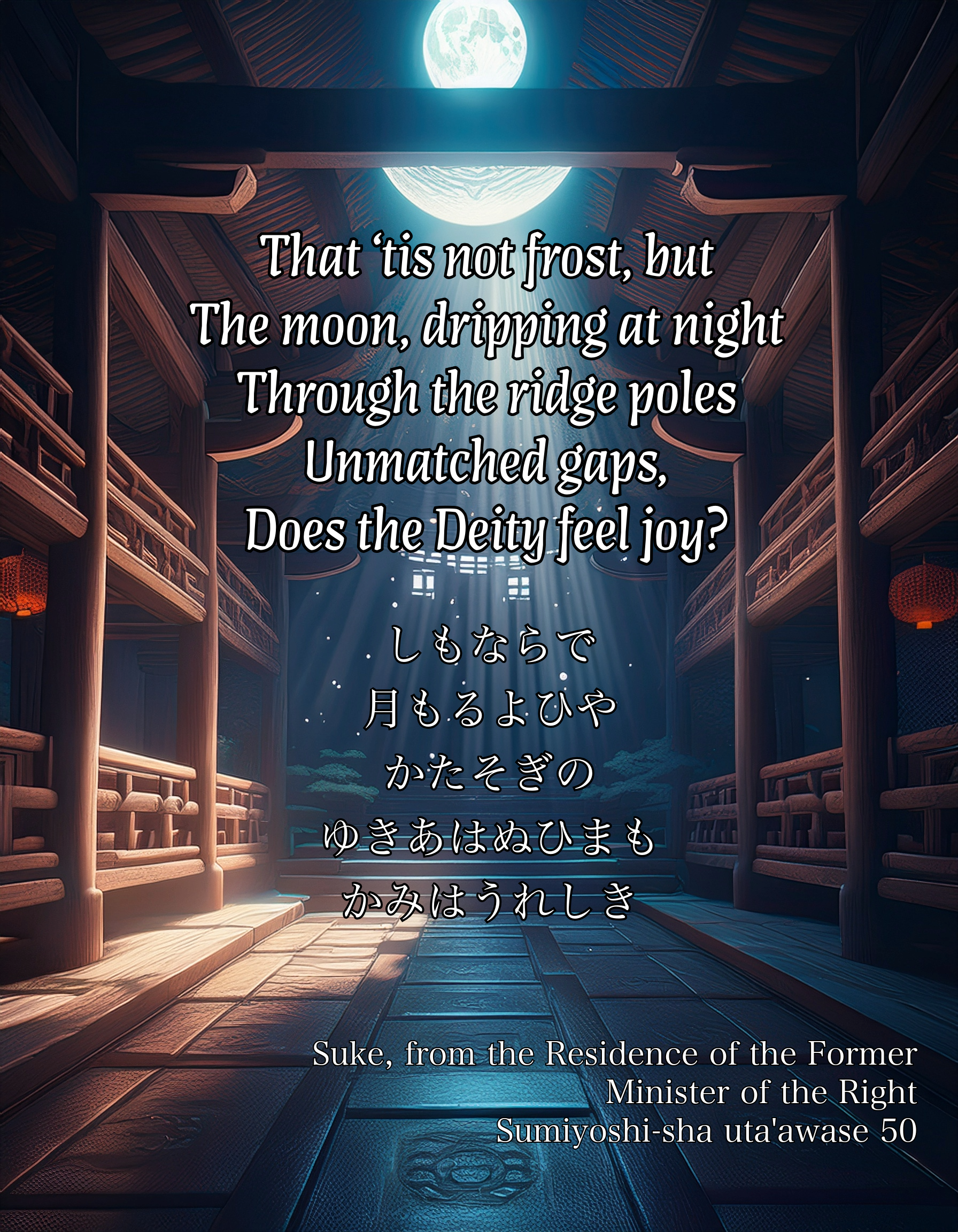
しもならで月もるよひやかたそぎのゆきあはぬひまもかみはうれしき

shimo narade
tsuki moru yoi ya
katasogi no
yukiawanu hima mo
kami wa ureshiki
That ‘tis not frost, but
The moon, dripping at night
Through the ridge poles
Unmatched gaps,
Does the Deity feel joy?

Suke, from the Residence of the Former Minister of the Right[2]
50

The Left poem’s ‘Blows late upon the moon / At Suminoe’ sounds pleasant, but there have been recent poems, such as ‘Brings waves–that / I would tell you!’[3] and ‘Simply with the waves / Did seem to draw near with the night’[4] and while the initial section of the poem here differs, basing a poem on this is not that unusual, I think. The tone of the Right’s poem is charming, but it does not seem likely that the Deity would feel joy simply at the moon coming through the gaps in His ridgepoles. The Deity’s power is limitless and wards eighty isles beyond Sumiyoshi—indeed, there is nowhere in Tsumori’s shore or Sumiyoshi beach, above the waves or in the shad of the pines that it does not reach. I have discussed ridgepoles earlier. Nevertheless, the configuration of the poem isn’t bad, so these should tie, I think.
[1] Shami Jakunen 沙弥寂念

[2] Zen-udaijin no ie no Suke前右大臣家佐

[3] 人しれぬ思ひありそのはま風に浪のよるこそいはまほしけれ hito shirenu omoi ariso no hamakaze ni nami no yoru koso iwamahoshikere ‘Unknown to all / My passion burns—toward a rocky / Beach the breeze / Brings waves–that / I would tell you!’ Middle Captain Toshitada (Horikawa-in enjo awase 17/KYS (2) 468/500)

[4] Composed when he was asked by people in the capital what the moon had been like, when he had returned there, after going to Akashi to gaze upon it, at a time when it was particularly bright. 有明の月もあかしの浦風に波ばかりこそよるとみえしか ariake no tsuki mo akashi no urakaze ni nami bakari koso yoru to mieshika ‘The dawntime Moon’s brightness, with Akashi’s / Beach breezes / Simply with the waves / Did seem to draw near with the night…’ Taira no Tadamori (KYS (2) III: 216/KYS (3) III: 212)

Sumiyoshi-sha uta’awase kaō ni-nen 18

Left (Tie)

てる月もおのがひかりやたむくらむしらゆふかくるすみよしのまつ

teru tsuki mo
ono ga hikari ya
tamukuramu
shirayū kakuru
sumiyoshi no matsu
Does the shining moon
Of his own light
Make an offering?
Sacred white streamers hung
From the pines of Sumiyoshi.

Lord Fujiwara no Koretsuna
Junior Fifth Rank, Lower Grade
Without Office[i]
35

Right

かたそぎのゆきあはぬまよりもる月はしもにしもをやおきかさぬらむ

katasogi no
yukiawanu ma yori
moru tsuki wa
shimo ni shimo o ya
okikasanuramu
The ridge poles
Fail to meet and from the gaps
Drips moonlight—
Is it frost atop of frost
A’falling?

Lord Fujiwara no Suesada
Junior Fifth Rank, Lower Grade
Without Office[ii]
36

The Left appears elegant, but I do not feel that ‘his own’ is particularly appropriate here. The Right’s configuration of ‘Is it frost atop of frost’ seems charming. However, there is also the point that I sincerely feel that there is no good reason in the current composition to shoehorn in ‘The ridge poles / Fail to meet and from the gaps’, and thus these tie again.


[i] San’i jūgoige Fujiwara ason Koretsuna散位従五位下藤原朝臣伊綱

[ii] San’i jūgoige Fujiwara ason Suesada 散位従五位下藤原朝臣季定

Sumiyoshi-sha uta’awase kaō-ni nen 14

Left (Tie)

ゆきもあはぬちぎのかたそぎもる月をしもとやかみのおもひますらむ

yuki mo awanu
chigi no katasogi
moru tsuki o
shimo to ya kami no
omoimasuramu
Fail to entwine do
The chiliad of trees, while from the ridge poles
Drips the moon—
‘Tis frost, perhaps, does the Deity
Deign to wonder?

Lord Taira no Tsunemasa
Supernumerary Director of the Bureau of Horses, Left Division
Governor of Awaji
Exalted Fifth Rank, Lower Grade[i]
27

Right

しろたへのゆきかとみればかぜさえて月ぞしづるるすみよしのまつ

shirotae no
yuki ka to mireba
kaze saete
tsuki zo shizururu
sumiyoshi no matsu
White as mulberry cloth,
I wonder, if ‘tis snow, I see—
In the chill wind
The moon slips from
The pines of Sumiyoshi…

Lord Minamoto no Nakatsuna
Governor of Oki
Junior Fifth Rank, Lower Grade[ii]
28

The configuration of the Left appears elegant, but the expression ‘chiliad of trees’ was said to be impermissible by Lord Mototoshi in his judgement on a poetry competition held in a certain place. The final section, too, seems to require a bit more thought [because it’s insulting to the deity]. As for the Right, the conception of wondering if the moon’s light shining through the trees is snow slipping off them is charming, but I do wonder about the sound of ‘the moon slips’ as a piece of diction. The initial ‘white as mulberry cloth’, too, sounds like it needs further thought [because this is not used to modify ‘snow’], so these should tie.


[i] Shōgoige-gyō sauma gon-kami ken awaji no kami Taira ason Tsunemasa正五位下行左馬権頭兼淡路守平朝臣経正

[ii] Jūgoige-gyō oki no kami Minamoto ason Nakatsuna 従五位下行隠岐守源朝臣仲綱

Sumiyoshi-sha uta’awase kaō ni-nen 10

Round Ten

Left (Tie)

まつもみなしらゆふかけてすみよしの月のひかりもかみさびにけり

matsu mo mina
shirayū kakete
sumiyoshi no
tsuki no hikari mo
kamisabinikeri
The pine trees, every one,
Are hung with sacred streamers—
At Sumiyoshi
Even the moon’s light
Inspires awe.

Hyōenosuke, in service to the Junior Consort
(formerly Handmaid Mikawa, in service at the Nijō Palace)[1]
19

Right

かたそぎのゆきあはぬまよりもる月をさえぬしもとやかみは見るらむ

katasogi no
yuki awanu ma yori
moru tsuki o
saenu shimo to ya
kami wa miruramu
The ridge poles
Fail to entwine, and from the gaps
Drips moonlight—
As chill-less frost, I wonder,
Does the Deity regard it?

Lord Fujiwara no Naganori
Supernumerary Minor Captain in the Inner Palace Guards, Left Division
Exalted Senior Fourth Rank, Lower Grade[2]
20

The Left’s poem appears to have a pleasant configuration with ‘Even the moon’s light / Inspires awe’. The poem of the Right, furthermore, has a charming-sounding sequence with ‘As chill-less frost, I wonder, / Does the Deity regard it?’ but in composition one usually states that the moon is fair precisely because of its chill. Thus, when one compares it to true frost, can one say that it lacks it? While I do feel that this is somewhat vague, both the poems appear to pleasant configurations, so I make this a tie.


[1] Nȳogo no ie Hyōenosuke moto nijōin Mikawa no maishi女御家兵衛佐元二条院参河内侍

[2] Shōyon’ige-gyō konoe gonshōjō Fujiwara ason Naganori 正四位下行左近衛権少将藤原朝臣修範