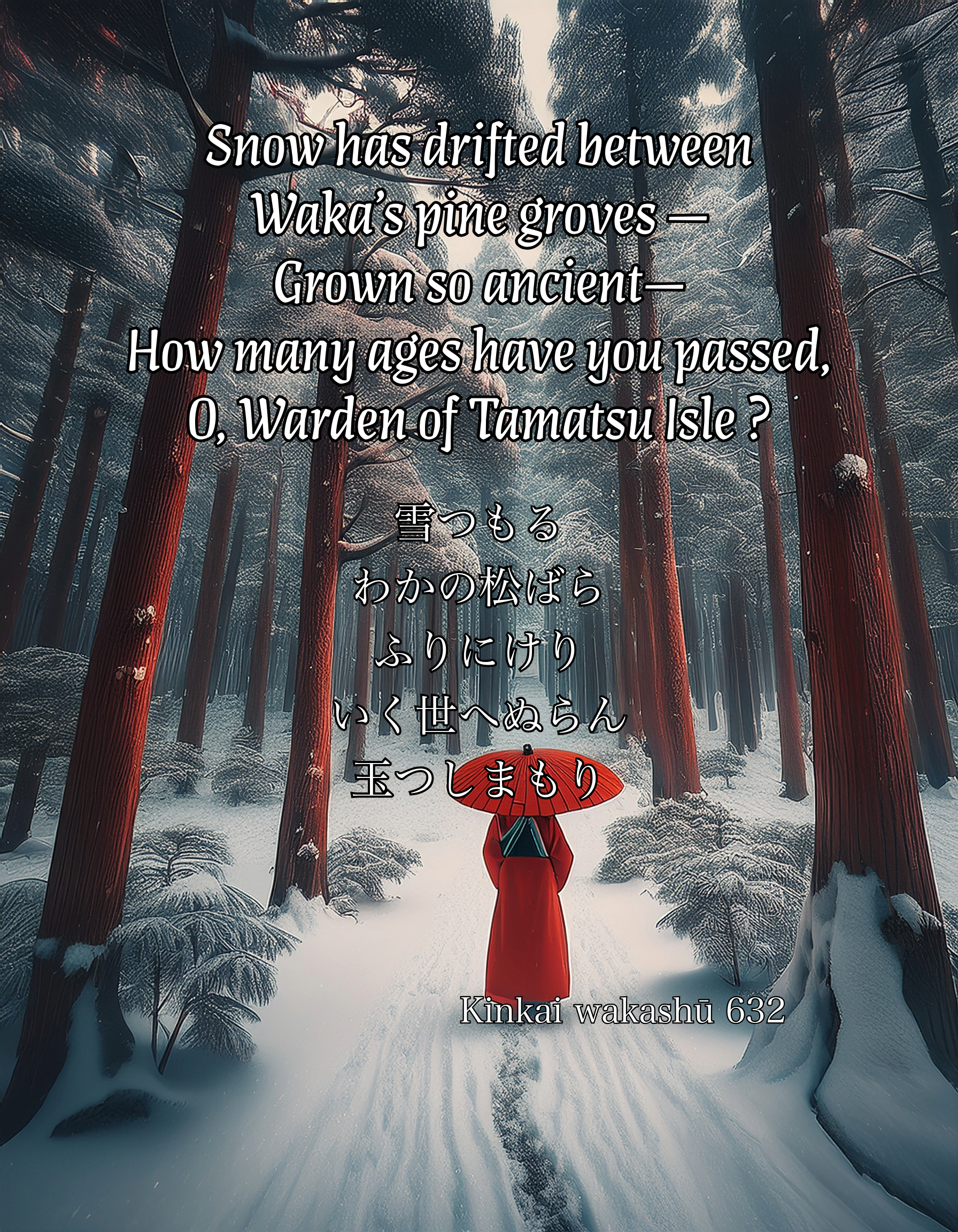
yuki tsumoru waka no matsubara furinikeri ikuyo henuran tamatsushimamori
Snow has drifted between Waka’s pine groves[i]— Grown so ancient— How many ages have you passed, O, Warden of Tamatsu Isle[ii]?[iii]
632
[i] The ‘pine groves of Waka’ (waka no matsubara 和歌の松原) were located in Ise, but Sanetomo mistakenly associates them with Waka Bay (waka no ura 和歌浦) in Kii—hence his reference to Tamatsushima in the poem.
[ii] In this context, ‘Tamatsu Isle’ (Tamatsushima 玉津島) is understood as referring to Tamatsushima Shrine which is located near the coast in Wakayama. One of the deities venerated at this shrine is Sōtorihime-no-mikoto 衣通姫尊, one of the patron gods of waka poetry, which Sanetomo evokes with his reference the ‘pine groves of Waka’.
Left and Right together state: we find no faults to mention.
In judgement: the style of both the Left’s ‘maid at Uji bridge’ (uji no hashihime) and the Right’s ‘Warden of Uji bridge’ (uji no hashimori) is pleasant, and the Left’s ‘Is this how she waits, the maid at Uji bridge’ (kaku ya machiken uji no hashihime) draws on the conception of a tale from long ago, and the configuration also seems deeply moving. Thus, the Left should win.