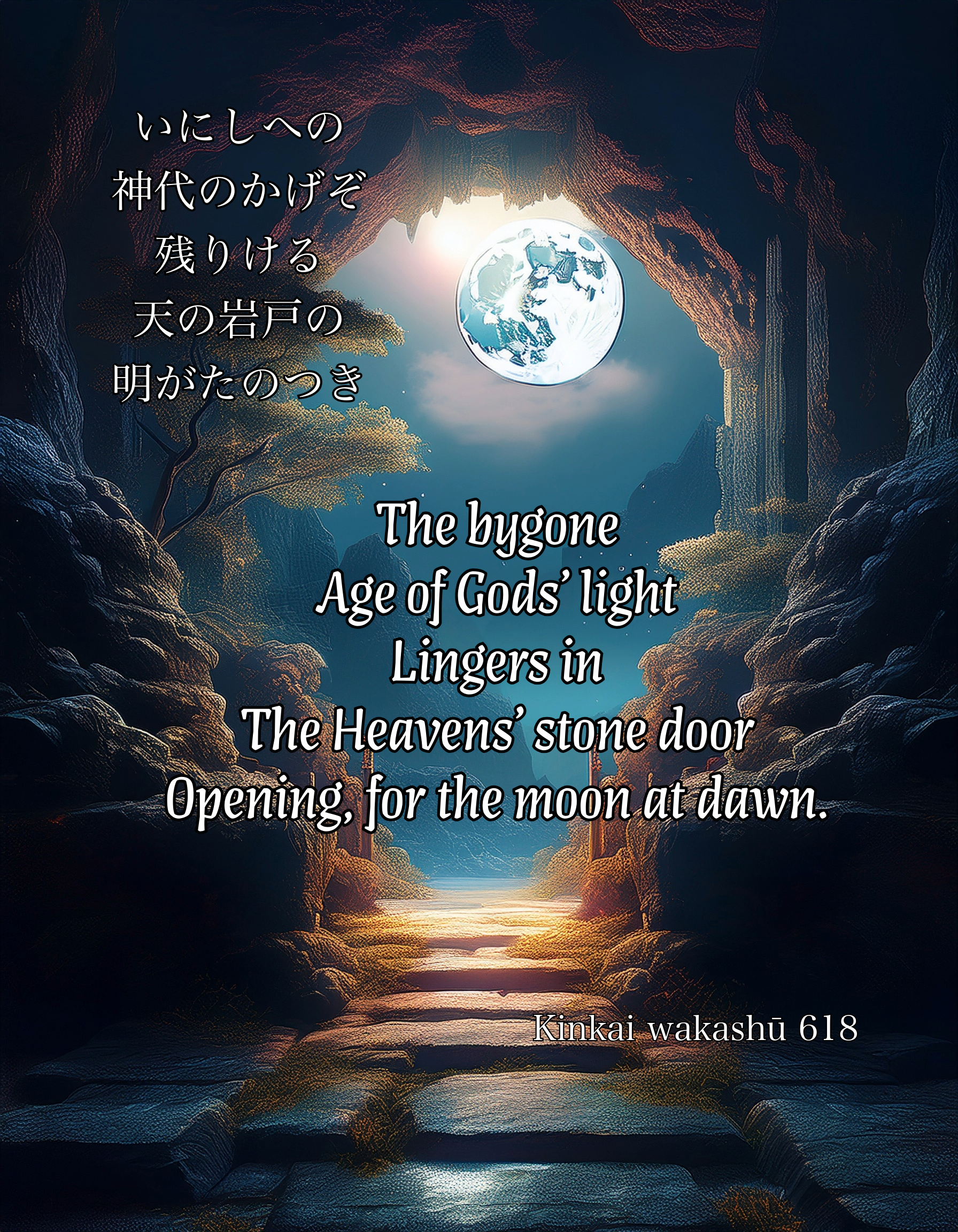
inishie no kamiyo no kage zo nokorikeru ama no iwato no akegata no tsuki
The bygone Age of Gods’ light Lingers in The Heavens’ stone door Opening, for the moon at dawn.[i]
618
[i] See: On the conception of the moon at dawn, for the Kasuga Poetry Match. 天の戸をおしあけがたの雲間より神よの月の影ぞ残れる ama no to o / oshi akegata no / kumoma yori / kamiyo no tsuki no / kage zo nokoreru ‘Upon the gates of Heaven / Pushing brightening / Through the cloud-gaps / From the Age of Gods, the moon’s / Light lingers.’ The Regent and Chancellor (Shinkokinshū XVI: 1547)
A poem composed during the year when the Ise Shrine was renewed.[i]
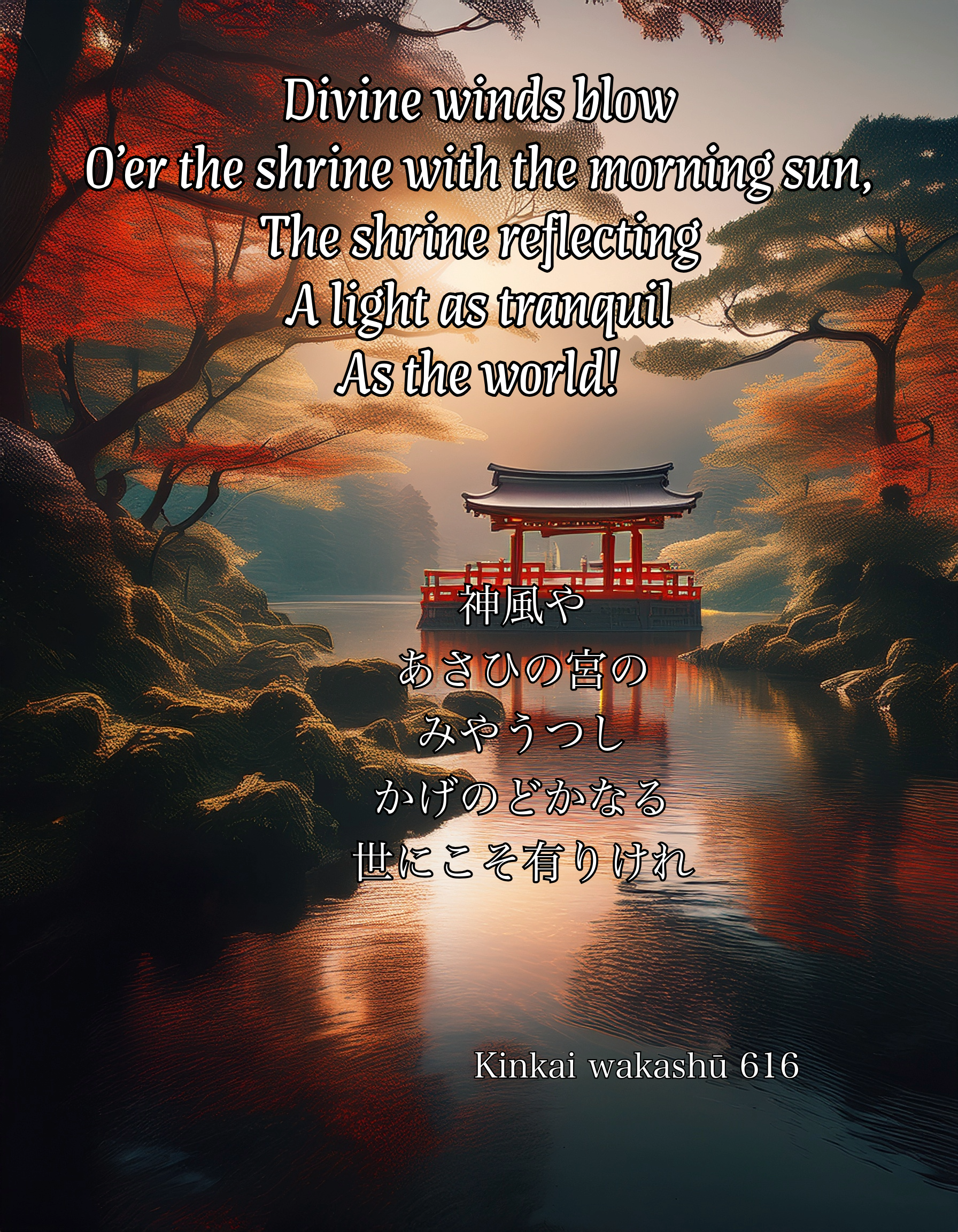
神風やあさひの宮のみやうつしかげのどかなる世にこそ有りけれ
kamikaze ya asahi no miya no miya utsushi kage nodokanaru yo ni koso arikere
Divine winds blow O’er the shrine with the morning sun, The shrine reflecting A light as tranquil As the world![ii]
616
[i] The Grand Shrine at Ise was demolished and rebuilt approximately every twenty years. The occasion Sanetomo is referring to here took place in the Ninth Month, Jōgen 3 [1209] (Higuchi 2016, 188).
[ii] See: In reply. 神風やいすずかは浪かずしらずすむべきみよに又かへりこん kamikaze ya / isuzukawanami / kazu shirazu / sumubeki miyo ni / mata kaerikon ‘Divine winds blow / Waves upon the Isuzu River / In numbers unknown, / So bright this age that / Ever will I return.’ Supernumerary Master of the Crown Prince’s Household Kintsugu (Shinkokinshū XIX: 1874)
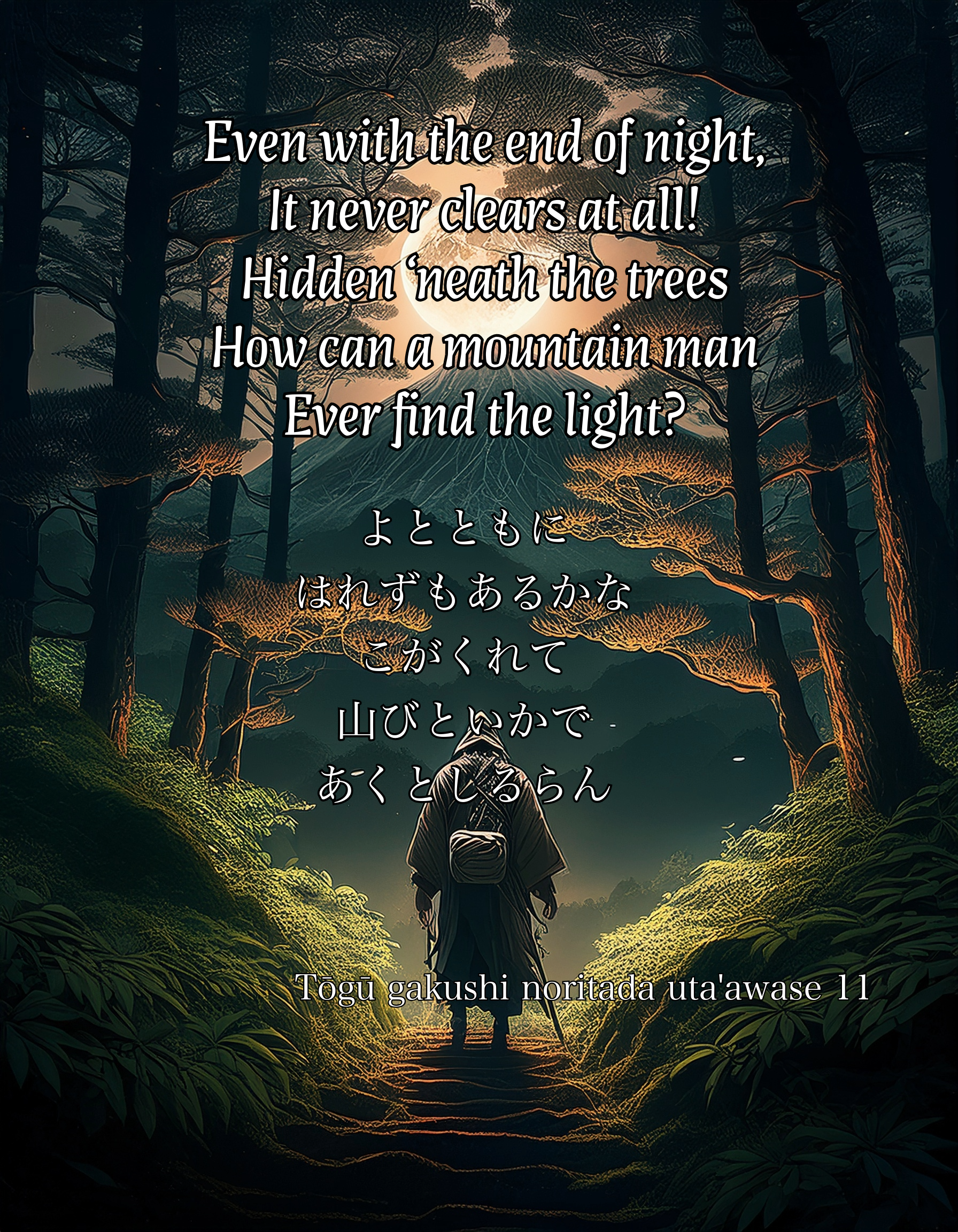
yo to tomo ni harezu mo aru kana kogakurete yamabito ikade aku to shiruran
Even with the end of night, It never clears at all! Hidden ‘neath the trees How can a mountain man Ever find the light?
11
Right
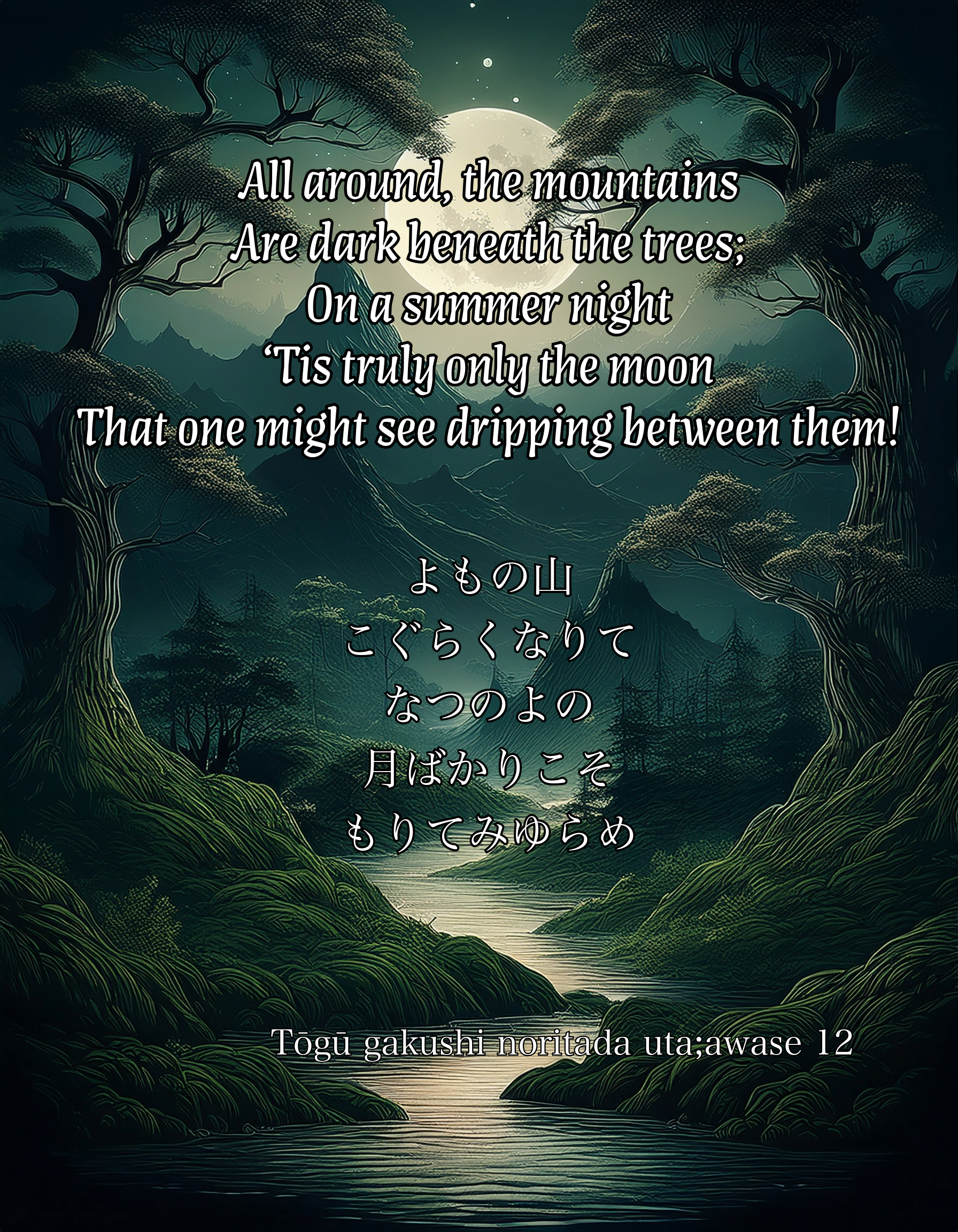
よもの山こぐらくなりてなつのよの月ばかりこそもりてみゆらめ
yomo no yama koguraku narite natsu no yo no tsuki bakari koso morite miyurame
All around, the mountains Are dark beneath the trees; On a summer night ‘Tis truly only the moon That one might see dripping between them!
12
This topic refers to a hunted stag concealed among the trees in the summer mountains. There is not a particular strong feeling of either evergreen or other types of mountain forests,[ii] but the Left’s poem has ‘Even with the end of night’, forgetting that this implies a season of biting wind and showers striking the leaves on the trees—thus the darkness here is excessively conceived. While the Right takes ‘dark shade’ as an opportunity to compose with the elevated conception of the moon dripping between the trees—and surpasses the peaks in doing this—I wonder if the conceptions of both poems don’t contain brightness? Thus, both Left and Right are examples of the ‘Reizei Palace’,[iii] so I would decide on a tie for these.
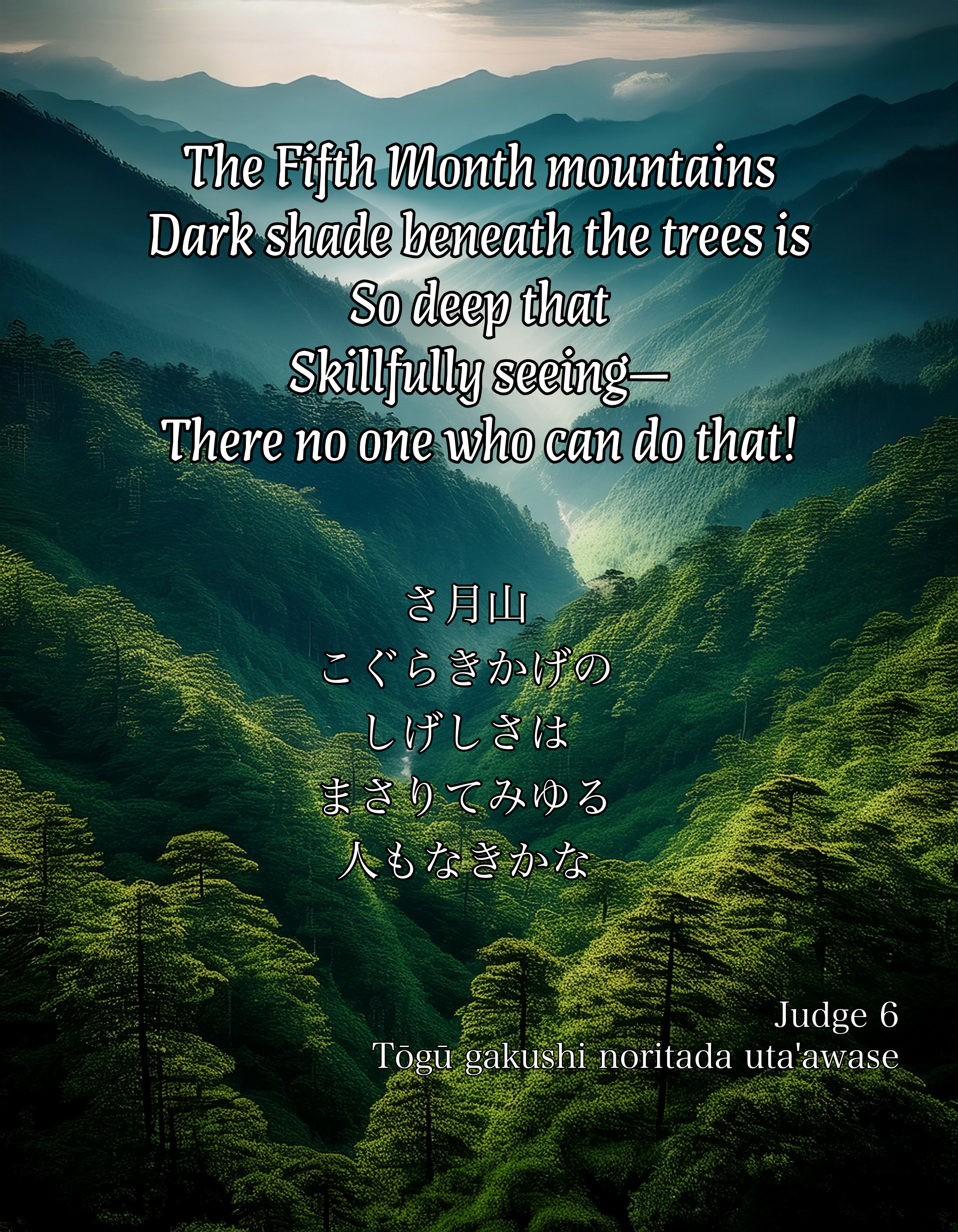
さ月山こぐらきかげのしげしさはまさりてみゆる人もなきかな
satsuki yama koguraki kage no shigeshisa wa masarite miyuru hito mo naki kana
The Fifth Month mountains Dark shade beneath the trees is So deep that Skillfully seeing— There no one who can do that!
On the 29th day of the Eighth Month, Taiji 3,[i] Head of the Department of Shinto, His Excellency Akinaka gave a lecture before the Hirota Shrine, and various people from among his friends and relative met together in the same place.
Judge Mototoshi, Former Assistant Captain in the Palace Guards, Left Division.
Personal Grievances and the Moon
Round One
Left
難波江のあしまにやどる月みれば我が身ひとつも沈まざりけり
naniwae no ashima ni yadoru tsuki mireba wa ga mi hitotsu mo shizumazarikeri
When, at the inlet at Naniwa Between the reeds a’lodging The moon I see, My sorry self, alone, Is sunk in sadness, am I not?
Lord Akisuke, Former Governor of Mimasaka 1
Right
かがみ川影見る月にそこ澄みて沈むみくづのはづかしきかな
kagamigawa kage miru tsuki ni soko sumite shizumu mikuzu no hazukashiki kana
In the mirror of Kagami River, The shape, I see, of the moon Clear down to the bed of Sunken flotsam— How terrible that I am so!
His Excellency Akinaka, Head of the Department of Shintō 2
While both Left and Right show awareness of the conventions, I find it difficult to be beguiled more by coming to the realisation that ‘My sorry self, alone, / Is sunk in sadness, am I not’ on seeing the moon lodging between the reeds, than I am by the conception of the one who seems to have seen the moon over Mount Obasute[1], so I could say that it has a bit of conception about it at present.
[1] Topic unknown. わが心なぐさめかねつさらしなやをばすて山にてる月を見て wa ga kokoro / nagusamekanetsu / sarashina ya / obasuteyama ni / teru tsuki o mite ‘My heart / Cannot be consoled— / In Sarashina / Above Mount Obasute / On seeing the shining moon…’ Anonymous (KKS XVII: 878)
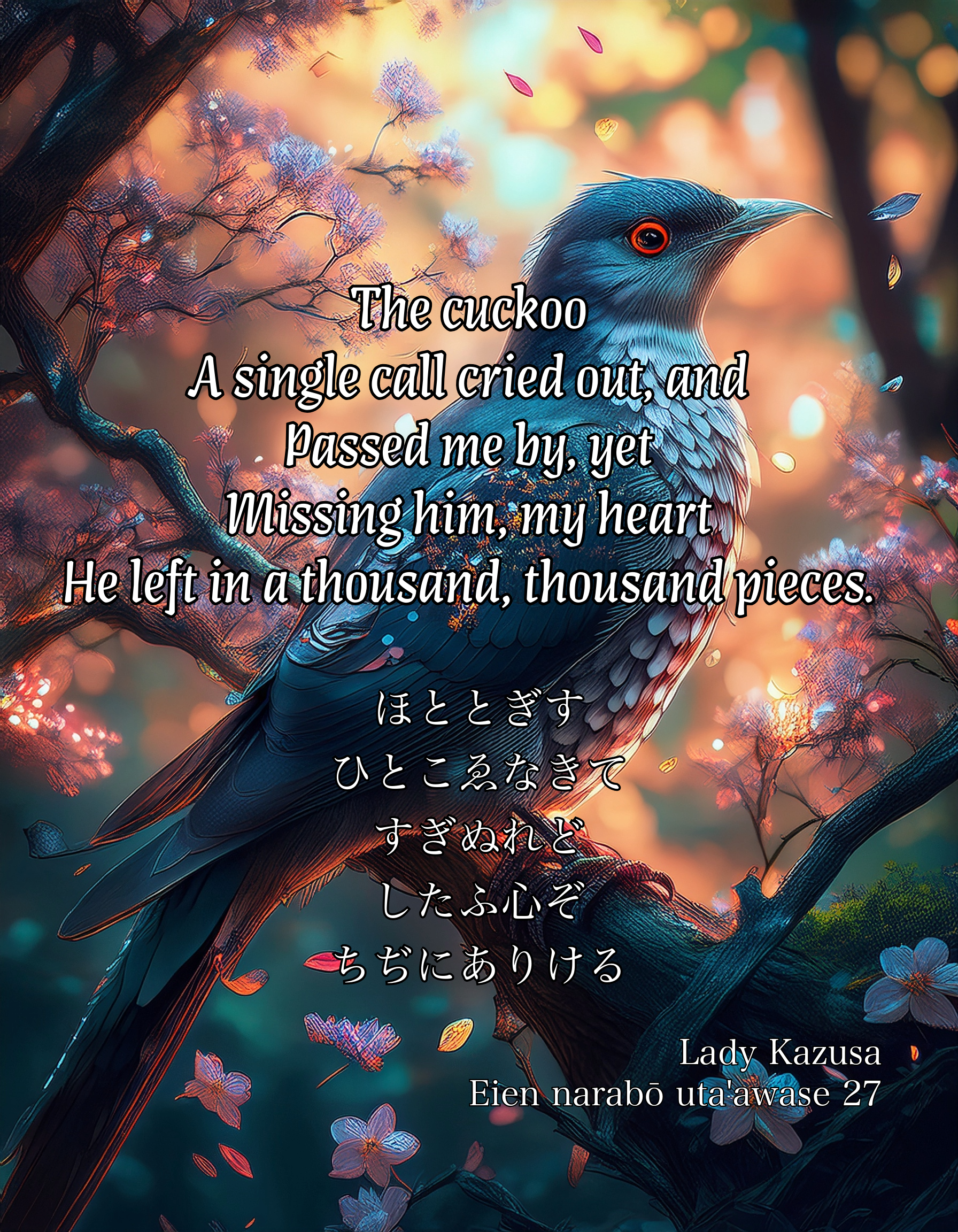
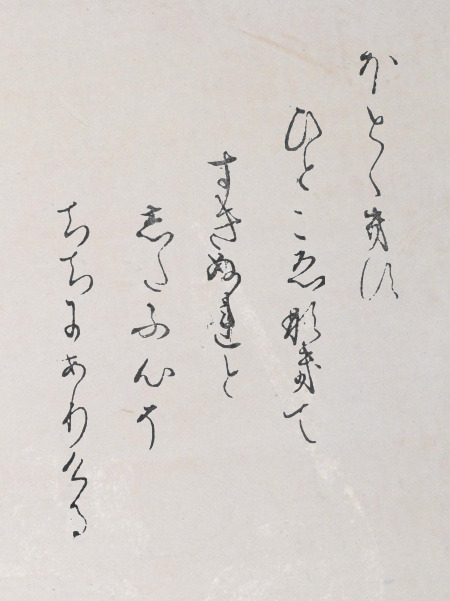
hototogisu hitokoe nakite suginuredo shitau kokoro zo chiji ni arikeru
The cuckoo A single call cried out, and Passed me by, yet Missing him, my heart He left in a thousand, thousand pieces.
Lady Kazusa 27
Right (Win)
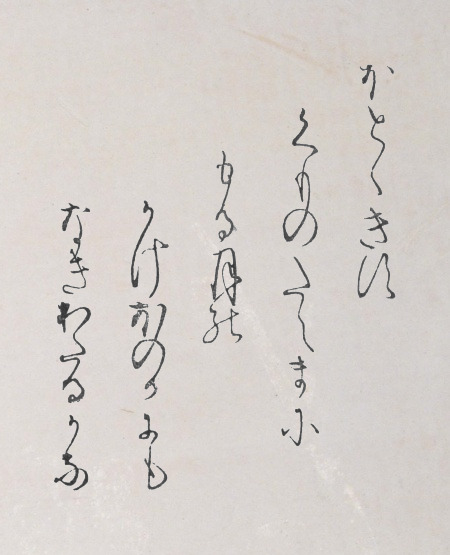
ほととぎすくものたえまにもる月のかげほのかにもなきわたるかな
hototogisu kumo no taema ni moru tsuki no kage honoka ni mo nakiwataru kana
The cuckoo, as From a gap between the clouds Drips the moon’s Light, faintly Calls on!
Lady Shikibu 28
Both poems are of the same quality.
The Left’s poem really makes me wonder why that should be the case, with the final ‘he left’ putting me in mind of someone in court dress who has forgotten to put on his shoes! The Right’s poem appears rather more bright than it needs to be. Furthermore, if one says that the ‘light is faint’ then shouldn’t the moon be hidden by the clouds? It’s vague over that, but if there were a prior poem as precedent, then it would be a good composition. For the present, I will make it the winner.