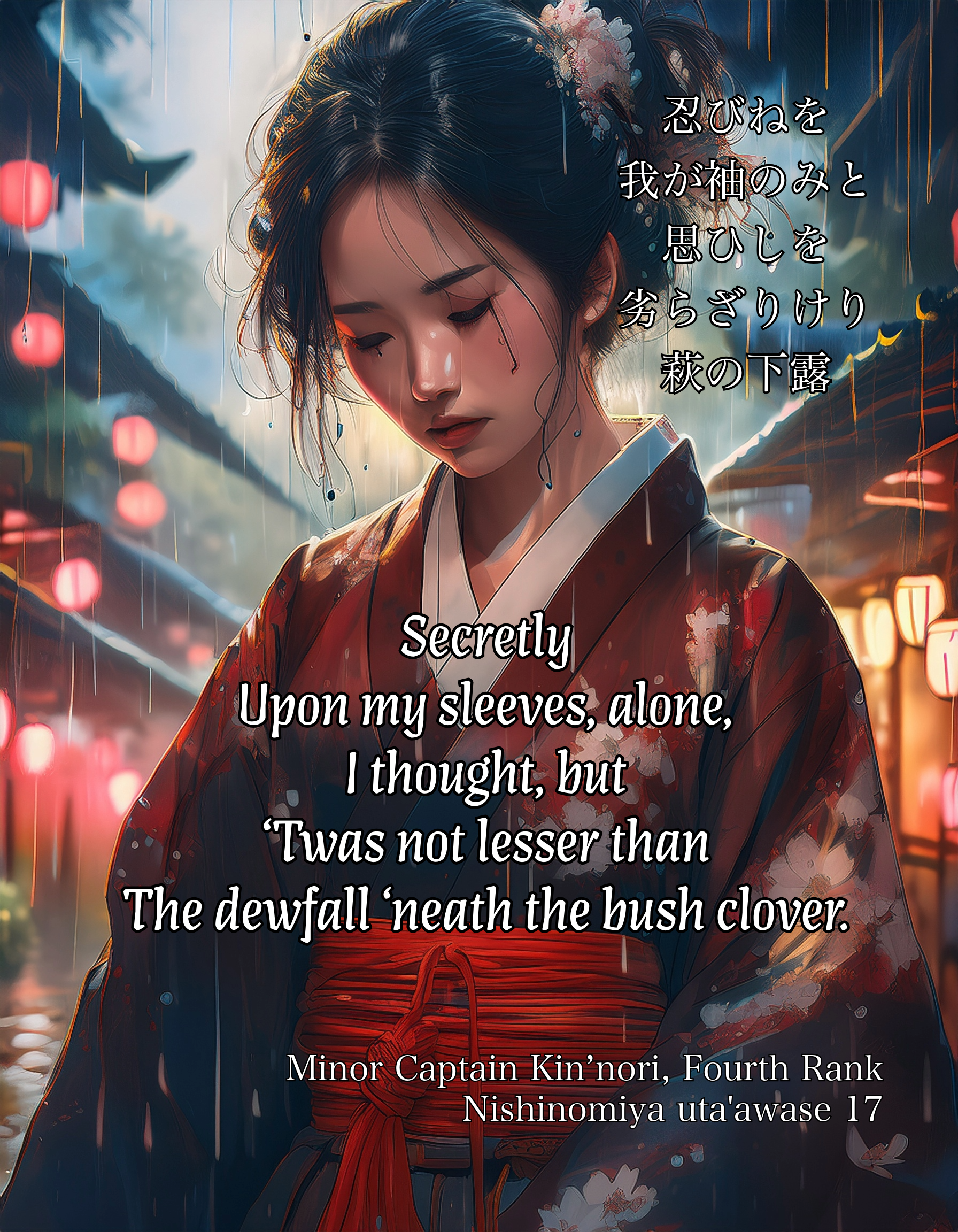
shinobine o wa ga sode nomi to omoishi o otorazarikeri hagi no shitazuyu
Secretly Upon my sleeves, alone, I thought, but ‘Twas not lesser than The dewfall ‘neath the bush clover.
Minor Captain Kin’nori, Fourth Rank 17
Right
色かはる萩の下葉の露けさは我が身のうへと成りにけるかな
iro kawaru hagi no shitaba no tsuyukesa wa wa ga mi no ue to narinikeru kana
A change of hue To the bush clover’s underleaves Drenched with dew— Upon my sorry self Has it befallen, too!
Tadasue, Senior Assistant Minister of the Sovereign’s Household 18
The image of the droplets of secretly wept upon the poet’s sleeves not being less than those of the dewdrops beneath the bush clover appears extremely charming and moving. In addition, the pain expressed by one’s sorry self being as dew-drenched as the bush clover’s underleaves—this has left my own sleeves, both left and right, seeming as soaked with dewdrops from the bush clover.
On the 29th day of the Eighth Month, Taiji 3,[i] Head of the Department of Shinto, His Excellency Akinaka gave a lecture before the Hirota Shrine, and various people from among his friends and relative met together in the same place.
Judge Mototoshi, Former Assistant Captain in the Palace Guards, Left Division.
Personal Grievances and the Moon
Round One
Left
難波江のあしまにやどる月みれば我が身ひとつも沈まざりけり
naniwae no ashima ni yadoru tsuki mireba wa ga mi hitotsu mo shizumazarikeri
When, at the inlet at Naniwa Between the reeds a’lodging The moon I see, My sorry self, alone, Is sunk in sadness, am I not?
Lord Akisuke, Former Governor of Mimasaka 1
Right
かがみ川影見る月にそこ澄みて沈むみくづのはづかしきかな
kagamigawa kage miru tsuki ni soko sumite shizumu mikuzu no hazukashiki kana
In the mirror of Kagami River, The shape, I see, of the moon Clear down to the bed of Sunken flotsam— How terrible that I am so!
His Excellency Akinaka, Head of the Department of Shintō 2
While both Left and Right show awareness of the conventions, I find it difficult to be beguiled more by coming to the realisation that ‘My sorry self, alone, / Is sunk in sadness, am I not’ on seeing the moon lodging between the reeds, than I am by the conception of the one who seems to have seen the moon over Mount Obasute[1], so I could say that it has a bit of conception about it at present.
[1] Topic unknown. わが心なぐさめかねつさらしなやをばすて山にてる月を見て wa ga kokoro / nagusamekanetsu / sarashina ya / obasuteyama ni / teru tsuki o mite ‘My heart / Cannot be consoled— / In Sarashina / Above Mount Obasute / On seeing the shining moon…’ Anonymous (KKS XVII: 878)
tanabata ni aranu wa ga mi no nazo mo kaku toshi ni marenaru hito o matsuran
The Weaver Maid My sorry self is not, but[1] Why is it that, Rarely, but once a year, That man’s visit I seem to await?
538
[1] An allusive variation on: Topic unknown. 篝火にあらぬわが身のなぞもかく涙の河にうきてもゆらむ kagaribi ni / aranu wa ga mi no / nazo mo kaku / namida no kawa ni / ukite moyuramu ‘A fisher’s torch / I’m not, so why does my sorry self / Yet / Upon a river of tears, / Burning, seem to drift along?’ Anonymous (KKS XI: 529)
ware mo ikade yo ni nagaraete sumiyoshi no matsu no chitose no yukusue mo mimu
Somehow, I, too, Would endure in this world, that Sumiyoshi’s Pine’s thousand years End I would see!
Masahira 125
Right
たとへけむなみはわがみにあらはれぬこぎゆくふねのあとはほかかは
tatoekemu nami wa wagami ni arawarenu kogiyuku fune no ato wa hoka ka wa
Might I compare The waves, which on my sorry self Have made their mark, with A boat rowing out, leaving A wake, or if not that then what? [1]
Chikashige 126
The Left seems to be imagining something very unrealistic. The Right has the poem ‘To what should I compare it? / Just as dawn is breaking’ in mind, and appears to have the charming conception of sorrowing over the face of Grand Duke Jiang appearing in the waves on the Wei River, but ‘if not that then what?’ sounds a bit overblown. With that being said, the Left feels like a plea for good fortune, and the Right evokes impermanence. The matters are only distantly connected, and thus in terms of faults and merits they are equal.
[1] An allusive variation on: Topic unknown. 世の中をなににたとへむあさぼらけこぎゆく舟のあとのしら浪 yo no naka o / nani ni tatoemu / asaborake / kogiyuku fune no / ato no shiranami ‘This mundane world: / To what should I compare it? / Just as dawn is breaking, / A boat rows out / Whitecaps in its wake.’ Novice Mansei (SIS XX: 1327)
yo no naka o umiwataritsutsu toshi henuru koto wa tsumori no kami ya tasukemu
In this mundane world, An endless sea of suffering, Have my years gone by; Might Tsumori’s Deity save me, I wonder?
Dharma Master Shun’e 115
Right (Win)
いへのかぜわがみのうへにすずしかれかみのしるしをあふぐとならば
ie no kaze wa ga mi no ue ni suzushikare kami no shirushi o augu to naraba
My house’s breeze of fortune To my sorry self I would bring cool, if For a sign from the God I were to seek…
Lord Sanekuni 116
The Left’s conception is charming, beginning with ‘An endless sea of suffering’ and following this with ‘Might Tsumori’s / Deity save me, I wonder?’, but ‘endless sea of suffering’ does not sound like acceptable diction. The Right’s conception of ‘For a sign from the God / I were to seek’ sounds charming, so I make it the winner.