shitaba ni wa iro naru tama ya kudakuramu kaze no fukishiku hagi no ue no tsuyu
From the underleaves Hues have the gemlets taken In their shattering? Spread by the gusting wind Are the dewdrops on the bush clover…
A Court Lady 49
Right (Win)
又やみむ又や見ざらん白露の玉おきしける秋萩の花
mata ya mimu mata ya mizaran shiratsuyu no tama okishikeru akihagi no hana
Will I see again, or Will I not Silver dewdrop Pearls spread upon The autumn bush clover blooms?
Ietaka 50
The Left’s poem does not seem to have a particularly superlative style. The Right’s poem, saying ‘will I see again, or will I not silver dewdrops’ is particularly charming and moving. Thus, it wins.
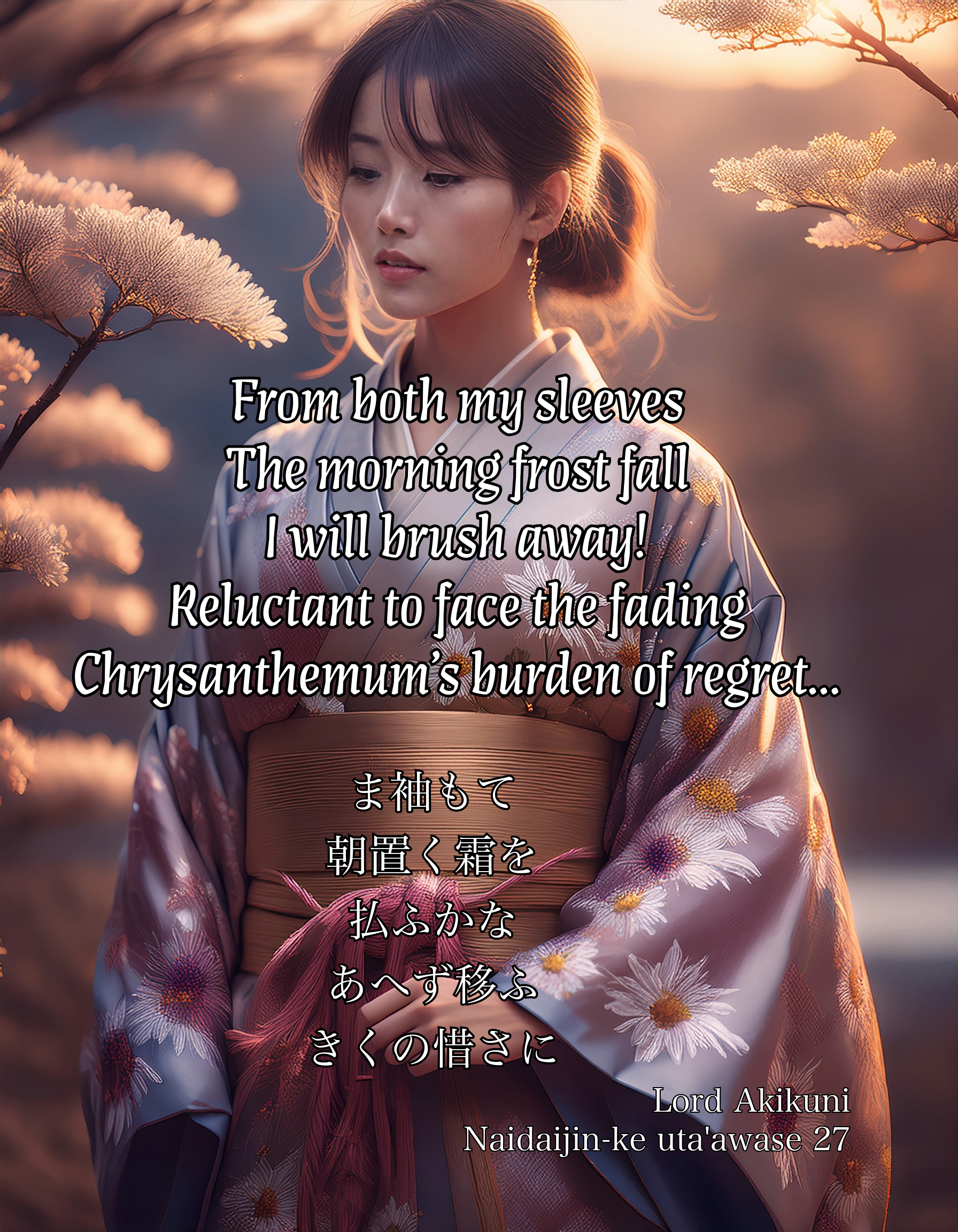
masodemote asa oku shimo o harau kana aezu utsurou kiku no oshisa ni
From both my sleeves The morning frost fall I will brush away! Reluctant to face the fading Chrysanthemum’s burden of regret…
Lord Akikuni 27
Right (Both Judges – Win)
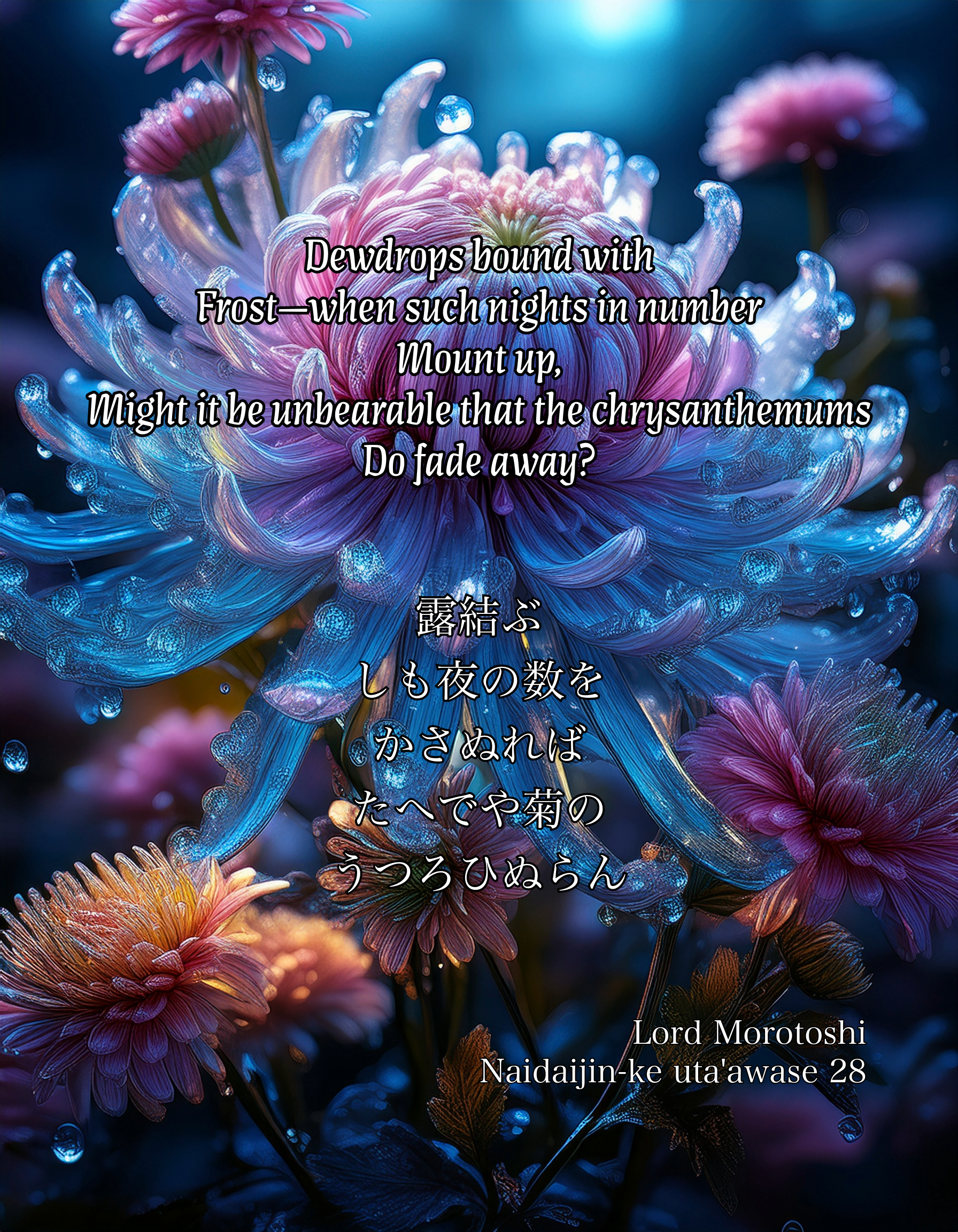
露結ぶしも夜の数をかさぬればたへでや菊のうつろひぬらん
tsuyu musubu shimo yo no kazu o kasanureba taede ya kiku no utsuroinuran
Dewdrops bound with Frost—when such nights in number Mount up, Might it be unbearable that the chrysanthemums Do fade away?
Lord Morotoshi 28
Toshiyori states: the first poem is extremely charming. Nevertheless, I must question the use of ‘reluctant to face the fading’ as I feel this is something I have not heard before. I can grasp the sense of diction such as ‘unable to do anything about’ or ‘without taking on autumn hues’, but did the poet mean to use the diction ‘unbearable’, perhaps? Even though this is somewhat archaic phrasing, it is used in composition. This poem’s expressions, though, I feel are somewhat unfamiliar. The conception and diction of the second poem are both extremely charming. However, this poem, too, is vague. What is going on with the initial ‘dewdrops bound’? Does it mean that the dewdrops get turned into frost? If so, then, from what is known of the calendar, this is something which only occurs on a single night, and from the following night there is only frost. It sounds as if the conception of this poem, though, is that night after night dew turns to frost, and this would be a fault. Despite this vagueness, however, its tone is elegant, so it seems superior.
Mototoshi states: the poem of the Left has a poetic configuration, but I strongly feel that it would have been preferable not to use the diction ‘both my sleeves’. It does seem as if this was used in the ancient Collection of a Myriad Leaves, but even given that was the case, in the preface to the Ancient and Modern, I recall it saying, ‘On examining the poems of ancient times, we find they use many archaic expressions. These were there not just to please the ear, but simply for moral instruction’. It appears that there are no instances of this piece of diction being used in poetry matches from the period of the Ancient and Modern, Later Selection and Gleanings, and these were all conducted for entertainment. Even in a poetry match conducted in Engi 12 [912], when the term ‘sleeve’ was used, I get the feeling that it was such a source of amusement that the poem was not recited. While the quality of the Right’s poem is not superb, the tone of ‘Dewdrops bound with / Frost—when such nights in number’ is not bad, so I feel the dew can still remain bound!