On passing through Tokiwa Grove at the beginning of the Tenth Month.
しぐれの雨そめかねてけり山しろのときはのもりの槙の下ばは
shigure no ame somekanetekeri yamashiro no tokiwa no mori no maki no shitaba wa
Showers of rain Cannot dye In Yamashiro Sempiternal Tokiwa Grove’s Evergreen underleaves…[i]
Dharma Master Nōin
[i] An allusive variation on: 四具礼能雨 無間之零者 真木葉毛 争不勝而 色付尓家里 shigure no ame / ma nakushi fureba / maki no pa mo / arasoikanete / irozukinikeri ‘Showers of rain / Fall without respite, so / Even evergreens’ leaves / Can fight no longer, and / Take on a hint of colour.’ Anonymous (Man’yōshū X: 2196)
akihagi no shitaba no tsuyu ni aranedomo kienu bakari zo hito wa koishiki
Upon the autumn bush clover’s Underleaves a dewdrop I am not, yet Simply will I fade away So much do I love him!
Taiyu no Suke 19
Right
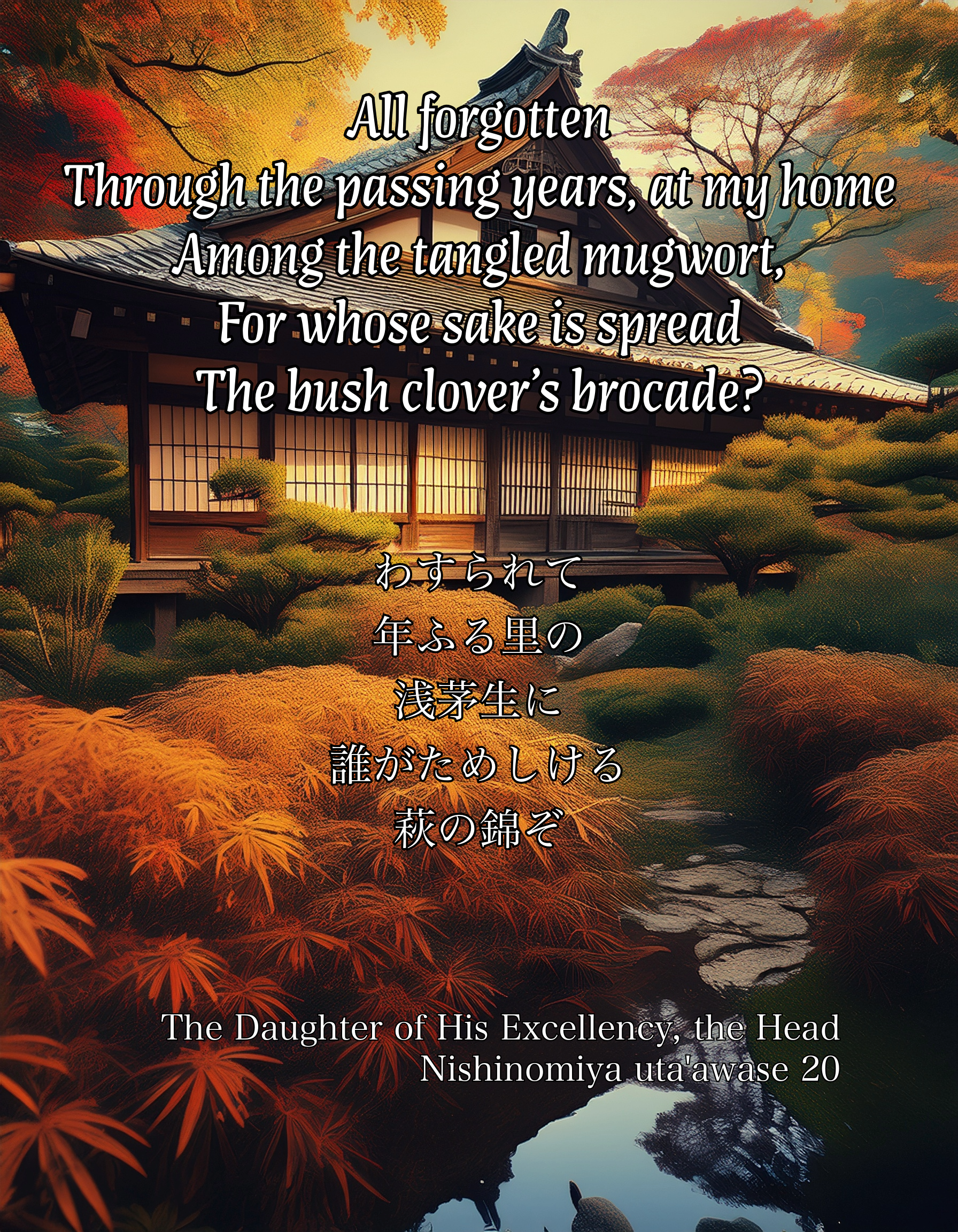
わすられて年ふる里の浅茅生に誰がためしける萩の錦ぞ
wasurarete toshi furu sato no asajū ni ta ga tame shikeru hagi no nishiki zo
All forgotten Through the passing years, at my home Among the tangled mugwort, For whose sake is spread The bush clover’s brocade?
The Daughter of His Excellency, the Head
20
I feel that the poem of the Left is conspicuously poetic, saying ‘Simply will I fade away / So much do I love him!’ while the poem of the Right’s ‘Through the passing years, at my home / Among the tangled mugwort, / For whose sake is spread / The bush clover’s brocade?’ makes me want to ask the bush clover the same question! The pull my heart in more than one direction, so here, too, I feel it’s not possible to decide on a winner or loser.
uwaba fuku ashita no hara no akikaze ni onore utsurou hagi no shitazuyu
Blowing upon the upper leaves Over Ashita Plain, The autumn breeze touches, Fading all of itself The dripping dew upon the bush clover.
Tomoshige 63
Right
今よりはたが涙とか成りぬらん下葉色づく秋萩の露
ima yori wa ta ga namida to ka narinuran shitaba irozuku akihagi no tsuyu
From now on Whose tears might They become? Colouring the underleaves Are dewdrops upon the autumn bush clover…[1]
Dharma Master Zenshin 64
Left and Right are in the same style. The Right’s poem wonders ‘whose are these tears’ and has a person’s tears as the dew upon the grass, which is something one often hears. Using dew on the grass as a person’s tears is a bit vague, yet it’s not going so far as to be a definite fault. These should tie.
[1] An allusive variation on: Topic unknown. あきはぎのしたば色づく今よりやひとりある人のいねがてにする akihagi no / shitaba irozuku / ima yori ya / hitori aru hito no / inegatenisuru ‘The autumn bush clover’s / Underleaves are colouring / From this point on, / For one all alone / Will sleep be harder to find?’ Anonymous (KKS IV: 220)
furusato no hagi no shitaba mo irozukinu tsuyu nomi fukaki aki no urami ni
In this old, familiar place The bush clover’s underleaves, too, Have changed their hue— Only the dew is deep As autumn’s misery…[1]
Dōchin 55
Right (Win)
白露の玉ぬきみだる萩が枝に涙かずそふ秋の夕暮
shiratsuyu no tama nukimidaru hagi ga e ni namida kazusou aki no yūgure
Silver dewdrop Pearls are strung in tangles on The bush clover’s branches— Innumerable tears added On an autumn evening…
Dharma Master Nyokan 56
Left and Right both have a refined style, yet the Right has a better tone and sounds elegant. Thus, it wins.
[1] An allusive variation on: 比日之 暁露丹 吾屋前之 芽子乃下葉者 色付尓家里 kono koro no / akatoki tsuyu ni / wa ga yado no / hagi no shitaba wa / irozukinikeri ‘Around thus time near / Dawn, the dewfall on / My dwelling’s / Bush clover underleaves / Has changed their hue!’ Anonymous (MYS X: 2182)
shitaba ni wa iro naru tama ya kudakuramu kaze no fukishiku hagi no ue no tsuyu
From the underleaves Hues have the gemlets taken In their shattering? Spread by the gusting wind Are the dewdrops on the bush clover…
A Court Lady 49
Right (Win)
又やみむ又や見ざらん白露の玉おきしける秋萩の花
mata ya mimu mata ya mizaran shiratsuyu no tama okishikeru akihagi no hana
Will I see again, or Will I not Silver dewdrop Pearls spread upon The autumn bush clover blooms?
Ietaka 50
The Left’s poem does not seem to have a particularly superlative style. The Right’s poem, saying ‘will I see again, or will I not silver dewdrops’ is particularly charming and moving. Thus, it wins.