uwaba fuku ashita no hara no akikaze ni onore utsurou hagi no shitazuyu
Blowing upon the upper leaves Over Ashita Plain, The autumn breeze touches, Fading all of itself The dripping dew upon the bush clover.
Tomoshige 63
Right
今よりはたが涙とか成りぬらん下葉色づく秋萩の露
ima yori wa ta ga namida to ka narinuran shitaba irozuku akihagi no tsuyu
From now on Whose tears might They become? Colouring the underleaves Are dewdrops upon the autumn bush clover…[1]
Dharma Master Zenshin 64
Left and Right are in the same style. The Right’s poem wonders ‘whose are these tears’ and has a person’s tears as the dew upon the grass, which is something one often hears. Using dew on the grass as a person’s tears is a bit vague, yet it’s not going so far as to be a definite fault. These should tie.
[1] An allusive variation on: Topic unknown. あきはぎのしたば色づく今よりやひとりある人のいねがてにする akihagi no / shitaba irozuku / ima yori ya / hitori aru hito no / inegatenisuru ‘The autumn bush clover’s / Underleaves are colouring / From this point on, / For one all alone / Will sleep be harder to find?’ Anonymous (KKS IV: 220)
tsuyu sugaru niwa no hagiwara irozukinu ika naru hito no omoisomuran
All clung with dew, The bush clover grove in the grounds Has taken on such hues, that I wonder who it is Might have just fallen into passion’s flames?
Chikanari 61
Right (Win)
おく露は秋のならひの萩が枝にあまるや雁の涙なるらん
oku tsuyu wa aki no narai no hagi ga e ni amaru ya kari no namida naruran
Dewdrops falling is Autumn’s custom for The bush clover branches, but Added to them are the goose Tears, perhaps?[1]
Ie’kiyo 62
The Left’s poem has a person’s feelings being dyed by the bush-clover, but I cannot think why this should be? The Right’s poem seems particularly pleasant. Thus, it wins.
[1] An allusive variation on: Composed on the occasion of a poetry competition at Prince Koresada’s house. 秋の夜のつゆをばつゆとおきながらかりの涙やのべをそむらむ aki no yo no / tsuyu oba tsuyu to / okinagara / kari no namida ya / nobe o somuran ‘On Autumn nights / The dew as dewdrops / Falls, but, / Perhaps goose tears / Stain the fields?’ Mibu no Tadamine (KKS V: 258)
miyagino no ko no shitakaze ya suginuran tsuyu ni okururu akihagi no hana
On Miyagi Plain has The breeze beneath the trees Passed by? For Missing the dewfall are The autumn bush clover blooms…
Takasuke 57
Right
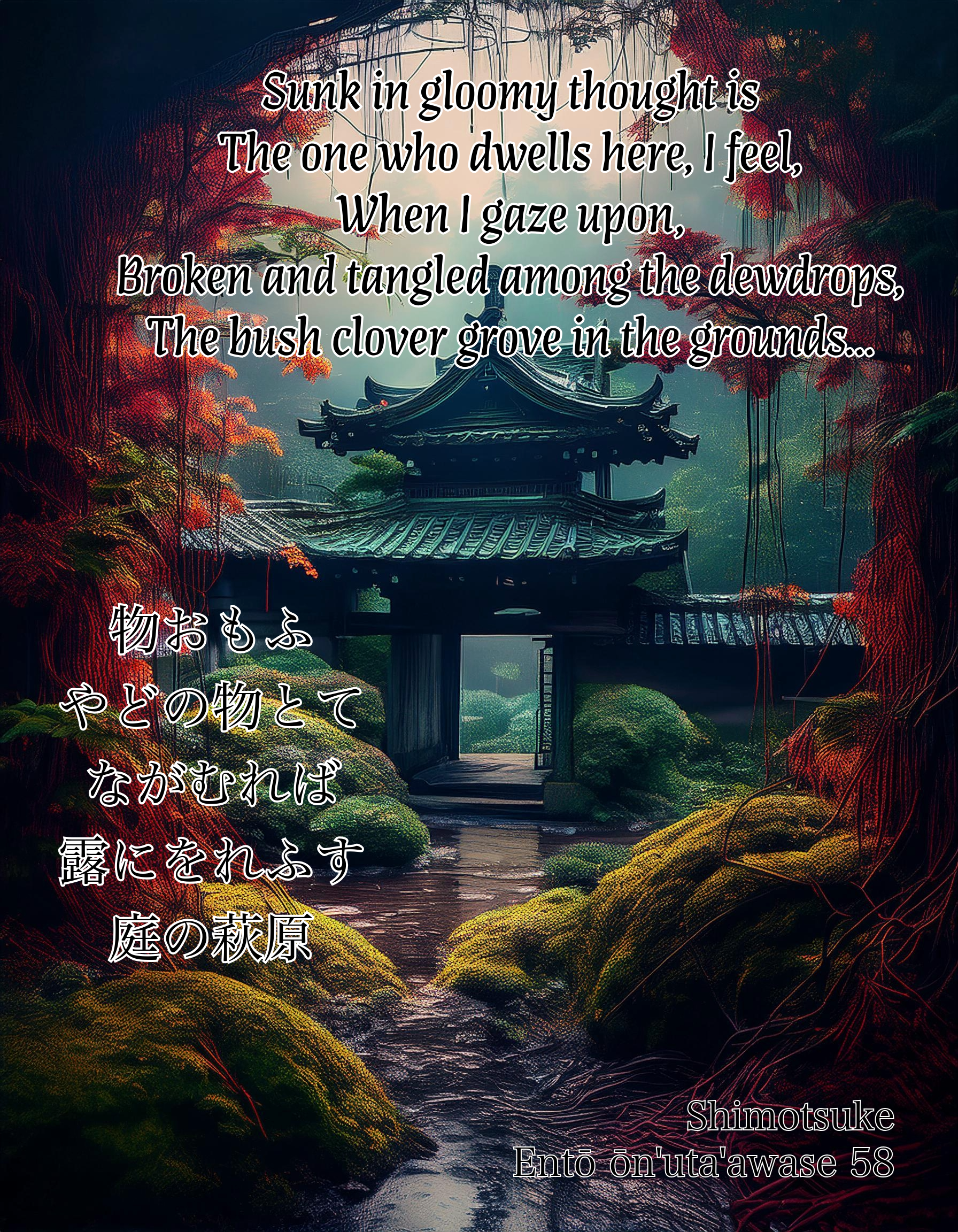
物おもふやどの物とてながむれば露にをれふす庭の萩原
mono’omou yado no mono tote nagamureba tsuyu ni orefusu niwa no hagiwara
Sunk in gloomy thought is The one who dwells here, I feel, When I gaze upon, Broken and tangled among the dewdrops, The bush clover grove in the grounds…
Shimotsuke 58
The Left poem’s ‘Missing the dewfall are the autumn bush clover’ sounds pleasant. The Right poem has no faults either, yet the Left should win.
furusato no hagi no shitaba mo irozukinu tsuyu nomi fukaki aki no urami ni
In this old, familiar place The bush clover’s underleaves, too, Have changed their hue— Only the dew is deep As autumn’s misery…[1]
Dōchin 55
Right (Win)
白露の玉ぬきみだる萩が枝に涙かずそふ秋の夕暮
shiratsuyu no tama nukimidaru hagi ga e ni namida kazusou aki no yūgure
Silver dewdrop Pearls are strung in tangles on The bush clover’s branches— Innumerable tears added On an autumn evening…
Dharma Master Nyokan 56
Left and Right both have a refined style, yet the Right has a better tone and sounds elegant. Thus, it wins.
[1] An allusive variation on: 比日之 暁露丹 吾屋前之 芽子乃下葉者 色付尓家里 kono koro no / akatoki tsuyu ni / wa ga yado no / hagi no shitaba wa / irozukinikeri ‘Around thus time near / Dawn, the dewfall on / My dwelling’s / Bush clover underleaves / Has changed their hue!’ Anonymous (MYS X: 2182)
takasago no susono no ma’hagi tsuyu fukashi mine no akikaze fukazu mo aranamu
On Takasago’s Slopes the fair bush clover is Deep in dew— O, that the autumn winds from the peak Would fail to blow…
The Supernumerary Major Counsellor 53
Right
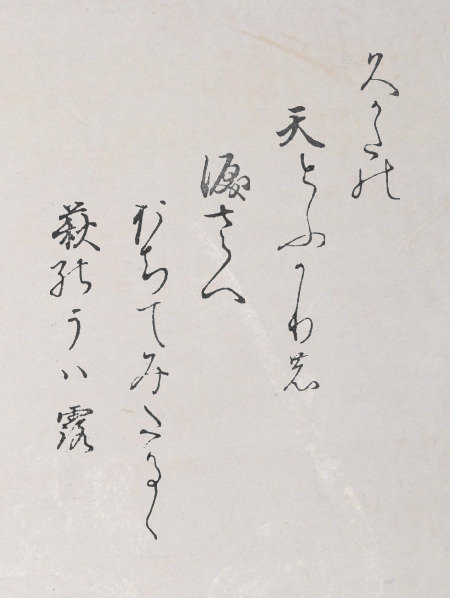
久かたの天とぶかりの涙さへおちてみだるる萩のうは露
hisakata no ama tobu kari no namida sae ochite midaruru hagi no uwazuyu
From the eternal Heavens flying, even the goose Tears Drop in confusion Overlaying the dew upon the bush clover.[1]
Nobunari 54
Both Left and Right seem particularly pleasant. Thus, they tie.
[1] An allusive variation on: Topic unknown. なきわたるかりの涙やおちつらむ物思ふやどの萩のうへのつゆ nakiwataru / kari no namida ya / ochitsuran / mono’omou yado no / hagi no ue no tsuyu ‘Calling across / Did the geese let tears / Fall? / My dwelling, lost in thought, / Has dew upon the bush clover.’ Anonymous (KKS IV: 221)
akihagi no tsuyu mo yosuga no sagariba mo kaze fukitatsuru iro zo mi ni shimu
On the autumn bush clover Dewdrops rest upon The dangling leaves, Whipped up by the wind, Their hues sharply sink into my flesh.
The Former Minister of the Centre 51
Right (Win)
さだめなき風を待つ間もうつろひぬもとあらの萩にむすぶ白露
sadamenaki kaze o matsu ma mo utsuroinu motoara no hagi ni musubu shiratsuyu
While the unsettled Breeze they do await, Faded from The sparse bush clover have The clinging dewdrops.[1]
Kozaishō 52
The Left poem’s ‘rest upon the dangling leaves, whipped up by the wind’ seems a novel style, and yet, even though everything about dangling leaves is contained in the Ancient and Modern, it does not sound particularly evocative. The Right lacks even a small fault and appears gorgeous, so it should win.
[1] An allusive variation on: Topic unknown. 宮木野のもとあらの小萩つゆをおもみ風をまつごと君をこそまつ miyagino no / motoara no kohagi / tsuyu o omomi / kaze o matsu goto / kimi o koso matsu ‘On Miyagi Plain / The sparse bush clover / Weighed down with dewdrops / Awaits the wind, just as / I do wait for you…’ Anonymous (KKS XIV: 694)