ima tsukuru miwa no hafuri ga sugi yashiro suginishi koto wa towazu tomo yoshi
Newly invested, At Miwa, a junior priest For the cedar shrine, but What has occurred It would be better not to ask!
635
[i] This is Ōmiwa Shrine (Ōmiwa jinja 大神神社) which is located on the western slopes of Mount Miwa 三輪山, in what is now Sakurai in Nara prefecture. Mount Miwa is covered by a cedar forest and the trees thus became an object of veneration at the shrine, something which was reinforced by: Topic unknown. 我が庵は三輪の山もと戀しくは訪らひ來ませ杉立てる門 wa ga io wa / miwa no yama moto / koishiku wa / toburaikimase / sugi tateru kado ‘My hut is / At Mount Miwa’s foot; / How I long / For you to come visiting / My gate where cedars stand.’ Anonymous (Kokinshū XVIII: 982). This poem was attributed to the deity of Ōmiwa Shrine, Miwa Myōjin 三輪明神, and firmly cemented the link between Miwa and cedars in poetry. See McAuley (2020, 577–578) for more details and example poems.
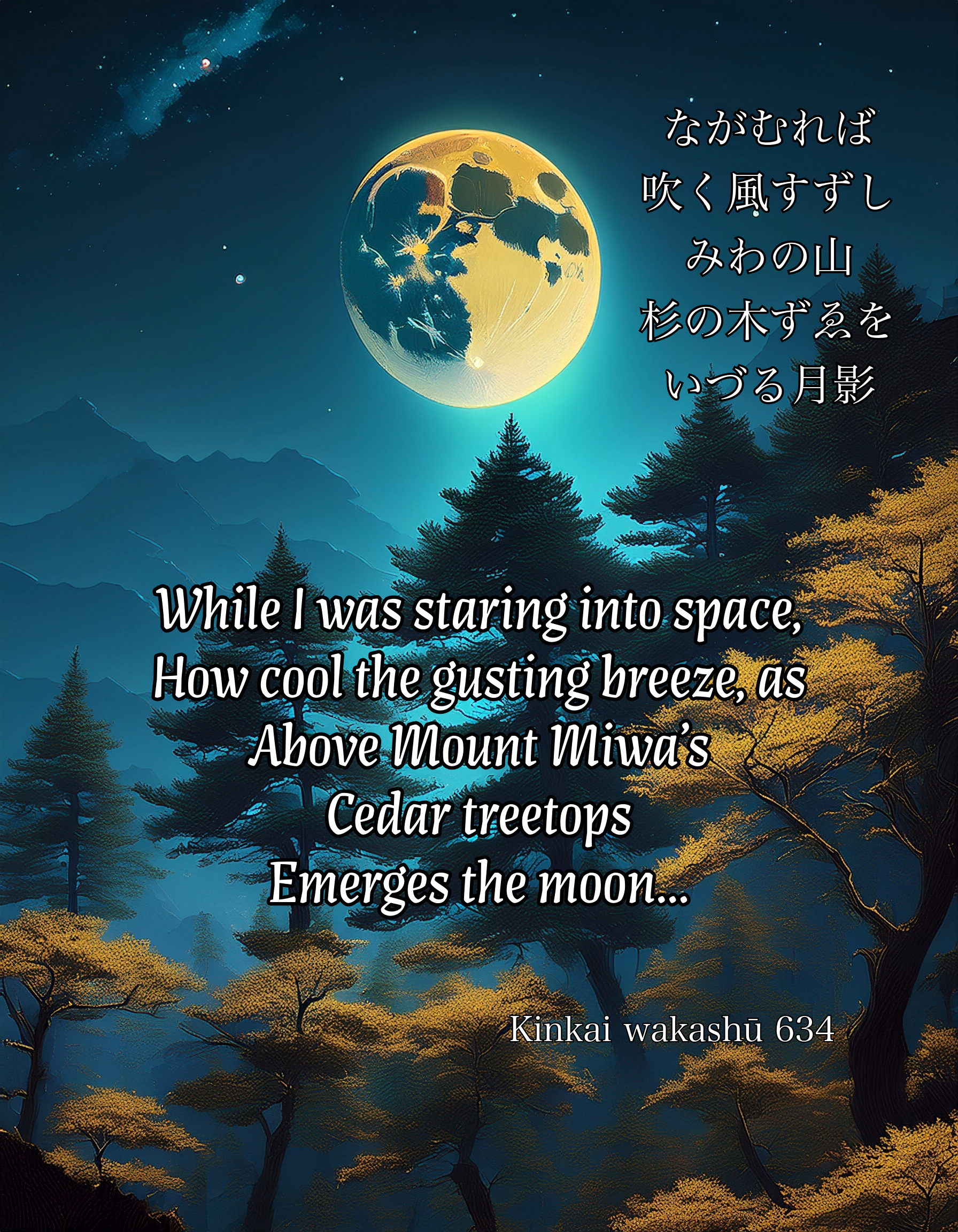
nagamureba fuku kaze suzushi miwa no yama sugi no kozue o izuru tsukikage
While I was staring into space, How cool the gusting breeze, as Above Mount Miwa’s Cedar treetops Emerges the moon…[ii]
634
[i] As with poem 631, the topic here, ‘The summer moon above the shrine’ (shatō kagetsu 社頭夏月) was generally used when the poet had a specific shrine in mind—in this case, Ōmiwa Shrine (Ōmiwa jinja 大神神社).
[ii] See: As part of a hundred-poem sequence. ながむれば衣手すゞしひさかたのあまのかはらの秋のゆふぐれ nagamureba / koromode suzushi / hisakata no / ama no kawara no / aki no yūgure ‘While I was staring into space, / How chill my sleeves became; / Upon eternal / Heaven’s riverbed / Comes an autumn evening.’ Princess Shokushi (Shinkokinshū IV: 321)
furu yuki ni yama no hosomichi uzumorete mare ni toikoshi hito mo kayowazu
With the falling snow The mountain’s narrow pathways Are buried; But rarely did he visit and now Cannot make his way at all.
Cell of Fragrant Cloud 53
Right
あしたつるみわのひばらにゆきふかみみやぎひくをのかよひぢもなし
ashi tatsuru miwa no hibara ni yuki fukami miyagi hiku o no kayoiji mo nashi
Reeds stand tall in Miwa, where the cypress groves Are deep with snow; To cut sacred timber, the woodsman Has no path to tread at all.
Cell of Compassionate Light 54
The Left’s poem, in terms of style and diction, entirely grasps the way someone might feel. What a sense of grief! The Right’s poem is composition that fairly drips and delves into playfulness, but in so doing lacks feeling. Truly, the former poem has superlative qualities, resembling a black dragon’s pearl![i] Thus, the Left must win.
The Left does seem to have been composed but simply stated. It possesses a calm elegance. The Right seems to have been created after a great deal of thought. This poem shows effort and the former such calm that I wish to declare them a tie. This may enrage the poets, but the ignorant may give the appearance of being knowledgeable, as they say. I wonder who composed these…
[i]Riju 驪珠 as an abbreviation of riryū no tama 驪龍の珠 (‘black dragon’s pearl’). Mototoshi uses this analogy deliberately as black dragons were associated with winter. The pearl, which they were often depicted as holding or being located in their throat, was a symbol of the dragon’s spiritual development and a marker of its immortality. This is thus an effusive statement of praise for Shōchō’s poem.
yuki fureba shirushi no sugi mo hana sakite miwa no yamabe mo ikaga tazunemu
When the snow has fallen, The symbolic cedars, too, Bloom with blossom— To Miwa’s mountainside How might I make my way?
Lord Saburō 45
Right (Win)
しらゆきにふるの山みちうづもれてたどるばかりになりもゆくかな
shirayuki ni furu no yamamichi uzumorete tadoru bakari ni nari mo yuku kana
In snow, so white, Furu’s ancient mountain paths Are buried, so Simply I must feel my way As I go along!
Ushigimi 46
The Left’s poem is an entirely transparent adaptation of an earlier work. This poem is:
ふる雪に印の杉もうづもれていづこなるらむ三輪の山本
furu yuki ni shirushi no sugi mo uzumorete izuko naruruamu miwa no yamamoto
In the falling snow, Even the symbolic cedars Are buried Where might be Miwa mountain’s foot?[i]
The Right’s poem has nothing of interest about it, nor does it have any faults to indicate. Thus, there are insufficient grounds for judgement.
The Left’s poem follows the conception of a poem which appeared in the Kaya Palace Poetry Match.[ii] Although this is an earlier work, truly, it’s not that good, and so this poem doesn’t seem that superlative. Why couldn’t one visit if blossom has simply bloomed? The former poem says it would be difficult to get there because it’s buried in snow. The Right’s poem isn’t that good, but it seems better than the Left, so it should win.
[ii] Snow. ふるゆきにすぎのあをばもうづもれてしるしも見えずみわのやまもと furu yuki ni / sugi no aoba mo / uzumorete / shirushi mo miezu / miwa no yamamoto ‘In the falling snow / The green cedar needles / Are buried, so / The symbol goes unseen, / Of Miwa mountain’s foot.’ Lady Settsu (Kaya no in shichiban uta’awase 55). This poetry match, Kaya no in shichiban uta’awase 高陽院七番歌合 (‘Seven Round Poetry Match held at the Kaya Palace’), was sponsored by Fujiwara no Morozane 藤原師実 (1042-1101) and held on the 19th day of the Eighth Month, Kahō 1 [1.10.1094]. The judge, Minamoto no Tsunenobu 源経信 (1016-1097), approved of this poem, saying it was ‘extremely charming’. It was later included in Kin’yōshū (IV: 285), with the headnote, ‘Composed on the conception of snow at the Poetry Match held at the Residence of the Former Uji Chancellor’.
The Right state: the Left’s poem has no faults to indicate. The Left state: the Right’s poem is not bad.
In judgement: the Left’s ‘at Miwa had I met you’ (kimi o shi miwa no) is elegant, but the final section is lacks force. The Right’s reaping reeds at Naniwa has only a faint sense of a merchant. Thus, the Left’s ‘Miwa Market’ (miwa no ichi) wins.