ima tsukuru miwa no hafuri ga sugi yashiro suginishi koto wa towazu tomo yoshi
Newly invested, At Miwa, a junior priest For the cedar shrine, but What has occurred It would be better not to ask!
635
[i] This is Ōmiwa Shrine (Ōmiwa jinja 大神神社) which is located on the western slopes of Mount Miwa 三輪山, in what is now Sakurai in Nara prefecture. Mount Miwa is covered by a cedar forest and the trees thus became an object of veneration at the shrine, something which was reinforced by: Topic unknown. 我が庵は三輪の山もと戀しくは訪らひ來ませ杉立てる門 wa ga io wa / miwa no yama moto / koishiku wa / toburaikimase / sugi tateru kado ‘My hut is / At Mount Miwa’s foot; / How I long / For you to come visiting / My gate where cedars stand.’ Anonymous (Kokinshū XVIII: 982). This poem was attributed to the deity of Ōmiwa Shrine, Miwa Myōjin 三輪明神, and firmly cemented the link between Miwa and cedars in poetry. See McAuley (2020, 577–578) for more details and example poems.
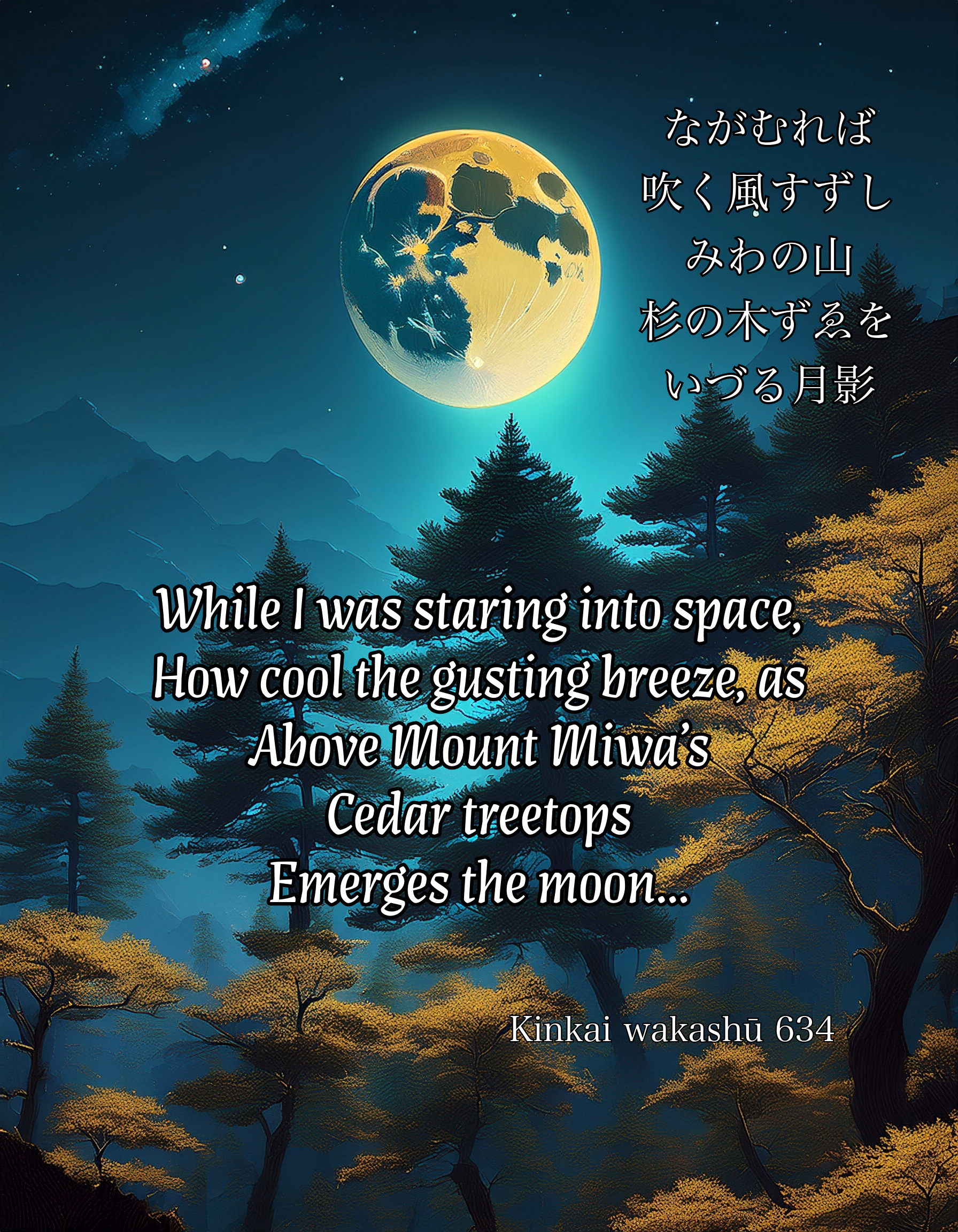
nagamureba fuku kaze suzushi miwa no yama sugi no kozue o izuru tsukikage
While I was staring into space, How cool the gusting breeze, as Above Mount Miwa’s Cedar treetops Emerges the moon…[ii]
634
[i] As with poem 631, the topic here, ‘The summer moon above the shrine’ (shatō kagetsu 社頭夏月) was generally used when the poet had a specific shrine in mind—in this case, Ōmiwa Shrine (Ōmiwa jinja 大神神社).
[ii] See: As part of a hundred-poem sequence. ながむれば衣手すゞしひさかたのあまのかはらの秋のゆふぐれ nagamureba / koromode suzushi / hisakata no / ama no kawara no / aki no yūgure ‘While I was staring into space, / How chill my sleeves became; / Upon eternal / Heaven’s riverbed / Comes an autumn evening.’ Princess Shokushi (Shinkokinshū IV: 321)
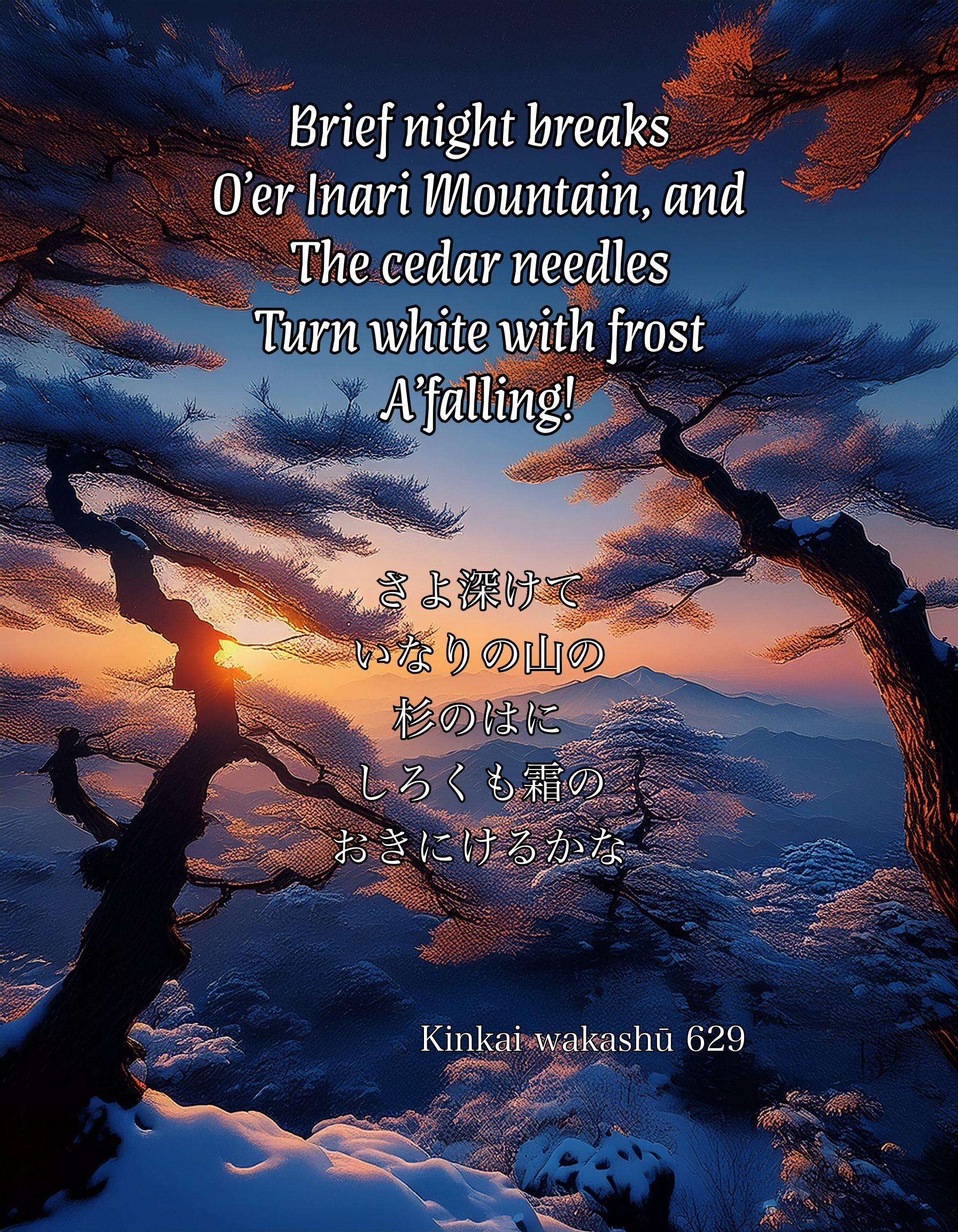
sayo fukete inari no yama no sugi no ha ni shiroku mo shimo no okinikeru kana
Brief night breaks O’er Inari Mountain, and The cedar needles Turn white with frost A’falling![i]
629
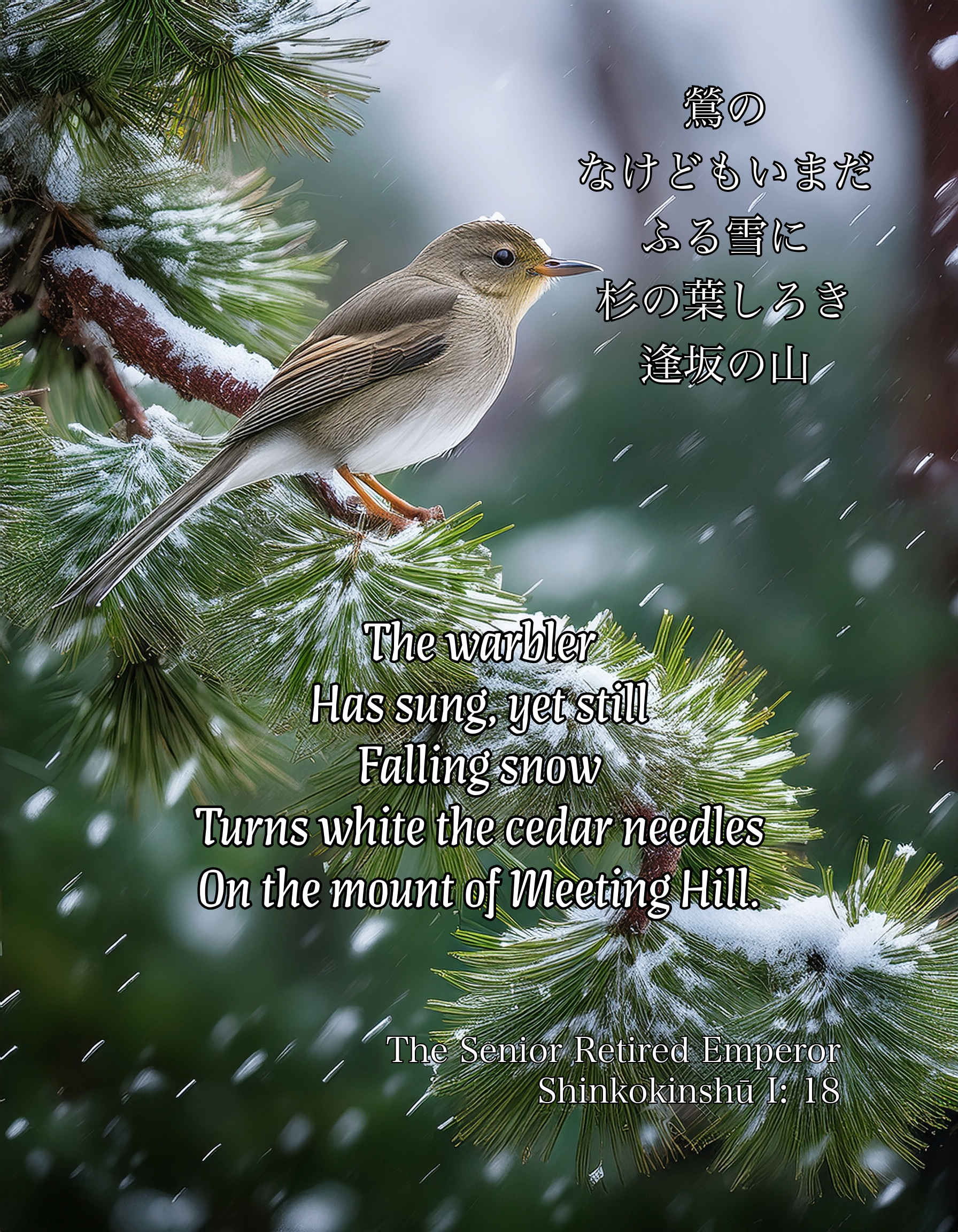
[i] See: Drinking vessels [mizunomi]. いなり山しるしのすぎの年ふりてみつのみやしろ神さびにけり inariyama / shirushi no sugi no / toshi furite / mitsu no miyashiro / kamisabinikeri ‘Mount Inari’s / Symbolic cedars / Carry years’ weight: / The three sacred shrines / Are venerable, indeed!’ Bishop Yūkei (Senzaishū XVIII: 1178); and: On warblers on the road to the barrier, while at the Poetry Office. 鶯のなけどもいまだふる雪に杉の葉しろき逢坂の山 uguisu no / nakedomo imada / furu yuki ni / sugi no ha shiroki / ausaka no yama ‘The warbler / Has sung, yet still / Falling snow / Turns white the cedar needles / On the mount of Meeting Hill.’ The Senior Retired Emperor (Shinkokinshū I: 18)
oto ni sae tamoto o nurasu shigure kana maki no itaya ni yowa no nezame ni
Even the sound Does soak my sleeves with A shower Striking my roof of cedar boards, Awaking at midnight…
Lord Sadanobu 13
Right
しぐれとて柞の杜にたちよれば木のはとともに降りかかるかな
shigure tote hahaso no mori ni tachiyoreba ko no ha to tomo ni furikakaru kana
When with a shower’s fall Within the oak forest I head to stand Together with the leaves, It strikes me as it falls!
Lord Munekuni 14
Toshiyori states: the first poem’s composition on one’s sleeves getting soaked on hearing a sound is extremely charming. It sounds like that’s really how it is. The latter poem, too, is smooth, and the final line appears to have had some thought put into it, so I dread having to say that the first poem wins.
Mototoshi states: ‘a shower at midnight upon a roof of cedar boards’ is a particularly superlative image, and that this would drench one’s sleeves is also extremely charming. While ‘the oak forest’ does not appear bad, it’s not that remarkable, and ‘waking at midnight’ is something that certainly occurs, I feel.
samo koso wa maki no mayabuki usukarame moru bakari ni mo utsu shigure kana
Truly, A roof of cedar boughs Seems scanty, for It simply leaks when Struck by a shower!
Lord Morotoshi 11
Right (T – Win)
木の葉のみ染むるかとこそおもひしに時雨は人のみにしみにけり
ko no ha nomi somuru ka to koso omoishi ni shigure wa hito no mi ni shiminikeri
‘Is it the leaves upon the trees alone It dyes?’ I wondered once, but A shower on folk’s Flesh does leave a mark…
Lord Masamitsu 12
Toshiyori states: the first poem deliberately starts with ‘A roof of cedar boughs’ and then concludes with ‘Struck by a shower’ which is vague. It does sound like the poet might have had ‘the lonely sighing sound of rain beating against my window’ in mind when composing. In any case, this is something which would have been better avoided. If he wished to compose on this sort of thing, and had done so without this element, then the poem would not be unpleasant. As for the Right, well, this does sound somewhat scanty! Still, what kind of colour might the poet’s flesh be marked? If it was the colour of the leaves, then this would be pretentious, wouldn’t it. If he wanted to refer to the hue of the wind in the pines, then why didn’t he say so? As a composition about a shower, though, this sounds slightly better.
Mototoshi states: having such a thin roof of cedar boughs struck by a passing shower feels frightening for the people under it. At the beginning of the world, rain as thick as axles fell, I hear—what a terrifying shower that must have been! The expression ‘rain beating against my window’ occurs in a poem from Cathay, referring, it seems, to rain blown by the wind horizontally striking one’s fence. Thus, it does sound extremely moving to compose about rains striking one’s window and keeping one awake, but, then again, while it’s certainly true that showers dye the treetops on the mountains in all directions, what sort of mark would they leave on a person’s flesh? It sounds like the old tale of the well-warden’s sign, doesn’t it! This round, both poems are about the same.
nanigoto o matsu to wa nashi ni sumiyoshi no kami ni kokoro o kakenu ma zo naki
Nothing in particular Have I to expect, but Sumiyoshi’s Deity within my heart Dwells not for no moments at all!
Shōkaku 147
Right
いたづらにおいにけるかないにしへの人のうゑけむすぎならなくに
itazura ni oinikeru naka inishie no hito no uekemu sugi naranaku ni
How brief it’s been, but I have grown old, though By ancient Folk a planted Cedar tree I’m not…
Jakuchō 148
The conception of the Left’s poem, saying ‘Have I to expect, but’ sounds extremely charming, but the configuration of the poem of the Right, composing ‘Folk a planted / Cedar tree I’m not’ also appears pleasant. Thus, these tie.